
Translated material
Anti -Excremism in virtual Russia in 2014-2015
Criminal prosecution : statistics and geography : hostility objects : place of publication : genres : punishment
Administrative measures : Pursuit under the Code of Administrative Offenses : Warning of Roskomnadzor Internet media : anti-ethrian access blocks
This report [1] is devoted to the review of the use of anti -ecstromist legislation in the Russian Internet segment in 2014 and 2015. The results of monitoring, which are the basis of the report, are based on data from open sources (reports of the activities of the prosecutor's office, the Investigative Committee, the materials of the courts, the media reports, bloggers and non -governmental organizations, etc.) and appeals of citizens involved in these cases.
The number of Internet users is increasing annually in Russia. According to the Public Opinion, in the fall of 2015, an Internet penetration of the Internet among the adult population of Russia was 67 %, or 78.2 million people [2] . And GFK reports that in Russia at the end of 2015 the Internet audience amounted to 84 million people [3] . Of course, television remains the main source of political information in Russia, but the number of people recognizing news from the Internet is also growing. And most importantly, it is on the Internet that independent public polemic and opposition political agitation are now possible, including, of course, the agitation of various kinds of radical groups. And this cannot but cause the authorities. And fears inevitably result in sanctions in this area. Legal mechanisms can be used by different ones, but anti -extremist legislation existing in Russia is ideal for imposing sanctions, too wide and indefinite. Law enforcement objects may vary depending on the political situation and public moods.
This report is not the first work of the owl center of this area. In 2011 and 2013, reports “Virtual Anti-Existramism: On the Features of the Application of Anti-Existromist Legislation on the Internet (2007–2011)” [4] and “The fight against extremism in the virtual world” [5] , describing the legal regulation of web space related to the theme of anti-ethrios, and the practice of criminal and administrative persecution for the persecution of Statements on the Internet. The current text is a thematic continuation of previous reports and chronologically covers the events of 2014 and 2015. Structurally, the report was slightly modified compared to the two previous ones. For example, we did not include norm -making initiatives over the past two years. Firstly, they were described in sufficient detail in the reports of our center about the unlawful anti-ethnication [6] . Secondly, in the past period the number of such proposals from the state has decreased, and for the most part they all came down to clarifying the existing methods of blocking and filtering content on the Internet, expanding the circle of organs authorized by this.
We are aware of the inability to describe all the nuances of the practice of cybercrection and dwell only on the main measures used to active users of web space-to individuals and legal entities. The text analyzes in detail the practice of criminal and administrative prosecution for "extremism" on the Internet. In addition, the sanctions of Roskomnadzor in relation to Internet media and Internet providers are considered.
Criminal prosecution
Statistics and geography
Criminal prosecution is the strongest measure in the struggle of the state with “extremist statements” on the Internet. “Extremist” we can call the statements for which someone was convicted under articles related to anti-extremist legislation [7] or which caused measures of anti-extremist administrative response, not yet affecting neither the political science assessment of these statements, nor our legal assessment of the legitimacy of all these actions (both about that and another we will talk below).
We know that in 2015, out of 232 sentences for public statements, which were assigned to extremist, 194 sentences were issued for sayings online, that is, about 84 %. In 2014 - at least 138 out of 165 sentences [8] , that is, the same 84 %. We write “approximately” because we are not aware of all sentences, but we can assume that the proportion of online statements in the essentially unknown decisions is about the same as in the well -known ones.
The geographical coverage of criminal prosecution for cyber proportagnes is wide - at least 70 regions over the past two years. The leaders were the Oryol and Samara regions (15 sentences each), the Chuvash Republic (14 sentences), the Krasnodar and Khabarovsk Territory (13 and 12 sentences, respectively). If earlier (in 2013-2014) we wrote that in Moscow and St. Petersburg the number of sentences for the Internet is small, then in two years the situation has changed. In 2014-2015, at least 8 such sentences were issued in Moscow and St. Petersburg. Almost all of them concerned well -known right -players. Recall our data for previous years. In 2013, we wrote about 103 sentences “For the Internet” of 133, in 2012-about 65 sentences of 89, in 2011-about 52 out of 78, in 2010-about 26 out of 72, in 2009-about 17 out of 56, in 2008-about 14 out of 45, in 2007-about 3 out of 28.
The Agora Association also notes an increase in the number of convicted Internet users and reports that, compared with 2014, in 2015, the number of cases of bringing Internet users to criminal liability [9] -from 132 to 203 [10] people.
In the graphs below, the dynamics of this process from 2007 to 2015 are clearly displayed:
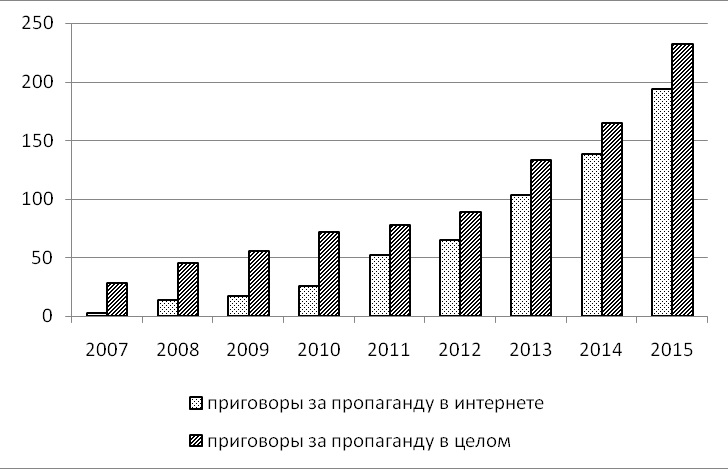
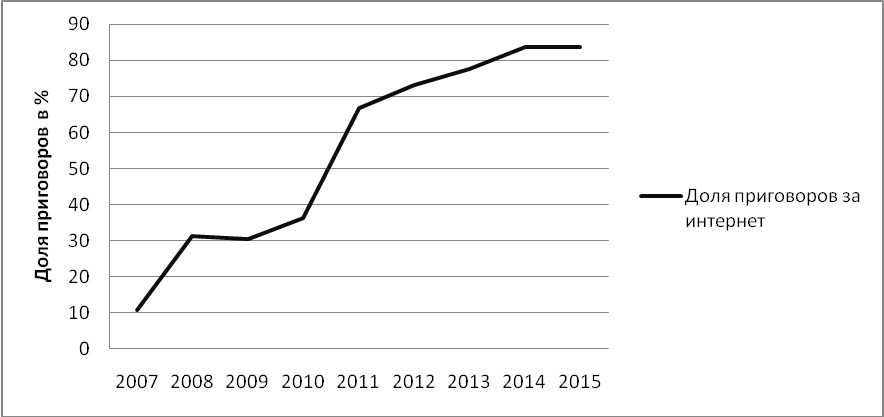
Thus, it is obvious that the number of sentences for “extremist statements” as a whole is growing with acceleration, and especially on the Internet. For the main reason for this phenomenon, we have repeatedly indicated: this is a clear reorientation of law enforcement officials to persecute those who are easier to detect and for whom it is easier to arrange the case, for the sake of building anti -ejectomic reporting. The mechanics of investigating cases for propaganda (including on the Internet) were well debugged several years ago, and the investigation of such cases became simple and familiar. However, the growth of the number of Internet users should also be taken into account, the increased value of Runet as a source of information, means of communication and, of course, political agitation.
Criminal prosecutions for utterances on the network are mostly held under Art. 282 of the Criminal Code ("excitement of national hatred or enmity, as well as humiliation of human dignity"). Less commonly, Art. 280 of the Criminal Code ("Public calls for the implementation of extremist activity"). However, over the past two years, this article has begun to be used more often. In 2014-2015, Part 3 of Art. 212 ("Calls to the riots") and Art. 205 2 (“Public calls for terrorist activity or public justification of terrorism”), a new Art. 280 1 (“Public calls for violation of the territorial integrity of the Russian Federation”), which was associated with a variety of pro -Ukrainian statements on the network [11] . Punishment under Art. 205 2 of the Criminal Code is heavier than the rest, since it already refers to anti -terrorism.
Enemy objects
Since the main accusation is the accusation of hatred, and even if Art. 282 does not appear in the case, in the incriminated statements there is still usually a certain “image of the enemy”, it is appropriate to figure out who the statements of convicted Internet users were directed against.
It should be noted that in many cases it is simply impossible to understand. Often, official reports of sentences are the only source and they are limited to something like: “... posted extremist content files on the Internet ”, “... records of a nationalist sense ” or “... materials aimed at arousing hatred, as well as humiliation of national dignity of citizens” (standard formulations of the prosecutor's office and investigative committees). Therefore, the classification below is obviously incomplete and approximate.
Where it was possible, we have identified the following groups of enmity objects (in the charged with convicted materials, enmity could be expressed to several groups):
| Enemy objects | ||||||||||
| 2007 | 2008 | 2009 | 2010 | 2011 | 2012 | 2013 | 2014 | 2015 | Total | |
| According to ethnic criteria | ||||||||||
| Natives of the Caucasus | 1 | 7 | 7 | 9 | 20 | 29 | 36 | 37 | 46 | 192 |
| Jews | 1 | 4 | 4 | 5 | 5 | 15 | 18 | 15 | 16 | 83 |
| Natives of Central Asia | 0 | 0 | 0 | 0 | 0 | 16 | 14 | 18 | 26 | 74 |
| Uncertain not Slavs | 0 | 0 | 3 | 2 | 3 | 10 | 14 | 13 | 17 | 62 |
| Russians | 0 | 0 | 0 | 3 | 1 | 1 | 7 | 5 | 13 [12] | 30 |
| Dark -skinned | 0 | 0 | 2 | 0 | 2 | 2 | 3 | 7 | 10 | 26 |
| Gypsies | 0 | 0 | 0 | 0 | 0 | 1 | 1 | 0 | 1 | 3 |
| Arabs | 0 | 0 | 0 | 0 | 0 | 0 | 1 | 0 | 1 | 2 |
| Malaysians | 0 | 0 | 0 | 0 | 0 | 0 | 1 | 0 | 1 | 2 |
| Tatars | 0 | 0 | 0 | 0 | 1 | 0 | 1 | 0 | 0 | 2 |
| Ukrainians | 0 | 0 | 0 | 0 | 0 | 0 | 0 | 0 | 2 | 2 |
| Turks | 0 | 0 | 0 | 0 | 0 | 0 | 0 | 0 | 1 | 1 |
| Komi | 0 | 0 | 0 | 0 | 1 | 0 | 0 | 0 | 0 | 1 |
| Bashkirs | 0 | 0 | 0 | 0 | 1 | 0 | 0 | 0 | 0 | 1 |
| Sezid Kurds | 1 | 0 | 0 | 0 | 0 | 0 | 0 | 0 | 0 | 1 |
| Americans | 0 | 0 | 0 | 0 | 0 | 0 | 1 | 0 | 0 | 1 |
| Mongols | 0 | 0 | 0 | 0 | 0 | 0 | 0 | 1 | 0 | 1 |
| Chinese | 0 | 0 | 0 | 0 | 0 | 0 | 0 | 1 | 0 | 1 |
| According to political criteria | ||||||||||
| "Inappropriate" (calls to | ||||||||||
| Armed jihad) | 0 | 0 | 0 | 0 | 4 | 4 | 2 | 15 | 16 [13] | 41 |
| State officials [14] | 0 | 3 | 2 | 2 | 2 | 2 | 4 | 3 | 14 | 32 |
| Anti -fascists | 0 | 0 | 0 | 0 | 0 | 3 | 3 | 1 | 3 | 10 |
| According to religious criteria | ||||||||||
| Muslims | 0 | 0 | 0 | 0 | 0 | 4 | 5 | 7 | 11 | 27 |
| Christians | 0 | 0 | 2 | 2 | 4 | 0 | 0 | 3 | 2 | 13 |
| Jews (unlike | ||||||||||
| Jews) | 0 | 0 | 0 | 0 | 0 | 1 | 0 | 4 | 3 | 8 |
| Gentiles | 0 | 0 | 0 | 0 | 0 | 0 | 0 | 0 | 1 [15] | 1 |
| According to other criteria | ||||||||||
| Pedophiles, | ||||||||||
| homosexuals | 0 | 0 | 0 | 0 | 0 | 0 | 0 | 2 | 3 [16] | 5 |
| Homeless | 0 | 0 | 0 | 0 | 0 | 0 | 0 | 1 | 0 | 1 |
| Addicts | 0 | 0 | 0 | 0 | 0 | 0 | 0 | 1 | 0 | 1 |
| Unknown | 0 | 3 | 4 | 5 | 13 | 16 | 35 | 55 | 70 | 198 |
Unfortunately, for the most part, the materials that have become the subject of criminal proceedings are not available to us and have to trust the estimates of law enforcement officers and (or) experts they attracted. For example, it is not clear how neatly the “Jews” and “Jews” are neatly separated from each other as the objects of enmity. Some formulations make us doubt that what was written was classified properly. For example, in one case, the prosecutor’s office reported that the convict called “ to violence against immigrants from the Russian republics of the Caucasus, as well as Armenians, Azerbaijanis and Dagestanis .”
The main volume of criminal persecution of Internet propaganda falls on ethnoxenophobes, radical Islamists occupy the second place. According to our observations of ultra -right activity on the Internet, Antikasz rhetoric prevails in this segment for many years [17] . And the period of 2014–2015 was no exception: the “Caucasians” were the main object of enmity. To a lesser extent, the objects of hostility were “Jews”, natives of Central Asia, all “not Slavs” as a whole and dark -skinned. The share of other "ethnic" collective objects of hatred is not so great.
In 2015, new enmity objects appeared (“Ukrainians”, “Turks”), which was directly related to political events. A deterioration in attitude to “Ukrainians” was associated with events in Ukraine and anti -Ukrainian rhetoric from state television channels. An increase in the war in Ukraine is also associated in the sentences in 2015 by the share of the language of enmity against the “Russians” (it should be borne in mind that the investigation lasts a long time, often about a year, so we are most often about matters initiated back in 2014). But the fact that, according to the given statistics, the share of rhetoric against the “Ukrainians” in xenophobic rhetoric is small (compared to sentences for rhetoric against the “Russians”) indicates only that law enforcement officers are less paying attention to it.
There are few objects of religious enmity, the share of anti -Muslim and anti -Jewish rhetoric in criminal practice is small. Indeed, among the right -winged youth, ethnic hatred noticeably prevails over religious. But in 2014-2015, persecution for radical Islamist rhetoric was noticeably intensified. The quantitative growth of such rhetoric on the Internet and more attention to it can be explained by the growth of interest - both society and the police - to the events in Syria and Iraq.
As for the objects of social hatred, “law enforcement officers” were the main object of hatred, which probably indicates the political bias of such criminal cases. However, the amount of anti -state rhetoric associated with calls for violence in the most radical part of the Internet is really large.
The given data can be considered as a source of information about who the enemy language is directed to in the runet as a whole. But it must be borne in mind that criminal cases are not quite an adequate source to analyze the enemy language itself on the Internet; The above statistics are more likely to characterize what the police pay attention to. Alas, we simply do not know other data on this interesting topic.
Place of publication
All these statements were located on the following types of Internet resources:
| 2007 | 2008 | 2009 | 2010 | 2011 | 2012 | 2013 | 2014 | 2015 | |
| All | 3 | 14 | 17 | 26 | 52 | 65 | 103 | 138 | 194 |
| Sites | 1 | 3 [18] | 2 | 2 | 3 | 0 | 0 | 3 | 2 |
| Social media | |||||||||
| (Read more see the table below) | 0 | 0 | 2 | ||||||
| 6 | 25 | 50 | 88 | ||||||
| 123 | 175 | ||||||||
| Blogs and microblogs | 0 | 2 (LJ) | 6 | ||||||
| (LJ - 3) | 1 | 1 | 0 | 1 | 1 | 3 | |||
| Comments on the forums | 1 | 4 | 1 | 2 | 5 | 5 | 2 | 4 | 0 |
| Video hosting [19] | 0 | 0 | 0 | 0 | 0 | 0 | 0 | 0 | 2 |
| Local network | 0 | 1 | 0 | 1 | 4 | 0 | 3 [20] | 0 | 0 |
| Sending by e-mail | 0 | 0 | 0 | 0 | 1 | 0 | 1 | 2 | 0 |
| Unknown | 1 | 5 | 6 | 13 | 11 | 10 | 8 | 5 | 12 |
Separately, we will consider in which social networks Internet propaganda was discovered:
| 2007 | 2008 | 2009 | 2010 | 2011 | 2012 | 2013 | 2014 | 2015 | |
| Total: | 0 | 0 | 2 | 6 | 25 | 50 | 88 | 123 | 175 |
| VKontakte | 0 | 0 | 2 | 6 | 20 | 40 | 68 | 88 | 119 |
| 0 | 0 | 0 | 0 | 0 | 0 | 0 | 1 | 1 | |
| Classmates | 0 | 0 | 0 | 0 | 1 | 0 | 1 | 6 | 3 |
| IN | |||||||||
| The circle of friends | 0 | 0 | 0 | 0 | 0 | 0 | 1 | 0 | 0 |
| My | |||||||||
| world | 0 | 0 | 0 | 0 | 0 | 1 | 1 | 0 | 0 |
| Not | |||||||||
| indicated | 0 | 0 | 0 | 0 | 4 | 9 | 17 | 28 | 52 |
As can be seen from the above data, since 2010 the main persecution of extremists, real or alleged, are associated precisely with their activity on social networks. Compared to 2013, the number of convicted users of social networks has almost doubled.
Among these networks, the largest VKontakte network in Russia is certainly dominated by [21] . This is clearly illustrated by the schedule below, which is given as a percentage of sentences for saying on social networks in relation to the total number of sentences for saying and the share of sentences issued for publications on the VKontakte social network, for the minimum assessment, from the same total number of sentences.
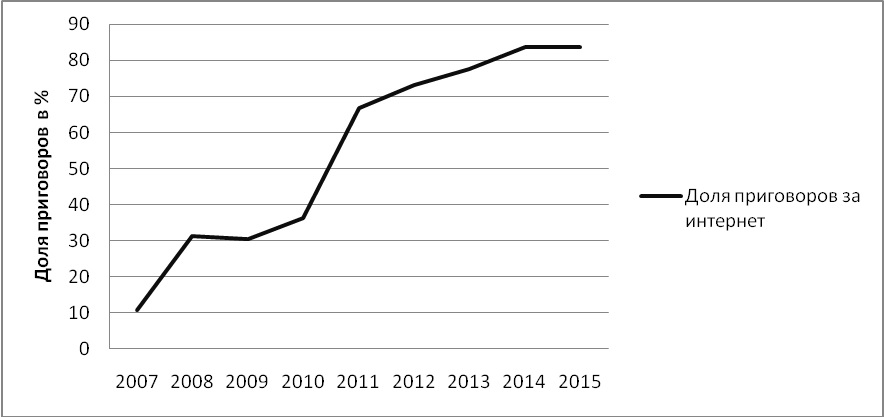
This resource was originally positioned as youth, and it is really very popular among young people, including radically configured. In addition, users of this network are easy to find. During registration, contact details and numbers of page owners are introduced, network administrators provide this information to law enforcement officers at the first request, while the administration of foreign networks (Facebook or Twitter, for example) will certainly consider the request from the police, compare with their rules and may refuse to provide information.
Looking at the table and the schedule above, it should, of course, take into account that, for example, relative to 30 % of sentences for social networks for 2015, we do not know which network meant. But by what we know, it was almost always “VKontakte”. Of the rest of the social networks, only “classmates” and Facebook were awarded to law enforcement officers in 2014 and 2015 [22] .
An important problem is the inability of the police and courts to take into account the main criterion that should be taken into account when considering a criminal case is the degree of public danger of an act. This is especially significant when it comes to cases of statements online. If we believe that some public statement is a public danger, then the latter depends not only on the content of this statement, but also directly proportional to the audience coverage, and not potential (potentially everything that is not hidden by password is available to all of humanity), but real. Obviously, the real volume of the audience among convicted Internet users varies very much. Unfortunately, this criterion when initiating criminal cases and sentences is practically not taken into account. We repeatedly write about this from the report to the report. But over the past five years, law enforcement in this regard has not moved out of a dead point. The number of views and the availability of incriminated material is mentioned in a matter of sentences, but even then these figures are often indicated rather than a low public danger.
Traditionally, most of the law enforcement against “extremist statements” is aimed at the little -known ordinary users of the VKontakte social network, mainly “ethnoxenophobes”, some of which, undoubtedly, were activists of the right -winging movement of the lower level. However, in 2014 and 2015, the figures significant for this movement, such as the ultra -right St. Petersburg figure Dmitry (frantic) Yevtushenko (“Slavic power”, “Russian scale”), the leader of the neo -Nazi movement “Restructure!” Maxim (Tesak) Marcinkevich, head of the press service of the South Siberian Cossack District, Oleg Gonchar from Khakassia, coordinator of the National Union of Russia, administrator of the Russian March 2013 group on the VKontakte network Nikolai Babushkin, the leader of the Russian Parting in St. Petersburg, Nikolai Bondarik, the head Shishkin, ex-leader of St. Petersburg "Russian jogges" Maxim Kalinichenko. Undoubtedly, the volume of the audience they have much larger than the bulk of the minor -convicted for two years of small activists, which are mainly not even the “creators” of the incriminated material (video or article), but only by the carpets. (For example, they simply put in their accounts on the social network Linka on video, which become part of the account of the account, but in reality are outside it.)
Genres
The genre ratio of criminal Internet materials in 2007-2015 was like this:
| 2007 | 2008 | 2009 | 2010 | 2011 | 2012 | 2013 | 2014 | 2015 | |
| Video and audio files | |||||||||
| (films, videos) | 1 | 3 | 5 | 10 | 24 | 46 | 59 | 60 | 106 |
| Drawings and photos | 1 | 1 | 2 | 3 | 2 | 13 | 22 | 33 | 56 |
| Articles and other whole texts | 0 | 7 | 9 | 11 | 19 | 12 | 14 | 30 | 40 |
| Replicas, comments, statements on the forums | 1 | 4 | 1 | 3 | 10 | 11 | 12 | 27 | 13 |
| Creating a group on a social network | 1 | 0 | 0 | 1 | 0 | 2 | 0 | 2 | 8 |
| Unknown | 0 | 0 | 0 | 1 | 2 | 2 | 7 | 11 | 18 |
As you can see, since 2011, the share of sentences for multimedia materials (video, audio, drawings and photographs) is very large. The reason for this is obvious: such materials are much more clear than the texts. In addition, the number of videos, “demotivators”, etc. It grows on the network, and technically set links (for example, on the site YouTube, Rutube) is very simple. It is significant that the clips themselves are often not criminal, but only their recovery. Often, convicted distributors of videos on social networks were neither their authors, nor even the first publishers. Of course, if you fight the videos in social networks, then much more benefit would bring the discovery of their authors, and if we are talking about the scenes of violence - those who do this violence than the struggle with accidentally turned up by reinforcements, that is, with those who are hiding worse.
The same can be said about the publications of texts: in most cases, ordinary carpets are most likely chosen by accident to criminal liability. However, as we have already noted, in 2014 and 2015, law enforcement has moved in this regard in this regard, and the attention of the law enforcement agencies was also honored by the well -known ultra -right ones. However, the evidence base and the choice of material for persecution against some of them are doubtful. It seems that the principle of "take for the first hit" also applies here.
Say, in August 2014 in Moscow, the court recognized the leader of the movement "Restructure!" Maxim (Tesak) Martsinkevich guilty of placing three videos (“throw out a chuckle! Electricity campaign!”, “Tesak about the film“ Stalingrad ”and the situations in Biryulyovo,“ The Tesak about the film “near -football” ”) [23] . The composition of the crime in the contents of these videos, we believe, there is, the popularity of Tesak’s videos is very large, but it is not clear why the leader of the leader “Restructuructure!” It was these, far from the most indicative, materials were selected. For example, Martsinkevich has a video with scenes of cruel bullying people under homophobic hacks. We believe that the materials incriminated by such well -known people in their environment should be selected especially carefully in order to clearly indicate the boundary of what cannot be published.
“Original texts”, and not by cargo, probably could be called replicas on social networks, blogs and forums, but, in our opinion, some replicas in the most part do not deserve criminal prosecution-at least because this genre itself does not imply much attention to a separate replica.
But the creation of groups in social networks to coordinate violent actions (we know several of these ultra -right groups) really poses a great danger. Unfortunately, the practice of pursuing for conducting such groups on the Internet is not developing very intensively. The number of cases about groups on social networks in 2014-2015 increased markedly, although, of course, far from all these groups were associated with the coordination of violence.
Punishment
Punishments for sayings online are usually not too strict by Russian standards:
| 2007 | 2008 | 2009 | 2010 | 2011 | 2012 | 2013 | 2014 | 2015 | |
| All convicts | |||||||||
| Of them: | 10 | 14 | 17 | 30 | 52 | 65 | 103 | 145 | 216 |
| Imprisonment | 8 | 1 | 0 | 3 | 5 | 1 | 3 | 18 | 43 |
| Fines | 1 | 4 | 1 | 4 | 11 | 16 | 20 | 29 | 35 |
| Mandatory work | 0 | 0 | 5 | 5 | 9 | 21 | 33 | 45 | 61 |
| Correctional labor | 0 | 4 | 4 | 2 | 2 | 14 | 29 | 33 | 26 |
| Imprisonment conditionally | 1 | 5 | 6 | 15 | 24 | 9 | 5 | 11 | 40 |
| Correctional work is conditional | 0 | 0 | 0 | 0 | 0 | 3 | 4 | 3 | 4 |
| Restriction of freedom | 0 | 0 | 0 | 0 | 1 | 0 | 0 | 0 | 1 |
| Educational measures | 0 | 0 | 0 | 0 | 0 | 1 | 0 | 0 | 2 |
| Forced treatment | 0 | 0 | 0 | 1 | 0 | 0 | 3 | 3 | 3 |
| The case is closed due to repentance | 0 | 0 | 0 | 0 | 0 | 0 | 0 | 1 | 0 |
| The case is closed after the statute of limitations | 0 | 0 | 0 | 0 | 0 | 0 | 4 | 2 | 1 |
| Unknown | 0 | 0 | 1 | 0 | 0 | 0 | 2 | 0 | 0 |
In 2015, not only the quantity grew noticeably, but also the share of people who received sentences related to real deprivation of liberty in cases of “extremist statements”. Of course, some of these sentences were sentenced to other articles of the prosecution (racist violence, vandalism, storage of weapons, theft, etc.). Some of the convicts went to the bars, taking into account the not -out -time period according to the conditional sentence or was already in prison (in both cases the punishment of imprisonment is practically inevitable). Some were convicted of “extremist statements” again, which greatly increases the risk of imprisonment. There were five people repeatedly in 2015: the already mentioned leader of the Association "Restructure!" Maxim Martsinkevich [24] , the editor of the “Radical Policy” Boris Stomakhin [25] , ex-leader of the “Russian run” Maxim Kalinichenko [26] , Bashkir opposition Airat Dilmukhametov [27] and Robert Zagrev [28] . Sentences to deprivation of freedom for the four last seem controversial to us. In 2014, one person was repeatedly convicted - Boris Stomakhin.
But in addition to the mentioned, a number of sentences are also known, which are presented to us unreasonably harsh. At least 16 people in 2015 were sentenced to imprisonment only “for words” without the above circumstances, and it seems to us that in many cases such a punishment was excessive. 16 people per year are an unprecedented growth of this kind of punishment for all the years of our observations. In 2014, we noted only three such overly severe sentences. In 2012 and 2013 - one at a time, but, however, in 2011 - 4 sentences against 6 people.
Similar data are given by the Agora Association, according to which, in 2015, at least 18 people were sentenced to real deprivation of liberty, with a total of 36 years 5 months [29] (the authors do not stipulate what kind of crimes we are talking about, but it is clear from the context and the above examples that it means “crimes of an extremist nature”). Of the sentences of 2015, two sentences to imprisonment - left activist Daria Polyudova in Krasnodar [30] and Tatar nationalist Rafis Kashapov in Naberezhnye Chelny [31] - we consider obviously unlawful.
Most of the convicts to imprisonment was talking about statements directed against the authorities and the President of the Russian Federation personally, against the armed intervention of Russia in the affairs of Ukraine, as well as calls for armed jihad. At least five were convicted of calls to xenophobic violence, and in general, as far as we managed to understand, calls for violence were appeared in the verdict at least nine people (two Polyudova and Kashapov - there were no such calls, five - unknown).
All these sentences (excluding the two mentioned above) do not seem unlawful [32] , but imprisonment for the most part seems excessive to us. And this cannot but disturb: after all, even in cases of legitimate sentences, the principle of proportionality of punishment and the balance, which must be maintained in terms of restrictions of freedom of speech, are often violated.
The share of conditional sentences in 2015 also grew. The sentence, even conditional, is a punishment: it causes significant damage to the reputation and a possible career, falling into the register of Rosfinmonitoring for a long time [33] also creates significant problems, and in addition, in the event of a second offense, not a retired period immediately burns the punishment.
However, real punishments that are not related to imprisonment - mandatory and correctional labor or fines are more adequate to us. And most of the convicts over the past two years were sentenced to such punishments.
The sizes of fines vary from 6 to 250 thousand rubles, most often - 100-150 thousand rubles. It is not entirely clear what the courts are guided by, awarding such different amounts of fines for similar acts. Probably, the sizes of fines are determined on the basis of the successfulness of the region and the personality of the defendants. In 2014, 26 people were fined up to 100 thousand rubles, 3 people - for the amount of up to 200 thousand rubles. In 2015 - 24 people for amounts of up to 100 thousand rubles, 11 people for the amount of up to 250 thousand rubles.
The society has long been discussing the issue of how legitimate the criminal prosecution for “words on the Internet” is generally legitimate. Anti -extremist legislation as a whole is very problematic, primarily in the field of counteracting the enemy language. However, many of its provisions are quite common for modern European law. The law should act equally for the “online” and “offline”. So you can answer the posed question more positively. But, as practice shows, the use of anti -extremist legislation in a number of cases is associated with various kinds of abuses. A fundamental, especially for the Internet, the problem of drawing a border between undesirable, but acceptable, and criminally punishable is not even approximately resolved. And first of all, this is due to the topic of “degree of publicity” discussed above.
Talking about the “legitimacy” of sentences, we talk about it only in the first approximation and we mean cases when even the literal meaning of the current legislation was clearly ignored by the court. In 2015, we consider the sentences for Internet publications in 2015 against at least nine people.
Firstly, we are talking about four sentences under Art. 282 of the Criminal Code. In addition to the mentioned activist of the Tatar national movement of Rafis Kashapov from Naberezhnye Chelny, these are the sentences to Elvira Sultanammetova from Pervouralsk for calls to Muslims not to celebrate the Islamic holidays, the Barnaul activist Anton under the Russian Rusophobia Poston, calling for discrimination of Russians in Ukraine, teacher From the chrome of the Oryol region, Alexander Formoshev for the poem “Ukrainian Patriots” calling for Ukrainians to meet “Muscovites” with weapons in their hands.
Secondly, five more people were convicted under Art. 280 of the Criminal Code for publications on the Internet, which are somehow related to Ukraine: Dmitry Semenov from Cheboksary, punished for the repost of the caricature with the charge of the Russian authorities of anti -Russian policy; Sergey Titarenko from Krasnodar - for repost reports that Ukraine is allegedly offered a reward for eliminating the President of the Russian Federation; Activist and blogger from Chelyabinsk Konstantin Zharinov-for the repost of the “Right Sector” appeal, LGBT activist from Khabarovsk Andrei Marchenko-for publishing calls for “Russian supporters of fascism and terror” and the already mentioned Anton Suphorov from Barnaul.
Art. 280 1 of the Criminal Code appeared in two unlawful sentences from the listed (Kashapov and Polyudova case).
In 2014, we knew only two clearly unlawful sentences for the Internet, and both under Art. 282 of the Criminal Code - a prominent figure of the Tatar nationalist movement of Fausia Bayramova for articles on events in Ukraine and, at least partially, an unlawful decision against a resident of Vladivostok for the publication on the social network (among other materials) of a harmless roller for Muslims of the Queen of Islam [34] .
Administrative measures
We distinguish three main categories of administrative measures to combat “extremist statements”: administrative persecution of individual Internet users, measures of influence on Internet media and hosting and Internet providers.
Pursuit under the articles of the Code of Administrative
In relation to the Internet, such articles of the Code of Administrative Offenses (Code of Administrative Offenses) are often used, as Art. 20.3 (“Propaganda and public demonstration of Nazi paraphernalia or symbols”) and Art. 20.29 (“Mass distribution of extremist materials, as well as their production or storage for mass distribution”). In 2014-2015, the number of decisions on these administrative articles has increased, although we still know more criminal sentences [35] .
In 2015, in relation to the Internet, we know about 81 cases of punishment [36] under Art. 20.3 Administrative Code. In 2014, we knew 42 cases.
As in criminal prosecution, cases of clearly unlawful law enforcement are noted here, and they are even more often. In 2015, sanctions under Art. 20.3 Code of Administrative Offenses, were unlawful, according to our assessment, on 24 people. In 2014, we noted three cases of improper sanctions.
The share of unlawful punishments under Art. 20.3 Administrative Code for the Internet in 2015 increased (24 out of 81) and amounted to 29 % against 7 % in 2014 (3 out of 42).
Thus, the dynamics of law enforcement in this area, and especially unlawful law enforcement, is very impressive.
The reason for imposing sanctions was a demonstration on the Internet of images of Nazi symbols and symbols of prohibited organizations [37] , the sale of objects in online stores with images of Nazi symbols. Most offenders were fined from 1 to 3 thousand rubles, some were sentenced to administrative arrests for terms of 5 to 15 days.
As noted more than once, the police and the court do not pay attention to the context in which this or that symbolism was used. There are frequent cases when “for the swastika” was condemned in cases where it was part of the historical image [38] or used as a polemic technique against the opponent [39] .
There are also quite curious cases. For example, in 2015, in Chelyabinsk, a local resident was fined for publishing on VKontakte a frame containing Nazi symbols, taken from the film “Iron Sky” - a fantastic comedy about the war of earthlings with the Nazis, who had hidden after the Second World War on the moon.
Under Art. 20.29 Code of Administrative Offenses (“Mass distribution of extremist materials, as well as their production or storage for mass distribution”) in 2015 70 people were held accountable. In 2014, we know about 43 decisions.
If we talk about unlawful decisions in relation to the Internet, then we know 14 cases in 2015 and 9 such decisions in 2014. In total, we know in 2015 about 47 unlawful decisions under Art. 20.29 Administrative Code. In 2014, there were at least 46 of them; Thus, the unlawful application under this article “shifted” on the Internet.
Under Art. 20.29 Code of Administrative Offenses of administrative arrest (from 5 to 7 days) was appointed by the trial by three, another teenager was put on preventive accounting, the rest of the convicts paid fines from 1 to 2 thousand rubles.
The violators were punished for laying out audio recordings and videos of the Kolovrat, Cyclone B, Mongol Shuudan, White Wars, Iron Order, Video Russian, Wake up, Skins, Skins, Russian Wolves Expecting the Slavic Union for Russians, books “Mine Campf” by A. Hitler, “ABC of home terrorism”, “Jews” by V. Gladkov, films “Eternal Jew”, “Games of the Gods”, articles of Boris Stomakhin, songs of the Chechen bard Timur Mutsuraev, various Muslim materials (for example, the video “The statement of the Jamaat“ Muvahidun Ar-Rusy ”,“ Letter of Fatima Mujahids ") and some other materials. The points of the federal list of extremist materials that attract the attention of the prosecutor's offices are negligible compared to the very size of the list. Probably, the prosecutors' employees are just as difficult to navigate in him as everyone else - which once again proves the futility of the existence of this monstrous mechanism. And this is not to mention cases of punishments for unlawfully forbidden materials, such as Jehovah's Witnesses, the film “Miracles of the Koran”, the book of Elmir Kuliev “On the way to the Qur'an”, the video of the supporters of Alexei Navalny “Let us remember the crooks and thieves of their manifesto-2002”.
In connection with the application of this article of the Code of Administrative Offenses and the replenishment of the federal list, we also encountered absurdity. In the Tomsk region, two people were fined for placing a classic anti -fascist cartoon of Walt Disney studio from the Donald Daka Fue Fuehrehrer's Face (Fuhrer's face) of 1942, which in 2013 to the federal list of extremist materials. Cartoon was included in the list-clearly due to the negligence of the prosecutor and the judge-under paragraph 2030 among the large number (more than 100) videos, mostly really racist [40] .
In September 2014, we first encountered punishment not for the original publication or even repost, but for the mark on the social network. In Perm, Evgenia Prychigin was sentenced to a fine of a thousand rubles under Art. 20.29 for the fact that was noted in the forbidden video “The Last Interview of the Primorsky Partisans”. Someone, who was at Prychigina in “Friends” on the social network “VKontakte”, noted it (and about 30 more people) when the recovery of this video. The girl confirmed the mark, although, according to her, she did not watch the video. We consider this decision unlawful. After all, it is completely incomprehensible what exactly is the distribution of extremist materials, which is charged with: the girl did not make a prohibited video, did not post a link to it on her page on the social network and did not even put marks on this video. In social networks, practice is popular to celebrate in photos and videos of friends in order to attract their attention to the material; Thus, dozens of people often note, and there is nothing surprising that Prochigina automatically confirmed the mark and did not look at the video. This is the first and so far the only case we know for “extremism” in this way. If the example of Perm law enforcement officers is picked up, this will give even more space for arbitrary persecution.
According to both articles of the Code of Administrative Offenses, at the same time in 2015, three people were involved, in 2014 - two. All of them were punished with fines of 1-2 thousand rubles for the publications of VKontakte (images of swastika and recognized by extremist audio or video files).
In 2015, to administrative responsibility under Art. 5.35 of the Code of Administrative Offenses (“Failure by parents of the duties on the maintenance and education of minors”) two mothers of minors of xenophobes were involved. The court ordered one of them to pay a fine, and the other received a warning from the commission on minors. Two similar cases were recorded in 2014.
There was no system on the qualification of offenses: almost the same acts are still used for the same acts from the Criminal Code, then from the Code of Administrative Offenses. For example, for the publication on the VKontakte social network the same song of the Kolovrat group in December 2015 in the Novgorod Region, the court brought a local resident to administrative responsibility under Art. 20.29 Code of Administrative Offenses and fined a thousand rubles, and a month before in Abakan (Republic of Khakassia), the court sentenced the court under Art. 282 of the Criminal Code of the 28-year-old local resident by 8 months of correctional labor. What are guided in these cases, the courts when making decisions remains unknown.
In addition to the persecution of individual Internet users, sanctions under the articles of the Code of Administrative Offenses are imposed on the media. On May 2, 2015, the next amendments were made to the Code of Administrative Offenses. Among other things in Art. 13.15 (“abuse of freedom of the mass media”) was added to part 6, introducing fines for legal entities (that is, the publisher, etc.) for “ production and release of products of the media containing public calls for terrorist activities and (or) materials publicly justifying terrorism, and (or) other materials that call for the implementation of extremist activity or extremist activity or (or) substantiating or justifying the need to carry out such activities. ” The size of fines is provided from 100 thousand to 1 million rubles.
The first decision on this new norm was made precisely with regard to the online publication. In 2015, the World Court of Syktyvkar found the publisher of the 7x7 Internet magazine guilty under Part 6 of Art. 13.15 Code of Administrative Offenses (“Production or release of products of the media containing calls for extremist activity”). A fine of 15 thousand rubles was imposed for the illustration of the material on the cancellation of the acquittal to the nationalist Alexei (Kolovrat) Kozhemyakin, who defiled the Jewish Cultural Center in Syktyvkar. The article published a photograph of the wall with a swastika and the insulting inscription made by Kozhemyakin (the text of the inscription was included in the federal list of extremist materials). We consider this decision of the court unlawful, since, publishing an illustration for the news, the editors in no way solidify with Kozhemyakin, did not promote his views, but on the contrary, they condemned them and even more so did not call for any extremist activity. The Decree of the Supreme Court “On the practice of applying the laws of the Russian Federation“ On Mass Media ”” dated June 15, 2010 states that “ the court should take into account not only the words and expression (wording) used in the article, tele- or radio program, but also the context in which they were made . ”
Administrative articles of the Code of Administrative Offenses are actively used in the struggle for filtering content with educational institutions, libraries, Internet cafes, post offices and other organizations providing citizens with Internet access. In 2013, Art. 6.17 Code of Administrative Offenses (“Violation of the legislation on the protection of children from information causing harm to their health and (or) development”). For individuals, the article involves the imposition of a fine of 5 to 10 thousand rubles, for legal - from 20 to 50 thousand rubles.
In 2015 under Art. 6.17 Code of Administrative Offenses for improper filtering of "extremist" content was fined at least 17 individuals and legal entities. In 2014, we know about six such cases. Under this article, the owners of computer clubs, shopping centers, a cafe, and the Chicken House, the director of the libraries and the administration of several schools due to the lack of and imperfection of content systems [41] were fined [41] .
Sometimes the case comes to the point of absurdity: in 2015, the case was opened and referred to the court in the Penza region regarding the owner of the Fresh Baking store. WiFi worked in the bakery, which was not equipped with a content filtering system, therefore, at the request of the prosecutor's office, “ children who come to the store can use the“ Wi-Fi ”network through their phone ”, and thus gain access to prohibited information [42] . The owner of the cafe was fined 5 thousand rubles.
We are opposed to prosecution for the lack of content-filtration of the cafe, Internet cafe, hotels and other similar institutions, since they are designed not only for children (supervision of which parents exercise), but also for adult users whose rights should not be limited.
Warnings
Roskomnadzor Internet media
Supervisory measures regarding the editorial offices of electronic media are carried out by the Federal Service for Supervision of Communications, Information Technologies and Mass Communications (Roskomnadzor). The agency issues warnings to the founder or chief editor of the media, including for “extremist content”, including in the comments of readers under publications. The procedure for issuing such warnings has been established since 2010 [43] .
The results of the work and the list of warnings Roskomnadzor until recently laid out on his own website. But since 2014, the activities of the department ceased to be open, Roskomnadzor stopped publishing on the site a list of warnings issued to founders or chief media editors. However, such warnings are issued. And, as a rule, they are associated with topical political events. We know at least about 14 warnings issued by Internet media "For Extremism" in 2015:
The editors of the Credo.ru website for the publication of the unlawfully prohibited text of the Canadian human rights activists David Maitas and David Kilgur “Report on the verification of claims on the extraction of organs from the followers of Falungun in China”;
The editors and founder of the ZNAK news agency for the material “In the Syrian Aleppo after the bombing of the demonstrators trampled the Russian Tricolor” with the image of a group of people who desecrate the state flag of the Russian Federation;
The Rosbalt information agency for the video for the news “Farion [44] , calling for the destruction of Moscow, accused the RF IC of“ Masque ””;
The Internet publication “Sib.FM” for the illustration of the article “Novosibirsk social activists opposed the monopoly of the Orthodox Church on morality and spirituality”, that is, for the well-known collage of the art group “Blue Noses”, depicting the three of the three of the three of Christ, Pushkin and Putin;
Infox.ru and “Republic” portals, Situres “Internevosti.ru”, “Lenizdat.ru”, www.kurier-media.ru, Brani.ru [45] , rb.ru, runews24.ru, as well as information agencies “VK Press” and Lenoblinform.ru for cartoons from the magazine “Charlie Hebdo”.
In general, the authorities violently reacted to the caricatures from Charlie Hebdo, which followed the attack on the editorial office of the weekly. In January 2015 alone, 10 Internet media received warnings about the inadmissibility of reprinting cartoons from the magazine. We believe that the actions of Roskomnadzor in the “protection of the feelings of believers” clearly contradict freedom of speech.
In 2014, we only knew about seven media warnings to Internet publications. “Polit.ru”, “Business Online”, “BFM.RU” and “Mediazona” received them for publications on “folk gatherings” in support of Navalny, the editorial and founder of the radio station and the Echo of Moscow website for the transfer to fights at the Donetsk airport. Roskomnadzor also issued a warning to Lenta.ru after the publication in March 2014 by Ilya Azar with the representative of the Right Sector Andrei Tarasenko, who spoke of the inevitability of a partisan war in the event of the invasion of Russian troops to Ukraine. The material also contained a link to the 2008 interview with the leader of the Right Sector Dmitry Yarosh, published by the Ukrainian nationalist organization Trizub.
We consider all the warnings we know to Internet publications in two years. Thus, it is obvious that the efficiency of the security department in this area clearly and radically worsened.
Anti -ecstromist locks
access
The main direction of the fight against “extremist” content on the Internet in the last three years has become sanctions in relation to Internet providers, first of all, blocking access to such content, since there is no reliable way to remove content, if it is not located on the Russian server, and users whose content is threatened with removal, transfer it outside Russia. Blocking can be carried out through several legal mechanisms. In all cases, the main actor is the prosecutor's office.
The oldest mechanism has been operating at least since 2007 and gradually retreats to the past as new (see below). Local prosecutors, as far as possible, checking with the federal list of extremist materials, require through the court from local Internet providers to block access to these materials or to whole sites containing them [46] .
Of course, the prosecutor's office is not always considered necessary to report such measures, and our knowledge in this area is obviously fragmentary. However, it is clear that the number of representations of prosecutors sent by the prosecutors to local Internet providers demanding to block access to “extremist sites” has become decline since 2014, and by 2015 it has sharply decreased.
The basis for blocking was the federal list of extremist materials. The share of the Internet materials in the list is growing: in 2014, out of 379 updates, at least 284 were materials from the Internet, in 2015-at least 594 out of 667 points (this is not about the online production of prohibited material, but about the ban on online material in court). If we talk about specific materials to which the attention of the prosecutor's office was attracted for the purpose of blocking, then in most cases they are not called (standard formulations “ Materials included in the federal list of extremist materials ”). Where it could be determined, it was about the books of Hitler, Mussolini, Goebbels, Gunter [49] , Martsinkevich, the book “Russian cuisine. The alphabet of “house terrorism”, article by B. Mironov, materials of Jehovah's Witnesses, Said Nursi, “Hizb-Ut-Tahrir” and some others.
From November 1, 2012, the second Internet filtration mechanism is functioning, based on a unified register of prohibited sites. This register is replenished at the expense of the resources that contain information “ prohibited for distribution in the Russian Federation on the basis of a court decision that has entered into legal force on the recognition of information prohibited for distribution ”. Initially, for such a wording were, again, network materials recognized as extremist and included in the federal list. The difference from the first mechanism was that the register acted as a guide to the action for Internet providers throughout the country. But in 2014, the courts began to make decisions on the introduction of sites to the register, not recognizing them extremist, on the grounds that they contain materials similar to already recognized extremist (usually almost the same).
Based on the data of the Roskomsvobod site [50] , we believe that as of June 1, 2016, there were at least 566 resources, according to preliminary estimates [51] . According to available data (only Roskomnadzor itself has complete information), 283 resources were “in 2015 for the decision of the courts in 2015. In 2014 - 139 resources.
In 2014, the introduction of approximately 20 points in the register seems to us doubtful or completely unlawful [52] . In 2015, it seems to us unlawful introducing 72 resources already in the register [53] .
The third mechanism of the blocking was created by the Lugovoi Law, which entered into force on February 1, 2014 and allowing the Prosecutor General (and only to it) to demand from Roskomnadzor immediate, without trial, blocking sites containing “ calls to riots, extremist activity, inciting interethnic and (or) interfessional growth, participation terrorist activities, participation in public mass events conducted in violation of the established procedure . ”
A separate register has been created on the website of Roskomnadzor to work with this mechanism. In 2015, 133 resources were introduced into it, in 2014 - 166. All this is without taking into account the various “mirrors” and varieties of writing addresses, as well as sites from which the blocking was removed after removing unwanted content.
In 2014, we seemed to be doubtful or unlawful in the “Lugovo Register” of about a third of materials (53), most of which were blocked opposition sites and opposition promotions [54] . In 2015, we consider illegal blocking about 25 pages [55] .
Formally, on the Roskomnadzor website, registers exist separately, but the procedure for working with them is almost the same [56] . At the discretion of Roskomnadzor, the blocking is made at a particular page address (URL), or, much wider, at the subdomain name, or even at the physical address (IP), which leads to blocking many knowingly innocent sites simply located on the same server.
For two years, the following types of resources were in the registers:
| Resources: | **Single | |||
| registry** | ||||
| 2014 | **Single | |||
| Register 2015 ** | **"Registry | |||
| Meadow "** | ||||
| 2014 | **"Registry | |||
| Meadow "2015 ** | ||||
| xenophobic | ||||
| Materials of modern Russian nationalists | 71 | 125 | 19 | 19 |
| Materials | ||||
| classics of fascism and neo -fascism | 6 | 21 | 0 | 0 |
| xenophobic | ||||
| Materials of other nationalists | 1 | 3 | 0 | 0 |
| Materials | ||||
| Muslim militants and other calls of political Islamists for violence [57] | 20 | 18 | 66 | 22 |
| others | ||||
| Muslim materials [58] | 17 | 65 | 9 | 17 |
| Materials | ||||
| Jehovah's Witnesses, Ron Hubbard and other religious materials | 0 | 6 | 0 | 0 |
| peaceful | ||||
| Opposition sites | 1 | 10 | 46 [59] | 18 |
| Extremely | ||||
| Radical anti -Russian speeches from Ukraine | 0 | 5 | 13 | 0 |
| sites | ||||
| запрещенных украинских организаций | 0 | 0 | 0 | 18 |
| иные | ||||
| материалы украинских СМИ и интернета | 2 | 14 | 11 | 32 |
| sites | ||||
| православных фундаменталистов | 0 | 2 | 0 | |
| different | ||||
| иные материалы, подстрекающие к беспорядкам и насилию | 11 | 7 | 0 | 4 |
| мирные | ||||
| материалы, критикующие РПЦ | 0 | 1 | 0 | 0 |
| пародийные | ||||
| материалы, запрещенные как серьезные | 0 | 1 | 0 | 2 |
| материалы, | ||||
| попавшие в список явно по ошибке | 0 | 4 | 0 | 0 |
| конспирологический | ||||
| фильм об 11 сентября неопределенной идеологии | 1 | 0 | 0 | 0 |
| копии | ||||
| сайта, полностью копирующие Федеральный список экстремистских материалов, но | ||||
| с корректно работающими ссылками | 7 | 0 | 0 | 0 |
| collection | ||||
| запрещенных материалов | 0 | 0 | 1 | 0 |
| website | ||||
| сетевой библиотеки | 1 [60] | 0 | 0 | 0 |
| big | ||||
| разнородный массив текстов, заблокированный целиком | 0 | 0 | 0 | 1 |
| Not | ||||
| поддающиеся идентификации материалы | 1 | 1 | 1 | 0 |
Судя по одинаковым ссылкам, реестры частично дублируют друг друга, и это кажется нам полной бессмыслицей: ведь речь идет о блокировке одних и тех же страниц посредством одного и того же механизма.
Некоторые сайты блокируются временно. Так, например, осенью 2014 года Роскомнадзор ненадолго внес в Единый реестр запрещенных сайтов Wayback Machine (archive.org) – автоматический агрегатор контента всего интернета с 1996 года. Поводом для блокировки стало то, что на сайте обнаружился видеоролик «Исламского государства» «Звон мечей», признанный экстремистским.
При анализе ссылок из Единого реестра наглядно видно, как за прошедшие два года разрастается очередной тяжеловесный и перегруженный механизм. Блокировки проводятся также несообразно и хаотично, как и пополнения Федерального списка экстремистских материалов.
Страницы с призывами к радикальному насилию, как со стороны наци-скинхедов, так и со стороны исламских боевиков, чередуются в нем с блокировками безобидных ресурсов или мирных исламских материалов, и это не говоря уже о страницах, признанными экстремистскими явно неправомерно. Так же как и ссылки с крайне радикальными выступлениями из Украины соседствуют с вполне мирными материалами украинских СМИ.
С 2015 года Единый реестр стал пополняться за счет блокировок не конкретных сайтов или страниц, а результатов выдачи поисковиков по ключевым словам, в основном – на музыкальных ресурсах (« Страница, содержащая ссылки на скачивание различных аудиофайлов, найденных поиском по ключевым словам “убей мента”, “доберман”, “дэвид лейн”, “коловрат” и др.»), что является явно неправомерным: ведь на этих страницах в перечне по ключевым словам могут встречаться совершенно разные страницы.
Что касается «Реестра Лугового», то тут несуразностей и произвола еще больше. В большинстве случаев вообще непонятно, зачем нужна была именно внесудебная (то есть срочная) блокировка материалов (например, разнообразной мусульманской литературы), уже много лет свободно находящихся в интернете.
В этот реестр попали страницы, блокировки которых были продиктована текущей политической ситуацией, – например, сообщения об оппозиционных акциях разного рода. По большей части мы считаем такие блокировки неправомерными и нарушающими право на свободу собраний и свободу слова.
В этом перечне есть и страницы, созданные для указания мест сбора на массовые несанкционированные акции (ресурсы с призывами собираться на «Русский марш» 4 ноября, «Русский Первомай» и т.д.). Принятие «закона Лугового», произошедшее вскоре после печально известных событий в Бирюлево-Западном, объяснялось именно необходимостью подобных блокировок – для того чтобы была возможность быстрого пресечения мобилизации участников потенциальных массовых беспорядков. Опыт предыдущих двух лет лишь наглядно подтвердил очевидную мысль, что заблокировать всю подобную информацию и таким образом остановить массовую мобилизацию невозможно, потому что в подобных случаях бывает задействовано слишком много каналов распространения одновременно. Вся информация в интернете о местах сбора до потенциальных адресатов доходила практически мгновенно. А огромное количество страниц, идентичных или почти идентичных заблокированным, до сих пор остается в свободном доступе.
Conclusion
Итоги нашего мониторинга неутешительны. За два года количественные показатели существенно выросли: умножается как число уголовных приговоров за высказывания в интернете, так и число административных наказаний разного рода. Помимо этого, стремительно растет количество блокировок или требований удалить контент.
Однако качество этого правоприменения явно ухудшается. Давление на пользователей всемирной паутины увеличивается. Репрессии, как административные, так и уголовные, могут коснуться практически каждого, что уже показывает практика. В рамках борьбы с виртуальным экстремизмом государство усиливает давление на самые разные категории граждан – от радикальных националистов, оппозиционеров, мусульманских активистов до людей и организаций, просто случайно оказавшихся в поле зрения борцов с экстремизмом. С 2014 года среди таких осужденных ожидаемо появились противники государственной политики в отношении Украины. В целом наказания становятся жестче. Если раньше наказания к лишению свободы за высказывания в интернете были редкостью, то в 2015 году их количество стремительно выросло.
Количество неправомерных санкций разного рода тоже растет. Насколько нам известно, пока не было наказаний за лайки, однако известен случай санкции за «отметку» пользовательницы в социальной сети.
Помимо политических целей сохраняет свое значение и «бюрократическая инерция» в правоприменении. И растущее количество приговоров за пропаганду во многом объясняется именно этим: борцы с экстремизмом в интернете уже давно занимаются отловом случайных републикаторов в социальной сети «ВКонтакте» и вынесением многочисленных и зачастую бессмысленных требований о блокировках не самых опасных по сути (или вообще не опасных) материалов. В результате таких бессмысленных и хаотичных требований и обществу, и правоохранителям, и радикальным группам остается непонятно, где же проходит «красная черта», что является допустимым, а что нет.
Таким образом, антиэкстремистская отчетность улучшается, однако происходящее никак не способствует укреплению безопасности в обществе и все более существенно ограничивает свободу выражения.
[1] Доклад подготовлен в июне 2016 года в рамках проекта, при реализации которого используются средства государственной поддержки, выделенные в качестве гранта в соответствии с распоряжением Президента Российской Федерации от 1 апреля 2015 г. № 79-рп и на основании конкурса, проведенного Движением «Гражданское достоинство» (http://civildignity.ru).
[2] Интернет в России. Динамика проникновения // Фонд «Общественное мнение». 2016. 8 февраля (http://fom.ru/SMI-i-internet/12497).
[3] Интернет в России вырос до 70,4 % за счет взрослых и пожилых пользователей // Cnews.ru. 2016. 28 января (http://www.cnews.ru/news/top/2016-01-28_proniknovenie_interneta_v_rossii_vyroslo_do_70).
[4] Юдина Н. Виртуальный антиэкстремизм: Об особенностях применения антиэкстремистского законодательства в Интернете (2007–2011) // Центр «Сова». 2012. 17 сентября (http://www.sova-center.ru/racism-xenophobia/publications/2012/09/d25322/).
[5] Юдина Н. Борьба с экстремизмом в виртуальном мире в 2012–2013 годы // Форум восточно-европейской истории и культуры. 2015. октябрь (http://www1.ku-eichstaett.de/ZIMOS/forum/docs/forumruss23/16Yudina.pdf).
[6] См. часть «Нормотворчество» в: Верховский Александр, Кравченко Мария. Неправомерное применение антиэкстремистского законодательства в России в 2015 году // Центр «Сова». 2016. 2 марта (http://www.sova-center.ru/misuse/publications/2016/03/d33946/); Кравченко М. Неправомерное применение антиэкстремистского законодательства в России в 2014 году // Центр «Сова». 2015. 30 марта (http://www.sova-center.ru/misuse/publications/2015/03/d31610/).
[7] Подробнее см.: Что является «преступлением экстремистской направленности» // Центр «Сова». 2016. 12 июня (http://www.sova-center.ru/directory/2010/06/d19018/).
[8] Здесь и далее мы приводим общие данные без разделения на правомерные и «неправомерные» приговоры. Более конкретную статистику именно по правомерным и неправомерным приговорам см. в годовых докладах Центра «Сова»: http://www.sova-center.ru/racism-xenophobia/publications/ и http://www.sova-center.ru/misuse/publications/). В том числе, например: Альперович Вера, Юдина Н. Движение ультраправых в ситуации давления. Ксенофобия и радикальных национализм и противодействие им в 2015 году в России // Центр «Сова». 2016. 20 февраля (http://www.sova-center.ru/racism-xenophobia/publications/2016/02/d33886/); Верховский А., Кравченко М. Указ. Op.
[9] Юристы из «Агоры» не выделяют из общего числа осужденных тех, кто были осуждены именно за «экстремистские преступления». Однако в тексте оговаривается: «Большинство уголовных дел связаны … с публикацией крайне правых ксенофобных и расистских материалов, однако в зоне повышенного риска остаются темы Украины, присоединения Крыма, критика власти», то есть, вероятно, речь идет именно об осужденных за такие высказывания.
[10] Гайнутдинов Дамир, Чиков Павел. Свобода интернета 2015: торжество цензуры // Медуза. 2016. 15 февраля.
[11] Подробнее см.: Верховский А., Кравченко М. Указ. Op.
[12] В том числе русские, воюющие на стороне самопровозглашенных республик ДНР и ЛНР. Сюда же мы относили высказывания в адрес «ватников» и «москалей» (в контексте украинских событий). В данном случае мы следовали за логикой приговоров.
[13] В том числе публикация материалов ИГИЛ.
[14] В том числе сотрудники правоохранительных органов, военнослужащие, представители власти и лично Президент РФ.
[15] Имеется в виду приговор Эльвире Султанахметовой из Первоуральска за призывы в соцсети к мусульманам не отмечать Новый год, Пасху и День Победы как языческие праздники. Подробнее см.: Обязательные работы за призыв не праздновать Новый год // Центр «Сова». 2016. 18 мая (http://www.sova-center.ru/misuse/news/persecution/2015/05/d31997/).
[16] В основном связаны с делом ультраправой группы «Атака». Подробности см.: Атака на «Атаку»: вынесен приговор // Центр «Сова». 2016. 23 мая (http://www.sova-center.ru/racism-xenophobia/news/counteraction/2016/05/d34609/).
[17] Интересно, что при этом ксенофобных нападений на уроженцев Кавказа меньше, чем на уроженцев Центральной Азии. См. статистические данные по нападениям в ежегодных докладах Центра «Сова».
[18] Все три эпизода 2008 года касаются создания собственных сайтов, относительно остальных лет информации нет.
[19] Не имеются в виду случаи, когда, например, автор «ВКонтакте» дает ссылку на Youtube. Эти случаи отнесены в строку «Социальные сети».
[20] Все – «Майн кампф».
[21] По данным SimilarWeb, «ВКонтакте» является первым по популярности сайтом в России и в Украине. А по данным Alexa Internet, «ВКонтакте» – второй по популярности сайт в России и Украине и первый — в Беларуси. В мае 2016 года среднесуточная аудитория составила 75 659 тысяч посетителей. Подробнее см.: Аудитория ВКонтакте. О сайте // ВКонтакте. 2016. 10 июня (https://vk.com/page-47200925_44240810).
[22] Впрочем, популярность Facebook в России – одна из самых низких в Европе. Согласно данным «КомСкор», в 2012–2013 годы аудитория Facebook в России упала в пользу «ВКонтакте». См.: Carlson Nicolas. In 2004, Mark Zuckerberg Broke Into A Facebook User's Private Email Account // Business Insider. 2012. 5 March (http://www.businessinsider.com/how-mark-zuckerberg-hacked-into-the-harvard-crimson-2010-3).
[23] М. Марцинкевич был приговорен к пяти годам колонии строгого режима. Позже приговор был смягчен до 2 лет и 10 месяцев колонии. Безусловно, суровость приговора была связана с личностью подсудимого. Ранее Марцинкевич был активистом Национал-социалистического общества (НСО), создал объединение «Формат-18». «Формат-18» специализировался на изготовлении и продаже видео со сценами истязаний наци-скинхедами бездомных и азиатов-гастарбайтеров. Обе организации были позже запрещены судом. Тесак был осужден в 2008 году за националистическую провокацию в клубе «Билингва» в феврале 2007 года, хотя за ним числились куда более серьезные деяния. В 2009 году он был вновь осужден за размещение в интернете видео с инсценировкой повешения «таджикского наркоторговца». С начала 2011 года Марцинкевич, выйдя на свободу, занялся новыми «проектами», в том числе создал движение «Реструкт!», быстро набиравшее популярность среди неонацистской молодежи, и проект «Оккупай-педофиляй».
[24] Данный приговор мы считаем оправданным. Ведь Марцинкевича обвиняли в реальных систематических призывах к насилию, адресованных большой и агрессивной аудитории
[25] Подробнее о Б. Стомахине см., например: Юдина Н., Альперович В. Движение ультраправых…
[26] Осужден в июле 2015 года за создание в социальной сети «ВКонтакте» группы «Русский правый сектор» по ч. 1 ст. 280 к двум годам и семи месяцам колонии строгого режима с запретом занимать определенные должности сроком на 1 год и 1 месяц.
[27] Осужден 12 марта 2015 г. по ч. 1 ст. 205 2 и приговорен к трем годам колонии строго режима за публикацию 2013 года. К сожалению, мы не знакомы с текстом, ставшим основанием для сурового приговора.
[28] Осужден 29 октября 2015 года к трем годам в колонии строгого режима по ст. 205 2 УК за публикации на интернет-порталах «Ревинформ» и «Социальная сеть Набат» статьи Айрата Дильмухаметова.
[29] См.: Гайнутдинов Д., Чиков П. Указ. Op.
[30] В декабре 2015 года Октябрьский районный суд Краснодара приговорил Дарью Полюдову к двум годам лишения свободы с отбыванием в колонии-поселении. Дело было возбуждено в августе 2014 года после попытки краснодарских активистов организовать «Марш за федерализацию Кубани». Полюдовой было предъявлено обвинение по ч. 2 ст. 280 1 УК за републикацию в соцсети «ВКонтакте» записи о том, что этнические украинцы на Кубани требуют присоединения к Украине, по ч. 1 ст. 280 УК – за фото пикета с плакатом «Не война с Украиной, а революция в России», по ч. 2 ст. 280 УК – за публикацию призыва выйти на площадь и свергнуть режим. Мы считаем, что уголовное преследование Полюдовой было частично неправомерно, частично непропорционально или спорно (как и большинство приговоров за абстрактные призывы к революции и «свержению»), а соответственно, неправомерен и вынесенный ей приговор. Подробнее см.: Дарья Полюдова приговорена к двум годам лишения свободы // Центр «Сова». 2016. 21 декабря (http://www.sova-center.ru/misuse/news/persecution/2015/12/d33508/).
[31] 15 сентября 2015 г. Набережночелнинский городской суд приговорил по ст. 282 и по ст. 280 1 УК председателя Татарского общественного центра Рафиса Кашапова к трем годам лишения свободы в колонии общего режима за публикации в открытом доступе на своей странице во «ВКонтакте» статей «Крым и Украина будут свободны от оккупантов!», «Вчера Гитлер и Данциг, сегодня Путин и Донецк!», «Защитим Украину и весь тюркский мир», «Где Россия, там слезы и death". На наш взгляд, вынесенный приговор неправомерен. Мы не нашли в статьях состава преступления, предусмотренного ст. 280 1 УК. Преследование же за изложение собственного мнения и норм международного права является нарушением свободы слова. В инкриминируемых Кашапову материалах нет также никаких признаков возбуждения ненависти на национальной почве и призывов к военным действиям. Что касается критики российской власти, то, согласно разъяснению Верховного суда, она не должна рассматриваться как возбуждение ненависти и преследоваться по ст. 282 of the Criminal Code. Подробнее см.: Рафиса Кашапова признали виновным в призывах к сепаратизму и возбуждении ненависти // Центр «Сова». 2015. 15 сентября (http://www.sova-center.ru/misuse/news/persecution/2015/09/d32800/).
[32] Впрочем, по некоторым случаям у нас нет достаточной информации, чтобы оценить правомерность приговоров. А некоторые из них нам кажутся неправомерными частично. Например, в августе 2015 года по ст. 282 УК к 10 месяцам лишения свободы в колонии-поселении был приговорен Андрей Бубеев из Твери за републикации в соцсети «ВКонтакте» разнообразных проукраинских текстов и картинок. Мы считаем, что обвинение по ст. 282 УК здесь неуместно, так как в постах Бубеева враждебные эмоции были продиктованы не этническими предрассудками, а деятельностью его оппонентов из числа российских граждан. Что касается российских военнослужащих и сотрудников правоохранительных органов, возбуждение ненависти к которым также инкриминировалось Бубееву, они, с нашей точки зрения, не относятся к уязвимым социальным группам, которые могут подлежать защите с применением ст. 282 of the Criminal Code. Подробнее см.: В Твери вынесен приговор за публикации в социальной сети «ВКонтакте» и хранение оружия // Центр «Сова». 2015. 28 августа (http://www.sova-center.ru/racism-xenophobia/news/counteraction/2015/08/d34004/).
Позже, в 2016 году, Бубеев был осужден еще раз. Подробнее см.: Тверь: вынесен приговор по делу о публичных призывах к экстремизму и нарушению территориальной целостности страны // Центр «Сова». 2016. 6 мая (http://www.sova-center.ru/racism-xenophobia/news/counteraction/2016/05/d34477/).
[33] Подробнее см.: Кравченко М. Неправомерное применение антиэкстремистского законодательства в 2013 году // Центр «Сова». 2014. 30 апреля (http://www.sova-center.ru/misuse/publications/2014/04/d29446/).
[34] В сентябре 2014 года Ленинский районный суд Владивостока вынес приговор в отношении местного жителя по ч. 1 ст. 282 УК к году и восьми месяцам лишения свободы условно. Суд установил, что мужчина, в частности, опубликовал на своей странице «ВКонтакте» видеофайл «Королевы ислама», в котором экспертиза усмотрела «противопоставления по религиозному признаку» . Нам неизвестно, какие еще материалы опубликовал житель Владивостока на своей странице. Однако «Королевы ислама» – это просто ролик с проповедью о необходимости для мусульманок носить хиджаб и с призывом к мужчинам-мусульманам не запрещать женам ходить в мусульманской одежде.
[35] Хотя, вероятно, наша информированность в этом смысле весьма неполна. Мы уверены, что знаем большинство уголовных приговоров, но не можем сказать того же о решениях по административным делам.
[36] Как физических, так и юридических лиц. Например, был наказан интернет-магазин «Дом подарка» за торговлю сувенирными кортиками со свастикой.
[37] Активист Народного ополчения им. Минина и Пожарского Анатолий Болтыхов получил девять суток ареста за публикации в соцсети «ВКонтакте» символики украинской организации «Правый сектор». Мы сомневаемся в правомерности данного решения, так как Верховный суд РФ запретил деятельность «Правого сектора» лишь через год после того, как Болтыхов сделал эту публикацию, хотя верно и то, что он не удалил ее после запрета.
[38] Например в марте 2015 года на тысячу рублей по ст. 20.3 КоАП была оштрафована жительница Смоленска журналистка Полина Петрусева за публикацию на своей странице во «ВКонтакте» найденной ей исторической фотографии родного двора времен оккупации Смоленска. На фотографии виден нацистский флаг и группа германских военных в обмундировании. Очевидно, что Петрусева не преследовала никаких пропагандистских целей. Подробнее см.: Журналистка из Смоленска привлечена к ответственности за публикации снимка родного двора военных лет // Центр «Сова». 2016. 2 марта (http://www.sova-center.ru/misuse/news/persecution/2015/03/d31392/).
[39] Например, в феврале 2015 года в Чите блогер zabinok был оштрафован по ст. 20.3 КоАП за то, что выложил в своем «Живом журнале» материал о грядущем повышении тарифов ЖКХ и сопроводил его взятым с сайта Carikatura.ru изображением человека в военной форме, держащего российский флаг с надписью «ЖКХ», где последняя буква была заменена свастикой. Подробнее см.: В Чите блогер приговорен к штрафу за карикатуру со свастикой // Центр «Сова». 2015. 27 февраля (http://www.sova-center.ru/misuse/news/persecution/2015/02/d31373/).
[40] Подробнее см.: Дональд Дак – антифашист попал под раздачу // Центр «Сова». 2016. 3 сентября (http://www.sova-center.ru/misuse/news/persecution/2015/09/d32717/).
[41] Помимо этого, за отсутствие или не работающие должным образом фильтры доступа в школах руководителям школ выносились и прокурорские предупреждения. Подробную статистику см.: Альперович В. Юдина Н. Указ. соч.; Верховский А., Кравченко М. Указ. Op.
От аналогичных требований страдают и библиотеки. Количество проверок в библиотеках и разного рода актов прокурорского реагирования по их результатам в 2015 году было 269, в 2014 году – 125. Мы считаем эти действия неправомерными даже в тех случаях, когда претензии к библиотекарям формально обоснованы антиэкстремистским законодательством, так как это законодательство находится в противоречии с законом «О библиотечном деле». Подробнее см.: Круглый стол, посвященный работе библиотек с изданиями, включенными в «Федеральный список экстремистских материалов». Фрагменты стенограммы // Центр «Сова». 2009. 15 марта (http://www.sova-center.ru/racism-xenophobia/publications/2009/03/d15492/).
[42] А уже в марте 2016 года было возбуждено дело по ст. 6.17 КоАП в отношении автобусного перевозчика, который также не фильтровал свой WiFi. Подробнее см.: Саратов: возбуждено дело об отсутствии контент-фильтров в автобусах // Центр «Сова». 2016. 18 марта (http://www.sova-center.ru/misuse/news/persecution/2016/03/d34073/).
[43] Подробный разбор приказа «Об утверждении порядка направления обращений о недопустимости злоупотреблений свободой массовой информации к средствам массовой информации, распространение которых осуществляется в информационно-коммуникационных сетях, в том числе в сети интернет» см.: Юдина Н. Указ. Op.
[44] Ирина Фарион – депутат украинского парламента от националистической партии «Свобода».
[45] Это второе за год предупреждение, вынесенное изданию, оспорить его в суде не удалось.
[46] Юдина Н. Виртуальный антиэкстремизм: Об особенностях применения антиэкстремистского законодательства в Интернете (2007–2011) // Центр «Сова». 2012. 17 сентября (http://www.sova-center.ru/racism-xenophobia/publications/2012/09/d25322/); Верховский А. Неправомерное применение антиэкстремистского законодательства в России в 2011 году (глава «Интернет и антиэкстремизм») // Ксенофобия, свобода совести и антиэкстремизм в России в 2011 году М.: Центр «Сова», 2011. C. 106–111.
[47] Кроме того, бывают и внесудебные требования в провайдерам, или, по крайней мере, бывали раньше. Нам известны три таких случая в 2008 году, один – в 2009-м, два – в 2010-м, три – в 2011 году, семь – в 2012 году, три – в 2013 году. В 2014–2015 годы таковые нам неизвестны.
[48] В этих случаях мы не можем судить о правомерности из-за недоступности текстов.
[49] Ганс Гюнтер – теоретик расизма 20-30-х годов.
[50] См.: Реестр запрещенных сайтов // Роскомсвобода (http://reestr.rublacklist.net/).
[51] См. обновляемый список: «Экстремистские ресурсы» в Едином реестре запрещенных сайтов // Центр «Сова» (http://www.sova-center.ru/racism-xenophobia/docs/2014/08/d30056/).
[52] Среди наиболее громких и одиозных – запрет сайта Свидетелей Иеговы jw.org и сайта поклонников творчества Саида Нурси nurru.com. Кроме того, был заблокирован весь сайт сетевой библиотеки «Грамотей» из-за одного или нескольких расположенных там экстремистских материалов.
[53] Большую часть из них, а именно 47 пунктов, составляют разнообразные мусульманские материалы, еще 15 приходятся на страницы оппозиционной направленности, 7 – на националистические материалы, 3 – на религиозные (не исламские) страницы. Кроме того, сомнения у нас вызывает запрет 8 страниц с материалами религиозно-политической партии «Хизб ут-Тахрир».
[54] Подробнее см.: Кравченко М. Неправомерное применение антиэкстремистского законодательства в 2014…; Юдина Н.: Борьба с экстремизмом в виртуальном мире в 2012–2013….
[55] Это страницы с анонсами акций в поддержку Алексея Навального, Дарьи Полюдовой, а также весеннего Антикризисного марша и забастовки дальнобойщиков, с памяткой Общества защиты прав потребителей о посещении Крыма, с песнями группы «Ансамбль Христа Спасителя и Мать сыра земля» и украинского «Дуэта имени Путина» и др. Некоторые страницы были заблокированы временно, позднее доступ пользователей к ним был восстановлен.
[56] Приказ Федеральной службы по надзору в сфера связи, информационных технологий и массовых коммуникаций от 21 февраля 2013 г. № 169 «Об утверждении порядка получения доступа к содержащейся в единой автоматизированной информационной системе “единый реестр доменных имен, указателей страниц сайтов в сети «интернет» и сетевых адресов, позволяющих идентифицировать сайты в сети «интернет», содержащие информацию, распространение которой в российской федерации запрещено” информации оператором связи, оказывающим услуги по предоставлению доступа к информационно-телекоммуникационной сети “интернет”»// КонсультантПлюс. 2013. 21 февраля (http://base.consultant.ru/cons/cgi/online.cgi?req=doc;base=LAW;n=144402;fld=134;dst=100011;rnd=0.9443686599843204).
[57] Видеоролики и обращения исламских боевиков, «Умма-news», «Чечен-news», «ВДагестан.com», «Кавказ джихад» и др. и их зеркала
[58] Книги Саида Нурси, материалы запрещенных организаций, включая «Хизб ут-Тахрир», и др.
[59] Сайты «Грани», «Ежедневный журнал», «Kasparov.ru» и их зеркала, блог Алексея Навального, обращение Борового и Новодворской к народу Украины). Впрочем, Генеральная прокуратура подчеркивала, что не пользовалась в этом случае термином «экстремизм»
[60] Заблокирован из-за одного материала.
Sources
- Юдина Н. Антиэкстремизм в виртуальной России в 2014–2015 годы // Медиазона. 2016. 28 июня.