
Translated material
In defense of society. Open platform
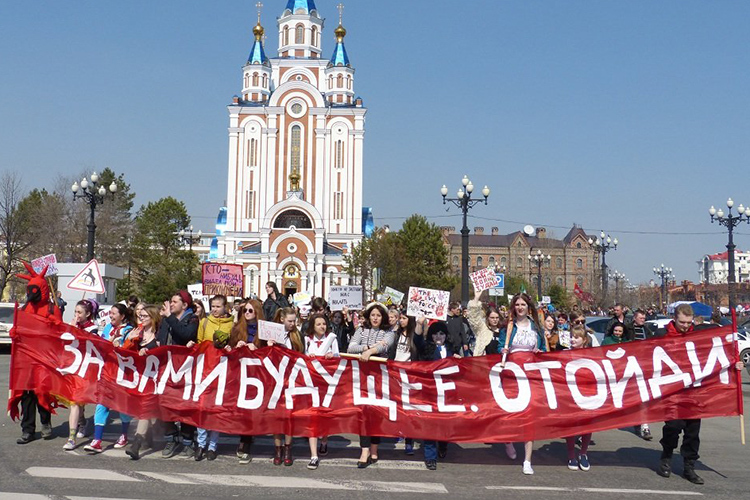
New time is new songs.
After a long inaction in the nineties and zero, which were occupied only by the arrangement of the present, in the tenth situations changed. Again, there was a need to look in the day after tomorrow, to do something for this day after tomorrow today, the Manifesto genre became important as efforts in this work on the future.
Colta.ru has recently published Alexei Tsvetkov’s manifesto “Mir in a hundred years. View on the left. "
Now another manifesto written by a group of intellectuals and activists has come to the editor; This time it is dedicated to the situation in Russia.
Our society is apathetic and fragmented than the ruling elite successfully uses. State media is crowded with loyalist propaganda, representing any protests as the machinations of external enemies, the opposition dominates the right -capacity flank with its apology of the free market and privatization. Almost no position is expressed that would connect the democratic and left summons. We believe that the only alternative to the course for impoverishment, barbarism, and the decay of society is a union for developing a general political position and a program of collective actions.
Today in Russia everyone is talking about a crisis. However, its causes are much deeper than the foreign policy of the authorities, corruption or pressure of the West. They are in the exhaustion of the post-Soviet capitalist model, the foundations of which were laid in the 90s and on the foundation of which the current regime grew. In this model, the privatization of property was inextricably linked with the privatization of political power, and the inevitable consequence of economic violence was the turn to the authoritarian presidential power in 1993. We consider the current Putin regime the organic development of Yeltsinsky, and the economic order, the expression of which it is, is a continuation of the country's de -industrialization and the predatory exploitation of natural resources in the interests of the elite. The paradox of this situation is that Russia, with its huge reserves of natural resources, has not directed a sufficient amount of funds received from raw materials exports to strengthen economic and public welfare. Instead, the Russian state introduced a policy of strict economy within the country, similar to the one that the European Economic Commission applied to Greece from the outside.
Russia with its reserves of natural resources did not send enough funds to strengthen public welfare. Instead, the Russian state introduced a policy of strict savings.
We can say that degradation - political, intellectual, social - has become the essence of this system. The result is not only the spraying of society, but also its powerlessness before repression, religious obscurantism and, most importantly, a continuous attack on social rights.
In the zero years, the authorities made a bet on “depolitization”, and proclaimed stability with its main achievement. The conflict in Ukraine and the active participation of the Russian authorities in it contributed to the creation of a new patriotic consensus. But the ideology on which it is founded, false and non -viable, and the proclaimed nationwide unity is false. The main technique of official propaganda is a constant switching of attention: foreign policy maneuvers become an excuse for antisocial policy and suppress basic civil freedoms within the country.
The “anti-crisis” government plan almost fully corresponds to the recipe for the so-called strict savings policy, which has been carried out in Greece, Spain and Italy since the late 2000s and has already led to the impoverishment and growth of unemployment in these countries. This is assistance to large banks and corporations, permanent removal of funds from the population through an increase in direct and indirect taxes and other requisitions, increasing the retirement age, reducing social programs, expanding privatization in the public sector.
In Russia, such measures are combined with a sharp devaluation of the ruble, the government’s refusal to index, as well as corruption and exposure of the budget. But if the European elites, conducting their consistent expropriation of funds for the majority, hope for economic growth, the Russian government does not have a clear perspective and lives exclusively today. Therefore, instead of a long -term strategy, it resorts to the tactics of “plugging holes”, trying to weaken the consequences of budget deficit. Under the knife, education and healthcare are primarily, on the agenda there is an increase in the retirement age.
Degradation - political, intellectual, social - has become the essence of this system.
The authorities pursue two short -term interests. Firstly, she seeks to satisfy the appetites of the elite in the previous volumes and therefore continues to “save” the state corporations and large banks at the expense of the budget. Secondly, she tries to prevent a social disaster, holding back the growth of open unemployment and demagogically demanding from the regions to “prevent reducing the incomes of the population”. Such a policy only puts off an inevitable catastrophe. Therefore, the elites have already begun the search for “scapegoats”, including in their own ranks. However, the “anti -crisis” course selected within the framework of the existing system is a non -alternative for the ruling class as a whole, and the change of individual officials or even the head of state will not change its main direction, which is openly hostile to the interests of the majority.
Unlike European countries, where trade unions and mass social movements are actively resisting the policy of strict savings, the Russian majority remains a passive victim. Nevertheless, since the end of last year, new protest groups have been stated about themselves, ready to protect their interests. Most often, performances such as the All -Russian campaign of truckers, rallies against paid parking lots or the “Italian” strikes of doctors in a number of regions are directed against individual most obvious antisocial aspects of the economic policy of the authorities, which directly threaten working places and living standards.
We believe that the new civilian nation in Russia can appear only in the general struggle of such movements and trade unions, and not in political technological design or in the crazy spotlights of nationalism of any stripes.
Unlike European countries, where trade unions and mass social movements are actively resisting, the Russian majority remains a passive victim.
The division of the country's inhabitants into “civilized citizens” and “scoops”, giving out social racism, is just as unacceptable. Instead of updating the confrontation lines of 1991 and 1993, playing the hands of power and capable of leading only to conflicts in the future, we need a civil consent program based on a general social and democratic agenda. We are talking about the economic interests of the majority, inseparable from political and civilian freedoms. We offer to unite everyone who shares our vision of the situation and is convinced of the need to implement the following basic requirements:
Stopping a hard economy policy. We demand to stop cutting social expenses, increasing taxes and entering new requisitions. Ensuring the effective work of the structures of the social state by cutting the income of large business and higher bureaucracy.
The annual indexation of salaries, pensions, scholarships and benefits at the current level of inflation. For both commercial and budget organizations, a single procedure for mandatory wages must be legally established.
A progressive multi -stage income tax scale directed against 10% of the population with the highest income. A worthy unemployment allowance, a revision of the methodology for calculating the subsistence level and an increase in the minimum wage to this value. The adoption of the law on minimum hourly wages. Tax holidays and affordable loans for small businesses. Expansion of the list of objects of taxation taxation tax on luxury.
Freezing for three years of payments for loans exceeding 10% of monthly income. A complete ban on collection agencies - any penalties should be regulated and carried out only by state bodies by court decision. Limiting the maximum rate on loans of microfinance organizations.
Nationalization of the basic sectors of the economy. Management of state -owned companies on the basis of a democratically organized planning system in the interests of the whole society.
A moratorium on privatization in any socially significant areas: healthcare, education and culture. The cancellation of the so -called The new system of remuneration that allows you to manipulate the salary. In budgetary institutions, the base part should be at least 80% of the total salary.
Reform of labor legislation: Actual provision of the right to create a trade union and the organization of a strike. Restriction of the so -called commercial secrets, providing representatives of trade unions of access to the accounting documentation of the enterprise. Providing labor teams with the possibility of monitoring the actions of the administration of the enterprise. Ensuring labor rights for all employees in the territory of the Russian Federation, regardless of citizenship.
Nationalization of the basic sectors of the economy. A moratorium on privatization in healthcare, education and culture. Freezing for three years of payments on loans. A complete ban on collection agencies.
Optimization of the police and the bureaucratic apparatus. Reducing government departments at the expense of salaries of bosses, and not at the expense of ordinary workers. The introduction of criminal liability for the illegal enrichment of officials.
Reducing the share of expenses for military and law enforcement agencies in favor of education, health and culture.
The universal right to free preschool, primary, secondary and higher education.
The universal right to free qualified medical care, providing people with vital drugs, regardless of age, social status and other factors.
The universal right to pension payments that surpass the cost of living and components of at least 50% of the latest wages.
The support of the state of science, culture and art, ensuring the widest access of people to these areas outside censorship and other restrictions.
Unconditional compliance and tightening of the norms of the maximum permissible concentration of harmful substances, an increase in fines for their violation and the targeted direction of the received funds for the development of environmentally friendly technologies, energy conservation and the construction of environmentally friendly housing. A moratorium on cutting forests without forestry, completely compensating for deforestation.
Publicity in making any foreign policy decisions. No “secret diplomacy” and unconstitutional, “hybrid” presence of Russian troops in the territory of other states. The official recognition of all combat losses among the Russian military.
Actual security of the secular nature of the state. The abolition of all discriminatory laws based on “morality” and “traditional values”, meaningfully defined not by society, but clericals from all religions. The elimination of the concept of "traditional denominations" from the legislation. Completely secular nature of school education.
Free elections to the authorities of all levels for any parties, except for inciting ethnic or religious enmity. Notifying procedure for registration of parties. The expansion of the list of questions possible for referenced, and simplify the procedure for its implementation.
Decentralization of power, fundamental expansion of budgetary powers of local authorities and mechanisms of public control over the use of land resources. The gradual redistribution of the revenues of the budget system in favor of the regional and local levels.
The withdrawal of the judicial system from the actual control of the executive branch. Bringing legislation in line with the Constitution. Revision of prohibitive laws adopted by the Duma of the 6th convocation.
Full support of the right to freedom of speech. The cessation of any pressure on the media, ensuring the freedom of expressing journalists in all the media, regardless of who is their founder, as well as from their organizational and legal structure and form of ownership. The state is obliged not to intervene in the work of the editorial office and guarantee the protection of journalists from persecution. The ban on extra -court blocking of electronic resources.
Ensuring the right to freedom of assembly, rallies and demonstrations.
The restriction of the presidential power, the transfer of real powers to the parliament and the strengthening of the role of representative authorities of all levels. The formation of the government’s accountable to the parliamentary majority.
Our platform is open for signing. We are convinced that only the society itself can act in its defense, and we hope that this document will be the first step to the dialogue and the search for new forms of interaction.
Elizabeth Aleksandrov-Zorin, writer, publicist
Evgeny Babushkin, writer, journalist
Svetlana Baskova, director
Lyubov Belyatsky, bookstore "All free"
Ilya Budraitskis, publicist, teacher, editor of the Open Left Site
Sergey Vasiliev, singer, director
Sergey Vilkov, journalist, "public opinion"
Tatyana Volkova, curator
Anna Gaskarova, journalist, Snob . ru
Igor Gulin, prose writer, critic, observer "Kommersant- Weekend "
Andrey Demidov, trade union "Teacher"
Ekaterina Larot, curator
Igor Dmitriev, journalist
Oleg Zhuravlev, Laboratory of Public Sociology
Karin Cleman, sociologist
Andrey Konoval, organizational secretary of the Interregional Trade Union of Health Workers "Act"
Matvey Krylov, artist
Pavel Kudyukin, co -chair of the University Solidarity Trade Union, editor -in -chief of the magazine Democracy and Socialism
Vasily Kuzmin, activist, left block
Boris Kupriyanov, Bookstore "Falanster"
Ekaterina Lazareva, candidate of art history, artist
Arseny Levinson, human rights activist, lawyer
Ilya Matveev, candidate of political sciences, teacher
Kirill Medvedev, poet, musician, Russian socialist movement
Anton Morvan, journalist, "public opinion"
Gleb Navparenko, editor -in -chief of the magazine "Disagreements"
Sergey Nevsky, composer
Andrey Oleinikov, Associate Professor of the RSUSU, union "University Solidarity"
Alexander Reznik, candidate of historical sciences
Galina Rimba, poet, Russian socialist movement
Alexander Skidan, poet, critic
Vladislav Sofronov, independent researcher, RSD
Nikita Sutyrin, director
Oksana Timofeeva, philosopher, Art. Lecturer EUSPB, Art. Researcher IF RAS
Artem Faustov, bookstore "Everyone is free"
Alexey Tsvetkov, writer
Keti Chukhrov, Associate Professor of the Higher School of Economics
Konstantin Shavlovsky, poet, film critic, "Word Order"
Jan Shenkman, journalist of Novaya Gazeta
Alexander Shubin, Doctor of Historical Sciences, member of the working group of the Community "Information"
Alexey Yurchak, anthropologist, professor of the University of California in Berkeley
You can subscribe to the comments to the material or on social networks:
Facebook.com/indefenseofsociety/