
Translated material
Raw and soft
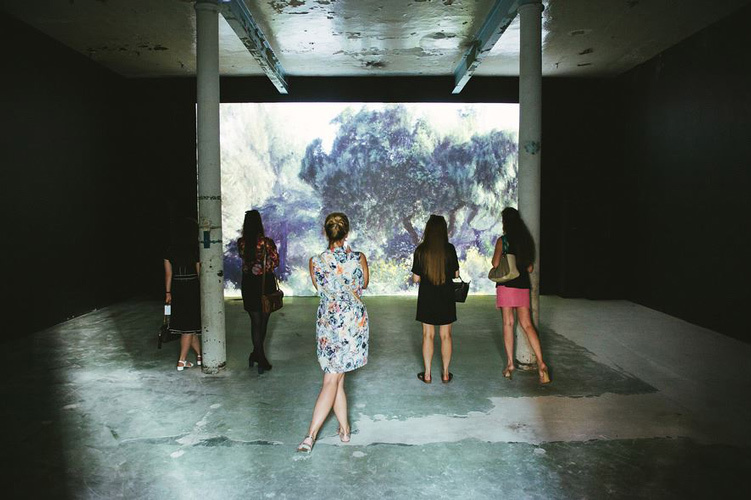
The Moscow International Biennale of Young Art arose for a long time, and its history is already partly forgotten - perhaps because the organizers deliberately erased it. Alexandra Novozhenov delved into the past of Biennale to understand what she was, what she became and what she could be.
14 years of the evolution of youth Biennale is the process of defocusing, behind which today it is impossible to see at least someone's articulated desire or clear intention. It is difficult to call it an institution, since the brand is not worth a reproducing structure - its tasks are changing depending on the conjuncture, and the obligatory treatment of changing cultural ministers about “support and development” of young art and the discovery of new names can hardly be called ideology. Biennale has historically does not have its own institutional body - it exists between two institutions: the state center of contemporary art (now part of the Rosiso) and the Moscow Museum of Modern Art, whose full -time employees carry out Biennale work once every two years. Her first enthusiasts and initiators - Daria Pyrkina and Daria Kamyshnikova - by the decision of museum directorate were removed from the management of the Biennial process back in 2012. In 2016, his own leadership was removed from the GUCSIA Office , and it was against this background that the new Commissioner Biennale, Ekaterina Kibovskaya, the former deputy director of the Gorky Park for mass events and the sister of Alexander Kibovsky, who replaced Kapkov in the chair of the head of the Moscow Department of Culture. She is an appointment from the outside with her small team, prescribed as an employee of the GCC, but essentially functioning as a prostect manager who should find money and position the “event in the city”.
“Artists without names,” that is, those who are programmed to show youth Biennale, today do not affect its device, performing the function of interchangeable suppliers of equivalent contents, drawn into a random movement that creates “youth” - a project organized and controlled in recent years by disinterested functionaries. As a large event, more and more actors every year, it shows little, finds out and creates, bearing almost exclusively reactive in nature and generating the maximum number of random connections. The main property of “youth” is not to articulate the relations of young artists and the existing artistic system, but to erode them as much as possible, creating the effect of an cascade of events in the summer non -season.
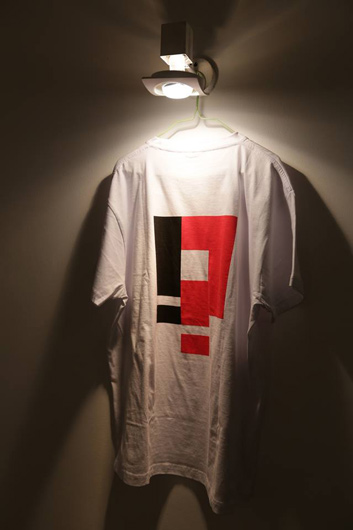 © MMOMA Exclamation and interrogative signs, preserved since the festival “Wait! Who is coming? " symbolism, you are still used by youth biennale
Perhaps this will sound rudely, but still - the concept of youth taken as a “construction” institutional principle becomes manipulative, only it ceases to be invested in a revolutionary idea. Not only in the sense of “struggle against the existing regime”, but also in the sense of the methodology of the work and the way to respond to institutional proposals. This moment was completely erased from the consciousness of the participants and organizers of the event to the fifth issue of Biennale in 2016. The first festivals "Wait! Who is coming? " (of which this Biennale has grown), which had been held since 2002, were largely filled with the work of almost the only existing group of young artists Radek, which were in the phase of the transition from state -owned street values to lapida microbes of works within artistic autonomy. Group exhibitions of the first festivals from the beginning to the mid-2000s (that is, until the transformation of the festival in the Biennale) were sharply politicized. The form of the festival appeared when the relatively narrow circle of young artists was busy with an internal discussion and the production of a new, maximum reductionist and aggravating relationship between the language. According to Daria Pyrkina, who, not yet graduating from the department of the history and theory of art of the Faculty of History of Moscow State University, initiated the first festivals and supervised their main exhibitions, the politicized art of the first half of the 2000s, because it was exhausted and tired.
But still there should be a connection between the institutional evolution of the form of the festival in the form of the “adult” Biennale and the artistic content, which this form is filled. Today, when no one wonders “Does the next generation of artists exist?”, “Youth” launches a race of overproduction of exhibitions, which offers “artists without names”, forcing them to rush in search of opportunities to exhibit - it doesn’t matter in what situation it is not important in the framework of what statement or institutional campaign. In the first festivals, in addition to the “Radeks”, Victoria Lomasco, the Summer group, Andrei Ustinov - artists who could not share common positions, but, in any case, were in a conscious polemic, reacting to each other and not just to the institutional request (exhibitions of Generation. Post 2002, “International” of 2005 and “Self-Education” of 2006). This allowed the form of the "local" festival.
The “democracy” of the application system seemed false to them, because as soon as it was introduced, rumors crawled that the organizers complain about the tedious need to view “a lot of shit”.
The first "youth" in the "Biennale" state began in 2008 and in many ways continued the festival format. They did not have the main project, the innovation was the introduction of an open application system - many exhibitions were built hierarchically only in the sense of size, all, according to the organizers, were formed from the works received in the form of applications on the Biennale website. Almost completely, these exhibitions were made by two early enthusiasts of the production of young artists - Daria Pyrkina from the GSIS and Daria Kamyshnikova from the MMSI. Both of these specialists were not curators in the author’s sense of the word - they did not seek to formulate a personal statement from the work, did not work with the topic, but were rather interested in processing the vast material that was at their disposal, and already based on it tried to formulate thematic blocks. They scolded these Biennale for the layout of the exposition and the secondary of the material - indeed, the application system instantly gave rise to a crisis of random work and the desire to bypass the application system. But the idea of “discovering” new names appeared - which they immediately began to take on the shield: on the 2008 Biennale with a sacrificial performance about “circulation in a circle”, Andrei Kuzkin appeared in a concrete slide, which was then called the opening of “youth” for a long time, although it was exhibited before. But if at the Glob (E) Scape exhibition, an application of confusion reigned in 2010, then at the Pro Pro exhibition (2008) in the GTSIA (curator of both projects - Daria Pyrkina) again - and, obviously, not quite according to the declaration of the application - were collected mainly by the Podoradek characters and close to them from other cities of Russia and the CIS: in it: in it in it: in it in it in it Olga Zhitlina, Ukrainian REP, Samara artist Sergey Balandin, Belorussian artist Marina Naprushkina, participated.
It was at this exhibition that David Ter-Oganyan, Ilya Budraitkis and Alexander Galkin made the only attempt to institutional criticism of the application system by artists, who, since then, seemed to perceive the Youth system for granted. Their work was called “neither the jury nor the prize” - it was a questionnaire filled with several dozen artists who did not participate in the events of Biennale: about 30 new names were thus dragged to the exhibition in addition to the application system. The institutionalization of previously more informal relations with the young curator, Pyrkina, and the institution that she represented, forced former “Radeks” to react by absurd questions about the position of the artist. The “democracy” of the application system seemed false to them, because as soon as it was introduced, rumors crawled that the organizers complain about the tedious need to view “a lot of shit”.
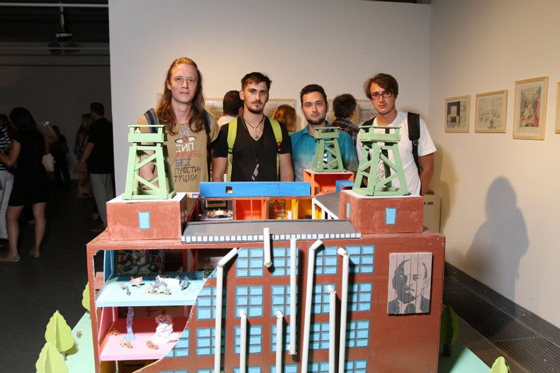 © MMOMA Group of SIPs against the background of its work. Strategic Project III Moscow International Biennale of Young Art, 2012
The second Biennale of 2010, which was again made by Kamyshnikov and Pyrkin, was marked by the “discovery” of the ZIP group (exhibition Glob ( E ) Scape ): Krasnodar artists became the emblem of another, not very widely implemented, fantasy of Biennale - “open” artists from the regions to the capital's audience. Since the Krasnodar artists first appeared with their installation about the monitoring of an abandoned plant of the art community, designed from the remains of an abandoned factory, they were shown in the main projects both David Ellitt and Katrin Bekker and in the strategic project (innovation of 2012), and Elena Selina. “ZIPs” served “sewn” on the request of the main projects of the Youth Biennale service of the “packed” form of the young community, which is not built into the exhibition at the level of ties or authors, as it was at exhibitions of the first festivals, but is always presented in the form of a separate object. Nevertheless, it was on this Biennal that the situation with random ties and pseudo -openings of the application large projects compensated for smaller exhibitions, at which the artists got the opportunity to act in the form of the established self -organized groups - this was a lot of demonstrative desire to represent themselves as such, to show the wrong side of their ties (exhibition of curators Andrei Parshikov and Alena Lapina “Intimate capital” ), but, in any case, it was a programmatic desire - the values of the community were in force, and Arseny Zhilyaev, who bravely assumed the role of their chief representative, then showed “inhuman”, according to Valentin Dyakonov, activity. Zhilyaev participated in Youth and in 2008, but two years later he was an author, a participant and organizer of at least four projects, plying between the ZSI Factory, where his first important exhibitions were made, his own workshop in Armenian alley, the circle of his comrades, intellectuals and artists from Voronezh, and new Moscow ties. It was this activity that, within the framework of the capabilities of Biennale, led to the fact that he literally usurped the concept of “young artist”, for several years becoming his permanent speaker in the media and associated him with the normalized left discourse and the concept of community. To the next youth Biennale, he was already exhibited mainly by the curatorial project, and his personal exhibition in the Tretyakov Gallery included in a parallel program.
Enthusiasts controlled the confusion - disinterested functionaries introduced order.
By 2012, Biennale underwent a fundamental change. Daria Kamyshnikova and Daria Pyrkina were removed from the production of Biennale - now they prefer to talk about it as a simple hardware decision, for which the time just came, but it is obvious that at that moment it was a sensitive blow for them. Mikhail Mindlin, the then Director of the HCSI, who made the main decisions regarding Youth (Vasily Tsereteli as the head of the second institution played not an ideological, but a supporting role), wanted to give her the form of an “adult” exhibition event, which was now not distinguished in structure from Big Biennale. The form of the main project was introduced with a certain coherent curatorial statement, for which the external curator was invited. They say that the first curators (Catherine Becker and David Elliott) were chosen “according to the notebook” of Mindlin - their choice was not explained by anything but personal relations of the director. The first fruit of these changes is the exhibition “under the Sun from Mishura” at the Central House of Medical Sciences undoubtedly differed, to the pleasure of observers, by greater made and accuracy, but also by a greater purely biennal accident between artists and work. It can be assumed that Becker really made the exhibition “On the request”; In any case, the exhibition again managed to make an “demonstration” discovery - the artist from Chechnya Aslan Gaysumov with darned books as a metaphor for war was a regional discovery with an ideal background and with the “youth” went straight to the large Biennale. But in addition to Gaysumov, the exhibition contained the maximum number of international stars that can be seen on many elderly international exhibition events, for example, Jorinda Voit, Ryan Maknamaru, Eva Kotatkova, Anna Titov and Arseny Zhilyaev: it was obvious that such heroes are not on applications. In order to still leave the function of lighting and supporting the local context with such a traditionally international version of the main project, the format of the “strategic” curatorial project, which Elena Selina did for the first time, was invented. She had to choose from the “remaining” applications, and although the case was not limited to applications (some artists who participated in the project did not remember that they were filled out to participate any applications-they simply received an offer to participate), work with mass materials was difficult for this curator.
About David Elliott, curator Biennale of 2014 “Dreaming Time” , it is known that he initially tried to supplement the work with the application system with traditional curatorial trips through the regions - nevertheless, the presence of Chinese and Kazakh artists, with whom Ellitt worked during his career, was very noticeable. It was the most age -related curator of Youth - and after it, with its difficult to develop from the previous project, Biennale still decided to rebuild in the direction of greater transparency and "youth". In the 2016 issue, the center is still the main project with a curator, which is now being selected at a closed competition by an expert council, consisting mainly of employees of the GCS and MMSI. Artists (at least officially) fall on it at the request, but in addition, there are two strategic projects for which there is a competition of curatorial applications, and in addition to a special and parallel programs. Unlike the first festivals and Biennale, when projects for all sites were gathered by the Biennel curator group and were offered to institutions, now the venues themselves offer their projects in the Biennale program. But, despite the changes in the procedure for choosing a curator, it is difficult to say what the Nadima Summan project differs from the Bekker and Elliott projects, except for changes in their own connections with artists who submitted applications for participation, and improved exhibition production at the level of architectural solution - that is, production.
Without a face, the identity that can be lost without institutional connections - it can afford that for ready and packed risk.
And at the very beginning of the existence of the festival, and today Daria Pyrkina interprets the concept of a young artist “stadially” - as the one who is just starting. But today-even to a greater extent than in the early 2000s, this can be understood only in a career sense and therefore needs to support resources and attention, then to switch to the next phase-made, ready (for use). Then dampness is the first stage that should be overcome by investment in production, in the show; A stage that transfers raw into a state of prepared.
Thanks to Svetlana Baskova and Anatoly Osmolovsky, who only do that they produce artists throughout the entire existence of Biennale, the raw metaphor surfaced again at the Exhibition of the Students of the Base as part of the Youth program of this year. Indeed, one can offer a version that is excellent from the “stadial” version, according to which the “young” in the metaphor of age stages will become the equivalent of the proletarian, whose material needs are minimal, who do not have symbolic accumulations and who, therefore, have nothing to lose and nothing to take risks. Young - raw, unprepared, unlawed - in theory, is capable of actions that are not capable of “ready”. Without a face, the identity that can be lost without institutional connections - it can afford that for ready and packed risk. It is this quality of dampness that is the opportunity, without doing anything, to do “anything”. Meanwhile, the form in which the youth Biennale exists today is a way to make a raw -ready or at least ready -made one - this is the task of all the improved design of the main projects, using the relay that is obvious, the secondary quality of most works is obvious. The raw at the same time does not mean secondary at all - the secondary is interchangeably, it is unique, if it does not begin to use dampness for itself, translating it from the opportunity to act without looking back into formal aesthetics. Полуготовое или готовое «на вид» нужно для «выставки» как для витрины — пусть оно просуществует ровно столько, сколько будет идти биеннале, а дальше не попадет на прилавки галерей (свести новых художников с галереями было одной из не очень широко реализовавшихся идей, лежавших в основе первых биеннале), а растворится в потоке тех, кто был художником на одну выставку или только по случаю биеннале.
Если смотреть ретроспективно, то в «молодежке» теряется и запутывается куда больше, чем открывается или проясняется. Глядя на каталоги прошлых лет, удивляешься, как много интересного было погребено в потоке участников и событий — гораздо больше, чем те немногочисленные имена, которые под маркой «открытий» или «вечно молодых» кочуют с проекта на проект, — возможно, одной из задач могло бы стать постоянное возвращение к прошедшим фестивалям. «Основные» проекты всегда вызывают вопросы, а самыми интересными все же были и остаются либо выставки сложившихся сообществ художников, либо выставки молодых кураторов, которые знают местную ситуацию, но не как «взрослые функционеры», а как участники, и работают с вопросами преемственности, производства художников и их связей: будь то «Яблоки падают одновременно в разных садах» Анны Зайцевой (2008) про проблему поколений, уже упоминавшийся «Интимный капитал» (2010) про изнанку выставочной репрезентации, «Контриллюзии» Стаса Шурипы (2012), которая стала кульминацией его преподавательской деятельности, или «Редкие виды» Жиляева (2010) про момент «входа» в искусство художников и теоретиков из его тусовки.
Понятие молодости становится манипулятивным, чуть только оно перестает быть инвестировано революционной идеей.
В этом обществе структура молодежной биеннале, не обеспеченная никаким пониманием того, зачем нужно понятие молодости, кроме как для маркетинговой фетишизации и градации карьерных стадий, год за годом производит все больше институциональных курьезов. Ценности сырости в смысле открытости разговора с общественной жизнью и ситуацией автономии деградировали до постоянного повторения своих оболочек, так что на разных проектах «молодежки» по сей день можно увидеть бывших «радеков» и близких к их кругу художников, как бы приговоренных сложившейся на их глазах институциональной системой к вечной, но бессмысленной молодости (на выставках 2016 года можно увидеть и Валерия Чтака, и Ивана Бражкина, и Алису Иоффе, которая была одной из первых слушательниц курсов Осмоловского на «Фабрике» и начинала выставляться еще на биеннале 2008 года). «Молодежка» породила «зависимых» художников, не способных найти себя нигде за пределами таких вот заявочных событий (скажем, Тимофей Парщиков, который участвует минимум во втором основном проекте и находится в состоянии «молодости», понятой как «поиски лица» уже многие годы), а также авторов, которые не являются художниками, но имеют тайное художественное альтер эго, воскресающее только на «молодежках»: оказалось, например, что критик и теоретик Андрей Шенталь в разные годы участвовал в четырех разных проектах молодежной биеннале, хотя вряд ли кто-то подозревал, что он производит что-то, кроме текстов. Художников, которых биеннале «открыла» и которые в качестве «открытий» участвовали в ее проектах год за годом (группировка «ЗИП», Андрей Кузькин, Аслан Гайсумов). Интересных художников, которые выставлялись на ранних «молодежках», но были погребены в бесконечном потоке событий (Андрей Устинов, Сергей Баландин). Художников, которые именно на «молодежке» сделали нечто интересное, но им несвойственное и потому опять же канувшее (Александр Повзнер с перформансом про двойняшек, играющих в пинг-понг, на выставке «Интимный капитал»). Авторов, которые работают в других креативных индустриях, но делают «художественные» работы под заявки (основная масса заявочного материала). Etc.
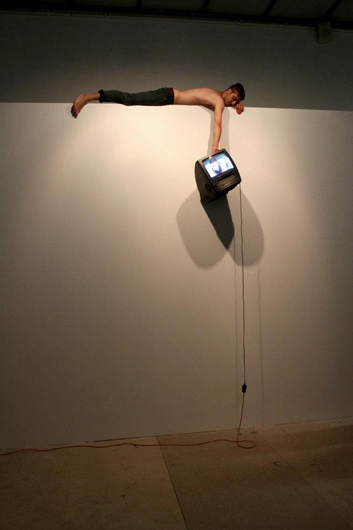 © MMOMA Перформанс на открытии основного проекта III Московской международной биеннале молодого искусства, 2012
Неразбериха ранних выпусков биеннале имела свое очарование: помимо официального «открытия имен» в ней действительно открывались случайные возможности — это все же было пространство, где становились возможны «сырые» ситуации, которых не бывало за пределами интенсивного фестивального периода. Это можно сказать и про заявочную систему в том виде, в котором она использовалась Камышниковой и Пыркиной, не пытавшимися выступить как доминантные кураторы, подверстывающие материал под темы. Неразберихой управляли энтузиасты — порядок внесли незаинтересованные функционеры. «Стой! Кто идет?» возникла на пороге нового застоя, когда язык искусства нормализовался до состояния осваиваемого «словаря», а молодые художники начали ощущать себя обширным, но атомизированным классом с непроявленной идеей, сплоченным только системой искусства и ее возможностями. В 2016 году никто из участников не задает биеннале вопрос, подобный тому, что был задан в работе «Ни жюри, ни приза» в 2008-м, а большинство сообществ художников, оформившихся на этот раз в выставки, — это сообщества школ (ИПСИ, «База», школа Родченко), которые сосуществуют только как одноклассники, выставляясь бок о бок, но не вместе. Можно допустить, что наивная институциональная критика изжила себя даже как школьное упражнение, а основной проект, собранный из работ, улучшенные аналоги которых можно найти на любом школьном просмотре в любой арт-школе мира, говорит о состоянии мировой молодости больше, чем вульгарно-социологическая возня со связями. Как говорит Дарья Пыркина, теперь, когда у нас есть столько школ, молодежной биеннале не нужно, как раньше, выполнять функцию поддержки для тех, у кого нет другой возможности произвести работу и выставить ее. Теперь это может быть «портрет поколения». А теоретик Борис Клюшников считает, что Надим Самман выстраивает между рандомно отобранными работами другую, более современную, связь, что ему удается «взаимодействовать без того, чтобы строить сеть, взаимодействовать, скорее, на позициях резонанса… построить такую парадоксальную связь без связей». Отличная идея, но нужно ли варить сырых, чтобы они вошли в резонанс? Хорошим ли проводником для резонансных колебаний станет такой бульон? Это тот вопрос, что должны поставить сами художники, которых все более сделанная и заметная молодежная биеннале манит выставочным обещанием «попадания» в проекты.

Рубрика «Отпечатки» выходит при поддержке фонда содействия изучению русского изобразительного искусства «Русский художественный мир».