
Translated material
The day before | Colta.ru

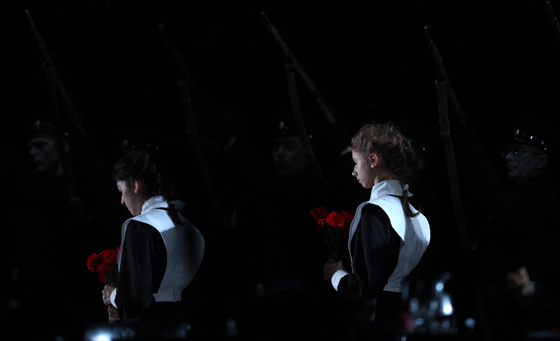
In the recent performance of the BDT "What to do?" “To whom the prime minister inherits partially, many times superior to artically,” the central question (the same, about interesting) was somehow imperceptibly lost, stooped, until he disappeared from sight at all. And he condemned the writers of reviewing headlines for puns like “there is nothing to do”, “there is nothing to be done” and so on. The Governor is not at all. For all the complexity of the directorial structure, the solid “academic” generosity of expressive techniques and three times the redeemed passion of the narrative, its main motive is distinct to persistence and will be quite good as a response to all the “what to do”, “where to swim” and other fatal questions until “nothing can be done”. Everything is simple: “a wave of a white scarf, shots, blood” - this is written by Leonid Andreev, and so this is set by Andrei Mighty. The theater that timed to the prime minister to the centenary of the revolution is one of the few who dares today to remind the famous replica from the “Bades“ Potemkin ””: “Hear? Do not shoot! ” Meanwhile, the same soldiers, built on the scene of the BDT in the ruler, are carelessly scorched in a defenseless stall.
Further, after the scarf, shots and blood, it probably follows what was once called the “logic of the historical process”-or, like Leonid Andreev’s, “a menacing image of the Avenger’s law emerging from the fog”; Then the revolution of 1905 (when the story “Governor” was written), or 1917, and in 2017 there are also a lot of interesting things ... But the “governor” is not about how everything inevitably rolled from the tragedy to the disaster, but about how everything suddenly stopped. For a few days, hours or minutes. Those that the governor of the provincial industrial city, who gave a fatal order to shoot at the hungry striking workers and destroyed forty -seven innocent souls, including children, spent alone with his conscience, in anticipation of close death.
 © Stas Levshin / BDT
To create a pause of unbearable tension, a numb stiffness, filled with mental work, which is invisible to the world, stretching it to a whole performance is a serious challenge for the theater. But the mighty keeps a pause exemplary, not “decorating” it with spectacular techniques, but explaining how it, this pause, is arranged from the inside. There are many diverse effects in the performance, but it is interesting that other of them are cranesized quotes from Leonid Andreev: and the mountain of corpses-doll, composed in the ranks, “as if at some extraordinary exhibition”, and the inevitable white (or even stained with blood) fateful scarf, which is playing the governor Dmitry Vorobyov, like a tired focus, then and business and business. He pulls out of all pockets - so the author directly says: "Focus." And, as in Andreev’s story, this grotesque kunshtyuk does not revive on the stage - it will be dead.
“He exactly lived in a room where there are thousands of doors, and no matter what he tried to open, he was met by the same motionless image: a wave of a white scarf, shots, blood.” Alexander Shishkin, who arranged a fantastic visual luxury (both architectural and color) on the BDT stage, seemed to carefully read the author: it turned out - “thousands of doors”, the bad infinity of the same official rooms, the formed sinister “accordion”, moving walls, the prospect of painful sleep.
The theater that timed to the prime minister to the centenary of the revolution is one of the few who dares today to remind the famous replica from the “Bades“ Potemkin ””: “Hear? Do not shoot! ”
The authors of the performance, apparently, were not inclined to limit themselves: in the gate, two stairs stretched out onto the stage, and a couple of angels in sparkling breasts and black Magritovsky pots descended along them. Important imperial angels with steel wings. But simultaneously with this “heavenly vertical” there is a human dimension: the official bed of the governor is equipped with a mirror system, so that his nightmares can be seen in different angles at close -ups.
Films and movie cysts are the most important part of the "governor". Three screens demonstrate the semblance of black and white films: here are quotes from the Protazanovsky “White Eagle” (set in 1928 according to the same Andreevsky story), and newsreels, and video arts, but the main thing is stop cadres, solidifying with portraits and neuggents of the heroes of the performance. And the characters themselves are unable to forget about their “dumb black and white” genealogy: black costumes, gray faces (these gray masks in return for the usual comedian tuned faces are a sign of a new, border, cinema reality). Against the background of official green curtains, black and gray characters seem to be cut straight from documentary chronicle, and the green background serves as a green screen of digital filming: these people are genuine and there will remain, but the landscape and time behind their backs can be changed.
 © Stas Levshin / BDT
The harmony of this performance consists of heterogeneous, sometimes contradicting elements. The acuteness of the conflict is supported by a verified style eclectic. Hidden somewhere in the box, Vasily Reutov reads the author’s text, and his melancholy intelligent manner inevitably dissociates with the dark expression of the worker’s monologues (Ruslan drums to break the aorta screams texts from the Andreevsky “Tsar of Hunger”). Confident, workshop, good tone Academicism of the game Dmitry Vorobyov, Anatoly Petrov, Irina Patrakova, George Shtil, Valery Degtyar and other actors (with all those who are supposed to be thin and excellently executed by “Russian psychological” or satirical overtones) sharply contrasts with the epic howling of a murderer, the mother of the murdered girl (Agranda Petrovskaya). The abyss between the governor, perplexed, why this workers cannot buy three -ruble golden -rings of engagement rings (and confident that “this cannot be that the child died of hunger”), and these people themselves with “tin rings” and a red banner in the play become an abyss between the external decoration of the traditional bourgeois theater - and heavy symbolistic symbolistic symbolist bursts. And against everything, like a meek protest, is a monologist of a gymnasium student, who sincerely regretted the governor appointed to slaughter, performed by Alexandra Magalatova with finely calculated lack of art, in the best traditions of “new sincerity”. And there is no hope for reconciliation, nor (with regard to the style) of the need in it - but everything in this performance ultimately tells the story of a gigantic common misfortune, one on all.
 © Stas Levshin / BDT
The Governor, who was waved by a handkerchief and signed a death sentence, is a person living in a second -class waiting for a shot. So Dmitry Vorobyov plays, holding his honest, near and kind -hearted hero on the painful line between doubt and repentance. There is no talk of any “enlightenment” - neither the author nor in the play: Mr. Governor was stuck in hell of uncertainty. Unable to bow his head, calm down in someone’s sympathy, he innocently drags a pillow behind him-the very one through which the angels shot him. On the pillow a dark spot, feathers are pouring from the hole, life has leaked. The “killer of the children”, the governor agrees to suffering and on a feat-just in some fantastic way to stop those shots that have already been sounded, and the one that is about to. By mail, along with letters, the Governor comes to the governor, in the parcel-the wires and something ticks. The hero with some completely heartbreakingly, moth gesture is stubbornly hiding a terrible bomb behind his bosom. But the bomb does not explode, the alarm clock rings everyday, the governor sober - there will be no feat, and time will not turn back.
This ticking bomb is the most reliable that the performance of Andrei Mogelny simply was obliged to work out. The well -known case is from the time of the “Cursed Sardinitsa”, with which the heroes of the first edition of the mighty “St. Petersburg” Andrei Bely were worn. In the 91st or in 2017, at the hell on the scenes (on Rzhevka) or in the “BDT”-but the dying longing of Senator Ableukhov or governor Pyotr Ilyich, the longing for the frozen time, ready to explode, turning the defenseless into merciless ones, this longing inevitably becomes excellent matter of theatrical art. "Time goes on, and the sardine is ticking for itself ..."