
Translated material
Why remember
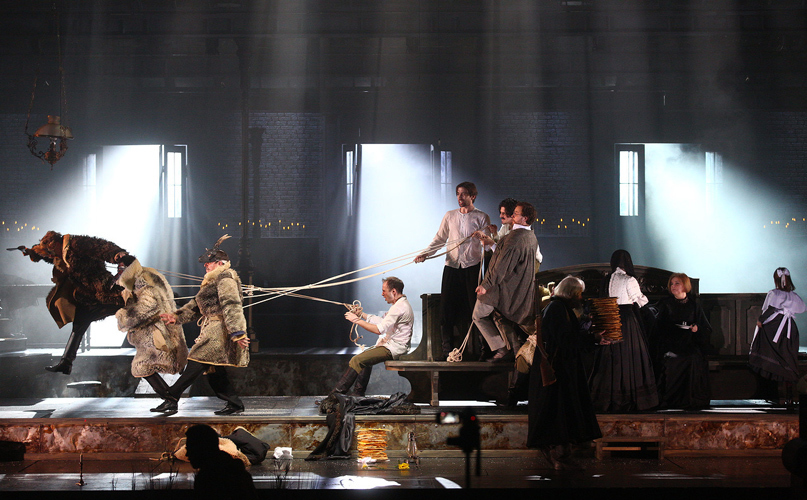
The current BDT premiere is impossible impudence. To put today in the house of Tovstonogov, the Chekhov’s “three sisters”-the dashing of a desperate, for this, it seems, one must be with the genius of the place somehow at all of a panicem. Because in the event of a failure or even half -ghosts, the chosen lucky ones who have forced the legendary Tovstonogovsky masterpiece half a century ago, perhaps, perhaps, will not be reduced to hot indignation. And what kind of good, young bold seekers who do not know the order will simply regret: they say, “oh you, the nonsense” ... It, of course, is small from condolences of this kind, but still sensitive.
Director Vladimir Pankov did not pretend that nobody put the Chekhov play before him in this theater. Moreover, he, as is now accepted in the BDT, even tried to testify his respect to both the great predecessor and the theater as such (for example, gave Irina to actress Lyudmila Sapozhnikova, who played the same role in the Tovstonogovsky performance). But here it would be nice to understand how the Ommage differs from Knicksen, and not to confuse one with the other. The performance of Vladimir Pankov is actually dedicated to memory, but this is another memory of something else.
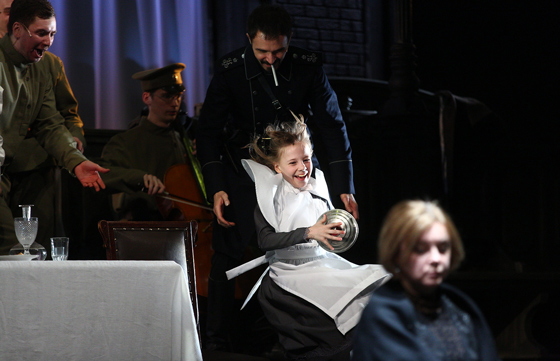
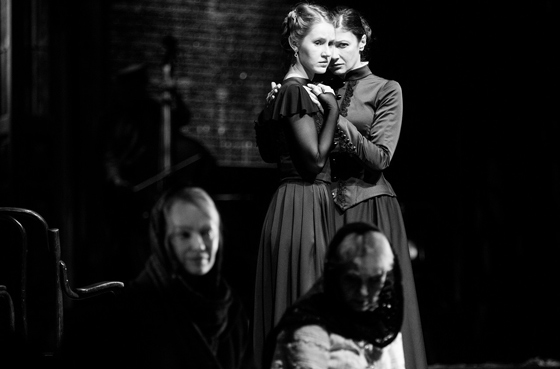
There are not three sisters in the play, but much more, but it is difficult to say with confidence how much. In addition to the young Trinity, whose plot was strictly in Chekhov began in the first act, on the day of the twenties of the name of Irina (Olga - Tatyana Aptyeva, Masha - Polina Tolstun, Irina - Alena Kuchkova), there are Sisters of the Prozorov who only observe the life of their young doubles and whose existence consists entirely of memories and reflection. Masha is played by Maria Lavrova, Olga - Elena Popova, Irina - Lyudmila Sapozhnikova. In addition to them, a little girl is frolicing on the stage in a gymnasium dress, who, a rally of the Tarator of the Chekhov’s replicas, strives to introduce all the sisters alternately.
 © BDT named after G.A. Tovstonogov
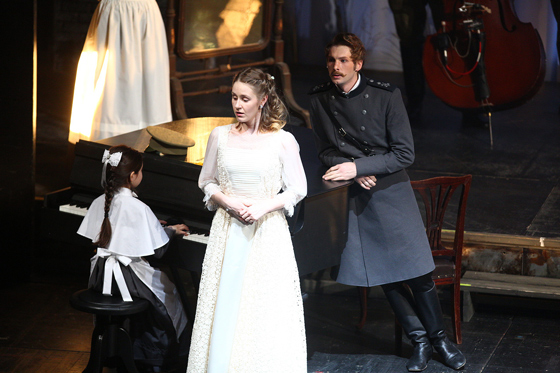
In the “sound drama” “Three Sisters” (Vladimir Pankov is faithful to the chosen genre) the trio of aged sisters does not develop in any way: Olga and Masha exist separately from Irina, who lives, as they say, “in her world”-in reality not existing at all. She, “our white bird”, as usual, is in a white lace cloak (unlike the mourning black clothes of older sisters), and her melted raised-academic intonation eloquently testifies to the life of an “eternal bride”. “The key to the locked piano” with the death of Tuzenbach was lost forever. The brick factory, too, seems to have disappeared into the fog. No matter what curly scales to seize the prose girls who survived all their men, the favorite of Dr. Chebutykin, two other sisters, is like non -native.
But Maria Lavrova and Elena Popova were especially beautiful in the duet: instant exchange with all-mercenary views, then sad, then bitter-irony, short touches, full of familiar tired tenderness, and most importantly-general intonation, adult, sober, stoic-biant. Elena Popova easily and without unnecessary sentimentality appointed her main motive the merciless copyright "Life has disappeared!" - And with her characteristic softness, the manner managed to make this everyday horror charming, while in the final monologue she reached the heights of almost tragic. And the heroine of Maria Lavrova was responsible for the main theme of the performance - the same Chekhovskoye “Why remember?”, In the latest BDT manner, filed without a question sign ( “What to do?” , “Why remember?” - what are the questions here). The actress makes heroic efforts so that the answer sounds sincerely: Chekhov’s “when my father was alive ...” thanks to her, it seems to be a memory of not only the brigade General Sergey Prosorov, but also about the artist Kirill Lavrov. Moreover, the shadow of the old workshop joke suddenly flickered in the author’s text-the salty replica “When a man philosophizes, it will be philosophy or sophistry there ...” Masha suddenly responded: “And when a woman philosophizes, it will kiss me in ...”, having quoted a well-known theatrical joke (so Kirill Lavrov has split the partners on the stage). But this hooligan-tracting greetings to the golden past disappeared in the numbness of the silence of the hall-even those who remember and know why to remember. " The “three sisters” of Vladimir Pankov give a paradoxical answer to his own question: there is no need to remember.
It would be nice to understand how Ommage is different from Knicksen, and not to confuse one with the other.
Because not a single topic - even the main one - in this directing has neither continuation, no development, nor permission. All “finds” - both acting and directorial - remain at the level of the ornament, not growing into action. Four and a half hours of sound drama, “decorated” with more or less whimsical interspersed of dramatic kunshtukov. In the scenery of the same station that would be close if it were not far away, the artists play the scenes of the Chekhov play, using any prepositions for musical, including indirect ones. They laugh every now and then (usually out of place, but melodious): the officers are goggling, the young Masha is virtually laughs, the Tuzenbach grins every minute (which is why Irina is in no hurry to get married, it becomes obviously from the first tact). The nanny shuts her remarks in a folklore manner, the child was lying loudly, Natasha forbade the mummers - but it doesn’t matter, they will still appear on the stage: they will not disappear for the new musical theme. Any “Tsyp-Tsyp-Tsyp” and “Tram-Pam-Pam” (not to mention Tararabombia, here God himself ordered) is welcome and growing into a separate issue. There are no questions to the composers of Artem Kim and Sergey Rogyukov, as well as to the orchestra accompanying each scene of the performance - all problems here are related to directing.
 © BDT named after G.A. Tovstonogov
In the "Three Sisters" Pankov, the characters are busy making certain sounds. Mostly very loud (“The louder the artist yells, the better he plays because he feels more” - this is a naive philistine conviction in the BDT began to be divided recently). Free family of Pro -Roads to sing romances - a small trouble even with modest vocal possibilities. But the manner of the game itself also gives amateur singing of romances: such a crackling recitation in this theater did not exist for a long time. We have to remind yourself every now and then that in the vast majority of artists who went on stage in the Three Sisters are good, thin, witty. Fortunately, almost everyone has already proved this in the new history of the theater. The question “why remember” does not stand here - the tasks set for the actors, otherwise you can’t name as primitive.
The characters of the characters are small, flat, relationships are superficial. Where it comes to individual characteristics, like “original dashes”, there begins a mere nonsense. Masha performed by the exquisite beauty Polina Tolstun unexpectedly turned into a reincarnation of some unknown hussar colonel, Bourbon and grip planted on a guardhouse for notorious behavior (and all the foundations-a little vodka and the escaped “ehma!”). Olga Tatyana Aptyeva made seemingly impossible: the key to the “three sisters” replica “every, even the slightest rudeness, indivisiblely said the word worries me ...”, uttered in a hurry, with a manner of sinking, suddenly became a direct continuation of the monologue of the midwife Zmeyukina: “I am pierced near you, give me the atmosphere ...” as for the master Officers who are pointlessly dangling, without taking their breath, the clock, organizing various whimsical sciences or shouting something rhythmic, then a meaningful salty, which, as everyone knows, was already three duel, becomes especially clear. Officers, of course, cannot be killed. But something needs to be done with them.
 © BDT named after G.A. Tovstonogov
There are no hopes left for the third act: the attitude of the sisters with their doubles from the past, as well as their interaction with the ghosts of the departed military, have not been worked out at all, although, it would seem, there is an extraordinary scope for fantasy. But the case was limited to a couple of reproachful glances and slap in the face, which adult Masha slammed herself, a young unhappy fool. The story, which began with the arrival of Vershinin and ended with the death of Tuzenbach, turned out to be a vague memory, from which it seems to be impossible to get rid of, but also to delve into it seriously, removing old wounds, also nothing. But the director had enough time and excitement to compose a scene where the evil salty treacherously soldes the unfortunate baron, and then he looks terribly ugly in front of the embarrassed Irina. There is nothing special to retell something - this is a direct quote from the Ryazanovsky “cruel romance”. And this unnecessary, awkward episode is as well as universal agitation, and passionate muttering on high colors, and romances of out of place, and frontal misanseas, and one -dimensional character, and silently sobbing in the final, and the villain Natasha, and Irina, who was staring at the final, and overshadowed everything and the whole death of Tuzenbach (the next washing the body and universal crying) - all this leaves no reason for doubt. The BDT put a very real good good melodrama. Of course, with a shot. It can, of course, be called the sound drama, even more beautifully comes out, but the essence will not change. As you want, cute, but a green belt is not good. No, there is no signs. It just doesn't go ... and somehow strange.