
Translated material
Forbes: Russian Bear is actually a mouse. The economy does not allow Russia to be superpower
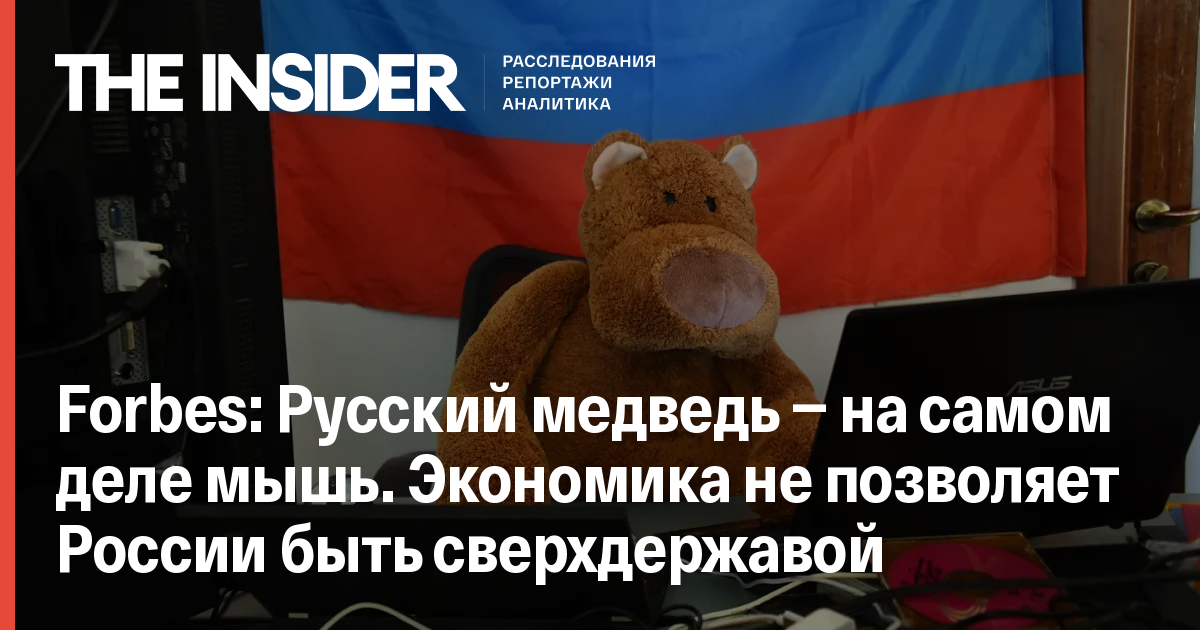
It is not necessary to exaggerate the danger emanating from Russia: its economy weakens and there is nothing to reinforce claims to the role of superpower, writes Forbes observer Kevin O'Mara. The Insider offers a complete translation of the article.
The theme of Russia in American news suddenly accepted the threatening size, but universal anxiety in a sense of disproportionate significance of Russia in the world. The bear is actually just a mouse, and no matter how loudly he growls: in the long run he has nothing to support his claims.
Corner
Adventures in Ukraine, Syria and - recently - off the coast of Connecticut attracted attention to the power of Russia. Her military capabilities should not be neglected, and how willingly she goes to action, she definitely strengthens. At the same time, cyber attacks and a skilled backstage game during the past elections in the United States show her desire for intervention, causing the times of the Cold War in memory. Fear grows, and not without reason.
But Russia is similar to the cowboy from an American proverb who has a large hat, but there is no cattle: its economic mechanism is in complete disorder, and there is almost no that dynamics that would allow to finance the global power in the future. Russia snaps like a beast driven into a corner; She is always ready to create problems - but only in order to distract attention from her own trajectory along the descending spiral.
Russia and the global supply chain: high risk and low profitability
In 2011, when the idea of the BRIC countries as a growing global power seemed relevant, the British company SCM World conducted a survey of experts on the supply, reliability, risks and future potential of Brazil, Russia, India and China in terms of using their resources. The results of India and China were high, and Brazil, noticeably inferior to them in relation to costs, looked good in everything else. But it turned out that Russia was not an opponent: in all four indicators she had the worst results, and the assessment of reliability was completely fail - 2.09 on a five -point scale.
In 2014, we invited professionals to name three countries, which, according to their companies, represented "too much risk so that surgery could be carried out there." 115 participants in the survey put Russia in fourth place in this list - immediately after Iran and before Syria. For comparison, Nigeria - a large but frightening developing market - was on the list of the eleventh.
Later, in 2015 and 2016, we asked a question about three countries in which the leaders of companies engaged in supplies planned to create new jobs. In 2015, Russia was in 19th place, behind Thailand, Hong Kong and Australia. The next year she was 16, immediately after Malaysia.
Very rarely, Russia is mentioned among the critically important links of the supply chains-such as Mexico, Vietnam, Taiwan or Poland-for any product produced. The study of the Massachusetts Technology Institute demonstrated some prospects for Russia as a supplier in a global chain. Despite its vast territory and population, its contribution to the added value of products is many times less than the contribution of Germany.
Export in 2015
| Russia | Germany | How many times the result of Germany is above Russian | |
| Machines and mechanisms | $ 11.6 billion | $ 334 billion | 29 |
| Food | $ 4.36 billion | $ 38.7 billion | 9 |
| Textile | $ 741 million | $ 25.4 billion | 34 |
Shoes | $ 168 m ln | $ 4.38 billion | 26 |
Integral schemes | $ 82 million | $ 12.2 billion | 149 |
Source: MIT Media Lab, Massachusetts Institute of Technoloogy
Russia makes a profit from sales of raw materials, especially oil and gas, which, together with coal, make up 57% of its exports. But there are times when oil begins to go into history and an inevitable turning point is approaching when renewable energy sources come to the fore.
The prediction of the turning point
| If the use of solar and chicken energy will grow per year on ... | ... and the global demand for energy will grow annually on ... | |||
| 0.5% | 1% | 1.5% | 2% | |
| 5% | 2033 | 2065 | 2091 | 2118 |
| 10% | 2021 | 2032 | 2040 | 2046 |
| 15% | 2017 | 2024 | 2028 | 2032 |
| 20% | 2017 | 2020 | 2024 | 2026 |
25% | 2017 | 2019 | 2021 | 2023 |
| ... then a turning point will be achieved this year. | ||||
Source and : Stratfor, University of Oxford
So is it worth it to be surprised what Putin is looking for, what else would concentrate on efforts?
How to deal with a crisis
For leaders working in the supply system, the question is what place all this occupies in the color and heterogeneous world of risk management. And here everything is not like the fears associated with economic policy, which can damage the US trade relations with Mexico, China or the European Union. Relations with Russia are unlikely to mean something at all. In some places, especially in Western Europe, the volatility of prices in the energy and petrochemical sectors is observed, but the long-term trend is downward, and the diversification of suppliers is rather a buffer that protects against extortion than a fundamental change in balance.
Probably, more concern should cause bizarre things such as cyber attacks, aggressive militarism and systemic destabilization of institutions, in particular, falsification of elections. Such actions can give rise to problems with the exchange rate, transportation routes and raw materials prices. This implies the need for a much more serious approach to scenarios of geopolitical disintegration.
In addition, you should think about the safety of your own home. The National Center for Counterintelligence and Security of the United States is making special efforts to inform the companies about possible leaks in supplies. The danger of hacker attacks is quite real, so be ready for this.
Russia is a geopolitical threat, but it is economically drying out. Keep calm and continue to work.