
Translated material
"I have never fought in my life"
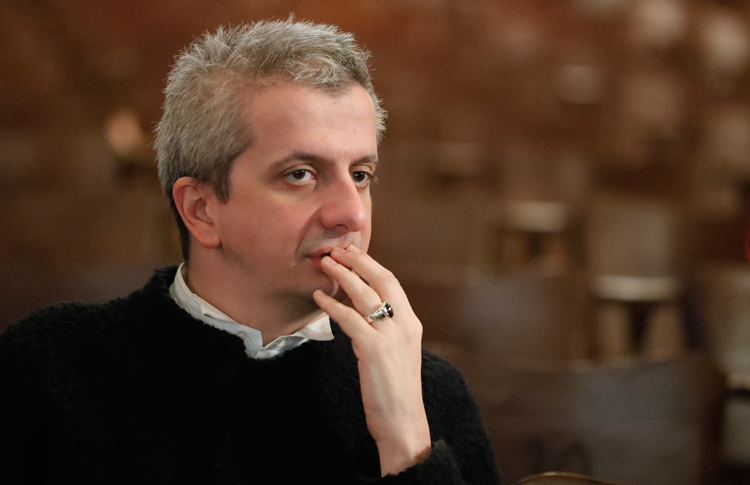
In mid -May, in Moden and Bologna they will show a new performance by Konstantin Bogomolov. Shortly before the premiere of “Crime and Punishment”, the director told Colta.ru why it is necessary to kill dragons, why put Woody Allen and why not be able to understand criticism.
- I heard, you were going to interrupt rehearsals in Italy to return to the Moscow Art Theater and play in the North Wind - the directorial debut of Renata Litvinova. Are you not tired of being an artist yet?
-I'm not tired of it-I am still open to any boiler. I am not interested in “playing roles”, but if I find some of my emotional-wood-bass in the material, then it doesn’t matter to me, the artist I am in this event, a dancer or someone else. I treat Renata gently, the “north wind” is a wonderful text, I would love to participate in it, but this time we did not coincide with the deadlines.
- What do you do with students in your Moscow Art Theater laboratory ?
- We talk, analyze the material, talk again, now they are beginning to show their passages. In general, beautiful guys, smart, thin, complex - all conversations about the degradation of the young generation are meaningless when you see them. Another thing is that these guys have no space where they can exchange energy - even just at the level of conversations. The laboratory to a certain extent is the house in which they come to stay in some, relatively speaking, intellectual comfort. And I'm glad that to some extent I can brighten up their loneliness. In live mode, I try to convey to them what has accumulated over the years in theoretically ... And I am very happy about it, because for me it is an opportunity to collect all my ideas and developments together and then give them a printed form.
- That is, you can talk about a certain system that has established?
- Well, yes. This is not just a theater system - it is a certain philosophy, a view of a person and a culture that directly flows into theatrical technology and technology. Because all these things are very related to each other.
- What will happen to your laboratory assistants later - will they become directors?
-Someone yes, someone is not. A significant part of the people there already took place professionally: say, Nastya Patlay from The Theater .doc or Vasya Berezin-for them it is some kind of enrichment of experience. There are movie people who want to try themselves in the theater. They don’t pay any money, and I don’t get anything for this - in general, this is such a philanthropic club, thanks to the Moscow Art Theater. But if they show something successful, the performance may grow out of this. Or even a few. Or maybe nothing to grow. In any case, they will not receive diplomas. In the end, the director is a character, and they must punch their way.
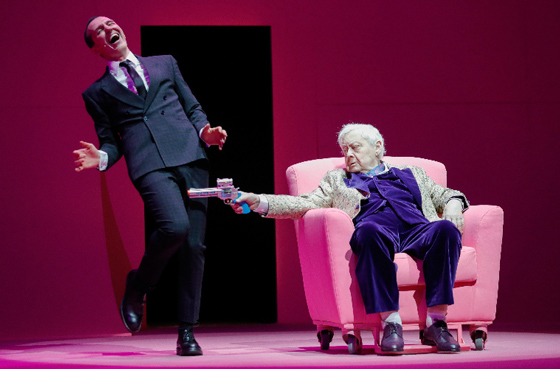 © Mikhail Dzhaparidze / TASS Scene from the play "Dragon"
- The question that I had after the premiere of the Dragon : did you intentionally want to express a change in social formations through a change in aesthetic? Or did you not formulate such a task for yourself?
- There, of course, there is this idea of the transition from totalitarian to liberal as a change in the aesthetic. But by and large this is not tied to the twentieth century. The presence of a quote from the film “Five Evenings” does not mean that we are talking about a change in Stalinism or Hitlerism to the regime of the thaw. I repeat what I said from the very beginning: this is a story that black is more honest in pink. Red, blood, fading, becomes pink. Although, of course, everything is contradictory in the Dragon: July rain (however, these are shots from “I walk around Moscow”), the bloody rain, under which, having removed the shoes, the Soviet intelligentsia is running, confident that the rain will wash everything off. I do not deny that this is an extremely mocking version of the thaw. A change in formations as a change in aesthetics is only one of the elements of this story. “Dragon” is to a certain extent an orthodox, religious performance, requiring faith not with the world, but with a sword. If you remember, there is a moment when the voice of Konstantin Simonov reads “Wait for me, and I will return” - this is an absolutely serious moment.
- Although a nervous laughter sometimes occurs in the hall ...
- ... a couple of morons. But, in principle, this is an extremely religious moment. This is the text of the warrior, the sacred text of the war - and a direct allusion appears on the screen on the Savior, sacrificing a sacrifice. This is the threat of the second coming and at the same time the requirement of faith. All this is quite obvious, the question is how much people are ready to read these meanings.
- The recent St. Petersburg exhibition of Jan Fabra “Knight of despair - the warrior of beauty” directly echoes your “dragon” - not because in both cases Lancelot appears, I leave it behind brackets. But the Fabr, in fact, does the same: you enter the face of an artist playing Lancelot, instead of the face of the Savior. And Fabr hangs his miniatures drawn by a blue ballpoint pen next to the great Flemings. And, considering them, you understand that contemporary art is very difficult and multi -layered, but it does not need to be explained - everyone understands it to the best of their capabilities. The picture of the Fabra “Self -Suicide Self -Portrait” - the author drawn, by the way, is the author’s blood - this is generally practically an illustration of your “dragon” ...
- I can’t comment - I'm not a fan of Fabra.
- The banal question: can you fight with the dragon and do not become?
- You ask this question because Lancelot in the finale appears in a disgusting form and it is clear that the pathos of fire is a directorial pathos. But this is an intellectual question: if a person asks him, he already a priori replied that the dragon could not be killed. Further, this question turns into an illustration of what an intellectual at a crossroads is: he is ready not to kill the dragon, because it can turn him into a dragon. A person asking this question, if he did not become a dragon, became Henry. That's all.
-You now put the “Crime and Punishment” -by the fortieth anniversary of the Emilia-Romania Province Theater. ” On the theater’s website, I read that Raskolnikov in your performance is a black emigrant who did not want to work. The old man-concentrate is raising her mentally retarded daughter Lizaveta, and the investigator Porfiry by the ears is in love with Raskolnikov ... Tell me how you work with the Italians?
- I work with pleasure. They seem to be too. I won’t say anything else yet.
- What will you do next? I know that you were going to staging another performance by Woody Allen.
- “Husbands and wives” in the Moscow Art Theater in mid -June. All my life I love Allen's films and texts. This is a subtle feeling of the world, and this is a brilliant training for a Russian artist: diving is not emotions, but intellect, the ability not to play with veins, to be cold, slightly detached, playing even the most household, family situation. This requires tremendous efforts from the Russian artist-I ran into this, releasing "350 Central Park West." It is very difficult for artists to be free, light, elegant - because only in this situation the text begins to work. Our hall is now laughing without ceasing - in the absence of gags and an unobvious reprise text. But critics do not understand what it cost me.
Previously, your colleagues told me that I did not own the profession. And only my character, my stubbornness and audience success changed something in my head.
- I do not agree. And by the way, I can testify: the hall laughed together already in the first performances.
- Do you know what horror is? You work, give out a certain product, and critics come (I'm not talking about an ordinary viewer) and they say: well, what is there, it is funny in fact. Our criticism cannot distinguish where the director’s efforts are made to the artist, she understands the result, but does not understand how he is achieved, what is the difficulty in the simplicity of this result.
- It's hard not to evaluate how elegantly they exist ...
- Not a damn, Alla, no horseradish! It is one thing to evaluate that they gracefully exist, and to understand the technology of achieving this elegant existence is not capable of this criticism. At all.
- Can I leave this when publishing?
- For God's sake. I am even ready to repeat this: our criticism does not understand anything in the technology of acting. Ne-hre-on! That is why the critic, seeing a raw performance, is not able to predict his development. Then in a year he will come, amaze - if he comes. That is, you come to the premiere, you see that the potato boils in the water, grab it and say: "Old man, something is not ready for you." Do you see that she is still cooking?!
-Sometimes she is inquisite-like-and turns into porridge.
- No, it can always be recognized by the elements of the performance, it will develop - it will not develop, I swear to you! I am harsh in this regard, because criticism is like part of the process and if criticism does not see and cannot recognize ... Glory to you Lord, seven years have passed before postmodern in the theater ceased to be perceived as a mockery. That is, critics have learned that it is possible to create certain worlds that do not exist according to the laws in the heads of those sitting in the hall, and they began to listen to these worlds. And before, your colleagues told me that I did not own the profession. And only my character, my stubbornness and audience success changed something in my head.
- Okay, I still can’t answer you - I must protect the workshop to which I belong. To change the subject, I’ll tell you that in January I revised the “perfect husband”. The performance passed perfectly. I have not enjoyed such a courage for a long time!
- This is not a courage. They do not need a courage to win the hall - they have complete autonomy, they work on another. This is a separate topic, a whole set of ideas that completely reformat the artist of the brain, his relationship with the public, an understanding that there is a stay on stage, what is an artist’s profession, how to tell a story, how to tell it for a thousandth time, etc. I do not rehearse my finished performances. The artists are pilots of this aircraft, during rehearsals I transfer to them control. It is stupid to train a pilot, and then regularly stand behind him. You must release them into the world so that they led this plane themselves, can be guided, to correct, to hear, to hear.
- Well, when they shoot in the series, they play in the entreprise, and then return to you?
- My performances are so built up that a person who exists in another mode will look like a moron. The artists develop hearing during rehearsals - they instantly notice this and switch to the desired wave.
- It is clear that you have developed a system that favorably distinguishes your artists from all others. It is clear that it is needed here and now and is very consonant with time. Are you not afraid that she, like any system, will begin to outstarly at some point, but will you not notice?
- No, because this system does not speak with the artists about what you need to play in this or in this style. I came to this not so long ago - five years ago I thought that the whole question is in the extent of the game, in the style of the game. Today you can see my performances post-dramatic and wildly aggressive, performances-shows and performances. In the Prince, Zbruev can exist in zero mode, and I myself can grimace, Mirkurbanov can exist in a jumping plus, and Khairullin in the very minus ...
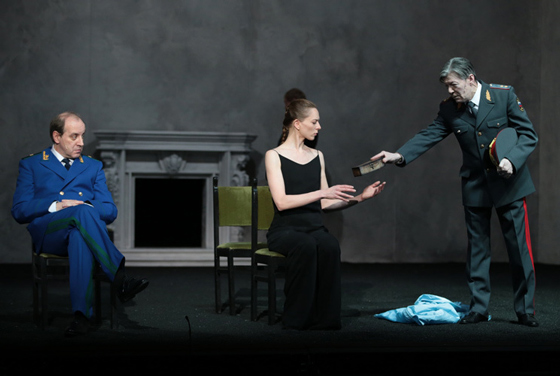 © Mikhail Metzel / TASS Scene from the play "Prince"
- You intrigue, say more specifically: how can you work on stage and not depend on the viewer?
- I will not tell anything. This is a very big conversation. It is very difficult to achieve freedom. This is the path in which there are a number of technological tricks. But the actor clearly sees the goal and clearly sees the difference between what he does, and what he can do.
- A year and a half ago, you told me that you will put one performance here, there is one more - and you will go to the cinema, because you can’t put performances all your life. Did you change your mind?
-Over the past year and a half, I have formulated some things, and, perhaps, in the theater, spaces have opened for me, which I am interested in moving.
“You haven't set the opera yet ...
“She will be , but in a year.”
- And the "magic mountain"?
- Let's hope that everything will be: Thomas Mann in the Electrotheater of Yukhananov, and the opera, and the performance in the center of Onassis in Athens, and the performance in Warsaw at the Grzegozh Yazhina.
- When will the film “Nastya” be released?
- It will come out. It will be a full -length movie, but I do not count on a rolling success - except for a festival life.
- Do you want to shoot more?
-If there is some special boil-I have no ambitions for the sake of the process itself.
- I am returning to the question that I already asked a couple of years ago: are you ready to take over the leadership of the theater?
- I do not reason in hypothetical mode. There will be a specific sentence - I will think.
- The page with the “prince” is closed, no proposals to restore it?
-I will tell you this way: adults-they are sometimes like children: they break something and think that you can restore. The play “Prince” was very expensive to me, I consider it one of my best performances. In a sense, this is one of my peaks. But there are losses that should remain irrevocable. Understand? Broken things sometimes do not need to be repaired. This is the best monument. A reminder that death is. The death of the performance, the death of the building in the ruins of the building. Not everything can be glued. This reminder is not to me, but to the one who killed this performance.
- You are cruel.
- This is not cruelty, it is pragmatism and work for the future. We are used to the fact that only a living organism can have death, especially since murder. So I want this performance - the fact of his murder - was not blocked by the fact of its restoration. Reincarnation will not redeem the murder. The same in human relations. A person must be responsible for what he did.
- Now I thought about this: you are talking to your daughter Anya - you say to her "death"? How do you explain it to her?
- I do not talk with Anya about death. I shore it from any depressive impressions. The child must live in a feeling of happiness. His psyche is so arranged that he himself will be interested in something if it naturally enters his life. In this regard, I am very conservative - I believe that the child does not need to know the excess. The child should live in a sensation of the world without pain, without death, without a number of concepts.
- You want to say that if a child lives in a world of happiness and immortality, then the world will turn to him only by these sides?
- Certainly! The most terrible mistake is to educate the child in the feeling that the world is aggressive and life is a struggle. At that moment, a person is programmed to look for a catch everywhere. And attack it. Here I have - I will say without modesty, what is the fighting character, but I have been brought up in a feeling of absolute failure of the world.
- Did you fight in childhood?
- I have never fought in my life. I have not tried drugs and did not smoke a single herbal cigarette-despite the fact that I studied at Moscow State University in the early 90s. I got drunk to unconsciousness once and by chance. Not because they protected me from this, but because I myself did not want this. I did not have the feeling that I needed it. So I try to convey to Ana that life is not a struggle, but a game and joy. Where you need to fight, I either use a trick, or just leave.
- What are you writing now?
- Nothing. Only texts for the "Russian pioneer". I had a breakthrough in working with the actor - and it is now more interesting to me than to sculpt texts.
- And Anya does not compose anything yet?
- No, what are you. Anya plays in tennis. Well, yes-I wrote something in five to six years. But all our ideas about what education, the standards of intelligence, intellectuality are - everything has gone the past. Because they read less, they do not become less complicated. We just gained difficulty due to reading, they are due to such information flows from which we would have cracked the head. There Anya is already spriving in German, I think that in a year or two it will begin to learn English, and at fourteen years I want to teach Chinese. And then it will be packed.
- Packed for what?
- For life in a changing world.