
Translated material
Dmitry Savelov: “Petition on Change.org is not the number of signatures, but the involvement of people in solving the problem”
People began to use online tools to solve problems. They not only arrange a collection of signatures, but also think over more complex ways of involving citizens: remotely collect groups of volunteers, urge readers to tell their stories and write appeals to officials, attract attention of the media and public organizations.
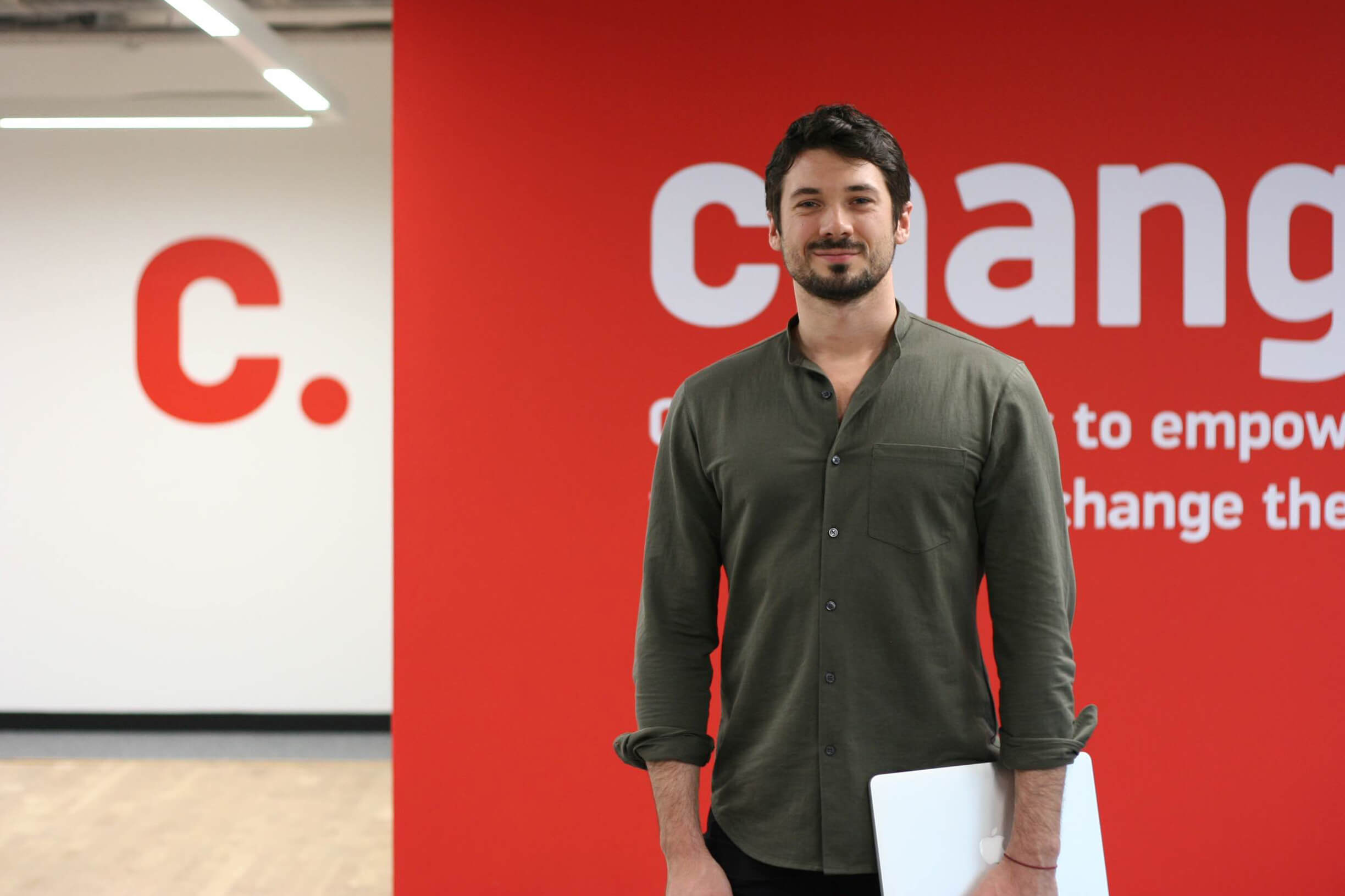
This was told by the director of the online platform for accommodating the Change.org petitions in East Europe and Central Asia Dmitry Savelov . The deputy editor of the greenhouse , Natalya Baranova, talked with an expert about what she managed to achieve in five years of work in Russia.
According to the expert, now around the world 180 million users of Change.org from 196 countries. In Russia - 12.5 million. On average, 500 thousand new users appear every month. In April 2017, 2.5 thousand petitions were created, and 687 thousand new users joined.
If in 2012, in the year of launch of the platform in Russia, there were only 13 victories, now there are more than a thousand. On a day, one petition achieves a result.
- Dmitry, how did user involvement have changed over the five years of the platform? What's new in the jurisdiction of campaigns?
- Five years ago - it was a completely new tool, now we are trying to explain to users the features of Change.org. This is a living community of people who are united around an important problem for them for a certain time. Change.org helps to formulate a new understanding of what it means to work together, involve journalists, experts, NPOs, officials. Over time, people began to use online tools more efficiently.
It used to be like this: a person creates a petition, if many signatures, the media notices it, they learned about history, and the petitions became successful. Now on the platform interesting and complex ways to organize people online.
For example, the campaign of Omsk Olga Rybkovskaya for the right to access relatives of patients, launched in the spring of 2016. She collected 360 thousand signatures. She perfectly built work with the signatures: she asked to tell personal stories, turn to officials en masse, and worked with the media. As a result, Olga not only achieved access to her relatives in intensive care, but also organized groups of psychologists and legal volunteers in different regions.
- What did the experience in Russia showed?
- In Russia, the site quickly grew to large scale. It seems to me that the main reason is the effectiveness of the platform. One petition is achieving results a day, and this motivates people to return to the site. Our platform increases the involvement of residents of the city in decision -making processes.
The experience of users shows that in different regions of Russia, you can achieve solutions to problems, uniting online, and not just going alone in different instances. For example, the Moscow journalist Vadim Kondakov created a petition to help the blind man from the Kaluga region. (It is called “Pull the blind from home hell” - approx. ) 180 thousand people supported him. He not only achieved new housing, but also organized a collection of funds for which they literally bought an apartment this week.
Olga Knor , a resident of Moscow, found out that cells with two exhausted bears were found near Samara. I created a petition, collected volunteers, money. As a result, the bears were saved. There are many such stories: people solve problems in other regions.
- How do private companies and state institutions react to the petition?
- The response from the addressees is active. At the end of 2016, we launched the verification of addressees on the platform - the companies themselves can register. We have registered Channel One, the Ministry of Health, Sberbank, MTS - a dozen companies. That is, if earlier the addressees of the petitions often responded through the media or directly, now they are conducting a dialogue on the platform, publicly with the authors of the petition.
More on the topic: 7 rules of effective social design
A great example is the campaign of Svetlana Lapina . 400 thousand people spoke out that Sberbank did not take from Svetlana, a disabled person of the 1st group, experiencing 4 stage of cancer, an apartment taken in a mortgage. Sberbank not only left housing, but also completely reviewed his insurance policy. We noticed that after that Sberbank began to work actively with other campaigns on our platform.
With private business, according to users, it is easier to work - it is sensitive to public things. And many petitions addressed to business are written in a positive way: we love this brand, but we want it to improve our policy.
- Do officials use the platform?
- Yes, there are examples when the deputies themselves write petitions. One of the recent examples - the deputy Lyubov Dukhanin created a petition for the opening of children's summer camps at schools and achieved the goal. Well, and constantly not only individual officials or politicians, but also entire parties support certain petitions on Change.org.
- What problems are most resonant?
- Rather, first of all, these are health problems, issues of access to drugs. For example, Svetlana Lapina, the one that has achieved from Sberbank a revision of the insurance policy, began a new petition for the right to get a very effective, but inaccessible drug for cancer patients.
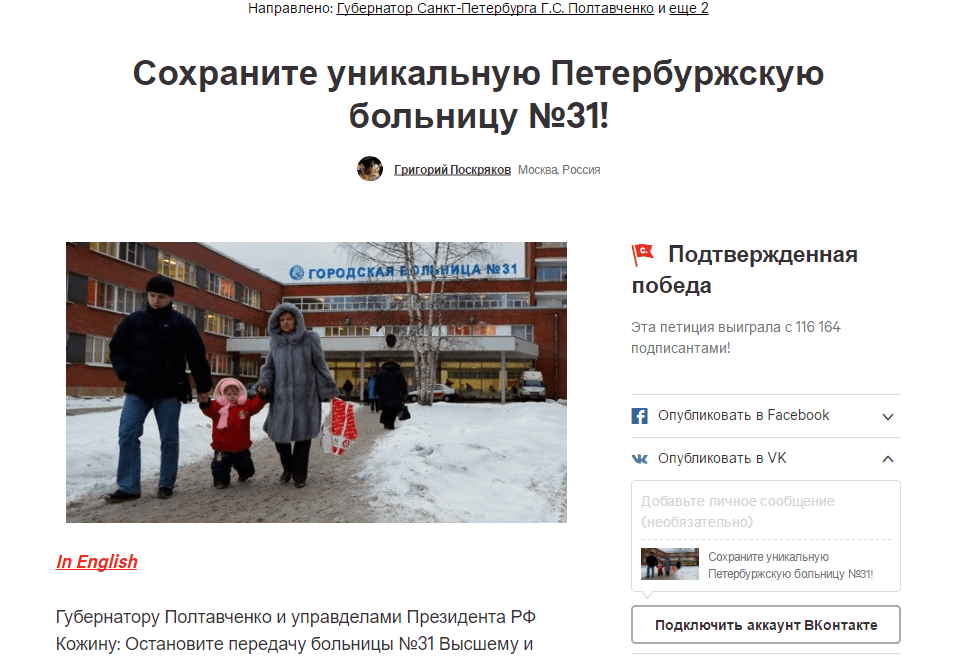
In 2013, there was a loud successful petition to save 31 hospitals in St. Petersburg. After it, a wave with similar petitions went in the regions - and several victories.
Then there were a number of petitions against the disbandment of kindergartens for children with hearing and vision problems. It all started with one kindergarten in Magnitogorsk, but people in other regions saw that there they managed to preserve treatment for children and this led to a number of victories in different regions. I have the feeling that this is how the community of people who support each other, for example, in health matters, grew on Change.org. In addition, the topics of animal rights are always popular, these are the most emotional petitions, consumer rights, human rights, education issues and culture and others.
- Let's try to make a collective image of a successful campaign. What must be taken into account?
-Firstly , in the petition it is important to state the essence of the problem so that it is understood by people who hear about it for the first time. Personal stories work well. On the platform, they definitely unite more people. All because it’s easier to feel the problem. Secondly , the addressee is clearly defined in a successful campaign. Until now, 70-80% are addressed to the president. It is clear that on most issues the decision is not made by him personally. So you need to determine the right addressee. This is a simple moment, but important.
Thirdly , the authors of successful campaigns involve their signatories. The petition is not the number of signatures. Behind each of them is a real person. At the end of 2016, we conducted a study, learned that 81 % of people who signed the petition would like to do something else to help the author. Help time, contacts, knowledge. This must be taken into account. And, fourthly , it is necessary to be able to work not only with signathers, but also with experts, the media, look for contact with people who make a decision on your issue, look for a constructive dialogue and be prepared for it.
- Is there any plans to introduce new functions for the platform?
- Now we are testing the new section "Communities" on the site. In it, people will be able to discuss further actions of the campaign. Now people can only comment on petitions, but we want to improve interactivity, develop a discussion. People will be able to communicate with the author, directly offer their help and discuss the ideas of joint actions.
We also work with the verification system of addressees. We want to improve this tool, make it easier to use. Also in the coming months we will release a guide for users on how to conduct a successful campaign.