
Translated material
What is good in Titian?
Until August 20, the exhibition “Venice of the Renaissance is operating in the PHMIA. Titian, Tintoretto, Veronese. From the collections of Italy and Russia ” , where you can see 23 paintings by the famous Venetians. A good reason to talk about the topic, why, in fact, a modern person needs to go to the museum and in what ways such art can be watched. By the way, on Saturday, August 5, a special tour of the exhibition will be held only for readers of Colta.ru. You can get to it here .
According to surveys, one of the things for which the spoiled Muscovite is still ready to stand in line is a visit to the exhibition . Of course, not contemporary art, but pillars of classical painting. Their names, wisely turned by museums into a brand, cause a huge stir and admiration - often thoughtless, automatic. Let us try to understand in peak a similar quasi -religious attitude, why Titian, Tintoretto and Veronese are still extremely relevant that they can give different types of the viewer and how, in fact, they differ from each other.
The viewer is thoughtful to remember: these three contemporaries-competing are not just a “business card” of the Venetian school. They created the standard of a picture that will affect directly or indirectly (as a struggle against his heritage), on the whole further history of painting. So we look at Titian and foresee Rubens, at Tintoretto - and predict El Greco, and then: Purussen, Bush, Engr and Delacrois up to complete allergies in the era of modernism. A curious exercise for visual erudition.
According to surveys, one of the things for which the spoiled Muscovite is still ready to stand in line is a visit to the exhibition.
This very standard consists in a special conceptual approach to mythological and Christian plots. And in the way, in an ideal proportion, mix beauty (but without the cold rationality characteristic of the ideal of Raphael and Leonardo) with sensualism and vitality. It is guilty of Venice itself with its forever festive atmosphere - therefore, canvases are filled with such a sense of joy of being, and therefore the flavor is so magical, full of golden radiance. The viewer, tired, but competent from the news of the modern economy, may try to imagine what a high level of GDP the state (the Venetian Republic) should have so that it can afford a similar level of vitality. Such as to produce such magnificent luxury items as these paintings, in huge quantities - from year to year. Moreover, by the forces of not one artist and not three heroes of this exhibition, but a much larger number of secondary masters. How many consumers exist for this luxury, this beauty?
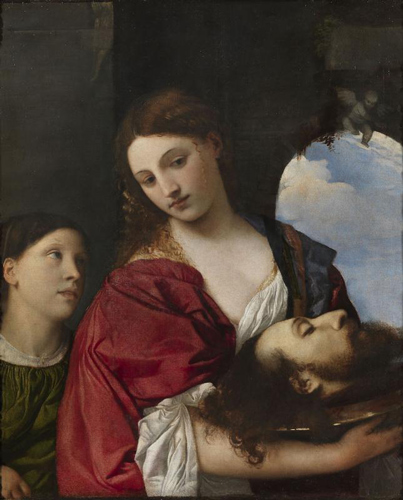 © 2017 Amministrazione Doria Pamphilj Srl Titian Vechellio. Salome. OK. 1515
However, they bought these paintings (as well as mirrors, books and much more) not only in Venice, but throughout Europe - that is, the republic acted both a global producer of values and a dictator of taste. Here we must stop and envy how much the artistic level was this “consumer goods”: Titian wrote about 400-500 works (depending on how to count), about 500 Tintoretto attribute about 500, and Veronese - about 400. And let we see many of them on the labels of many of them. Painting worked at the highest level.
Or maybe the point, on the contrary, is that the picture is easier to “become a masterpiece” if it hangs in a prominent place?
Let's go to personalities: the largest figure of these Venetians is, of course, Titian. He lived for almost ninety years and accepted Italian painting with Botticelli, and left her with Caravaggio. Such an age is a huge term for the master, and Titian has passed all the stages of the Renaissance: from silent serenity (Venus Urbinskaya, 1538) to the foreboding of cruel baroque (“Punishment of Marcia”, 1570-1576). And if you recall that it was this artist that was one of those Titans of the Renaissance that these stages determined, then his figure becomes especially majestic.
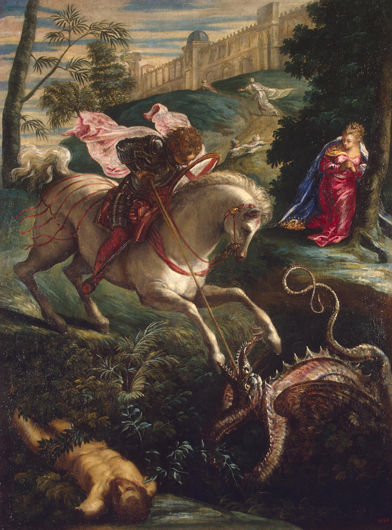 © State Hermitage Jacopo Tintoretto. St. George. 1543-1544
His evolution is fascinating both technical terms and psychological: not without reason, the late Titian resembles Goya with the negligence and gloom of his brush. By the way, a demonstration of Titian's heritage from the first years to the last is a great way to present, as a guru expressed from psychology, “a lesson in humility” to those who consider “old masters” always infallible and ideal. There are failures in his career, and failures, the periods are good and the periods are magnificent, as well as outright hack and commercial self -regulators of successful hits (sometimes very high quality). Even with his example, it is clearly visible that for some mysterious reasons, masterpieces are usually in the famous museums, and the little-known works that are stored in small museums are really not so remembered. Or maybe the point, on the contrary, is that the picture is easier to “become a masterpiece” if it hangs in a prominent place?
Pictures do not exist to just look, but also to think and read a lot.
Paolo Veroneza, his younger contemporary, is more so-so-so-so-so-so, preserving in a vennian cheerful view of the world throughout all creativity. The authorship of the paintings by Veronese and Titian, it happened, confused - however, with only one of the Titian periods, its golden middle, when playful eroticism has already appeared in the paintings, but depression has not yet slipped. The evenness of Veronese, his calm and, as a result, less glory in comparison with a violent colleague is another reminder that not everything is so simple. A reminder for those spectators who, measuring the creators in themselves, require them to be one hundred percent mental balance, as well as impeccable morality and morality. And then they are shocked and amazed at the navigations from Bunin ( 1 , 2 ), the mother from Pushkin or the Vrubel syphilis. Another way to look at Veronese is to see that he was better than Titian: it is multi -figure compositions. Titian did not write crowds, except in rare bacchanalia, but Veronese loved to populate many outsiders (including his contemporaries) even such secret rendezes as a secret evening. Moreover, he did it with ease and virtuosity, which would at least learn Glazunov at least a little (and it would be interesting).
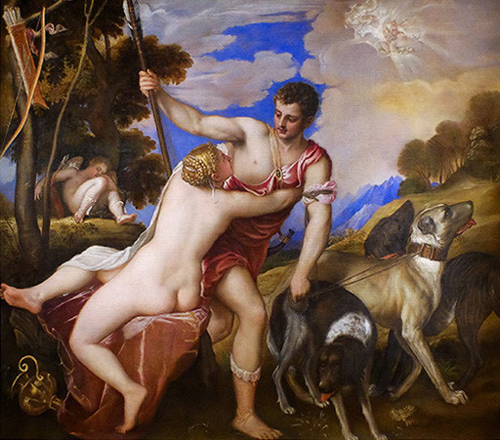 © Classic Foundation Titian. Venus and Adonis. About 1545 (copyright repetition)
Tintoretto was born ten years earlier than Veronese, but it doesn’t matter - in his development he went further, already to mannerism. Let the same spicy golden atmosphere be preserved in his paintings that Titian and Veronese have, let his naked beauties with Mila with the same butt of the same charm. However, it is clear that it was not for nothing that the artist received the nickname IL Furioso (“frantic”): so dramatic he wrote, so free, energetic, and sometimes even careless his smears (lovers of impressionism, follow the pedigree through Delacrois and Gerico). But we must understand that this is not the result of mood or senile weakness, like Titian, but already a consistent ideological position. Gestures and poses become more and more spectacular, saints do not soar, but soar with acceleration - a new era comes, a new stage in the history of painting. The Renaissance ends, and the combination of its three main Venetian masters at one exhibition is not just an unfolding panorama of art, but a comparison and contrast, a reminder that the paintings do not exist to just look, but also to think and read a lot.