
Translated material
Underdrew | Colta.ru
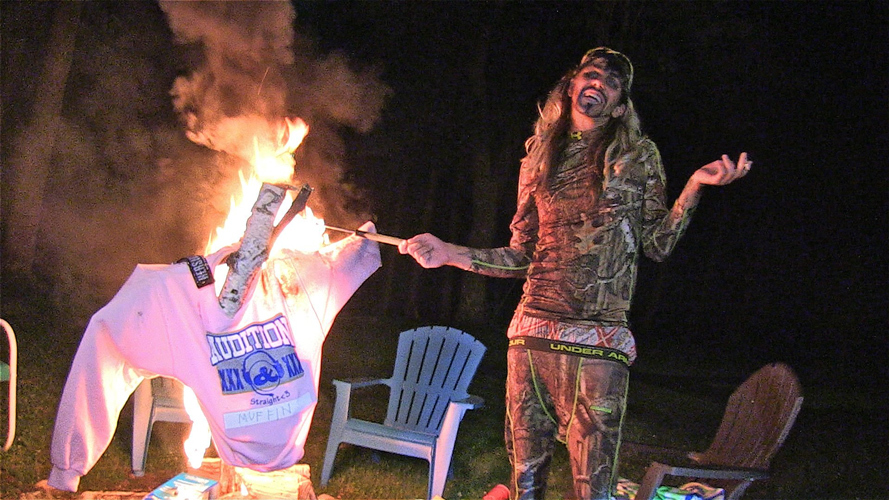
During September, three Biennale, different in age and history, opened in Russia. A week after the IV Ural Industrial Biennale, the VII Moscow Biennale started in Yekaterinburg. Since the middle of last year, storms have not subsided around this exhibition. Both the change of leadership , and the mysterious way of forming the expert council , and the change in the venue of the Biennale (they eventually became a new Tretyakov Gallery), and the ambiguous presence in the list of participants in Dasha Namdakov , were discussed.
Claims ( 1 , 2 ) have been repeatedly presented to the Moscow Biennale, but over the past year the critical attitude to this initiative for Russia has reached a record level. In such a situation, the constant delays with information on the exhibition only heated the situation, and the critics and in general in the art community were far from rainbow expectations and moods. One can imagine what the psychological state of the Japanese curator Yuko Khasegawa, who, faced with such circumstances, could simply be confused, which would have entailed a complete collapse. But, despite the serious, if not large -scale, technical and logistics problems at the opening of the Biennal, she was still able to create an exhibition that corresponded to both the original concept (quite interesting, I must say), and its own curatorial strategy, which has long developed.
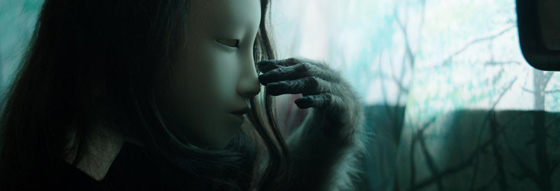 © Courtesy: The Artist, Hauser & Wirth, London, and Anna Lena Films, Paris Pierre Yuig. Without the name (human mask). 2014
Back in the very beginning of the 2000s, Khasegava outlined the circle of her interests. First of all, this is work in the border zone. The first great statement of this kind was the VII Istanbul Biennale (2001), where the curator placed the project on three whales: collective consciousness, collective mind and coexistence . The very place of its holding - a city located on the border of cultures and continents - was supposed to contribute to the imposition of contexts and human destinies. In 2013, at the XI Biennale in Sharje Hasegawa, she advocated for the “new cartography” ( 1 , 2 ), also using context and geographical location. Emirates as a new place of assembly of socio-economic reality turned out to be an excellent basis for the curatorial concept. Labor migrants from South and South-Western Asia, Western expans and party-made arts from the art world meet in the Middle East, where, in addition, a strict way of life is encountered, based on religion and traditions (Sharja is the most conservative of the emirates), and the modern world “without borders”.
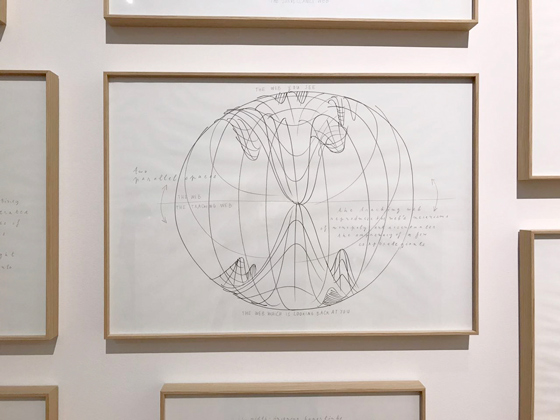 © Louise Drulhe Louise Dryul. The critical atlas of the Internet. 2016
At the current Biennale in Moscow, Khasegawa, in fact, did not need to be invented. She simply drew further the lines with which she had previously worked. The theme of the main project, which sounds not quite accurately-“sky-high forests” (in the English version- Clouds ⇄ Forests ), reports the central thesis of the curatorial idea. Due to inaccurate translation, many had the impression that the exhibition is about nature and ecology. And although nature is quite clearly present here, it is not a decisive one, rather, it is a metaphor and material for talking about today's society-not only in general, but also specifically Russian. Yes, the story shown by Khasegava is quite relevant for us, although, as will be said later, the curator stopped where they were expected from a logical continuation.
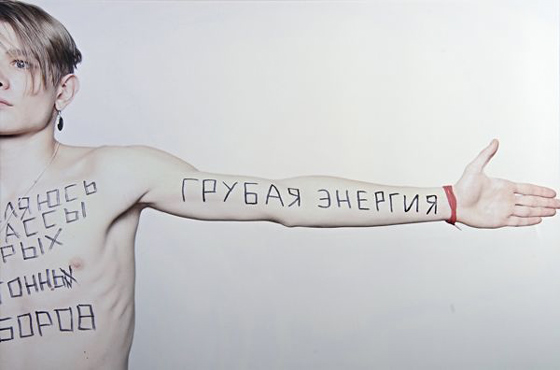 © Alina Gutkina Alina Gutkina. From a series of photos "I am." 2010
This is a recognizable confrontation: “clouds”, meaning a new, (post) digital, generation that does not want to look back, dismisses the rest of society, considers it a brake - and “forests” symbolizing people who are trying to fenced off from the inevitable transformations that occur around them and, more importantly, as if they were denied these changes. If you come to the exhibition itself, it is clearly visible that the works that would directly demonstrate these social perturbations and describe the above human groups are not so many. After all, if the curator wanted to be directive, she would simply write a large article or a book where she would have outlined her thoughts on the current state of the world, or take part in a specialized initiative at some activist festival, there are such benefits in Russia. However, first of all, she made an exhibition - a complex structure, which ideally, the presence of complex conceptual transitions and spatial rhymes.
Ryan Trekartin. Signer craft. 2016
That is why the two videos of the Swiss artist Uriel Orlov about how the “Western” type of knowledge literally prohibits the worldview of Africans, expressed in traditional medicine, a clear anti- and post-colonial statement, filled with sympathy for rather dubious practices, is adjacent to the exhibition with the works of the American Ryan Trekgraduate, which built her artistic career, On the contrary, on the promotion of everything new, from changes in gender roles to modern visual culture, which the farther, the more incomprehensible in the "forests", it simply can not be stored behind it. As for Russian artists, Alina Gutkina’s photo project about the “boys” seeking to break out of the bad infinity of sleeping areas, is located within walking distance from the room with the works of Ilya Fedotov-Fedorov, where the viewer is invited to contemplate the bead wands, which clearly refers to the traditional view of the world, only outdubitors. Some of the works were brought straight from the last Berlin Biennale , while others - like the same Dasha Namdakov - were taken from the thick -phase thickness of Russian reality. There are no right and guilty, progress or obscurantism for Yuko Khasegava - the curator looks environmentally and neutral at everyone.
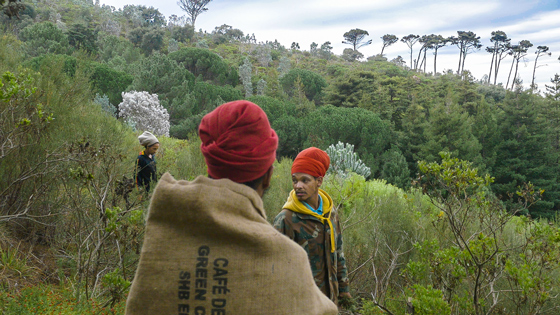 © Uriel Orlow Uriel Orlov. Muti. 2016
This position, with all its peculiar equalizing justice, cannot but cause well -deserved criticism, given that it was in modern Russia that the conflict of “clouds” and “forests” went quite far and starting from the trial of Erofeev and Samodurov , and later the situation around Pussy Riot , not to mention the latest cultural and political battles in public battles, acquired the nature of an ineffective disease. Such a dead end state can hardly be resolved peacefully, just to be removed, the most important battles of our society have yet to survive - or not to survive. According to this point, Khasegawa does not even have an approach to all questions that are exciting, not like answers.
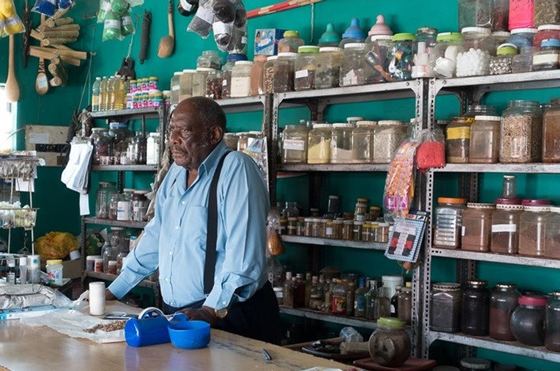 © Uriel Orlow Uriel Orlov. Muti. 2016
The Biennale exposition is built as a change of day and night - this is a series of dark and lit halls. In this design, it is not difficult to assume based on the above, there is no direct reference to the “forests” and “clouds”. This is a parallel story, which, on the one hand, is due to transitions from video works requiring darkening, installation, painting, graphics and photographs that need lighting, but, on the other hand, in such additional zoning of the exposition - the ideas and ideas of the curator and organizers, which could be shown that the entire presented material could be shown an alternative way. Transferring, offer a more intelligible picture of today's day. All the ingredients are available, but unfortunately they could not be mixed in the right proportions and correctly.