
Translated material
The turn of the oligarchs. Russian businessmen are preparing for personal sanctions
The richest people in anxiety are waiting for February 2018 - they hire lawyers, use lobbyists and contacts in Washington, fearing US personal sanctions. In the risk zone - “oligarchs”, which are not included in the traditional circle of “friends” by Vladimir Putin.
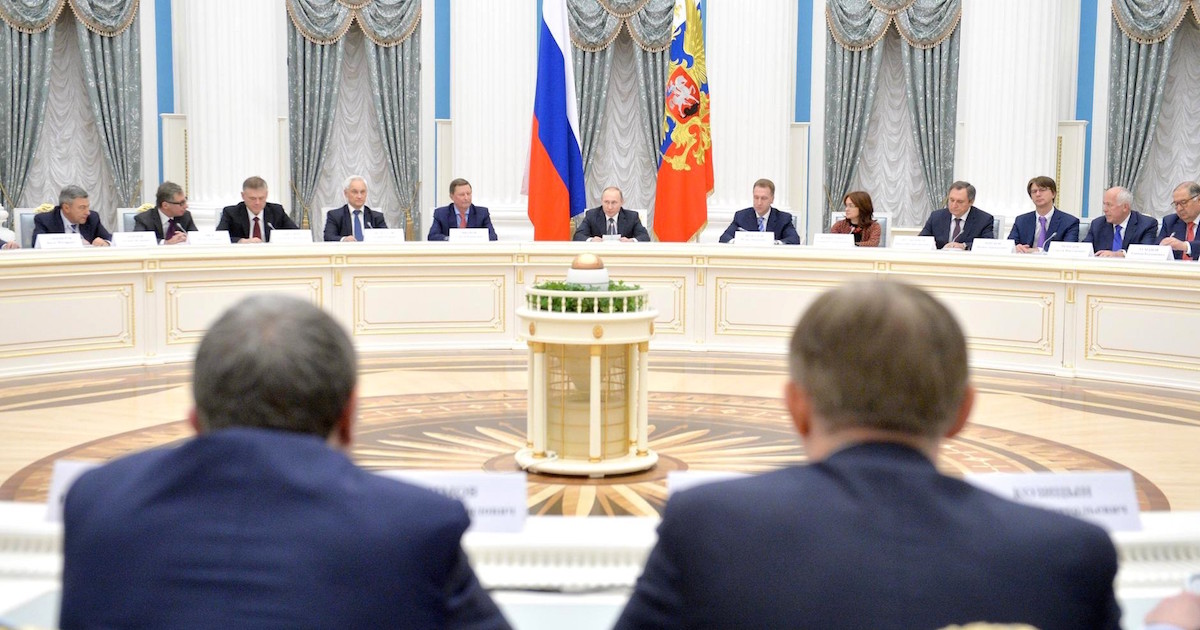
Meeting with business representatives in the Kremlin in 2015. Photo: kremlin.ru /( cc by 4.0 )
The basis for the alarm of the Forbes list participants is the Law “On Countering the opponents of America through sanctions” ( Caatsa ), which US President Donald Trump signed on August 2. Under the opponents, it means Iran, Russia and North Korea. The law states that within 180 days, that is, by about February 2018, the US Department of Finance, together with the Director of National Intelligence and the Secretary of State, must submit a detailed report on Russian “oligarchs” and senior officials involved in foreign policy in the relevant committees of Congress.
Once in this report may threaten the introduction of personal sanctions, follows from the document. Usually they provide for a ban on entering the territory of the United States, freezing assets and a ban on doing business with American citizens and companies.
Who is at risk?
We talked with a dozen Forbes list participants. Almost all of them are aware of this provision of the law and admit that they are extremely preoccupied with how not to be in the impending list. To make certificates about what is happening, you have to fly to Washington, one of the interlocutors of The Bell said. But so far no explanations have been received from the American authorities. “Nothing is clear: no one works on these sanctions, no one draws up a sanctions list, nor any criteria or sources of information that forms the basis in it,” the interlocutor of The Bell lists. Even local lobbyists cannot find out this, according to him.
Specific surnames in the law are not mentioned. Between themselves, businessmen discuss that Oleg Deripaska is most at risk of being sanctions - the American authorities have accumulated many questions, the most relevant of which isthe connection with the former head of the headquarters of Donald Trump Paul Manafort. Representatives of Deripaska did not answer the request of The Bell.
Also at the risk zone there may be Alfa groups and its shareholders led by Mikhail Friedman. The group is mentioned in the scandalous dossier of the former British intelligence officer Christopher Steel, which was published last year in BuzzFeed. It says that Alpha allegedly carried out Putin’s instructions and contributed to interference in the American elections. Now the co-owners of the Alfa Group are sued with the publication and the customer of the dossier, demanding that the information that does not correspond to reality.
Representatives of Alisher Usmanov and Roman Abramovich, whom the media was often called one of the closest businessmen to Vladimir Putin, refused comments.
Not only businessmen from the first dozens of Forbes list are nervous - it was enough to at least once end up in the media, for example, in the ranking of large state -owners, and now you can no longer sleep calmly, the assistant to one of the businessmen explains.
In the administration of Barack Obama, the coordinator of the sanctions policy of the US State Department, an expert at the Washington Atlantic Council, Daniel Frid , could answer the Barack Obama. But he resigned immediately after the elections, and as of July, his position was vacant. “With whom to consult now is, in principle, it is incomprehensible,” says one of the participants in the Russian Forbes list.
“I perceive this in such a way that the Americans signal us: figure it out there yourself with your Putin, but do not go to us,” adds another interlocutor The Bell.
The Russian authorities are well aware that large businesses may have problems. Vladimir Putin gathered all major Russian businessmen one and a half to two years ago to warn them about the risk of personal sanctions, two participants in that meeting said. Even then, Putin assumed what everything was going on and advised to be outlined if possible, says one of The Bell's interlocutors. Putin’s spokesman Dmitry Peskov did not answer the questions of The Bell.
What threatens the oligarchs and their business?
From the text of the law signed by Trump, it follows that by February the American authorities should:
- Determine the circle of senior officials involved in foreign policy and oligarchs close to the Russian authorities;
- To establish in what relations they are with Vladimir Putin and other representatives of the Russian ruling elite;
- Find out if there are signs of corruption in the actions of these persons;
- Assess the size of the conditions and sources of income of these persons and members of their families-wives, children, parents, brothers and sisters (including assets, investments, any other business interests and significant shares in any companies);
- Determine if they have business communications and assets outside of Russia;
- To evaluate the potential effect of imposing sanctions against the “oligarchs”, state and semi -state companies on themselves, the economy of Russia, the USA and their allies.
- Finally, the law has an order to evaluate the possible effect of the introduction of secondary sanctions against the Russian “oligarchs”. And this is a very serious measure. Secondary sanctions mean restrictions that apply beyond the US borders - to third countries (if you fall into such a “black list”, you cannot, for example, find funding not only in American, but also in European banks).
The introduction of sanctions against a particular businessman does not mean that all his business is automatically under sanctions, explains Ilya Rachkov as the Department of International Law, the Department of International Law, MGIMO. But most often, personal sanctions and sanctions against companies associated with one person or another go hand in hand. In any case, for any major businessman, getting into “black lists” bears huge risks. Firstly, the American and European authorities in matters of sanctions are trying to keep up with each other. Secondly, in the case of secondary sanctions, the US authorities are strictly monitored by their observance around the world and violators threaten large fines.
Office of Foreign Assets Control ( OFAC ) is responsible for compiling sanctions lists. It was this agency in 2014 that included Gennady Timchenko, Arkady and Boris Rotenbergs and Yuri Kovalchuk in the SPECIALALLY Designed National DESGNATED List , motivating this because they are “President Putin’s personal circle”. Later, many other Russians were added to them, including, for example, the head of Rosneft Igor Sechin.
OFAC can independently expand the list of restrictions, practically not coordinating its decisions with anyone. Here are just a few facts about this department (in 2014, RBC wrote a large text about him):
- The agency can freeze American accounts, limit foreigners and foreign organizations access to the US financial system and ban American banks to cooperate with any financial organization in the world;
- Bypassing sanctions threatens with serious fines;
- Once on the “black list” OFAC, getting out of it is extremely difficult. There is no clear appeal of such a decision - you can file a complaint, but OFAC has the right to simply ignore it.
- To freeze the accounts of the former Libyan leader of Muammar Gaddafi totaling about $ 30 billion, OFAC in February 2011 needed only 72 hours.
How are they preparing?
“You won’t prepare for this,” one of the participants in the Forbes list sighs. But several interlocutors say that they work tightly with lawyers. Law firms themselves are also touring with master classes . But nothing particularly comforted lawyers say, one of the interlocutors of The Bell admits. The most reliable way consultants call a divorce from his wife with the execution of assets on her, he says.
The most loud similar story lately is the separation of Roman Abramovich with Daria Zhukova. Officially, the couple announced this on August 7 (five days after the signing of the law), but the decision was made much earlier and was not related to sanctions, the source surrounded by Abramovich claims.
Yesterday it became known that in October, the owner of almost 7% of the shares of the EN+ holding (owns UC Rusal and energy assets) Oleg Deripaska became his wife Polina. The package is estimated at $ 500-600 million. This transaction is not connected with possible sanctions, also approves the acquaintance of Deripaska. Whether it has a relationship to the matrimonial status of spouses and what he is now is unknown.
Another option is the sale of assets. More actively, the owner of ONEXIM Mikhail Prokhorov has recently been engaged in this recently. True, he began to leave various businesses last year. Prokhorov sold the next 7% of the shares of UC Rusal on August 10 - 8 days after the signing of the sanctions law Trump, and recently - decided to reduce it a little more (the businessman did not respond to the Bell request).
Is there a chance that there will be no sanctions?
Last week, Trump began to transfer individual powers to implement this law to various departments and executive bodies (the Regulation on the oligarchs has not yet been painted). At the same time, two senators - Ben Cardin and John McCain - turned to Trump and his administration with an appeal "to realize the law in the most full."
Irina Malkova, Svetlana Reuters, The Bell