
Translated material
"Tsar Peter Alekseevich"
On November 1, the fifth book of the Cycle of the Russian State is published in AST. Today in "New" is the first publication
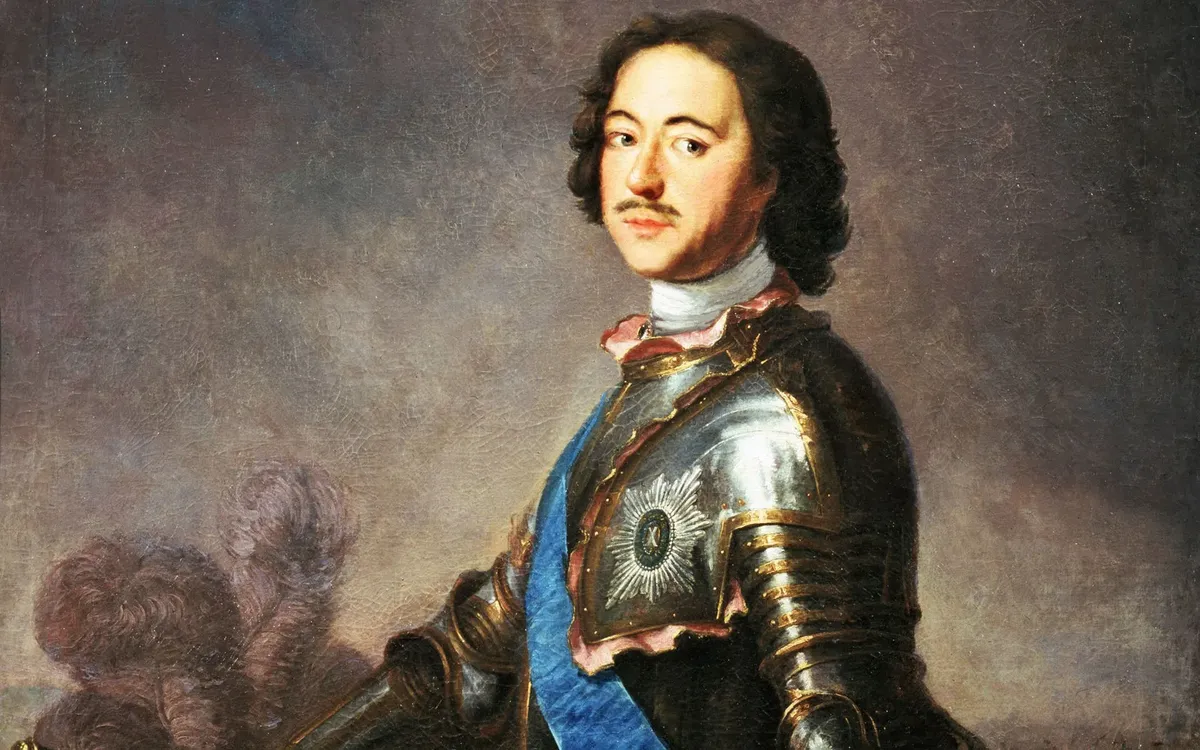
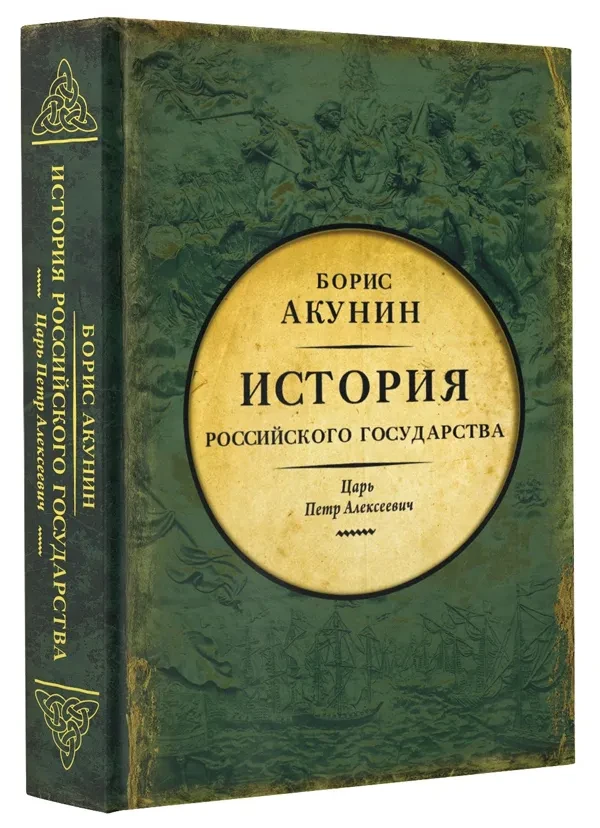
The period described in this book is very short, even shorter than the reign of Peter I (1682–1725), because at first the monarch ruled only nominally, and the events of those years were set out in the previous volume. However, the thirtieth anniversary, during which Peter Alekseevich conducted his transformations is of great importance. It determined the subsequent fate of the country and significantly influenced the course of the world, primarily European, history.
A very significant reconstruction of the Russian state occurred, moreover, not as a result of the national disaster, as in the fifteenth century after the Mongol yoke or in the seventeenth after the Troubles, and due to consciously implemented reforms. This experience deserves a careful study.
The reconstruction of the state was caused by the causes of completely objective (imperfection of the previous model), but in its course a lot of subjective, coming from the personality of the person who initiated and headed this process is traced, and since the personality was quite bizarre, the era was equally colorful.
Writing about Peter and his time was very difficult. We have four major historical figures, the attitude to which is painted with strong emotions: Ivan the Terrible, Lenin, Stalin - and Peter the Great. Not only historians are passionately arguing about these rulers.
Each name here is a symbol behind which there is a certain ideology and its own view of the state system.
Because of Peter, they broke and break less copies than because of the other three, but the more often they refer to him, put as an example and edification. We are usually admired by this ruler, they are honored and loved, but there was never complete unanimity here. Yes, most authors evaluate the first emperor with a greater or lesser degree of enthusiasm, and there are very few those who refuse to recognize Peter the Greatness - but still they are, including those from which you will not dismiss.
I will give two polar grades. They belong not to scientists, but to the writers, the greatness of each of whom - if we talk about greatness - is not inferior to Petrovsky.
The reverent and recognition point of view of the majority is reflected in Pushkin’s textbook lines:
An autocratic hand
He boldly sowed the enlightenment
Did not despise the country's native:
He knew her purpose.
Either an academician, then a hero,
Either a sailor, then a carpenter,
He is a comprehensive soul
On the throne there was an eternal worker.
But in Leo Tolstoy, Peter's figure causes disgust and horror: “The raging, drunk, rotten, rotten beast destroys people for a quarter of a century, executes, burns, burns the living in the ground, imprisones, courageous, drunk, drunk, herself, amusing, cutting his heads, blasphemous, rides with the likeness Detail members and likeness of the gospels - a box with vodka praises Christ, i.e. Curses over Veroy, crowned B ... his own and his lover, ruins Russia and executes his son, and dies of syphilis, and not only does not remember his atrocities, but until now they have not ceased to praise the valor of this monster, and there is no end of all kinds of monuments to him ”(the famous fragment from the draft to the story“ Nikolai Palkin ”).
The valor of Peter really praised at all times: under the monarchy, and in the USSR, and in post -Soviet Russia. The fact is that this ruler impresses both of the haunting camps-both “statesmen” and “liberals”, but very differently. The first king likes as the creator of a powerful military power, the second - as a Wester, who turned the country face to Europe.
In the Russian mass consciousness, the image of Peter the Great is firmly formed by the same novel by another Tolstoy, Alexei Nikolaevich.
This remarkably talented work shows the king a patriot and a bearer of high plans, but in an earlier story, the same author depicts the king completely differently - a rude, ridiculous, rash -like tyrant: “What was Russia to him, the king, the owner thought about good when he was distorted from anger and impatience with his face jumped out of Holland to Moscow.” When the other “master”, Joseph Stalin, ordered the whole country to love Peter, changed his point of view and the writer, but it is difficult to say how he, who studied historical documents well, treated the emperor in fact.
I must say that before the start of work, my own idea of the historical role of the reformer was close to Pushkinsky, but I decided that I would renounce all previous knowledge and I would get acquainted with Peter Alekseevich as if again, mainly relying not on the judgments of historians, but on sources, the benefit of them is more than enough. There are documents and numerous evidence of contemporaries. Peter - the first Russian monarch, which was opened for wide communication, spent a lot of time abroad and was interesting to everyone . For the first time, Russia was also interesting for the world, which in Europe had almost no attention in Europe. A lot wrote a lot about the amazing king, especially foreigners. There are Russian memoirists, of course, less free in their judgments, but better understanding the essence of what was happening. These voices are contradictory, but in their aggregate they give a complete and convex picture of the era.
Entering, I will say that as a result of this abundant reading, my ideas about Peter and my understanding of the essence of his activities have changed significantly, but I will state my conclusions in the very last, final chapter, and it is very possible that the reader will not agree with them.
It remains to explain how the book works. Those who read the previous parts of my “history” already know that the principle of organizing material from Tom to that changes. Each historical period has its own specifics, and it is more convenient to conduct a story applied to these features.
There are four sections in this volume.
The first is completely dedicated to the figure of Peter. Without knowledge and understanding what this person was, it would be difficult to understand why events went this way and not otherwise. The circumstances of his personal life, character traits, the mental structure, the system of views, addictions and phobias, even the state of health - all these seemingly, in particular, had a considerable influence on the life of the country, and some of them have become part of the national matrix and are today perceived by the world as something in the original Russian. If Russian literature “left the Gogol's overcoat”, then about the Russian state we can say that it is still rewarding Petrovsky boots.
The second section is called "Events". This is a consistent, chronological presentation of the reign of the reign, divided into 13 temporary nodes.
The third section is thematic. In it, the main directions are isolated in which the life of the country changed during the reconstruction.
Finally, the fourth section gives a group portrait of the members of the Peter's “team” - associates and assistants, without whom the sovereign would not carry out any of his large -scale plans. All these people are strong, bright, children of their era and at the same time its creators.
This book is generally about how the ancestors learned not to follow the story, but to create it, how something they did, but something does not. And why.
Upbringing. Chapter from the book
In general, he didn’t receive any education as such - if you mean by education the conscious and responsible preparation of the likely heir to the throne for the highest power.
This omission cannot be attributed to the primitiveness of the then pedagogical representations, because the previous kings, Fedor and Alexei, at the dawn of life, were held very good at that time, who made them educated (albeit in the Staromoskovsky understanding) people and taught the “royal craft”. But Peter's adolescence passed in a very specific environment, when no one seriously engaged in them and even the modest wisdom of the Russian seventeenth century was taught the boy badly.
However, the early childhood of Tsarevich did not foresee any deviations from a long -developed order. The fourteenth child of the sovereign Alexei Mikhailovich was born on May 30, 1672.
The impressive large childhood monarch (he will have sixteen offspring) is deceiving. To continue the dynasty, only male offspring, surviving children's age; By the time of the birth of Peter, the king had only two of such sons, and both are very unhealthy - as they say, “not tenants”.
The third son was born strong, and one could hope that he would survive. In the Kremlin, from great joy, they called the bells for three days and fell from guns.
Peter continued “normal royal childhood” for ten years, while his father, who died in 1676, ruled, and his elder brother Fedor Alekseevich, who had stolen all his short life and died in the spring of 1682.
At the age of five, as expected, the little prince began to teach the alphabet, the Chasoslov, Psalms, and the Gospels. The grinding Nikita Zotov taught, who seemed to cope with his own business poorly - it is not surprising when taking into account the subsequent career of this subject in the very most allless and crazy cathedral. Zotov was a worthless man, a big drunkard. He could not teach his ward even a competent letter. For all the conventional of the then spelling, the royal notes looked monstrous. “He writes it is impossible,” V. Klyuchevsky complains, “does not comply with the rules of the then spelling, hardly displays letters, does not know how to separate words, writes words by reprimand, between the two consonants now and then suspects a firm sign:“ All -out ”,“ Sitter ”,“ Vyuf ”.
The handwriting was even more terrible, the purity of which was then distinguished by an educated person. In Petrovsky Karakules, completely unreasonable, only specialists can figure it out today. Perhaps, in the future, the prince would be more lucky with teachers, but in May 1682 a radical fracture happened in the boy’s life: he was declared a Russian autocrat, at first solely, and after the Streltsky rebellion, along with his brother Ivan.
I will not retell these political perturbations described in detail in the previous volume. Now they are interested in us only from the point of view of Petrovsky education and education. The first was catastrophically distorted; The second actually stopped.
There are several reasons for this.
Firstly, the status of the monarch, let the nominal, assigned serious, mainly ceremonial duties on the boy and forced others to treat him differently-some kind of, and the sovereign. Secondly, the position of Peter after the seizure of power by Princess Sophia became fragile and ambiguous: the ruler and her environment perceived Peter as a threat. The more inextricably and, so to speak, the “younger king” remained stupid , the less foundations were to be afraid of him. Sophia and her favorite Vasily Golitsyn relied on the "senior king", the legally incompetent Ivan, and the courtyard of Peter was touched and deprived of money; There were no good educators and teachers that could not have obtained sensible, sensible people, from which there were no good educators and teachers.
There was another interesting feature here. In that era, men seemed to be seasoned with everyone, but Peter grew up in a world where women dominated. The country is the rule of Tsarevna Sofya Alekseevna, the head of the opposition was Tsarina Natalya Kirillovna. The men of both parties were subordinate. In adulthood, Peter will be completely deprived of the usual mizoginia for the old Rus', will release women from the locked tower, will treat them as equal, and he will elevate his chosen one to the position of the ally, giving start to the coming “eyelid of women”.
Little Peter was entirely in the care of his mother, the Dowager Tsaritsa Natalia, and her relatives of the Naryshkin, who completely did not care about teaching the boy. By this time, the initial stage of study was just over, at which Peter was very least mastered by letter, scripture and church singing. Further, according to the already established order, he had to switch to the care of the monks of the Kyiv school, which would teach him grammar, rhetoric, philosophy, dialectics, as well as Latin, Greek and Polish - this is how, according to the Western Russian system, his older brothers and sisters studied. However, to comprehend all these wisdom to Peter was not destined. As S. Platonov writes, the king remained "unequal and ignorant." Get the boy a standard “Slavic” education, it is unlikely that he would have been drawn so eagerly to Europe so eagerly, but instead of Greek-Kyiv scholastic scholarship, Peter will be carried away by another system of knowledge-German, pragmatic. This will determine the direction in which his brisk mind will develop.
The “uncles”, that is, the educators of Peter, at that time were the brother of the queen Lev Naryshkin, another relative - the Okolnichy Tikhon Streshnev and Prince Boris Golitsyn. The famous memoirist, Prince Kurakin, who knew the life of the tsarist court well, gives all three unflattering characteristics: the young Lev Naryshkin (eight years older than the pet) “is unconscious of drinking” and “much intermediary mind”; Streshnev is a palace intrigue and also inanimate; Golitsyn, though smart, but a drunkard and "to indirect affairs, loved fun." We will see how helplessly the Naryshkin party will show itself after 1689, when he receives power over the state.
Being in the care of this trinity, the royal lad was generally left to himself: he was only engaged in what he fascinated, and studied only that caused curiosity.
The interests of the young king were limited to two areas - he loved military games and mechanical devices.
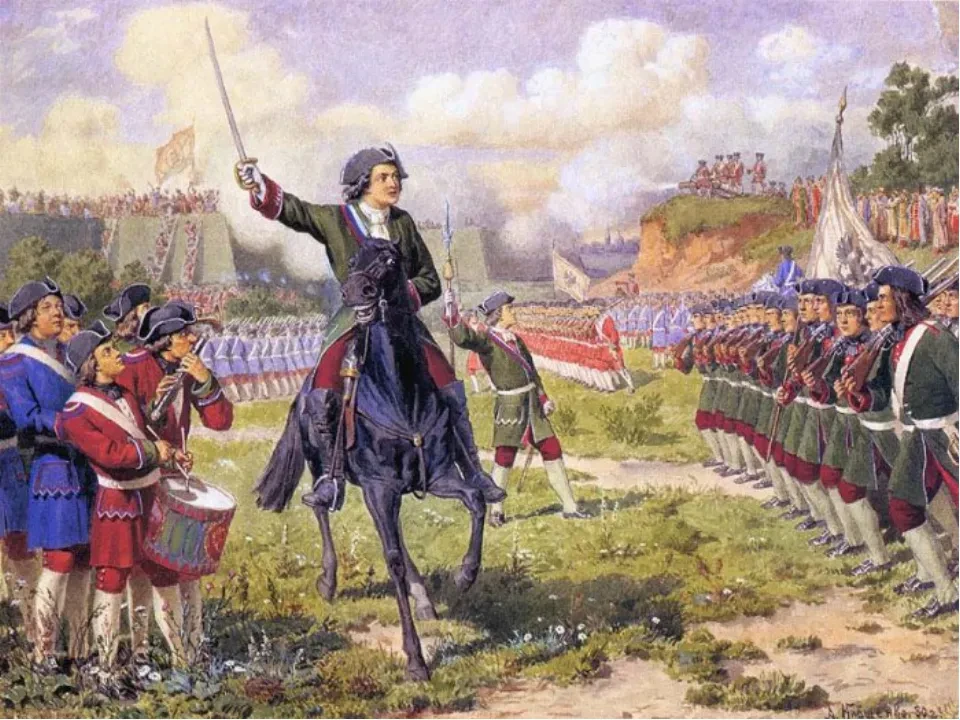
Documents have been preserved on which you can restore the gradual evolution of the interests and requests of a boy, teenager, young men. At first, a toy weapon was purchased for him, then the present, then the turn came to a more serious equipment. The ten -year -old king had a “funny” platform with wooden guns, where he played in the war with “amusing guys”, his peers from the children of the palace servant. But a year later, in the village of Vorobyov, Peter begins to fade from real guns. At thirteen, he builds a small fortress with towers and a lifting bridge on Yauz, it is called Presburg - therefore, at this age the king already loves everything German. The "guys" are growing up, there are more of them, the score is already going on hundreds. Part lives in the Preobrazhenskaya Sloboda, part in Semenovskaya - this is how two future guards of the Russian army arise. These live toys learn to march, blow in pipes, beat in drums, arrange shooting.