
Translated material
Parvus is lonely white
Conspirology and anti -Semitism in the anniversary television series "Demon of Revolution" and "Trotsky"
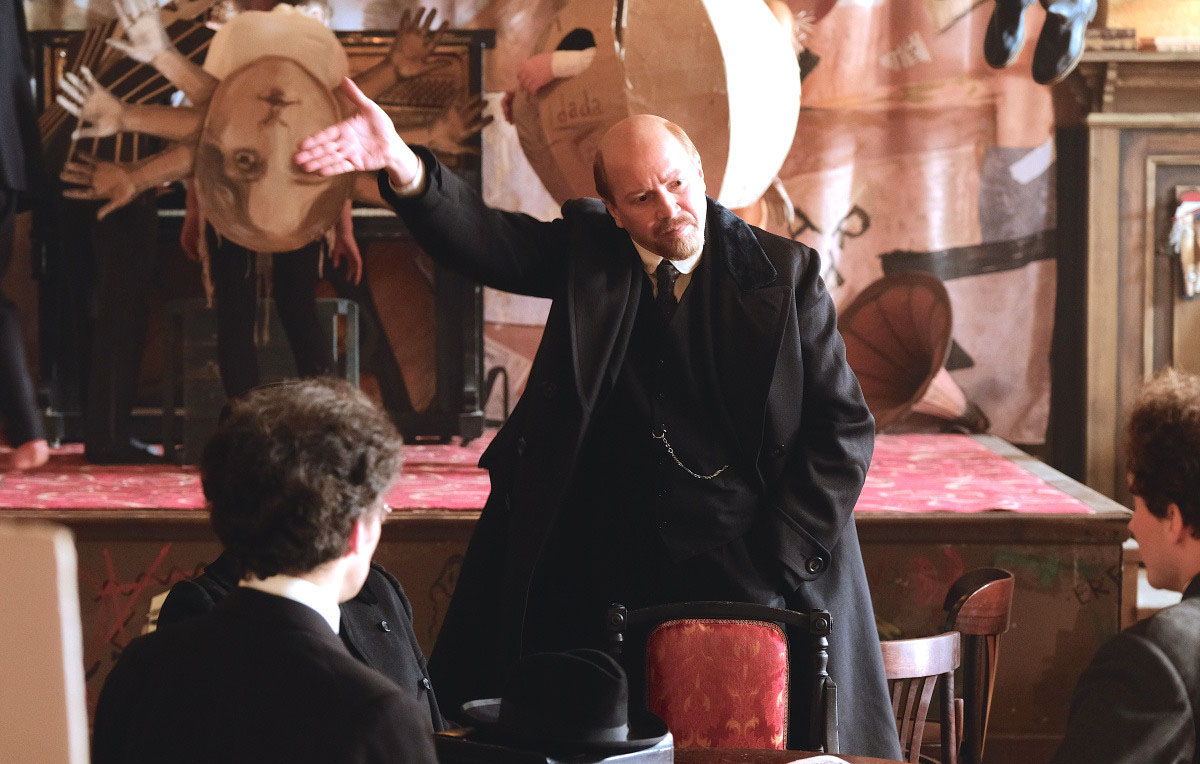
*Frame from the series "Demon of the Revolution". *Photo: kinopoisk.ru
Discussing the November fireworks of pseudo -historical series about Lenin and Trotsky on the main television channels of the country, the main thing is not to become like Natalya Poklonskaya and its associates and not to start discussing feature cinema in terms of his correspondence of historical truth. In order to find out how everything really was, you need to read serious historical research, and as much as possible, the series here will not help in any case. The artist has the right to come up with any reality, and television is also show business, that is, the idea should be simple, entertaining, scandalous and spectacular.
Nevertheless, the series discussed are not copyright cinema and not pure show business at all. In the decorations of the conditional past, the creators of the series, not particularly masking their intentions, filmed theses from the actual Kremlin dungeon, filling its dry lines with poster brightness.
What is there, in this dungeon?
Conspiracy against Russia
The series “Demon of Revolution” and “Trotsky” - attempts by the language of the movie to illustrate the conspiracy concept of the history of Russia, and so annoyingly and straightforward that it is even inconvenient for authors and actors.
In the fantastic universe of the series in question, tsarist Russia has no objective difficulties. Its main problem is not a war, not a land issue, not the managerial mediocrity of the elite, but a handful of emigrants, which is manipulated by one particular person-Alexander Gelfand-Parvus. He takes money from the Germans and gives it to the revolutionaries, and they balamot the people, and because of this, a revolution happens. That is, if there were no Parvus, the Western special services and piles of revolutionaries behind him, then there would be no revolution, in any case, both series bring us to this thought.
In the decorations of the conditional past, the creators of the series, not particularly masking their intentions, filmed theses from the actual Kremlin Temnik, filling its dry lines with poster brightness
In fact, this is not a conversation about history, but the continuation of all talk shows on federal channels, and the pathos of the authors is quite obvious: any discontent with the government has one reason-another parvus gave money to the next Lenin and Trotsky, then they somehow cunningly shaved naive simpletons and people who were confused in life, and the money was clearly received from the special services of enemy states!
Money generally really excites the creators of these series, and they cannot, and they do not want to hide their reverence for thick packs of bills.
At the beginning of the 20th century, Parvus tells his customer, to some conditional German figure that a lot of money needs a lot of money to organize a revolution. And the mustachioed German immediately takes out a thick package of money from his pocket and gives them to the petitioner. And such a scene there is not one - money is most often shown precisely in the form of packs of cash, which through secret channels flow to Russia: “This is not a brook, this is an avalanche!” - proudly tells the counterintelligence a revolutionary in the series “Demon of the Revolution”, answering a question about the money found in the packets tied with ropes.
In fact, this is not a conversation about history, but the continuation of all talk shows on federal channels, and the pathos of the authors is quite obvious: any discontent with the government has one reason
In this universe, everything is done exclusively for money and for their sake. Moreover, for money you can not only make a Jewish young man the leader of the social democratic movement, but even organize a revolution in a large country. A sign and characteristic scene: Parvus says to Trotsky: "I" made "Gorky, I will make you too." That is, no one in itself costs nothing, no one has any beliefs and talents, someone “made” everyone, “promoted” everyone for money. The fact that Gorky was a gifted writer without Parvus, and Trotsky already had the experience and reputation of the revolutionary by the time of acquaintance with Parvus - is missed. We are again presented with a wretched thesis: all opposition politicians are someone’s projects, you just need to find who gives them money, and everything secret will become clear.
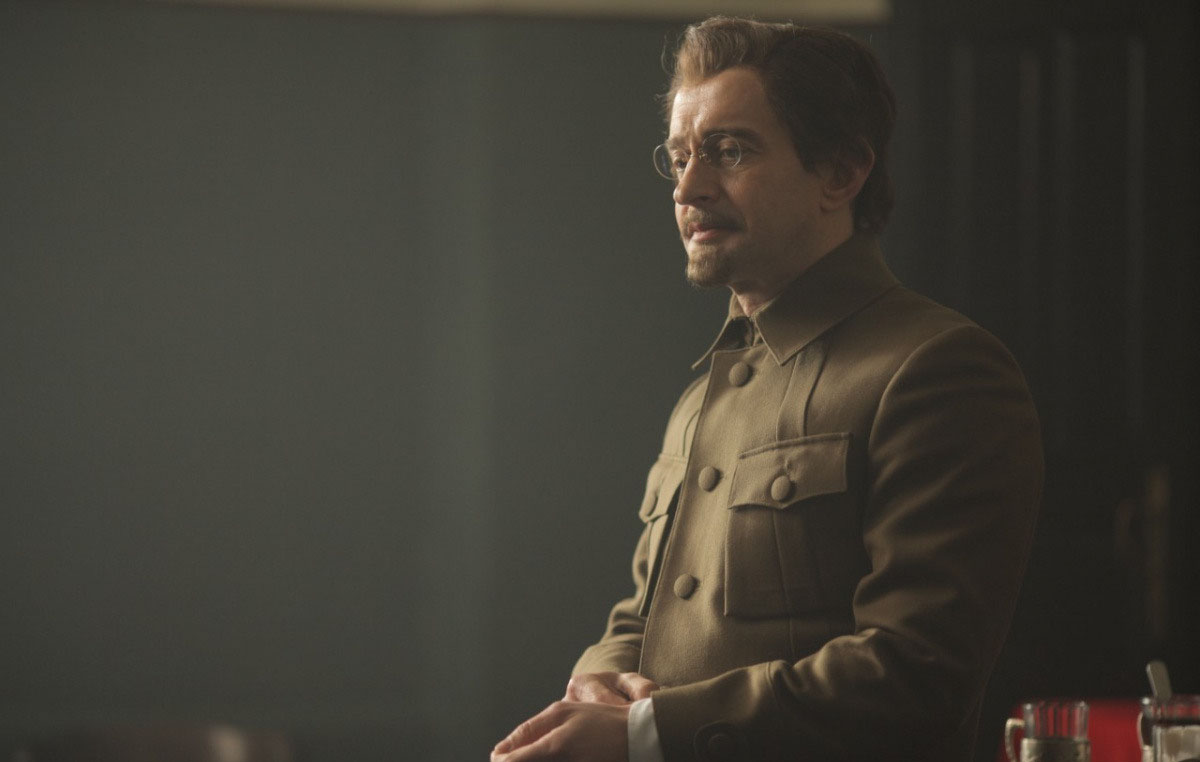
Frame from the series "Trotsky". Photo: kinopoisk.ru
The sacred victim and bloodthirstiness of the opposition
As we recall, the phrase “sacred victim” not so long ago was introduced into an active circulation by Vladimir Vladimirovich Putin himself. And the authors of the Trotsky series, sensitive to the statements of the leadership, illustrate the thesis of the national leader with poster straightforwardness. On the screen, a mustachioed German instructs Parvus: it is necessary to promote Trotsky, and then kill him in front of many people - this will be a sacred victim. Please note that in the film about the beginning of the 20th century it is precisely this phrase that is used, that is, an almost direct quote from Putin.
Parvus says to Trotsky: "I" made "Gorky, I will make you too." That is, no one in itself costs nothing, no one has any beliefs and talents, someone has surely “made” everyone, “promoted” for money
Since we are talking about the events of the 1905-1907 revolution, it is impossible to kill Trotsky, therefore, in the series, not anyone saves him from death, but heroic state security. The thought is clear here: if a large opposition figure is killed somewhere, then most likely it was done by his own backstage hosts to get the desired “sacred sacrifice”. State security does not kill opponents of power, it protects them from their own insidious comrades and owners.
The revolutionaries and their owners from the Western special services in the imaginary universe of the Lord of Rodyansky and the ced generally kill both their and strangers without any sentiments and often without any reason. The message again is extremely clear: you will contact these villains-oppositions, and then they will kill you for something, they just have it!
It is clear that the historical Bolsheviks were not at all humanists, but quite the opposite, but even in the scenes of the Civil War, Trotsky and his assistants kill outside the historical context, unmotivated, just like that.
In the series “Demon of the Revolution” there is a completely stunning plot: after the February revolution, the heroic counterintelligence is arrested at the direction of the assistant Parvus, who became a new government, and is tortured in the Peter and Paul Fortress. The “bloody dungeons of Kerensky” are shown with the North Korean naivety, and the creators of the series seem to tell us: here they are, your opposition - not only do the spies, having come to power, also begin to torture patriots, because villains and sadists.
St. George ribbons against "color revolutions"
The plot about the heroic royal counterintelligence-patriots is striking in the "demon of the revolution" with its absurdity. Despite ancient uniforms, we are once again shown by lubious security officers from late Soviet and modern Russian films and series.
Of course, they are all patriots and idealists, faithfully serving the king and the Fatherland. Even if during the search they throw a suspect of military fortifications to the suspect, then this is the same for the benefit of the case to bring a disgusting lawyer associated with the spy of Parvus to clean water. The fact that the plot turn is stolen from the “meeting place cannot be changed” is no longer surprising, but very well demonstrates the origins of the authors about the methods of working “good guys”.
Kerensky’s “bloody dungeons” are shown with the North Korean naivety, and the creators of the series seem to tell us: here they are, your opposition - not only do the spies, who come to power, also begin to torture, for villains and sadists
The real film patriot on the chest, by the way, is necessarily hanging some cross, and quite often-Georgievsky. And here the point is not so much in the cross that was actually not so easy to get at that time as in the ribbon. We are demonstrated by the fictitious continuity of visual symbols - then there were tapes of these flowers on the chests of fighters and revolutionaries now. A trifle, of course, but all the series under consideration consist of such trifles that create the very feeling of an acute agitation bast of 2017, for some reason taken on the material of a century ago.
For example, the bloody and stormy in reality events of 1905-1907 in the film “Trotsky” look like a dull parody of a rally in Bolotnaya Square: a small crowd of random people, built by provocateurs and spies, gathers in the center, listens to the speaker and, according to his call, calmly diverges around the houses, throwing the flags on the bridge. Either to show street battles and barricades to the authors of the series forbade curators from those very organs, so as not to give a bad example to the audience, or the scriptwriters, directors and producers sincerely believe that the peaceful standing of citizens in the square is the same terrible and bloody first Russian revolution.
Anti -Semitic tunes
The most outrageous and causing topic is a deliberate, in the style of classic anti -Semitic agites, emphasis on the ethnicity of a number of leaders of the revolution. If in the “Demon of the Revolution” this topic is only designated and the conclusions are left at the discretion of the viewer, then in the “Trotsky” the viewer is constantly reminded: Parvus - Jew, Trotsky is also a Jew, and his dad is a Jew, and in general the revolution is clear who made it. Then, Comrade Stalin personally reminds Trotsky of his Jewry: how can you be an icon of the Russian revolution, if you are a Jew? Then Lenin tells Trotsky: the Russian people will not tolerate the Jewish country at the head of the country! Then Trotsky himself tells Lenin himself: I cannot be the main thing, because a Jew cannot lead Russia.
The dead end of protective propaganda before our eyes acquires the ominous features of the newcomers agites of the beginning of the 20th century, directly accusing the conspiracy of dark forces of the unreasonable participation of the Jews
The fictional close friend of Trotsky, the sailor of Markin, constantly calls him a Jew or the Jew, preventing the viewer from forgetting the main thing. For some reason, a scene of the beating of Trotsky’s father by some rural anti-Semite, in detail commenting on their actions, was inserted into the series. Finally, the strangest and absurd scene is negotiations in Brest-Litovsk, where the German General Hoffmann speaks to the patriotic Russian general Skallon: there are no more the Russian Empire, but there are advice of Jewish deputies.
In short, the conclusion from this film production is one, and it is simple as mooing: the revolution in Russia made Jews for the money of German intelligence, and Russian people are stupid and eternally drunk cattle, which Trotsky ruthlessly shoots, and they somehow are not particularly sorry.
In addition to natural Jewry and the work of foreign intelligence services, the authors of Trotsky (and in the less explicit form of the “Demon of the Revolution”) find another motivation for their anti -heroes, however, also traditional for anti -Semitic agites: the whole thing is in sex, in a deliberately demonstrated and even directly commented on the sexual obsession of Jewish revolutionaries.
The above does not need any special conclusions. The dead end of protective propaganda before our eyes acquires the ominous features of the newcomer agites of the beginning of the 20th century, directly accusing the conspiracy of dark forces of the indispensable participation of the Jews of the troubles. Even against the backdrop of the notorious “sleeping”, this is a very serious step beyond all the conceivable facets of decency, but something tells you that it is far from the last.