
Translated material
The monument is stagnated
Why modern power glorifies Alexander the Third, and Tsar-reformer Alexander the Second was not to the court
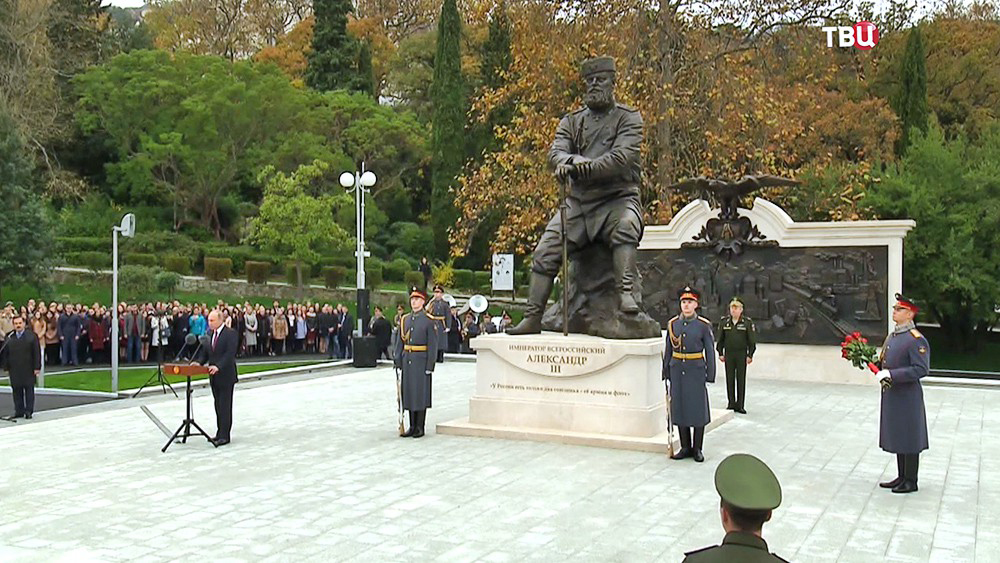
*The opening ceremony of the monument to Alexander the Third in Crimea, November 25, 2017 *Photo: tvc.ru
The discovery by Vladimir Putin of the monument to Alexander the Third in Crimea again forces to reflect on the difficult issue of the self -posing of the Russian authorities through a number of historical figures.
The legal foundation of the modern Russian state is the Soviet Union, whose successor the Russian Federation considers itself officially, plus a set of documents and practices that arose in the early 1990s, after the collapse of the USSR and the allocation of Russia into a separate country. The modern Russia has no legal attitude to the Russian Empire-in any case, the property of the subjects of the Romanov empire, which was requisitioned by the Soviet government, is not returned to the legal heirs, its laws do not apply, the socio-political system is completely different. Nevertheless, the existing regime pretends to have something to do with the notorious "Russia that we have lost." Even the restoration of property is carried out - however, not for the descendants of the property classes, but for the Russian Orthodox Church, which, although it was legally created in 1943 by Joseph Stalin and Lavrenty Beria, was declared the heiress of the pre -revolutionary synodal church. An important nuance is that just the church under the Romanovs, in fact, was part of the state, is not discussed at all.
Tsarist Russia seems to the Kremlin seekers of the “Russian idea” attractive for ideological construction, because it has not existed for a hundred years, and no one remembers about historians and other lovers of antiquity how everything was actually there. The ordinary layman knows about the story very little and very approximately, so he can be inspired to tell any tales about the incredible power of Russia in the conditional king Gorochi - and they will be uncritically perceived as the truth in the last instance. There are seduction to declare tsarist Russia with the same lost paradise, for the acquisition of which we must strive and around this to build at least something similar to a state ideology.
It is important to immediately note: as such, the return of the monarchy is neither Putin nor his environment at all interested in whatever the marginals of all stripes are composed there. The monarchy in the 21st century is a very subtle political institution that does not arise out of the blue. The main meaning of the monarchy in general is the continuity between the current state of society and the whole history of the state through the figure of the crowned legal representative of a particular dynasty. It is easy to make sure that in Russia there is no continuity, which goes deeper than Boris Nikolayevich Yeltsin, all the more, the dynasty, around which could certainly (and most importantly - wanted!) The whole society could unite. In the yard is not the 19th century, when Napoleon proclaimed himself the emperor and this seemed an acceptable decision. Even in the 20th century, the attempt of the African dictator of Bokasso to declare himself the emperor seemed ridiculous, to say about our time.
Even the restoration of property is carried out - however, not for the descendants of the property classes, but for the Russian Orthodox Church, which, although it was legally created in 1943 by Joseph Stalin and Lavrenty Beria, was declared the heiress of the pre -revolutionary synodal church
Thus, we can talk not about the return of the monarchy, but about an attempt to instill in society nostalgia for a certain excellent period of the history of Russia, which must be rushed to, adjusted for modern efforts. And the figure of Alexander the Third is very convenient here, especially if you do not go into the details of its real political biography and not take into account the pan -European context, which it is actually very tightly inscribed.
Firstly, he ruled for a short time by historical standards: his grandfather reigned for 30 years, his father was 26 years old, and his son was 23. During the thirteen years of the reign of Alexander the Third, those positive trends that were outlined under Tsar-reformer Alexander the Second, have already begun to bear their fruits, and his own efforts to preserve and even the archaicization of the country have fully produced their destructive potential. With his son, Nicholas the second. In addition, it was just a successful time - without wars that Russia could lose, against the backdrop of the growth of world capitalism, all the fruits of which it regretted.
Within 13 years of the reign of Alexander the Third, those positive trends that were outlined under Tsar-reformer Alexander the Second have already begun to bear fruit, and his own efforts on the conservation and archaization of the country have demonstrated their destructive potential with his son
Secondly, Alexander the third is one of the few Russian emperors, who died his death and not against the background of any political or military defeat. Paul the first was killed by the conspirators, who elevated his son, Alexander the First to the throne. Alexander the first ruled for a long time and quite victorious, but for some reason died in Taganrog, and then the Decembrist uprising also happened. Nicholas the first would be an ideal figure for creating a cult around him, for his rule is fully consistent with the ideas of the modern Russian authorities about how it should be: in Europe - the gendarme and in Russia - an autocrat. (About the cult of cruelty in Russian society - also in the column of Leonid Gozhzman ).
Everything would be fine, but the Crimean war spoils everything. And whatever one may say, it was she who became the result of his long rule and a sentence for an archaic autocracy. Again - Russia suffered defeat from all of Europe, and where - in the Crimea now declared by sacred! Therefore, Nicholas the first is completely not suitable for wide use in modern propaganda.
Alexander the second is bad and the fact that he was a reform and was inclined to the liberal forms of organizing political life, and by the fact that he was killed by terrorists. Our modern government does not like reforms and terrorists, so what kind of Alexander the second “liberator” is here! Around him they tried to build something during a short presidency of Dmitry Medvedev, but all this was left without consequences-however, like much more of what was declared in those years.
Alexander the second is bad and the fact that he was a reform and was inclined to the liberal forms of organizing political life, and by the fact that he was killed by terrorists. Our modern government does not like reforms and terrorists
Nicholas the second power is dearly loved and is fully consistent with all its ideas about the correct rule: no democracy, no liberalism, the sovereign and the law of God in schools. But the sad end of the reign of Nikolai Alexandrovich nevertheless cools the ardor of the propagandists: it is clear that the enemies and traitors overthrew him, but-after all, they could! Even against the backdrop of this cursory excursion into the history of Alexander the Third, it seems the only possible in the current situation.
The very fact is that the thirteen -year reign of Alexander the Third, in essence, is a passing and non -interesting, attracted the attention of the Kremlin ideologists, is another evidence of the moral collapse and the most complete unprofitability of the current regime. Modern Russian society is invited not to be equal to any intelligible ideas, doctrines or achievements, but on a stupid slogan, the symbol of which is Alexander the Third in the modern Russian pantheon-about the army and navy, the only allies of Russia. It is characteristic that even he did not utter her, as he did not have the relationship to those things that were immortalized on the notorious Crimean monument.
In a sense, Alexander the third for Putin’s officials is a substitute for the comic figure Leonid Brezhnev, who could be happy to erect a monument, but it would be completely funny. Therefore, the elegant bearded king was a symbol of stagnation, inertness and futile conservatism, but the essence does not change from this: our government has neither plans for the future, nor strategy, nor ideology - nothing. There is only one idea that Alexander the third personifies: at all costs to stop social and political progress, so that imperial luxury is enough for their human age, and then not to grow grass. (On the ideology of the end of the third term, Vladimir Putin - in an interview with Alexei Venediktov ).
Yes, the majority of the nobles of the times of Alexander the Third lived a well -fed and happy life, not living until the collapse of everything that seemed eternal to them. But we know how the Romanov empire ended, and no monuments then helped her then. And if the monument to Alexander the third work of Trubetskoy in St. Petersburg did not save the monument from the revolution, then the monument to Kovalchuk’s work, especially in the Crimea, will not help him.
* Political scientist, permanent author NT.