
Translated material
Pure change
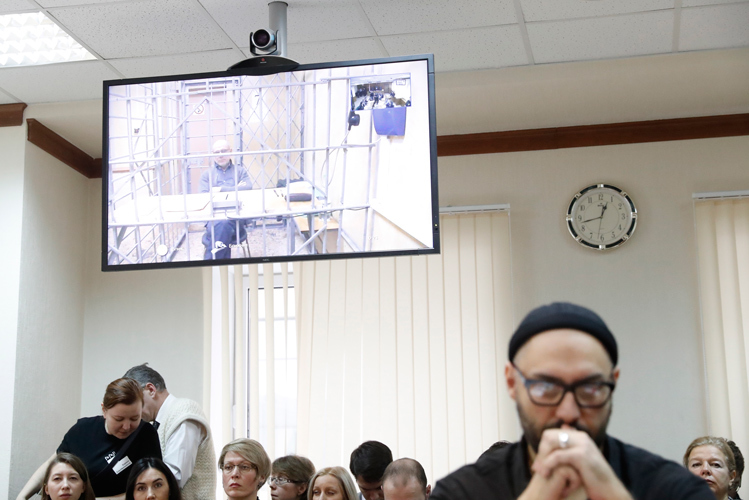
Summing up the results of 2017 , the Association of Theater Critics (ATK) called the “man of the year” the former general producer of the Seventh Studio, Alexei Malobrodsky, detained by law enforcement agencies in June. On December 26, the Moscow City Court appointed a meeting to change the preventive measure to another person involved in the high -profile process - director of Ramta Sofya Apfelbaum, accused of fraud on an especially large scale. About the political background of the case of the Seventh Studio - Sofya Dymova.
1.
On March 24, 2011, Russian President Dmitry Medvedev visited the Multimedia Art Museum, where he discussed with cultural figures issues of state support for the development of modern art. The theater workshop was represented by Vasily Barkhatov, Elena Gremina and Kirill Serebrennikov. Barshatov spoke of the lack of demand of young Russian composers in his homeland, Gremin - the need to support the state of independent theater companies, silverniks - about the impossibility of interdisciplinary search on the territory of the repertoire theater.
According to the results of that commemorative meeting, Medvedev supported three initiatives - the “operape” of Vasily Barkhatov, “Platform” by Kirill Serebrennikov and invented by “Theater. DOC "Program " Theater Plus Society " . In the same 2011, the Ministry of Culture received an order from Prime Minister Vladimir Putin to finance these projects-in a targeted way, bypassing the competitions that have just been recognized in all areas, including in the field of culture.
In relation to the Platform, a precedent of financing on the basis of copyright to the project and its methodology that allowed the copyright and its methodology was created - it was recorded in the Decree of the Government of the Russian Federation of December 28, 2011 and was signed by Vladimir Putin. Now they resort to such a wording in order to finance, say, the Territory festival and other similar projects. Further, the head of the Ministry of Culture of the Ministry of Culture Sofya Apfelbaum, together with the authors of the Platform concept, was to develop technical specifications and finance them - which she did, fulfilling the order of the government. The organizers of the "Platform" created a legal entity - ANO "Seventh Studio", it was with him that Minculter concluded agreements.
2.
In May 2012, after the presidential election, the diplomat of Alexander Avdeev as head of the Ministry of Culture was replaced by historian Vladimir Medinsky. In the fall of the same year, Vladimir Putin proclaimed on Valdai a policy of changing elites.
The new Minister of Culture began the change of elites in the theater block with a radical renewal of expert councils that evaluated grant applications for the competition to support modern drama, young directives and innovation - the corresponding order was signed by First Deputy Minister of Culture Vladimir Aristarkhov. In the policy of the Medinsky newspaper Culture, which became the mouthpiece, shortly after this, the resonant material “The Ministry of Culture warns: contemporary art can be dangerous to the health of Russians” , stigating the previous compositions of expert councils and signaling that in previous years “budgetary funds were spent on Chernukha, mother, pornography, and mediocrity shamanism under a proceeding under all that is all that is that everything that was all that is that everything that was all that is that all that is that all that is that all that is that everything that was. Dimovs the viewer, drives him into depression, kills living feelings in a person, creates the image of Russia as a dull and unpromising country. ”
Sofya Apfelbaum, who invited to cooperate experts, was dismissed from the Ministry of Culture in October 2014. Together with her departure, the resignation of ANO and other non -state organizations - financial operators of various projects to support contemporary art. On programs and initiatives that were supported before, a cross was set. The Operapex ceased to exist after the first successful year of work, the project “Theater Plus Society” was reformatted by the new financial operator, the Capital Foundation. The Platform designed for three years did not like the Minister of Medinsky too much, but the Ministry of Culture was obliged to implement the government’s decree and was forced to continue financing.
The Ministry of Culture uses the case of the Seventh Studio with its supposedly economic winding for frankly political purposes - to change elites in culture.
3.
Last May, when the Investigative Committee started the case of the theft of the “seventh studio” of budget funds, the Ministry of Culture recognized himself as the injured party - which, it seems, had never done before. On the day when Kirill Serebrennikov was searches, the Chekhov festival was opened in Moscow, at the press conference of which Deputy Minister Alexander Zhuravsky said that it was not in his competence to comment on the activities of the investigating authorities. Meanwhile, it became known in the fall that Andrei Malyshev, who took the place of the head of the Department of State Support of Art and Folk Art in 2014, replacing Sofya Apfelbaum in this post, gave evidence against her in the Investigative Committee - and this is the direct evidence that the Ministry of Culture uses the “Seventh Studio” case for his supposedly economic intensively, for the replacement for the replacement - for the replacement - for the change - Elites in culture.
4.
He graduated from GITIS and defended his thesis on the topic “Public Relations in the theater”, Sofya Apfelbaum was invited to the Ministry of Culture in 2006. The department then de-Jure was led by Alexander Sokolov, but by the entire programmatic architecture of the Ministry of Culture, the chairman of the Federal Agency for Culture and Cinematography Mikhail Shvydka actually was in charge.
The activity of the Ministry of Culture in those years was summarized by two directions - the preservation of heritage (monuments, museums, libraries) and the development of theater and other performing arts. The wards of Sokolov and Shvydky pursued a policy of asphalting of paths trodden by artists and society: any creative initiative that showed its steady development (say, a new drama) began to be supported by the authorities. That is how the notorious grants arose to support modern drama, innovation and young directors, about the allegedly unlawful distribution of which the “culture” wrote.
The Minister of Culture occasionally acted as an arbitrator in controversial matters like the construction of an Okta center, but in general the department silently and actively supported long-term and sustainable initiatives. Particularly emphasized on reporting: in terms of additional subsidies, the theater department of the Ministry of Culture worked only with those non -state organizations, whose management was professional and whose reports were impeccable. The strict rule for all theater creators and producers sounded something like this: if you have wonderful potential, but you do not know how to dispose of money within the framework of the law, you will not receive it.
5.
A public agreement in the field of culture, which was supposed to carry out the ministry, was mainly in the meetings of the authorities with artists and cooperation in terms of the distribution of grant (additional) funds based on competitions with the involvement of independent experts.
However, the authorities soon abandoned the idea of a public agreement and decided to create a directive - the “Fundamentals of the State Cultural Policy”, the idea of which arose at a meeting of the Presidential Council for Culture and Art in November 2013. The document, approved in 2014 with a presidential decree, recorded a new, conservative, country of the country in the field of culture. The Law on Culture , adopted simultaneously with the Constitution of the Russian Federation, is so diverging with the practice of application that it is impossible to talk about it as a real existing one - so the “foundations” should have become a base for creating a new cultural legislation. The work on him by quiet Sapa has lasted all the last years-which is indicative, without any public or professional discussions, under the influence of cook games and struggle of interests alone.
6.
In the spring of 2015, First Deputy Minister of Culture, Vladimir Aristarchkhov, made a strict criticism of the largest and most authoritative in the country of the Golden Mask theater festival, accusing the organizers of the forum of consistent propaganda of performances, “provoking a society that obviously containing elements of Russophobia, contempt for the history of our country and consciously going beyond moral frames” and doubting the need for financing Festival by the state budget. In the final of his speech, Aristarchus suggested that the theater community answer the question: “With whom are you, the master of culture? With the people or against the people? "
The wards of Vladimir Medinsky managed to find an alternative to the “Golden Masca” only by the fall of this year, when the Biennale of Theater Arts “Lessons of Directs” , financed by the Ministry of Culture and supervised by the confidentials from the theater-critical workshop Marina Tokareva and Olga Egoshina, was first held in Moscow. The colossus on clay legs, not distinguished by either the original concept, or at least a clear methodology or transparency of software selection, “Direct lessons”, meanwhile, are quite unequivocally designed to consolidate theatrical forces longing for revenge. It is symbolic that the festival program was released exactly in those days when the criminal “platform” was declared, which became the point of assembly of art elites of the early 2010s.
7.
In the theater, there is the concept of “pure change” - a change or rearrangement of scenery, which is made in the shortest possible time without closing the curtain, in front of the public.
Economic, which seems to be “seventh”, which is performing today as a political process - albeit a tragic, but only one of the episodes of the global “pure change”, which has been carried out in recent years in Russian culture as part of a conservative turn. Often it is realized by the same people who at one time were pioneers of cultural modernization.
Within the framework of the new course of the party and government, people and reputation are destroyed by any means, and the accusation of an economic crime, as you know, is the most effective means in such a struggle. Cleaning the rows should be completed, in theory, to the elections.
It remains only to bear the convictions.