
Translated material
Cubature of the child
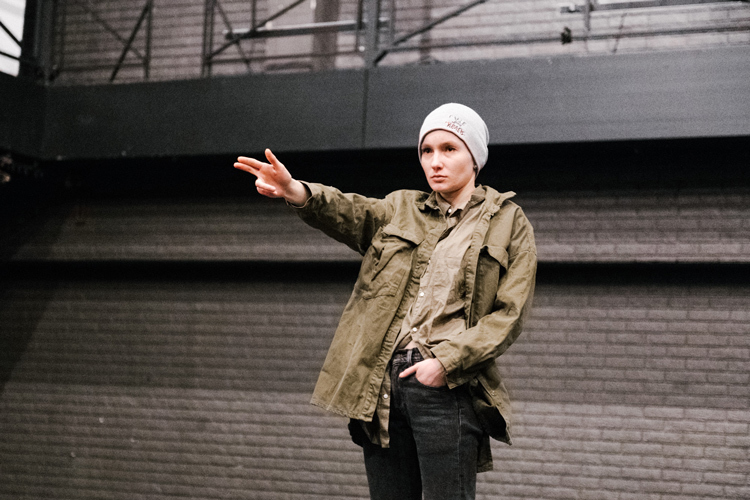
On February 9, Tsim will present the prime minister of the Play-Utopian play by the Play of Utopia, which is prohibited and never staged by Vsevolod Meyerhold , “I want a child” . Meyerhold, Tretyakov, Eisenstein - as well as activists of the feminist movement Ella Rossman, Daria Serenko, Sasha Alekseeva and Natalia Pole, will be discussed about sexual importance on the stage of the Great Hall of Tsima. Especially for Colta.ru, the director and playwright of the project Sasha Denisova tells about the play “I want a child”.
I put the play by Sergei Tretyakov - and for some time I am in conflict with her.
After the success of impressive productions at the Meyerhold theater, Tretyakov writes another play - “I want a child”. She is huge, generous and spreading. Meyerhold calls it only "material for discussion." The troupe’s face sees: I like the play. Imperfect, weak - means good. And we will straighten it with the means of the theater. And Tretyakov will add on our advice.
The success of the previous productions of Tretyakov in Tim inspired both Meyerhold and the troupe. At first there was a “land on end”, the play by Martine in the Tretyakov version dedicated to the Trotsky and Red Army: trucks, motorcycles, aircraft, and actors used real weapons went to the stage. In the depths of the scene, the crane stuck. Sometimes this power was played in the Leninsky mountains, in the open air. Tim Tim, however, will still be remembered.
Then there was “growls, China!”, Practered by the student of Meyerhold Fedorov, where there were attractions and unprecedented on stage again: real water, boats, cruiser. Witnesses of the miracle said that mass scales are similar to the figurine -coated with ivory. Tretyakov wrote about China, in fact, after a trip to the Middle Kingdom: he taught Russian literature in Beijing, watched anti -imperialist demonstrations - and the plot was born by itself. Babanov played the Chinese fight, Lunacharsky praised for campaigning, the chief Mayakovsky himself set the play on a par with his “mystery-buff”.
Tretyakov’s documentary is a portrait of reality, accurate, like a square of Malevich.
Tretyakov took a newspaper title - in the provincial city of Vansyan, that on the Yangtze, the American military demanded to shoot two Chinese for the death of the American. And they shot - but then the struggle of the oppressed people began. Tretyakov first wrote in poetry, then remade "Right, China!" In the play. Working with Mayakovsky, he always faced the fact that he rewritten his poems - and it seemed to be annoyed, so that Tretyakov gradually left the poems. When Mayakovsky shot himself, Tretyakov fell into a coma. And he hated poems for good.
Tretyakov loved newspapers. He is called the father of modern documentary drama - and this is right, but with a small reservation: Tretyakov’s documentary is a portrait of reality, accurate, like the square of Malevich.
Yes, Tretyakov and Lefovites proclaimed the literature of the fact - but which one? Here's the answer: Twenty -year -old Varlam Shalamov was given a task - go in and describe the Lef’s room, what do you see? “Mirrors,” said Shalamov. “Not mirrors,” Tretyakov snapped. “And the cubic meter.” Shalamov did not work in Lefe.
Tretyakov’s documentary art is a cubatic. Exactly described-but still a cubatic.
The actors and I are faced with this cubature and in the play: there are enough strange cubaturistic words - wiper, capture, disciplier.
Tretyakov created the term “bio-interview”-after the “biomechanics” of Meyerhold. Bio-interview is his novel about Chinese student Dan Shi-Hua. “I rummaged like a miner in the magnificent bowels of people's memory, probing, exploding, squabbles, filing out, I was alternately an investigator, a confessor, a questionnaire, an interviewer, an interlocutor, a psychoanalyst. Often a completely simple thing was able to be found only in a roundabout way for long hours of conversation. All that I designed is difficult to name other than the interview, but the interview covers the whole life of a person-so I called this thing “bio-interview”. ”
 © Center named after Sun. Meyerhold
Tretyakov was, first of all, a talented writer. The reporter - but the poet, documentary - but the futurist. Yes, he mounted the fact in his own design. But he did not have verbatims in our understanding - literally recorded monologues. It was not the time for them then: the documentary was a distinct taste of futuristic hyperbole, cut with a metaphor, and pricked with lithota.
“How can you admire Leo Tolstoy, when every day we turn over the most amazing page of the novel called“ Our Life ”,” says Tretyakov.
Eisenstein will put three Tretyakov’s plays in the Plaletkult at once. In the “Wise” (Ostrovsky variation, witty attraction, clowns, buffoers) he will first try a movie: he will shoot the Glumov Diary under the leadership of Dzigi Vertov. In the play, Grigory Alexandrov ran out into the hall right from the screen - they acted, they say, quite playfully.
Eisenstein puts “gas masks” by Tretyakov at the Moscow gas plant - original. Like, Meyer has an acting theater, and I have an impact, immersion! The audience immersionally rummaged through the workshops and soon fled - because the immersive smelled of a very smelled gas. (I remember, Castelpelli poisoned us with some kind of lime , wanting to show the decomposition of the body of Jesusov.)
"You hear, Moscow?!" - “Operational response” to the uprising of Ernst Telman, Agitginiool. Having heard from the Mayakovsky stories who came from abroad about the production of the squeak, where the audience is so enthusiastic about what is happening on the stage, which are prompted by communist actors, where the counts hid, Tretyakov also wanted a theater where the Komsomol members would shoot at the actors. Meyerhold for a similar effect was two hands for.
And Tretyakov read that a socialization of women is announced in Saratov - that is, you can come to get acquainted with them, conceive a child and not burden yourself with a marriage. Time has not yet cooled from the slogan “Down with Susiness!”, Kollontai offered to liberate, armed with her collection “Love of Labor bees”, the thesis of the “glass of water” regarding sexual activity is still by ear. How, we are building a new life - and new gender relations. The heroines of Kollontai are not alien to polyamoria and same -sex relationships: a woman is engaged in production along with a man - let's remove the philistinism from sexual question. Students of the Moscow Forest Institute socialized everything - glasses, pants and women. On the sexual girls, advanced girls, the question is sprouting the question “open their lips to everyone indiscriminately or not to open” in museums and libraries - we, they say, are not objects, we ourselves choose who to converge with.
 © Center named after Sun. Meyerhold
Critics cautiously warn that “sexual licentiousness and atrophy of restraining sex centers” will lead “to debauchery and sexually transmitted diseases”, and already closer to 1929 they begin to listen to them: another vocabulary - rot, dissolving.
A conservative coup and the Stalinist bias in a conservative family come. In 1936, an abortion ban was again introduced. The woman is again chained to her husband, stove and machine.
But back in 1926, among the raging elements of sexual question, Tretyakov writes “I want a child”: “The play was born from the thought that the costs of sexual energy entail mental wear, a wave of abortion, and a stream of sexually transmitted diseases. And the goal of sexual energy is the birth of a child. The bottom line is not to eat more guys - the essence is to navigate them more healthy, so that the events of the Soviet government, aimed at protecting motherhood and infancy, manage the woman’s consciousness. Therefore, in the center of the play is a Soviet worker who realizes his sexual tension by the birth of a child, taking into account the requirements of the practical Eugenics. ”
Tretyakov proposed a real model of the future, the algorithm - where to give birth, where to take, how to carry out conception. And Meyerhold decided to open a discussion about all this right in the theater.
The main character Milda comes to her theory, having seen enough of the panorama of the 1920s-in the painting of which Tretyakov is quite ruthless. A chubby verbose play is a report with hundreds of votes. Meyerhold is recorded in the explication: "20 fathers, 20 babies." Or here, with a careless hand, - "The crowd (ten people)." There were power!
What goes before the reader's eyes in the play? Dramatic studios, where they put ballets about the emancipation of a woman, patterned plays about the Bolsheviks, and in the corner behind the drums seduce naive kitty rushing to the theater. Here they arrange Shimmi Bal, “play the fox banned in the Soviet” (and after all, Meyerhold had a jazz on the stage-is this scene specially written for him?). The heroine wants to arrange a nursery in the breed nest, but the manager and the director are against it. The question is posed by the rib: art or social guarantees?
Crowds of mothers, darmed with work, party and abusers' husbands pass. Hwoligans from the famous “Chubarovsky affair” come to the stage: in Leningrad in 1926, thirty people raped a girl in Chubarova Lane - it was odious, they shot the top, the rest were sent to the camps for twenty years. Tretyakov describes this situation in sufficient detail - both the scene of violence and arrest.
Well, spermodonor, eco, give birth without a husband. Then Tretyakov looked into the water. But the future that Calls Mild, with crowded orphanages, has come - and it is terrible.
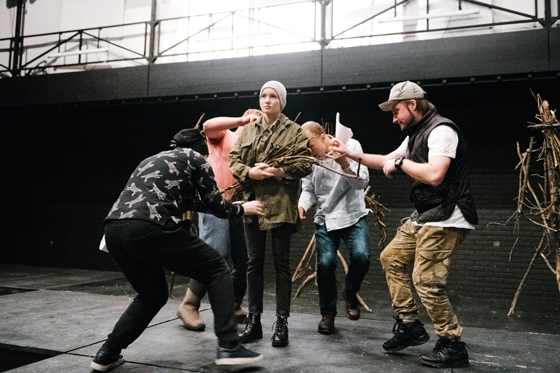
Today in the performance of Tsima, all roles are played by men. Milda lives in the masculine world, where they are raped around and - here is the word Tretyakov - “they are scratching”. She walks and sleeps with a nagan. Dresses in the male. He cares about other women, but does not understand their craving for dresses and guys. In the world of male violence, communal life, where primuses hiss and infect with syphilis, where they compact so that they fall from the windowsill, there can be no love. In this world, you just need to find a spermodonor. Find a purebred. Without any feelings to sleep, until the child is determined. Or get a syringe from the state with the best sperm - and then give the child to the orphanage.
We, modern women, understand her exactly until this moment - well, spermodonor, Eco, to give birth without a husband. Then Tretyakov looked into the water. But the future that Calls Mild, with crowded orphanages, has come - and it is terrible.
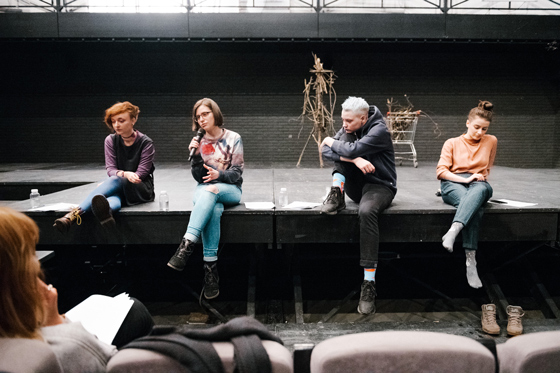
Ella Rossman, Daria Serenko, Sasha Alekseeva and Natalya Pole will enter the stage of Tsima to say: I do not want a child. And if I want, I'll take it from the orphanage. What kind of happiness - to transmit your unforgettable genes? What kind of joy is to give birth every year, to get sick, to transfer home and sexual violence and not to leave your area for years? Activists of the feminist movement organize volunteer projects, engage in educational work, therapy of domestic violence - all that the state does not do. Because everything that Tretyakov is talking about in the play has not been outdated for nine decades since then - Victimbleming (the victim’s accusation; recent loud murder and rape Tatyana insurance for this proof), Skiyshiming (accusing a woman for provoking clothing - although 80 percent of the raped are usually dressed in a potato bag - well, or a downbutor there or there or there or there or Jeans), double load, sexism, glass ceiling. All this is in the "I want a child" - and we will talk about this in Tsim. According to the covenants of Meyerhold.
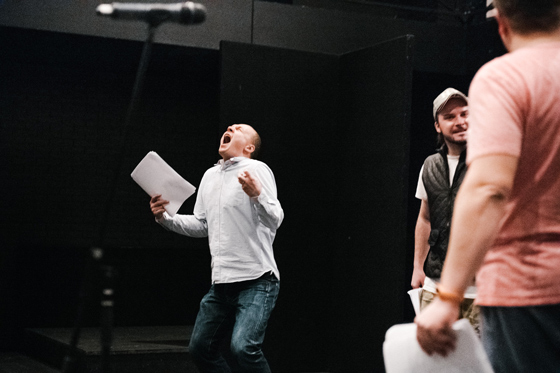
Vsevolod Emilievich himself proposed to build a performance discussionly: “I continue the auditorium on the stage. We will sell places, and transfer some places to those organizations that will take part in the discussion. SanPosvet, Zhenodddd, Okhmatmad. The action will be interrupted for discussion - deliberately. "
Glavrepertk, having familiarized himself with the play, decided to ban it. SanPosvet and Okhmatmown were also strongly against it. The writers were also against the play - the play, they say, sinners with schematism. The worker from the Sickle and Hammer plant does not understand why to show the propaganda of masturbation - we are not ready for this, suddenly a sixteen -year -old daughter will hear such words. The play is for thirsty spicy sensations, and not for an organized viewer - a calm, family who goes to the theater to relax. Oh, how much we heard on the performances of the new drama of the opinions of such “people from the audience”.
 © Center named after Sun. Meyerhold
The play is too physiological, only censors say. Others are that there is a protrusion of details. In addition to everything, there is a scene of rape of a girl by Soviet workers.
The prohibitions of “Tanneser” and “Nureyev” are also examples of the reflection of the current censors about morality: the prohibitions of children's fairy tales, where the eye fell into the toilet.
However, sometimes for a successful outcome of the case, even the pressure of censors is not needed - directors and playwrights, as you know, are used to quarrel.
At some point, another defendant appears in the case, director Igor Terentyev,-an exotic frame, a hem-bunker, a friend of the twisted and Zdanevich: who adored Meyerhold and who wanted to arrange his branch in Petrograd, he looked at the “auditor”, decided that the master had gone into the “out-of-senior symbolism”, and he himself staged a play by Gogol in Zaumi. Terentyev also wants to release the “I want a child” - offers to put a glass booth in the hall and transfer the pre -prepared questions and answers to the leading pre -prepared questions. Meyerhold is in shock - not to give the play Terentyev, Tretyakov conspired behind me!
Tretyakov as on execution, I agree to correct - to correct, put the doctor into action, only so that the “I want a child” is not put behind him.
And here is what we have in the dry remainder. The play was banned for everyone except the Meyerhold theater. El Lisitsky made grandiose scenery for a new guests on the triumphal. But neither the theater nor the play was shining.
The general atmosphere began to heat up. To begin with, they arrested the Umbli -Minor Terentyev - in 1931 he was sent to Belomorkanal, where he put together a brigade from the prisoners and put sharp, scary to say, overwhelmed about camp realities. He will be released-but in June 1937 they will already be shot.
Stalin became looked closely at Meyerhold Krivlyak.
Tretyakov spits on dramaturgy and plunges into different matters. Goes to collective farms. He writes a book about a friend Brecht and the Germans - a piscian, Eisler, Wolf. It leads reports from Red Square.
Meyerhold, too, fate will lead to Red Square - to put a parade of physical cultures, to be present on which he will no longer be.
In July of the same 1937, Tretyakov’s Lubyanka will be taken from the hospital. All the texts will be seized into special security. His name will be crossed out of drama. If they put it, then in the west or in China. His wife will be sent to camps for seventeen years. His manuscripts daughter and mother will be found only after the death of Stalin.
Meyerhold will be taken in 1939. A person who created the theater from his students, a successful, loud theater, shocking, exciting scale, a theater, where cranes, cars, boats, jazz, avant-garde structures, first artists, mass sciences, acrobatic bodies, sharp themes, clogged halls,-arrested.
 © Center named after Sun. Meyerhold
A man who collaborated with the authorities, of course, took money from her - but to his theater.
As the feminists say - #this is noted .
The analogies here are the most direct. You can disagree, say: the nuances, the era, why so attract the ears? But we see the direct answers of the authorities: "Meyerhold sat for political reasons, and Serebrennikov - in economic ." So, there is still an analogy.
But then, then they took everyone. Who took the money - and who did not take anything, like Terentyev and Tretyakov. Who was generally sitting at home, closing on all locks, moving the doorbells of the doorbells. Who despised the Lefovites who served as ideology. Who we are in order to judge them - they believed in it, lived in this.
In the finale of the Play of Utopia, Milda says to the opponent: “A few years will pass. Complete the houses. Primuses and closets will die. Unemployment will go out. They will die out housewives. The nerves of people will catch their breath. There will be a nursery. Not a nursery - a whole house for children. We, brother, will demolish both children there. And we will be friends. "
Ninety years have passed-and the law on domestic violence has not been adopted, women in Russia are chopped off hands, kill and rape, directors are planted, their performances are prohibited.
Our performance, probably, is that while we are arguing about replicas, scenery and props, all of our discussions about art can be swept at once.
And we still feel so significant-artists, overlords, creators when we say (exactly as they said in the 1920s and in the 1930s): my explication plan is ...
Someone can have a completely different explication plan for us.
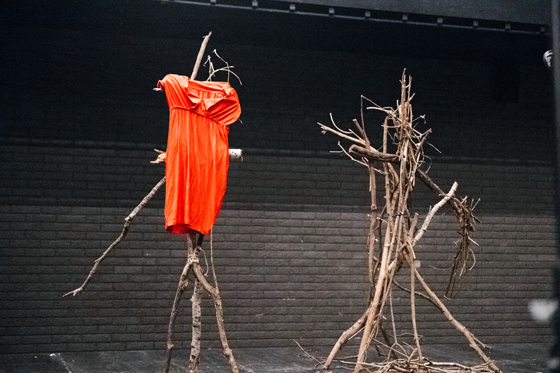
The artist Lobanov came up with a lot of people from the trees for the performance in Tsim: “The forest is chopped-chips fly”-Stalin, they say, loved this proverb.
Meyerhold bequeathed to us to discuss. Only this seems to be left to us.