
Translated material
"I could never become a prosecutor"
February 15 - 95th anniversary of the birth of Elena Bonner - famous human rights activist, wife and friend of academician Andrei Sakharov
In recent years, she lived in the United States and rarely gave interviews. In 2011, the book “Talks with Andre Gluxmann”, one of the leaders of the Parisian protest of the late 1960s, was published in Paris. We publish an excerpt from this book translated by Zoe Light.
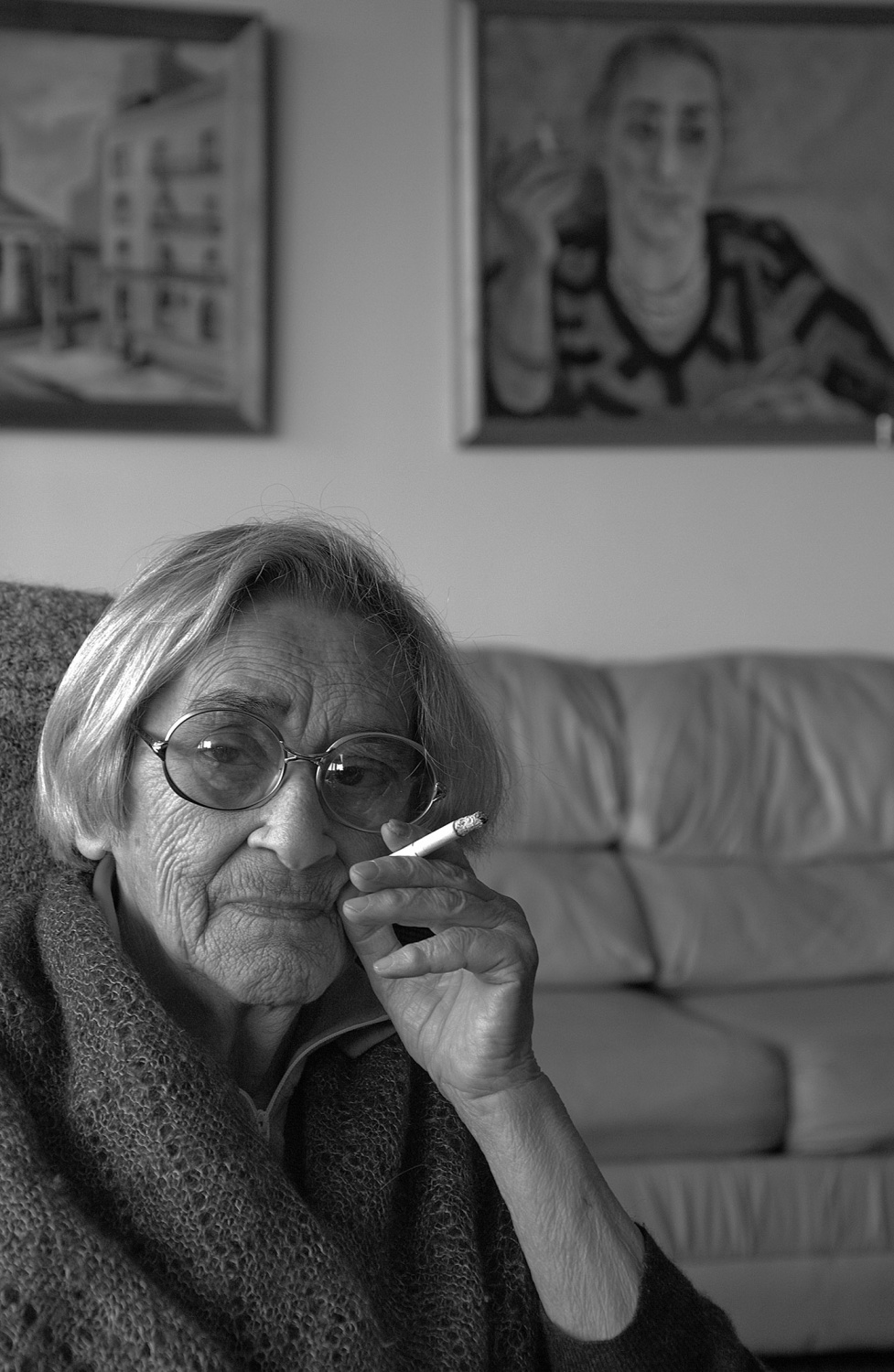
She died on June 18, 2011 in Boston
Photo: Yuri Rost / Kommersant
NT: *How did you become a human rights activist? *
I really never wrote about this aspect of my life. I used to be one of many. And then I became the wife of a great man. Andrei commented on my performances in the West: "In my opinion, they do not listen to what you say, but just for half an hour they list my titles." It was terribly angry with him.
Maybe now, after the death of Andrei, I am a human rights activist who can theoretically substantiate his activities with public speeches, publications, etc. But before that, my human rights activity was reduced to letters, parcels and premises. Everything else always seemed to me not quite real. Maybe because by nature I am absolutely not a theorist, I am a practitioner. At the age of 14, I faced this because of my family and her relations with the environment. In a sense, I was lucky, because not all families develop such relations when friends of children are friends of parents and vice versa. I grew up in such an environment. What allowed me to talk about the secretary of the Central Committee of Armenia at the age of ten that he was my great friend. And when the tragic 1937 came, in fact, the whole circle of friends of my parents was arrested. I was from the children of this circle of one of the elders. And I felt responsible not only for my brother and sister (our father and uncle, after all, were also imprisoned), but for all our familiar children. Moreover, the tragedy of the 37th year has not at all affected my ideological attitudes. Despite everything, I continued to believe in the world revolution and all that.
NT: *And when did you stop believing in the world revolution? *
During the war. In those years, I already began to think like an adult.
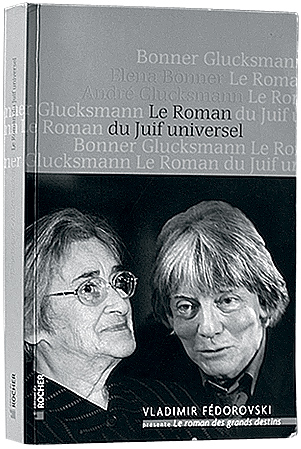
Le Roman du Juif Universel,
Editions du Rocher, Paris, 2011.
Compiled by Galina Ackerman
Address: Gulag
NT: *You say that at the age of 14, you began to send parcels to the camps ... *
According to the rules of those years, the parcels were accepted only from relatives. But in general, no one paid attention to this. And my mother, who also sat in the camp then, in letters gave me the names of her friends who were sitting. I calmly sent parcels to different people, indicating my return address and signing each time the name of the addressee. In addition to my mother’s acquaintances, I helped women from the Comintern, who were mostly lonely and whom there was no one to take care.
Well, in 1948, the mother’s generation began to return-women planted in the late 30s. Everything with very poor health, of course. And by that time I was already a physician and helped them get in hospitals for treatment. And there were those who were not allowed to live in Leningrad, they settled around, very many were lonely. Someone had sons at the front ... these are such fates. Of course, one could turn away from this, but if you are at least a little human, then it is impossible to move away.
* Andre Gluksmann is a French philosopher and an essayist writer. Known for his articles against the war in Chechnya, as a result of which he actually became Persona non grata in Russia
** Scientists Revolt Pimenov and Boris Weil were convicted in 1970 by the Kaluga Regional Court for five years of exile for distributing samizdat
With Sakharov I met at the process of Pimenov and Vaile **.
NT: *What has been a turning point for you, which changed your attitude to Stalin and in general to Soviet power? Khrushchev’s speech at the XX Party Congress? *
Among the people of my circle, everyone knew about Stalin's crimes. But in a strange way for me, such a turning point was the Picasso exhibition of the late 1956, the year of the Hungarian uprising. It was amazing not that Picasso hung on the walls, but that young people gathered at him and everyone argued lively. It was the feeling that some kind of key had turned and everyone had discovered a hitherto closed mouth.
The path to dissident
NT: *Your human rights activity, starting with the premises of the prisoner, has grown into participation in the dissident movement. How did you come to this? *
In 1968, through Vladimir Bukovsky, I met those who in the Soviet Union produced the Chronicle of current events. I myself took up its spread. For example, I went to Leningrad, distributed copies of the “chronic” to dozens of people. And a month later, the same people reprinted collections on writing cars, and there were so many copies that no one knew how many they were walking in Samizdat. In addition, I went a lot, collecting information for the "Chronicle of current events." We were all very poor then. The same of us who were in exile far from Moscow lived in constrained circumstances. Often I had to buy houses there, because no one was eager to rent housing with a political exile. They collected money for this housing. As a war veteran, I had a preferential tariff for travel by train and by plane. And, of course, this used this without any remorse. Therefore, I often traveled around the country with various kinds of instructions.
In fact, dissident activity began during the trial of Andrei Sinyavsky and Julius Daniel in 1966. During the process, my friends and I gathered at my house and read Sinyavsky aloud - we had only one copy of his book. We were not at all worried about the fact that “bugs” were installed throughout the apartment. At that time, my daughter was 13 or 14 years old, and I allowed her to read forbidden literature, although my mother opposed it very much and accused me of putting my daughter to prison!
The thirst for freedom
NT: *often they say that it was you who made the great human rights activist from the academician of Sakharov. Is it so? *
I answered this question in Moscow at the Conference "Thirty Years of Sakharov's Presence" in 1998. Sakharov’s “manifesto” was perceived as an elite text only because it was dedicated to intellectual freedom. In fact, Sakharov speaks about freedom as it is, he speaks of a person in daily life, and not about some abstract “intellectual freedom”. And this thirst for freedom is the basis of dissident.
NT: *It is known that at some point Sakharov ceased to be the same “romantic of science”, which endlessly believed in its power. And he became a human rights activist. How did this turn of 180 degrees occur? *
There is no need to talk about 180 degrees about any turn - no radical changes occurred with Sakharov. It cannot be said that at some point he repented and abandoned his past beliefs, he always consistently argued that the full nuclear disarmament was dangerous for the planet, but excessive weapons were not needed and should be destroyed. He believed that in the 21st century, some part of the nuclear weapon would continue to exist. Everyone is trying to come up with some Sakharov, who personally is not familiar to me.
*** In September 1989, the annual Congress of the French Physical Society and the award of the title of the title of Doctor Honoris Kauza at Academician Sakharov at the University of Claude Bernard were held in Lyon. On September 27, Sakharov gave a public lecture “Science and Freedom”. It was published in No. 21 of the magazine "Ogonek" for 1991 by its 70th anniversary
There is as much sin behind Sakharov as for any person of science, since a person has become Homo sapiens. Here in the Lyon lecture ***, which I highly recommend to you, Andrei says that the primitive man dug the earth, was interested in a worm and thought about how this worm was arranged. And it is impossible to stop the flow of thought from worm to cosmology. The progress of fundamental science is in parallel, and in the Sakharov era, when the publications were not as fast as today, it was evident how the same scientific problems solve in parallel in different ends of the planet. Sakharov was well aware that if he and his colleagues did not make a hydrogen bomb, someone else would certainly have done it. But what distinguishes just a scientist from a great scientist is the ability to overcome some kind of knowledge that has already become a stereotype, and step over to the next step. In the fate of Sakharov, this is very traced: already as a student, he offered atypical solutions to typical problems. Plus, he had intellectual courage to say what he thought. This was present in public problems, and in scientific - the conviction that everything that the predecessors said, in the name of approaching the truth, can be cheated.
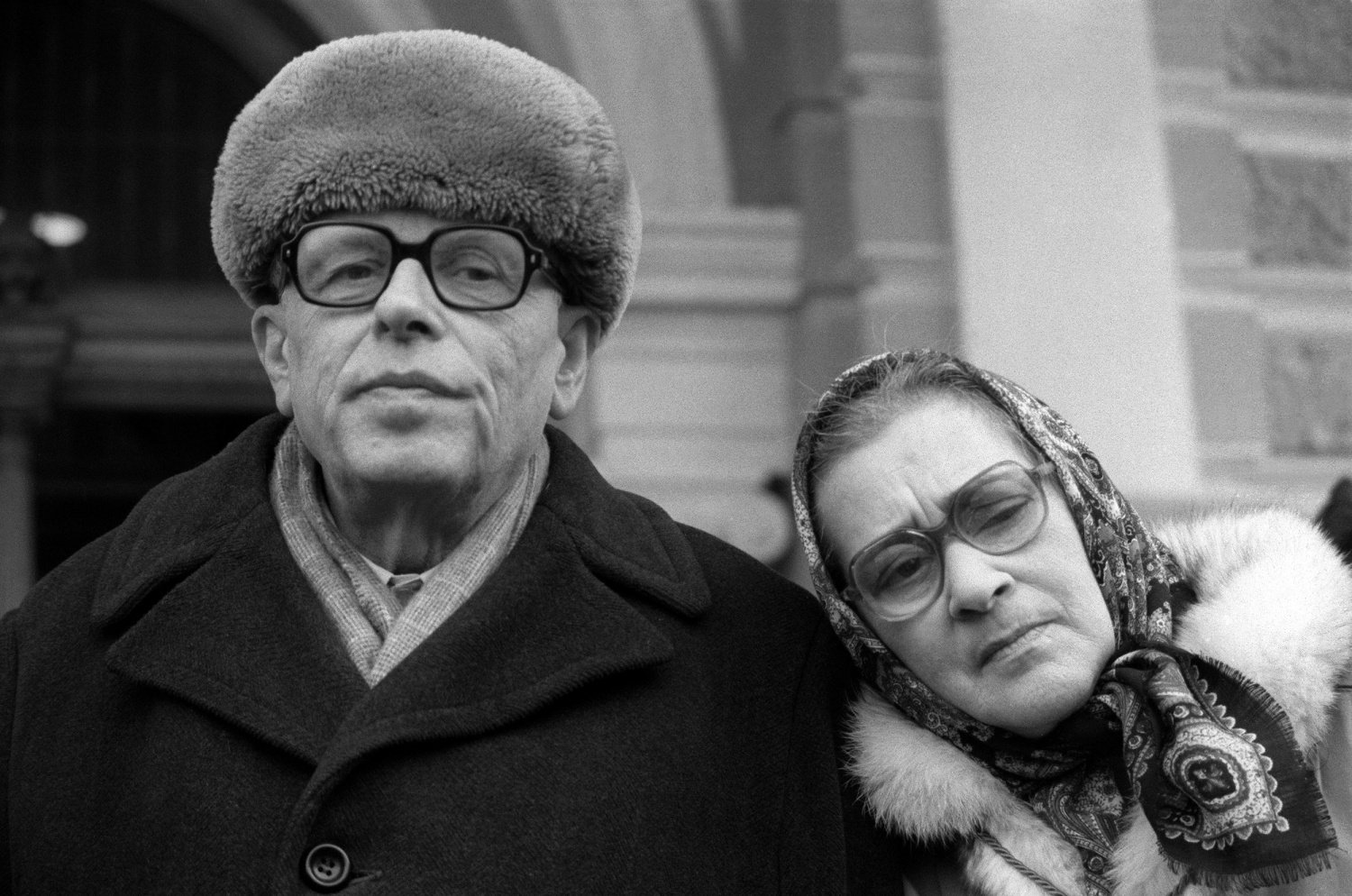
Andrey Sakharov and Elena Bonner. March 31, 1987 Photo: AFP
Three generations
NT: *Tell us about your life with Sakharov. It seems to me that you were very connected with him, and are connected after his death: you continue the same struggle. *
If we are talking about me and Andrei, then there was a counter movement. Both of us were driven by the desire to protect the weak. Then this is probably my feature. I remember that even when my parents were alive and we had a generally prosperous family against the backdrop of this country, then at the age of 12, I constantly went to our class teacher to burn out those who were punished. She even called me the "Bar Association." Probably, each teenager already has such characterological features: someone manifests himself more as a prosecutor, someone as a lawyer. I could never be a prosecutor, I know that for sure. So in my case, it was a movement from private to the general understanding of the country, society, the world.
And Sakharov, on the contrary, has very abstract thinking. From his youth he was thinking about general historical laws. And at some point we came together. He began to notice people, and I began to notice that the events associated with specific fate are actually based on general processes.
Soon after I became his wife, I found out that Sakharov gave all his huge, by those standards of savings. And I was beside myself and told him how many people could help with this money and that the state rightly does not dispose of them. And he all convinced me that this was the most correct contribution. But in the end, I realized its mistake - that the state did not care about the toilers at all.
Sakharov has always led a rather closed life. And they had such a family, and he wrote about this in his diary that none of his school or university friends was at his house. And when he gathered with me, he got into the house very open, where not in parallel, but three generations existed together. The team of mother’s friends, who almost all went through the camps, the team of my peers, many of whom went through the army, and the team of friends Tanya and Alyosha. And, for example, when friends of the children came, it never occurred to us to avoid them - they were happy to talk to us, we were always with them. So it was a psychologically new environment for Andrei. And she undoubtedly influenced him.
I will tell you another story related to my son Alyosha. He studied in the 9th or 10th grade, when they had to take place with the so-called Lenin lesson on which it was necessary to read the application, and you were accepted into the Komsomol. Entry into the Komsomol was a kind of obligatory moment of the biography of a teenager, if he wanted to go to the university later. Alyosha then studied not at a regular school, but in the famous Moscow second mathematical. He entered there long before Sakharov’s appearance in our house, without any blat, my mother and I learned about this last. To enter the university, it was necessary to be a Komsomol member. And once Andrei says to me: “I have now talked with your son, and he presented me with a moral lesson.” I must say that they were generally retireed at all in the kitchen and solved the tasks from Kwant magazine there. They had common interests - not only mathematical, but also political. Well, it turned out that Andrei convinced Alyosha to go to Lenin's lesson, then to have every chance for entering the university. I myself and Alyosha never led such conversations: neither against nor for. And Alyosha Andrei, this is what answered: "You allow yourself to be honest, well, let me." He did not join the Komsomol. And at the university (at the reception exams) he was demonstratively overwhelmed ...
NT: *to which of the two of you owns the concept of “ideology of human rights to protect”? *
In 1977, I was in Italy at the conference. There I was interviewed by an American journalist. In a conversation with her, I first used this expression “ideology of human rights to protect”. Sakharov at that time was in Moscow and heard my interview on the Voice of America radio. The next day, he began to use this expression with might and main. So it is generally accepted that he came up with this term. It was he who at one time aroused the anger of Alexander Solzhenitsyn, who fell upon him with the question: “What kind of ideology is it that this is the invention?!”
During that conference, I said that the ideology of the protection of human rights is the only ideology that allows humanity to unite: it can be separated by people of all nationalities, different skin color, regardless of the country of residence. I deliberately used the concept of “ideology” in order to contrast the ideology of the protection of human rights to all other ideologies: socialism, capitalism, Marxism, Nazism and other things.
Printed with abbreviations
First published in NT No. 4 of February 11, 2013