
Translated material
Berezovsky is who?
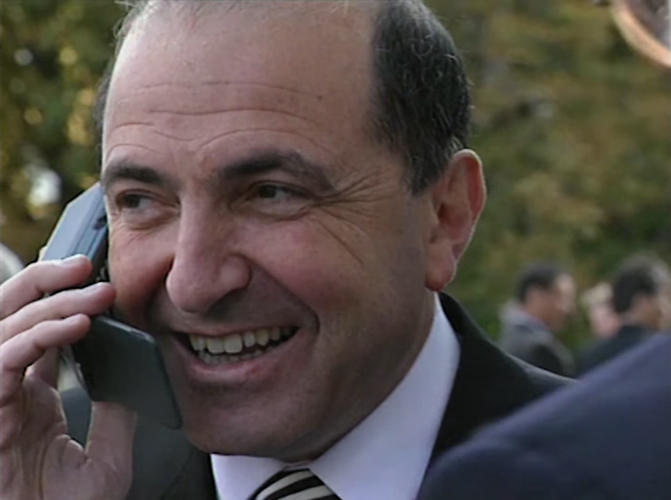
This weekend, in Moscow, at the “era of change” festival, the presentation of the ten-part web series Andrei Loshak “Berezovsky is who?”, Which was shot in parallel with the work of Peter Aven on the book “Time of Berezovsky” , took place. The public, gathered in the Cinema October, showed the first episode and nine promotional rolleries of subsequent series. The project is promised to be up to the network in late March.
Each video in the presentation precedes the screensaver - a disturbing question pops up against a black background: Berezovsky - who is he? In the book, Peter Aven shows the hero in several hypostations: a mathematician, a businessman, political strategist, a state official, an oppositionist, an exile. Judging by the replicas of the author of the series Andrei Losk, he is most interesting to the last stage of the hero’s life-exile and political struggle, and not the everyday life of the Institute of Management of Management in the 1980s or the Logovaz operation in the 1990s. Thus, the accents in the series are shifted, it seems that there is nothing left of the rogue novel - one continuous Shakespearean tragedy.
But the first series tells just about the limited mathematical talents of Berezovsky - a born businessman, but not a scientist. In the book - in the chapter "Mathematician" - the former colleagues of Berezovsky on IPU are talking about this time. And there, despite the abundance of the specific details of the “problems of management”, which were made by Berezovsky, and decided by less entrepreneurial subordinates, Aven is mostly explained to the reader almost the main thing: that the position of the intellectual in the late USSR was reduced to the role of a disagreed, but passive commentator, and Berezovsky took this model and broke. I moved from words to business.
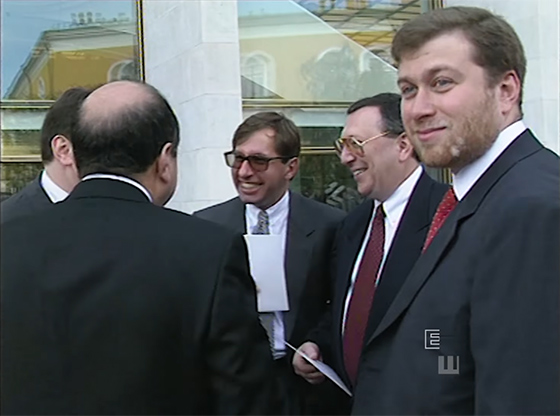 Frame from the series "Berezovsky is who?"
In the series, this important thought, alas, is crumpled-it seems that the authors are afraid to tire the audience with a scientific texture-and the then Berezovsky’s activity is more or less reduced to his curious detention at the Makhachkala airport with linen for sale. Already in the first series, historian Yuri Felshtinsky and publicist Alexander Goldfarb appear (in the book of Aven they enter only the third part - “oligarch”), but IPU colleagues Mikhail Denisov and Vitaly Greenberg, on the contrary, disappear. It seems that the narrative is accelerated in order to quickly move the viewer to a period of political intrigue more interesting to the author.
Berezovsky is already building in the first series - according to the stories of contemporaries - Napoleonic plans. I will be a member, academician, a Nobel laureate, the CIS secretary, and then Russia will become free. Personnel of chronicles act in the series, in which difficult Russian citizens stand with a doomed look in endless lines or waving the Berezovsky, return millions. These television techniques clearly reduce the effect of meeting with the heroes of the film. The authors, as they said from the stage, had 60 hours of interview at their disposal - it is a pity that they did not limit them to them. Even to those who read the book, it is interesting to look into the eyes of Aven's interlocutors - associates, fellow travelers, friends and enemies of Berezovsky. After all, one thing is a text on paper, the other is living voices and faces, intonations, emotions, grimaces, smiles and silence that are more eloquent than words.
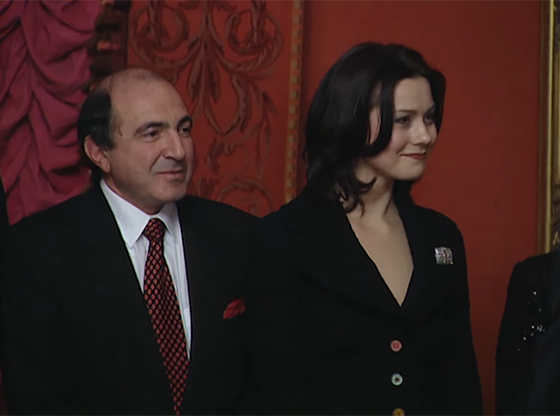 Frame from the series "Berezovsky is who?"
This more than popular move - to illustrate the interview with contrasting chronicle - Andrei Loshak at the presentation explained by the fact that the audience needs to be entertained. But at the same time, the author seemed to overestimate the awareness of his potential audience: for some reason, not one of the characters of the series is equipped with a biographical certificate. It is assumed that the audience knows who Vladimir Borzenko or Alexander Gnedin is. And, for example, the main interlocutor of Peter Aven in the first series Leonid Boguslavsky is represented as the son of Zoe Boguslavskaya.
After the presentation in the hall, a brief and rather chaotic discussion took place with the participation of Peter Aven, Andrei Loshak and the producer of the series Anatoly Golubovsky. The moderator Stanislav Kucher shall be clearly imposed by the authors of the project, why they got involved in all this, how they still relate to Berezovsky and what to understand about the past in order to move to the future, but those present on the stage were clearly not ready to answer. Aven made it clear that there was no purpose to answer such questions - he undertook to write because he wanted to talk with old friends.
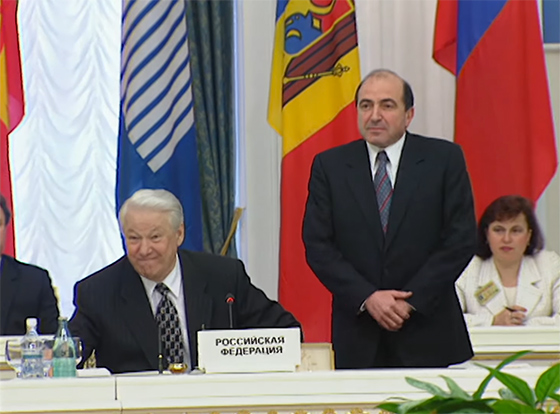 Frame from the series "Berezovsky is who?"
After reading the book, it seems that everything and everyone are compromised in Russia - and all its heroes could say: "Berezovsky is us." But at the same time, they seem to be engaged in group psychotherapy-"Hello, I am such and such, and I have nothing to make excuses for." Responsibility for the past is shifted to the shoulders of the deceased - in the end, he redeemed blood, we don’t even need to wash his hands.
And after watching the series (at least the first series), on the contrary, you think: no one is to blame. Although Andrei Loshak actualized the situation - judging by the promo of future episodes , Berezovsky’s defeat with parallel installation of the inaugurations (triumphs) of Putin. But for now, causal relationships are invisible, and it seems that no one dragged anyone into power-in this the authors of the film, by the way, coincide with one of the most equanimous interlocutors Avena Valentin Yumashev: to repent to those who survived, all the roads lead to Yeltsin Center, even the pilgrims of the pilgrim and craft.
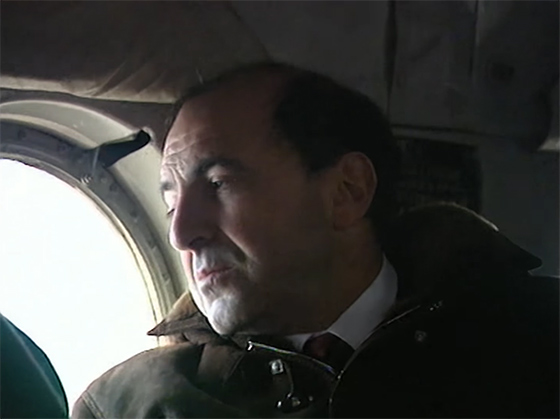 Frame from the series "Berezovsky is who?"
So it was during the time - changes, missed chances, anti -democratic intrigues, seven -banking, new, unprecedented opportunities - Berezovsky time? And what remains of the "time of Berezovsky"? Former editor -in -chief of Kommersant Andrei Vasiliev in the film says - nothing. The audience, who watched the first episode in the hall, did not agree. "Putin, Putin stayed!" -shouted from somewhere from the upper rows. “A very right remark,” Anatoly Golubovsky boldly joked.