
Translated material
Nuclear ashes 35 years later: the pre -election “sketch” or the latest world order?
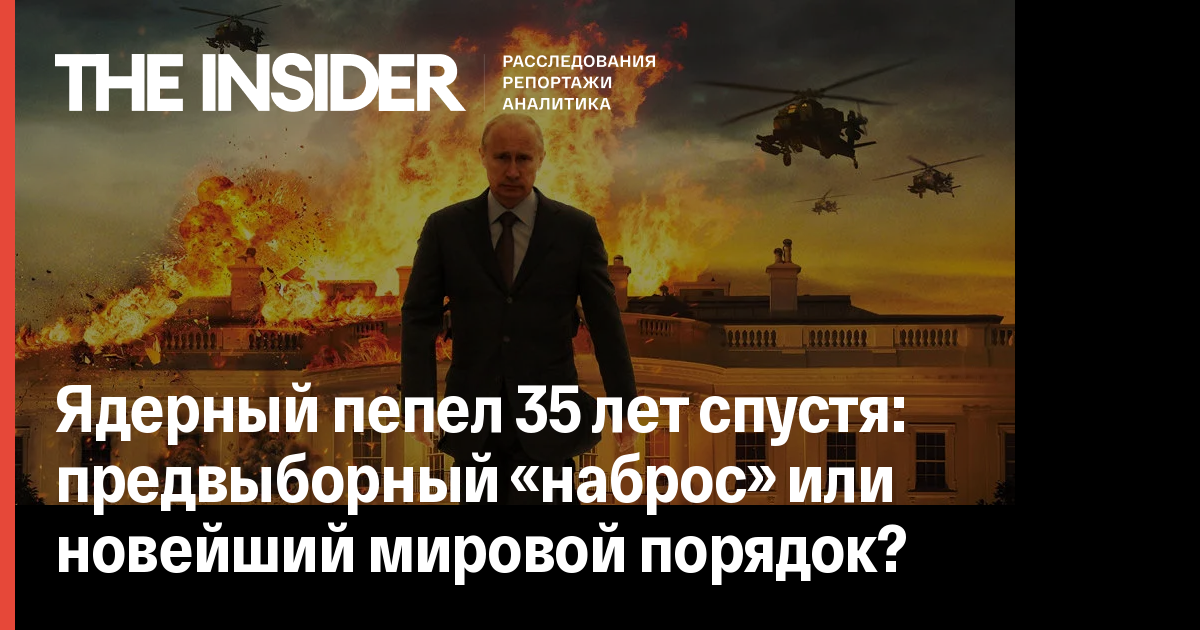
In the television movie of Vladimir Solovyov “World Camp 2018” Vladimir Putin discusses the nuclear war: “Yes, for humanity it will be a global catastrophe, for the world there will be a global catastrophe” and wonders: “Why do we need such a world if Russia is not there?” A series of warlike statements by the Russian president has become the subject of discussion among politicians, experts and world media. As the apocalyptic rhetoric of the Russian president is perceived in the West and what the language of the new Cold War could lead to, the media analyst Vasily Gatov tried to figure out.
Deja vu
35 years ago, around the same days of March 1983, US President Ronald Reagan informed the United States citizens that he decided to develop a new generation of weapons - a strategic defense initiative (soy/SDI), which should become a shield of the country and free world with aggression of the Soviet Union. The SDI did not embody into a real defensive (or offensive) system, and, most likely, was primarily a subtly calculated information operation, but in many ways it was the “star wars” that turned out to be the reason that plunged the USSR into another round of crazy expenses into service and defense - a round that turned out to be the last for a communist experiment.
It is difficult to resist this memoirs today, when the Russian president specifically reports - Urbi et orbi - about the new Russian weapons, the next day states that the main thing is that he would like to change in the past is the collapse of the USSR, and a day later says that he is ready to turn the whole world into nuclear ashes, "if there is no Russia in it."
As the psychologist would say (even without the coincidence of the dates) - Putin “mirror” the image of America, turning with the old, if not archaic, fears to consciousness injured by a cold war. It is likely that he seeks to obtain reaction from the American elites similar to that erroneous policy of the Soviet Union after 1983 - the promotion of the economically destructive arms race “on new physical principles”, which, in turn, leads to an increase in internal contradictions in society, destabilizing the ruling regime and, in the end, to its capitulation.
Military experts and weapons experts have already analyzed the specific details of Putin’s performance about the new nuclear “tsatski”: the presentation was cooler than reality, the degree of novelty and secrecy in the message in the message was noticeably exaggerated (one way or another, it was known about all the “new products” as prototypes - maybe without details, such as “nuclear energy installation”). It is significant that the reaction of the Pentagon and the USB of the United States was even more cold -blooded: American generals reported that they had been aware of Russian developments for a long time, and the leak organized from military intelligence also reported that the Americans observed and saw failures on the tests of a terribly secret missile with a nuclear power plant. The real challenge of American military power Russia can (if everything works out) to quit no earlier than 2025 , the American commander of forces in Europe said. The official representative of the State Department Hizer Nauer only said that Putin’s appeal to the rhetoric of nuclear confrontation is regrettable , and refused to answer the questions of Russian journalists at a press conference (most likely, because these questions would be expected about “how frightened by our new superweapon”). President Donald Trump did not even receive news from Moscow by tweet (not to mention the official reaction), although, as the host of Channel One was fantasized, he was “woke up 28 times during Putin’s message”.
Even in permanent hysteria about Russian intervention, the American press did not particularly strain about the news about Wunderwaffe (with the exception of, perhaps, CNN - but this is a special article). The decades of real missile and nuclear discharge have been made from the American editions of the authors who are versed in the relevant threats , and they tend to rely on the opinion and information of experts (which, as I said, reacted more than cool). The fact of the ignorance of the Message obviously addressed to him was attracted much more attention.
But still, the analogy with SOI and the performance of Reagan does not leave on March 25, 1983: the famous military expert Michael Kofman joked that Putin’s speech was perceived in the American VPK as a guarantee of Mutually Assured Spending (mutually guaranteed missing money; The principle of guaranteed mutual destruction lies at the heart of all concepts of nuclear deterrence - VG).
The statements of the President of Russia will primarily be read and translated into the language of financial tables - and, most likely, have already been translated. However, you should not forget about the Upamo-REMOUSTION OF RECRIPTION OF BOTICTION OF THE Strategic Nuclear Potential (TRADA) in 2013, and supported by Trump in 2017, expanding this program-with the clarification that Russia (together with China) becomes the main goals of the detainment policy (Containment). Almost all the years between 1991 and 2016 in our country in the crossroads of this “sight” were not for various reasons-from the weakness of the early 90s to the mess of the reforms of the mid-2000s. However, even the accounting approach does not promise the “tantrums” that the Kremlin dreams of: the Pentagon’s budget for the current year is almost $ 600 billion (and the total defense costs, new weapons, the fight against ISIS and maintaining the entire military machine in working condition and more - almost $ 875 billion ), almost ten times more military expenses of the Russian Federation. On Putin’s words about the cheapness of Wunderwaffe, American analysts are frankly laughing, providing their readers with numerous links to the facts of corruption in the Russian military -industrial complex and the Armed Forces.
... and a little about the weather
The Russian president pronounced his message by Urbi et orbi in the context of the election campaign; His subsequent explanations (at the journalistic forum, in an interview with Vladimir Solovyov, at a meeting with the FSB workers) are all the more part of the communication strategy of the election on March 18. However, one can consider these statements “inside out”-by seeing the elections in Russia as part of the geopolitical strategy of raising bets, blows on the “unipolar world” in the 1990-2010s with the undeniable leadership of the United States and the alliances created by the Americans, Putin, as if enchanted, reproduces the “stupefaction” models described by Vladimir Lenin in the article about the article “about about the article“ about about the article “ The student Putin did not read the national pride of the Great Russians ”(it seems to me that, despite the Soviet education, this work of the classic of Bolshevism has not read).
At the same time (within the framework of the concept “inside out” this is better), Russian military thinkers and Putin are trying to knock out supports from the concept of mutual deterrence . Their main argument is that the United States “first began”, developing and unfolding about PRO systems in Eastern Europe, as well as antique reminders of America about its own sins regarding the intervention in the internal affairs of opponents and allies, the former daily practice of the Cold War.
Since the elections on March 18 have a 100% predictable result, the “West” imagined by Putin and the General Staff should realize (“Nobody listened to us. Listen now”) that the devaluation of the principle of mutual deterrence is seriously and for a long time, and ... look at paragraph one, get involved in the exhausting armament race around relatively implausible systems.
As they say in some circles, it is a “good sketch of shit on a fan” - indeed, the “West”, which is imaginary in the Kremlin, which is real, is serious about strategic long -term threats. Complex liberal-democratic societies encountered strategic challenges launched the processes of crystallization of interests, conflict discussion between representatives of these interests, coordination and development of a common (or at least acceptable for the majority) reaction. For example, the refugee crisis of 2014-2018 led to a significant increase in the right -wing populism in the EU countries, crystallizing the interests of those who scares and outrages the current inclusion policy - now Europe is at the point of searching for the balance, which is expressed in the electoral successes of parties and movements set up for xenophobia and isolationism. The Kremlin, by the way, joyfully supports these forces, believing that they will be able to destroy or at least weaken European and Atlantic unity (first of all, in terms of restraining the Russian Federation).
These serious calculations are not devoid of certain grounds: EuroSceptics and NATO are at least wary, and the undermining of the Atlantic Bloc is the cherished goal of Russia, which alone is stronger than any European country, but is powerless against the collective defense (and political position). The only constant motive in Putin’s foreign policy concept is certainly since the time of the 2007 Munich speech is that NATO has been outdated and should be dissolved, replacing the hypothetical security structures “from Lisbon to Vladivostok”.
Any weakening of NATO increases the chances of Russia to an effective projection of power - even “tough”, even “soft”, even “sharp” (as American scientists Christopher Walker, Jessica Ludwig and Joseph Ney suggest now calling a hybrid threat coming from Russia and China). Such a projection makes European politicians more accommodating from Tallinn to Lisbon; Opportunities for Russian business and Russian corruption are growing, but, most importantly, a more old dream is returning - the possibility of managing Europe in the "concert of nations" (never voiced by Putin, but repeated by its interpreters like Sergei Karaganov).
However, all these theoretical constructions and even efforts on the invisible front of the support of European right and nationalist radicals can become a reality only in the event of a sharp change in the US policy in relation to European security. Moreover, so sharp that this will require much more than Donald Trump's statements to European leaders about the need to “pay his share” in the NATO budget.
The American geopolitical theory (including the doctrine of containment and the principles of the projection of force) is a historically determined and very complex concept that arose as a result of more than 200 years of coordination of interests. It bizarrely combines the “doctrine of Monroe” and the expansionism of Woodlo Wilson, who made a decision on the participation of the United States in the First World War. The “red threat” of the beginning of the 1920s is mixed with McCartism of the 1950s and was diluted with the most difficult maneuvers of Franklin Delaino Roosevelt at the beginning of World War II. This is not a “Dulles plan”, invented by Soviet counterintelligence, and not the anthology of the mistakes and successes of the presidents of Eisenhower, Kennedy and Nixon. This is precisely a complex and constantly updated cocktail composition, which has always has one component - European security since 1918. In order to achieve the desired result, all of the above must be “canceled” (for all the extravagance of Trump is unlikely), and then wait for America to distinguish from Euro-security to a distance that makes Russia to its historical dreams. Igor Klyamkin, analyzing these constructions, wisely noted that with the “game of long”, especially in the Cold War mode, Russia historically did not work out. Most likely, hopes are also deceptive this time.
Meanwhile, the Putin missile-nuclear invectives caused a different reaction than the one that was expected-at least in the early days. Instead of “strategic fear”, something else is observed: Russia's reversing from Trublemaker (annoying, creating problems) in Adversary (enemy, enemy) and even Rogue state (state-criminal state) . If, before the message of purely negative assessments, they mainly related to Russian intervention in the election of the US President in 2016, then, starting from the Nuclear Posture Review (a report on the state of nuclear weapons, a regularly updated document describing what strategies it is needed in connection with the existence of nuclear weapons. In other countries of the world - VG), such estimates are common to other elements of the foreign and military policy of Russia. Accordingly, the military, diplomatic and, above all, the US missile and nuclear policy for the first time in 25 years will proceed from the need to deter Russia (together with China, North Korea and Iran, as well as terrorist groups). To achieve such “re -taxation” is a great “success” of Russian foreign policy. Although, in fact, the main goal for Putin was the internal policy.
Bastions, catapults and imagination
Before the 2018 Epistle, the key message of Russia was the idea of a besieged fortress , offended by inattention and even humiliation from the "surrounding". The tightening of domestic policy in such a “fortress” is, in accordance with the analogy, the search and elimination of the gap in fortunes, the identification of agents of the influence of aggressors and the consolidation of the spirit of the defenders (for especially meticulous - the search for the Achilles heel; however, this did not save three, as you know). This concept, seasoned with the ideas of spiritual superiority, strangely contradicted the significant dependence of the country both on the export of energy produced in Russia, and the same, if not more, the country's dependence on the import of complex products and technologies. Turning to Homer's images, it was as if Troy earned, selling grain to the Achaeans, at the same time completely dependent on supplies, say, plumage for arrows from Greece).
Putin what was said in the message is, first of all, a revision of the concept of the “besieged fortress” (and this change was perfectly considered both in Washington and in European capitals). The "fortress" passed from the defense of its borders to - so far - verbal aggression; If Putin was limited only to a demonstration of weapons, his rhetoric could be attributed to his personal hobby with nuclear rattles. But the President of Russia, led by either his own instincts, or the advice of insane PR managers, goes further and literally declares that he is ready to turn the rest of the world into ashes, "if there is no Russia in it."
As I said above, in the Kremlin’s political line, an imaginary West plays a significant role synthesized from Hollywood films, speculative series such as “Card House” and the modernized nonsense of N. N. Yakovlev (who wrote the book “CIA against the USSR”, on which the generation of Putin was certainly brought up). However, the “fortress”, which the collective Putin defends in its imagination, is also imaginary - only completely different books and films serve as soil for imagination. I don’t know where Putin & Ko has seen enough and read about the gullible Russian people who are easy to seduce and who does not see the “right enemy” (that is, his exploiter), but - and any of his text to this, proof of this, the main fears are just the stupid Russian fairy tales about the White Goby of the United States.
Unfortunately, in the modern Commoned World there is no such thing as “internal propaganda”. Everything that Putin speaks for “home consumption” not only gets west, but also becomes the subject of careful consideration - just like a public reaction to these “samples”, genuine or invented by VGTRK. And if four years ago, in the Crimean-Donbass times, the real West was ready to carefully peer into Russia and understand how plausible the explosion of nationalist self-affair is, today an increasing number of influential analysts do not even turn to a liberal reservation: "Putin is Putin, the Russians as a whole is not Putin."
The game of the besieged fortress, ready to sacrifice everyone - including himself - just to prove to the world that “you are wrong,” as you were, remains a dangerous and meaningless game. History ironically throws up many options for the development of this line - where there are the latest bastion defenders who broke the course of history, and backward barbarians who conquered Rome, and camel riders, absorbed the remnants of ancient civilization. However, the XXI century is not the Middle Ages and not antiquity; Competing civilizations not only dealt with the problems of nomads and built walls, impregnable and lustful. In the information era, the winnings are not achieved on the bloody fields of the battles, but where you will declare you the winner of CNN (therefore it is not surprising that Putin’s words about the super -weapons are most interested in them from American channels), and where you will have a large and bold contract with the “official broadcaster of a small/big war, necessary to enter”.