
Translated material
The kingdom of broken mirrors
For the media, Putin's last term has become a turning point. For six years, the Fourth Power has come from point censorship to almost total control by the state
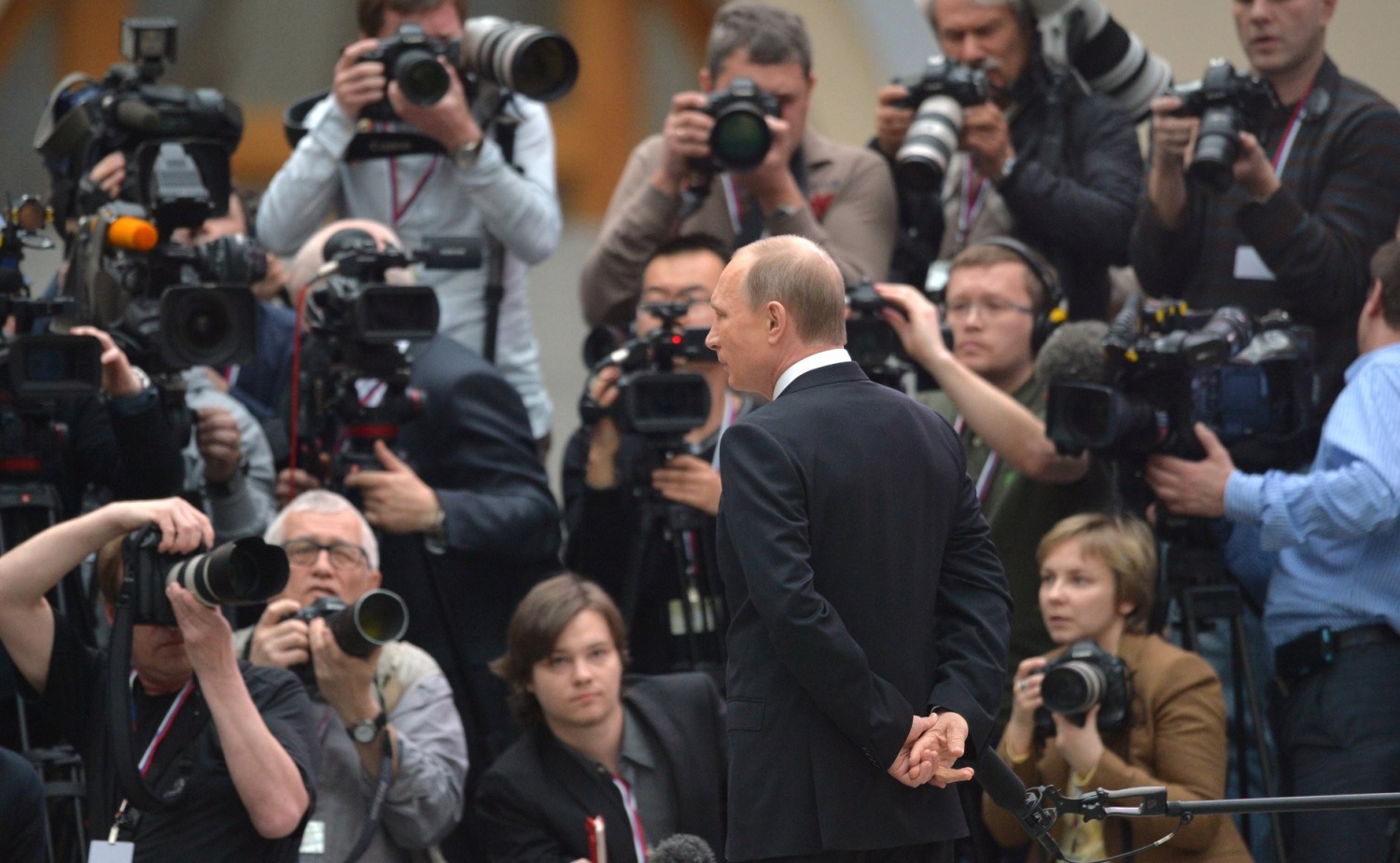
Photo: kremlin.ru
Masters of the servility
In recent years, “it has become very difficult to work, Putin is increasingly demanding to praise and you can at least somehow ironize less and less,” one of the journalists of the Kremlin pool sighs in a conversation with NT. This is logical, the president is increasingly called the “king” in the bureaucratic environment, respectively, and in public it can only be positioned as a higher being, the expert cooperating with the AP notes.
Society has recently become an almost mandatory element in Putin's work. “This is how everyday the President of Russia coughing into a scarf, and many politicians in the West and Generals of NATO must have been thrown into heat,” in such expressions, for example, described the last message of the president to the Komsomolskaya Pravda federal assembly. “(Putin) is already a man - a national idea,” said the TV presenter Irada Zeynalov , talking about his nomination for the fourth term in the NTV “Results” program.
Now such epithets seem obligatory, but not so long ago the situation has not been so close to the press of Brezhnev times. Until the beginning of the 2010s, the position of the authorities was tough, but had its own limits: the authorities strictly controlled federal television, pluralism was allowed in the rest of the media. This pluralism also had restrictions: the authorities periodically punished too independent journalists (in 2004, Raf Shakiro B, Putin’s, “this betrayal”, became a black tag for Shakirov), but in general with independent print media, Internet media, and even channels with a small audience for the photos of the chief editor of Izvestia in Beslan. Motioned.
The last throats of freedom
The situation began to change at the end of 2011, when Putin decided to return to the Kremlin. After the Duma elections of December 2011, which showed a decrease in the rating of United Russia, Kommersant-Vlast magazine published a photograph of the ballot, on which Putin was invited to go in a well-known direction. The editor -in -chief Maxim Kovalsky was immediately dismissed.
The general director of the Izvestia newspaper Aram Gabrelyanov, according to the memoirs of one of the employees, gathered leading journalists and warned them that the newspaper would have to "take a patriotic position." Gabrelyanov eventually fulfilled a promise and turned the newspaper into a combat sheet of power, but this happened a little later.
When the protests on Bolotnaya began, television still tried to demonstrate some objectivity. On December 10, immediately after the rally on Bolotnaya, the host of NTV, Alexei Pivovarov, said that he would refuse to go on the air if the channel would not illuminate protests in the country. After that, within a few weeks, representatives of the opposition (Boris Nemtsov, Vladimir Ryzhkov, Ilya Yashin) were regularly shown on the air of federal TV. And Ksenia Sobchak in early February, a month before the presidential election, was given to hold the State Department, the leaders of the opposition took part in the MTV channel, which was popular with the Youth Channel. True, the next broadcast, with the participation of Alexei Navalny , refused to broadcast the channel, but it was shown according to RBC-TV .
On January 18, 2012, the editors were invited to a meeting in Novo-Ograevo with President Putin: “It was a very tough conversation,” said the editor-in-chief of the independent newspaper Konstantin Remchukov
Repressions against the main editors, even quite loyal media, began shortly after the December 2011 parliamentary elections. The New Times wrote then: “According to sources, the deputy head of the AP Alexei Gromov compiled a list of 5 chief editors who needed to be restrained. It included the editor-in-chief of Kommersant-Vlast magazine Maxim Kovalsky, the chief editor of City-FM Alexander Gerasimov, the owner of the rain television channel Natalya Sindeeva, the editor-in-chief of Echo of Moscow, Alexei Venediktov and the head of RIA Novosti Svetlana Mironyuk. Gerasimov and his deputy Igor Zimakov were fired on December 14. Cause? Lighting of Moscow protests. After 2 days - Maxim Kovalsky lost his place. For days earlier, problems began with the State Agency of RIA Novosti, which led television from the prohibited rally on the triumphal square on December 6. At the twelfth minute of Mironyuk’s broadcast, as sources in the agency say, Alexei Gromov called. This came to the employees of the agency in the following interpretation: “They called us from above and said:“ Are you very stunned? Spread everything, ”says an agency employee on the condition of anonymity.” But Mironyuk, according to sources, managed to fight back. “She played a fool and said that this is just a mistake and video actually users should not see,” the source says.
Prochrevsky political analyst Sergei Markov accused RIA of supporting the "Swamp performances." In the end, this cost Mironyuk work : she was discharged a wolf ticket, and the agency was liquidated. He actively broadcast the measures of the opposition and the Rain television channel, which was included in the packages of almost all cable operators, including regional ones: the Channel Channel Natalya Sindeev, after that, was called to the carpet in the Kremlin. It also went to others: on January 18, 2012, the chief editors were invited to Novo-Ogarsevo to a meeting with President Putin: “It was a very tough conversation,” said Konstantin Remchukov, editor-in-chief of the independent newspaper. “Echo of Moscow” is pouring me with diarrhea from morning to evening, ”the candidate Putin, the chief editor of the radio station, rode out“ Present ”to the chief editor of the radio station. As the next six years showed, he did not forget anything. And did not forgive.
Between the "Law of the Schools" and the Crimea
In early 2013, the Russian leadership was preparing for the next round of confrontation with the West. This policy demanded the struggle against the “fifth column” within the country and did not even allow Putin's formal criticism. At the end of 2012, the “Law of Dima Yakovlev” (“Law of the Scoundrels”) entered into force, which banned - in response to the adoption by the US Act of Magnitsky, to adopt Russian children. At the same time , power began a real attack on the media on all fronts.
The symbol of the change was the new leading main final program of the Russian Channel “Vesti Week” - since the end of 2012, Dmitry Kiselev became it. “Putin, by general recognition, is perhaps the most competent head of state on the planet, if not the most competent,” he said
On federal television channels, this resulted in the destruction of even harmless humorous formats. There are an analogue of the famous program of the old NTV “Dolls” as the “Cartoon” project that was published before 2013 on the “First Channel”, but completely loyal to power. Basically, all jokes concerned foreign leaders or secondary officials. However, by this time, Putin’s representation in the form of a funny character became, according to the Russian leadership, inappropriate.
The symbol of the changes was the new host of the main final program of the channel “Russia”, “West of the Week” - since the end of 2012, Dmitry Kiselev became it. “Putin, by general recognition, is perhaps the most competent head of state on the planet, if not the most competent,” he said in one of the issues. The presenters who tried to look neutral, from the federal channels, left completely, as Alexei Pivovarov did at the end of 2013.
In 2014, the last independent program of Ren-TV “Week with Marianna Maximovskaya” was closed. And in the same year, the Rain channel was on the verge of destruction, which was removed from cable networks, using as an occasion an unsuccessfully formulated issue regarding the blockade of Leningrad.
If Gromov was engaged in stripping television channels, then another senior official - the Kremlin curator of domestic politics Vyacheslav Volodin, undertook to “put in order” the Internet
At the end of 2013, the liquidation of the lighting protest of the RIA Novosti team - the new leaders of the agency with the new name - MIA Today - became Dmitry Kiselev and Margarita Simonyan. The latter was called the favorite of the Kremlin curator of information policy Alexei Gromov. And another state agency, ITAR TASS, returned the Soviet name - TASS.
Do not believe printed
Gradually, the authorities took tight control and print media. This was most vividly manifested in the Kommersant holding. The Kremlin’s fury that once caused Kommersant-Vlast magazine was actually eliminated, Director General of Kommersant Demyan Kudryavtsev was dismissed, the Kommersant-TV project was closed, the leadership of the Kommersant-FM radio was replaced, and the famous daily newspaper began to be hard to censored. As a result, acute materials stopped in the newspaper, while the leadership of the newspaper began to more and more often delete the already released materials, which contained criticism of the country's leadership and the mention of Alexei Navalny.
But the authorities did not stop there, but moved to the establishment of control over the Internet media. If Gromov was engaged in stripping the channels, then another senior official - the Kremlin curator of domestic politics Vyacheslav Volodin , undertook to “put in order” the Internet.
By 2013, there were two obvious leaders in the Internet media market, producing unique content-“Lenta.ru” and “Gazeta.ru”. They were combined into one holding and transferred to the department of loyal entrepreneur Alexander Mamut . In September 2013, the leadership of Gazeta.ru was replaced by Galina Timchenko, editor -in -chief of Lenta.ru, was dismissed at the beginning of 2014 (a most part of the editorial office left her): instead of Timchenko, a manager close to the Kremlin, Alexei Gororevsky, was appointed. In 2018, he already officially transferred to work in the Kremlin administration and, according to some reports , he could in the future lead the Presidential Office for Public Projects.
Crimean consensus
In 2014, after the accession of Crimea, a new stage has come in the life of Russia. The Duma parties began to vote on all issues unanimously, and the media - almost unanimously praise the president.
But there were still several publications that could afford to conduct investigations and objectively, without self -censorship, to analyze the situation in the country - business publications of RBC and Vedomosti, New Gazeta and The New Times weekly. Initially, there were no tasks of destroying them, it was only necessary to enter them into the Crimean consensus in order to make them controlled in emergency cases, says the interlocutor NT, close to the Kremlin. Their permissiveness against the general background looked very strange, he reasoned.
As for The New Times, the magazine for a long time saved the phrase, said at one of Putin’s meetings and the owner of the magazine Irene Lesnevskaya. "She spends her money - well, let her spend." The magazine was actively read in AP, but strictly forbidden to give an advertisement to the magazine: "He will die." In early 2013, Lesnevskaya left the magazine. The next four years, the magazine lived on a hard cash diet, which became almost hungry when the magazine was practically blocked by the possibilities for distribution. Kioskers posted an announcement: "The New Times magazine is prohibited by the Government of the Russian Federation." It was not true, but it worked: the distribution networks refused to take the magazine. Subscribers asked to deliver a magazine in brown bags - so that concierges and neighbors would not see that the name was reading an opposition publication. In the end, in early June 2017, the paper version of the magazine was stopped - it remained - so far - only the site.
They took up RBC and Vedomosti approximately at the same time, but RBC fell under a greater blow. By 2016, this publication had several own investigations about the President Putin family. This caused the rage of the Kremlin, notes the interlocutor close to the presidential administration. As a result, the holding leaders were replaced by immigrants from the state Tass.
Initially, there were no tasks of destroying RBC and “Vedomosti”, it was only necessary to enter them into the Crimean consensus to make controlled NT, close to the Kremlin controlled in emergency cases. Their permissiveness against the general background looked very strange, he reasoned
The leadership and RBC-TV were replaced, the so-called “Watching from the Kremlin” appeared in the holding-the protege Gromov Alexei Abakumov became the director of development. All this became possible thanks to the change of owner - shortly after the searches that the FSB held in the office of the owner of RBC Mikhail Prokhorov and his other companies, and subsequent problems with the sale of his Russian assets, Prokhorov agreed first to the media to the owner of the Komsomolskaya Pravda, which was also close to Gromov, Gregory Berezkin.
A separate law adopted in 2014 helped change the leadership of the “Vedomosti” Kremlin. He forbade foreigners to own more than 20% of the shares of Russian media. The initiator of the law was Vyacheslav Volodin, at that time the first deputy head of the AP, which was responsible for domestic policy. As a result, the consortium of foreign owners sold the newspaper Demyan Kudryavtsev and his partners (there are still rumors in the market that the real buyer, or one of the real buyers, was the co -owner of the Siberian Anthracite and the Rosneft partner Igor Sechin, No. 97 in the Russian Forbes list Dmitry Bosov). Soon after, the chief of the publication Tatyana Lysova left the post, and Ilya Bulavinov, who previously led the Website of Channel Channel, replaced her.
The same thing happened with the Russian Forbes. After the adoption of the law, the German Axel Springer was forced to sell the magazine to the publisher of Glovza (L'Officiel, SNC, OK! Etc.)
Alexander Fedotov. He immediately stated that there was too much politics in the magazine. The journal changed the editor -in -chief, and many key journalists left. Soon there were suspicions of censorship-in the next rating of the salaries of top managers, the leadership of the magazine decided not to indicate the income of the head of VTB Andrei Kostin.
The changes also affected the “new newspaper” (she celebrates her 25th anniversary this month-congratulations to colleagues!), Which has released more than one resonant investigation-in particular, about Putin’s friend, the cellist and, as it turned out, Millionaire Sergei Roldugin . Last year, the editor -in -chief was replaced in Novaya, instead of the founder of the newspaper Dmitry Muratov, the post was taken by its general director Sergei Kozheurov. The decision was preceded by rumors circulating on the market about the new investor of the publication: his name ultimately called Ksenia Sobchak - Sergey Adonyev, co -owner of Yota Devices, convicted and served in the United States and, as they say, included in the orbit of the influential colleague of Putin in Dresden, the head of Rostec, Sergei Chemezov. ADONEV became one of the sponsors of the presidential election campaign Sobchak.
By and large, there is practically almost no one to close, so the Kremlin breathed a sigh of relief, says a specialist who is engaged in the president who is engaged in Telegram channels. According to him, the greatest concern of the authorities now is the channels in Telegram: the Kremlin is actively trying to enter this market. It is easy to work with the rest of the media - they can either order, or - under extraordinary circumstances - block the relevant materials and links by decision of Roskomnadzor. This is exactly what happened with a loud investigation of the FBK about the walk of Oleg Deripaska and Deputy Prime Minister Sergei Prikhodko in the company of Nastya Rybka and her friends. Obviously, a lot of headaches is the Kremlin and the YouTube channel of Alexei Navalny “Navalny Live” , which has 462 thousand subscribers, and his individual issues are watched up by up to 3.5 million people. On February 19, in YouTube, the Leonid Parfenon channel started. What will be the Kremlin’s response-we will see in the next six months, most likely after the completion of the 2018 World Cup.