
Translated material
Atlas of Putin
On the eve of the inauguration, the ruler took up history and cartography: he is already preoccupied with perpetuating his ideas about the world
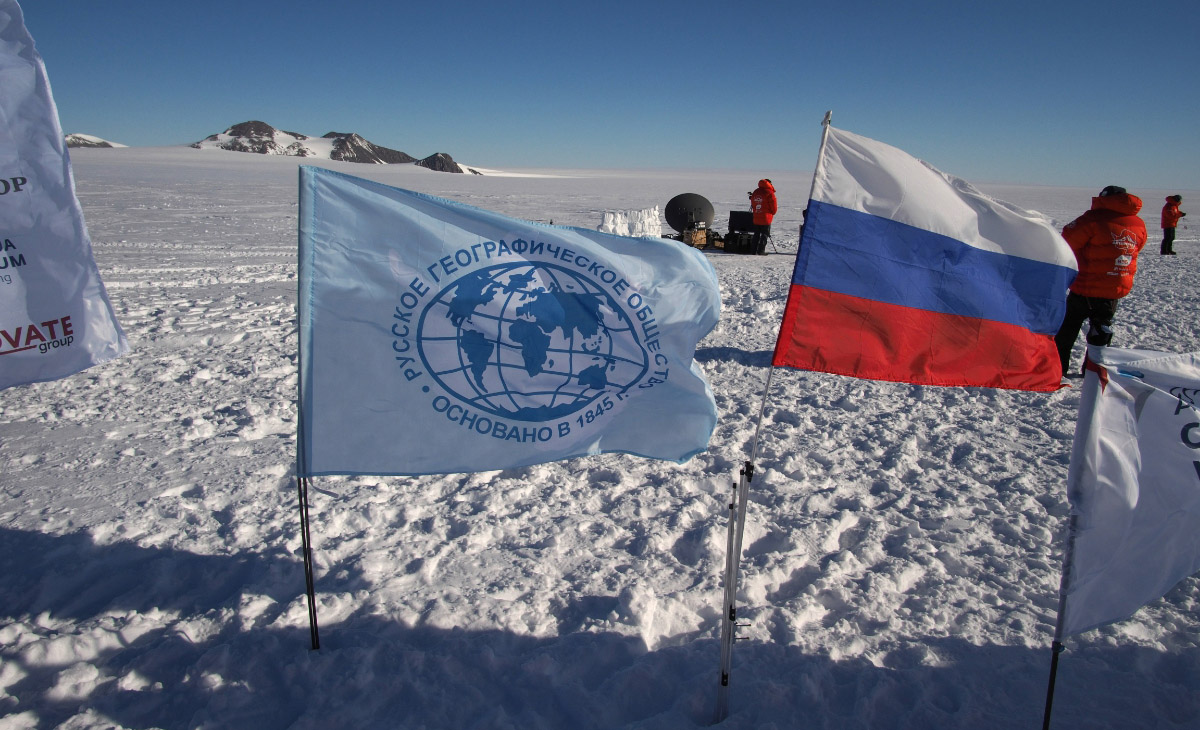
Photo from the archive of the Russian business expedition “Antarctica. Leaders Club 2015 "
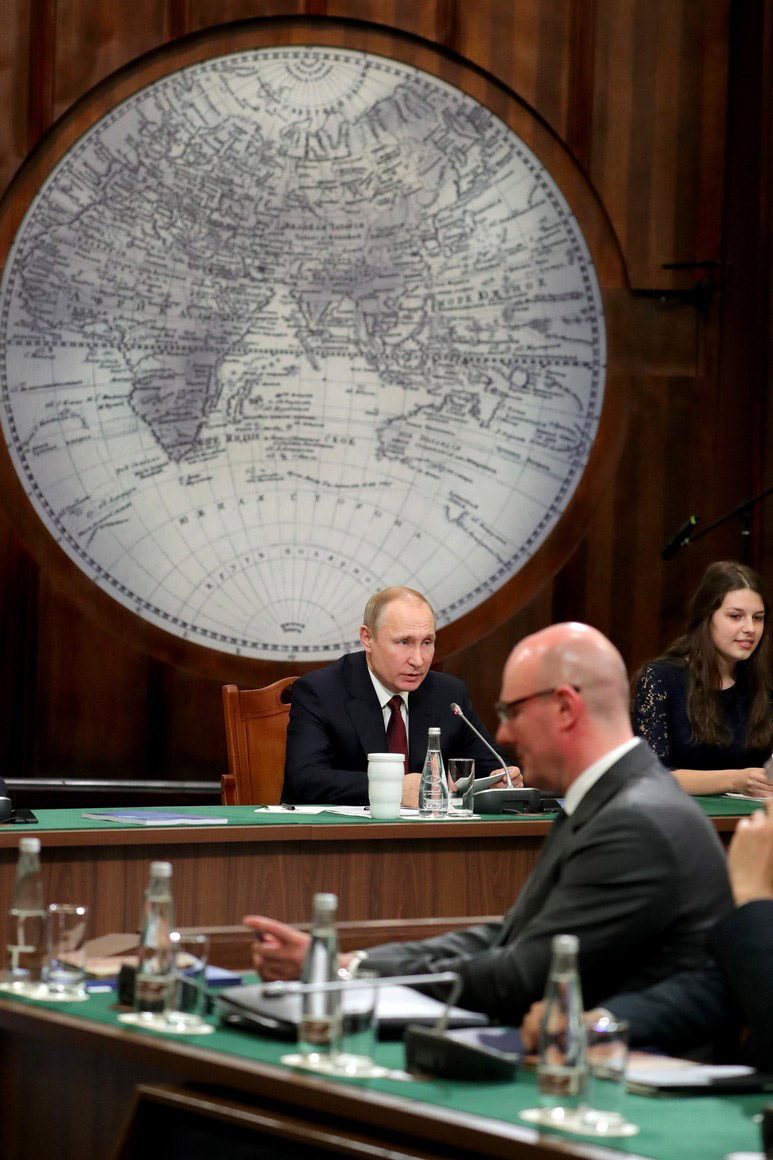
Board of Trustees of Russian
geographical society,
April 27, 2018 Photo: Kremlin.ru
At a meeting of the Board of Trustees of the Russian Geographical Society, Putin talked about geography and proposed creating a new atlas of the world. In 2018, when both Google cards and Yandex cards and many more different cards are available on any smartphone, it may seem that Vladimir Putin suggests urgently invent a bicycle.
However, everything is not so funny. The president is not at all worried about the technology at all, but dear to him ideology: “It is proposed to prepare a new Russian atlas of the world in which all such cases (renaming the toponyms bore Russian names) will be correctly interpreted,” he said. The President believes that through the use of other names on the maps “the memory of Russia’s contribution to the study of the planet and the development of science is also erased.
Putin also gives concrete examples, “where the names, given by the discoverers of the continent (Antarctica) Lazarev and Bellingshausen, almost came out of the turnover ... Today, only units know that the original, historical name of the island of Smith is Borodino, that Snow is a small Yaroslavovets, and Livingstone is actually Smolensk, and so on. But in 2020 we will celebrate the anniversary of the discovery of Antarctica. ”
We can talk about the non -recognition of post -Soviet renaming, that is, the peak of Ismoil Somoni will have to be called the peak of communism (or even the peak of Stalin), and the city of the Dnieper is Dnepropetrovsk or even Yekaterinoslav, and so on, up to Tiflis, Vilno and Revolution
The theses of Putin raise questions. Firstly, Antarctica is still quite far from Russia and a sparsely populated place, therefore, in a practical sense, most Russians can hardly find out how insidious Anglo-Saxons call the island of Borodino on their maps, and what prevented Russian names on Russian maps-then a secret. Secondly, it is not very clear how atlases with the names approved by Putin will be used in Russia, not to mention the rest of the world. In the XXI century, any officially published atlases (especially if it is paper atlas!) Could hardly affect modern people about the world, first of all, because in most cases they use Internet resources with cards and choose those that are most accessible and convenient as possible. Therefore, no matter what a wonderful atlas publishes the Russian Geographical Society, it is very doubtful that it changes something in world toponymy, especially outside Russia.
A separate question is-is it only a matter in Antarctica, or Putin wants to get such an atlas of the world where all geographical objects bear the names that meet it conservative-ray ideological attitudes? First of all, as you can suspect, we can talk about the non -recognition of post -Soviet renaming, that is, the peak of Ismoil Somoni will have to be called the peak of communism (or even the peak of Stalin), and the city of the Dnieper - Dnepropetrovsk or even Catherinoslav, and so on, up to Tiflis, Vilna and Revel.
Victory Day in Afghanistan
Militarism and imperial nostalgia are most painful in the past, more precisely - in history as science. And the coming 30th anniversary of the withdrawal of Soviet troops from Afghanistan can become a catalyst for very curious processes.
Deputy Shamanov appealed to the President on behalf of veteran organizations calling for a political result under the 10-year war that the USSR waged in Afghanistan: the USSR leadership did not do this at one time, now, on the eve of the anniversary, this can be done in the form of decisions of the Federation Council and State Duma.
Shamanov wants not so much to summarize the results of a long -ending war, but to create new PR opportunities for the past to lead the country. And Putin willingly accepts the feed
However, it is completely incomprehensible to what right and with the help of what procedures the modern leadership of the Russian Federation can summarize the political results of the decisions adopted by the Politburo of the Central Committee of the CPSU regarding Afghanistan 1979-1988?
If we are talking about a symbolic gesture, then the deputy Shamanov and his colleagues should turn to Mikhail Sergeyevich Gorbachev and other living members of the then Soviet leadership, inviting them to take stock - this would be true both historically and politically. If we are talking about establishing the truth, then historians should be addressed, even if it will be historians in uniform, and invite them to formulate the political results of the Afghan war, taking into account all the data and methods available at their disposal.
But it seems that Shamanov wants not so much to summarize the results of a long -ended war, but to create new opportunities for PR in the past to lead the country. And Putin willingly accepts the feed: “I agree about the Afghans. And the measures must be held, and estimates must be given. I agree with you completely. "
If Shamanov’s project is being implemented, then we will witness an amazing ritual, comparable in its absurdity with the presentation of the Victory Order Leonid Brezhnev in 1978. In the year of the 28th anniversary of the liquidation of the USSR and the 30th anniversary of the withdrawal of Soviet troops from Afghanistan, completely different people in a different state and with other laws, economics, symbols and borders will take the forthings of that shameful war with serious persons. But is anyone surprised if the main person at the celebration of the 30th anniversary of the withdrawal of Soviet troops from Afghanistan in 2019 will be Vladimir Putin personally, who was by no means in Kandahar or Kabul-in Leningrad, Moscow and Dresden during the war in Afghanistan (1979–1989)? Alas, even if he was awarded the highest military award for the end of the Afghan war, no one will be particularly surprised. Such times have come.
* Political scientist, permanent Columnist NT
The author’s opinion may not coincide with the opinion of the editorial office