
Translated material
Promotions against the “king”: beaten, detained, minors
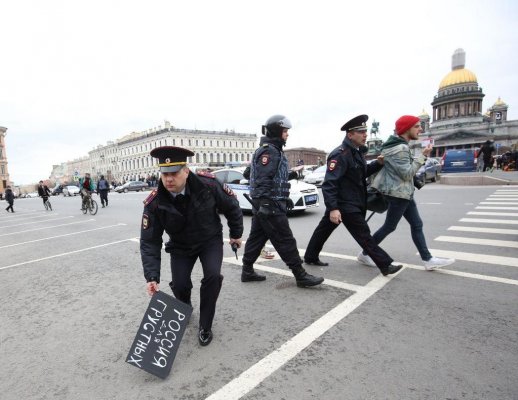
The protests on May 5 against the inauguration of Vladimir Putin, initiated by Alexei Navalny, led to mass detentions throughout the country. As the data of the ATS-Info show, people were detained both on coordinated shares and inconsistent. But on some disagreed - they did not detain.
So far, only one criminal case , open against the detainee. In Moscow, in addition to employees of the Ministry of Internal Affairs and the Russian Guard, protesters were dispersed by Donbass veterans and participants in the pro -Kremlin movements.
Detention and approval
On May 5, 2018, about 1,600 people were detained throughout the country, of which 719 in Moscow (153 were spent in the police), 217 in St. Petersburg (95 left at night in the police), 185 in Chelyabinsk, 64 in Krasnodar, 48 in Voronezh, 45 in Krasnodar. In total, the detentions in 27 cities are known.
According to the ATS-INFO, applications for the “He NOT TAVICE” shares were submitted in 96 Russian cities, they agreed from only 15 of them. In 17 cities, the shares were not agreed by the organizers initially asked, but they still agreed to the proposed options.
Often, the authorities offered unacceptable alternative protests. For example , in Kostroma they offered to hold an action at 7 in the morning in the area of the zoo, in Samara-on the Avtodrome on the outskirts of the city, in Yoshkar-Ola-next to the cemetery. In 7 cities, protests were held in a guide park, in 42 they were not agreed.
OTD-info data show that people were detained both in coordinated and inconsistent events. And on some disagreed - they did not delay. There are only one detainee for thousands of inconsistent promotions in Ufa and Yekrinburg, and in Tver the 150 participants of the permitted promotion in the Hyde Park-six.
Problems with the police had an unprecedentedly large number of journalists. According to the journalists trade union, 23 media workers were detained and/or beaten during protests throughout Russia.
Throughout the country, protests tried to disrupt a variety of methods. In Voronezh and Yakutsk, at the place of their conduct, the ensembles with loud music were arranged, the St. Petersburg activists of the Vesna movement complained to the telephone spam atak: the ongoing series of calls dropped when raising the tube.
In many cities, preventive detentions were used: in Chelyabinsk, ten organizers of local protests were detained before the start of the action on suspicion of theft, in Kemerovo, two leaders of the Navalny headquarters decided to interrogate - on a weekend during the planned protests - in a criminal case about insulting the judge. The Coordinator of Open Russia in Tomsk was going to fly to Moscow, but in his car they searched for a bomb for five hours: until he missed all the flights to the capital. In the center of Moscow, before the start of the action, one of the leaders of the headquarters of Navalny Nikolai Lyaskin, as well as activists of liberal and nationalist groups, was detained. On the evening of May 5, the official plan “Fortress” was announced in the Moscow ATS, limiting the access of defenders and lawyers to the detainees. It managed to break through to the detainees mainly with the help of members of the public observation commission.

NOD, Nashists, Veterans of Donbass
The most massive action “He is not the king” traditionally took place in Moscow on Pushkinskaya Square - and, traditionally for mass shares initiated by Alexei Navalny, without coordination. In addition to the employees of the Ministry of Internal Affairs and the Russian Guard, Cossacks, some young people with St. George ribbons, were opposed in Moscow, the small, but the active, but the active group of SERB and the more massive national liberation movement of the State Duma from United Russia Evgeny Fedorov. These people and groups were also engaged in “anti -Maidan” street events in 2014-2015.
On May 4, Fedorov said that he had in hand the approval of his own rally on May 5 in support of Putin on Pushkinskaya Square. There was Anton Demidov, one of the leaders of Anti -Maidan, who has been engaged in organizations of pro -government street shares for the past one and a half decades.
This video records in detail the actions of civil assistants of the Ministry of Internal Affairs and the Russian Guard:
Cossacks and young people with St. George ribbons took part in the acceleration.
There were two groups of Cossacks on Pushkinskaya Square. In the blue uniform there were fighters of the Central Cossack army. Accordingto The Bell, the “army” has financial support from the Moscow City Hall.
The shares were also attended by Cossacks in camouflage form with black chevrons with skull and bones. Such chevrons are used by the Crimean chieftain of Baklanov Cossack regiment, created in Sevastopol during the annexation of Crimea.
- The interlocutor of the ATS-Info, involved in the public life of Sevastopol, said that there are practically no Crimeans in the Baklanovsky Regiment: in 2014, the visitors of the "romantics of the Russian world" were gathered in him. In the video of the end of 2016, published on the channel of the Union of Volunteers of Donbass Alexander Boroday, the Crimean Baklan Cossacks hold their “circle” in Moscow. In the “Circle” it is mentioned that more than a hundred fighters of this group died in the Donbass.
Certificates
The attacks of the Cossacks on Muscovites took place not only on Pushkinskaya Square. Here is an excerpt from the story of one of the participants in the protests, who applied for legal support at the ATS-Info: “When I left the square with my friends and ended up in the center of Sretensky Boulevard near the monument to Rakhmaninov, a group in the form of Cossacks in the amount of about 15 people was played with us. It seemed to them that I was photographing them on the phone, and they began to shout in my direction of threat. One of them knocked out the phone out of my hands. I raised it and managed to take two pictures. After that, one of the “Cossacks” hit me in the face. The face and asphalt were flooded with blood, and the “Cossacks” quickly left. After that, I was delivered to the ambulance to the first Grad hospital, where I was diagnosed with “Nos bones” and I was operated on. ”
Violence was not used for all detentions. A participant in protests in Yakutsk Karpov told the OVD-Info that in the capital of Yakutia no one was beaten and soon released from the police.
“On half the way was a narrow plot, fenced with a construction“ gut, ”the whole group was very competently and detained. They grabbed indiscriminately - journalists, passers -by, participants. But they were delayed rather softly: however, there were no resistants. They delivered to the police and accumulated everyone in the assembly hall. One of the organizers made a roll call, my friends and I heard the figure of 85 people, but then the one who arranged a roll call said in an interview that there were 75 people: apparently, we misheard, ”says Karpov.
In other cities, there are many evidence of violence.

Vladimir, Krasnoyarsk: “Being a doctor, he tried to provide medical assistance to the victims, they did not let me go to them, they knocked on the ground, hitting my head three times. They did not provide medical care. After he was released (without drawing up the protocol - he signed the turnout for the 11th), he independently turned to the hospital. The bruise of the knee and a closed head injury were diagnosed. Since the receiver indicated that the injury was obtained due to unlawful actions in relation to me, an employee of the Ministry of Internal Affairs came to my house in the evening, and I wrote a statement. ”
Artem A., Moscow: “He sat on a curb stone on Pushkinskaya near the monument behind the benches. At some point, an incomprehensible brawl began, people began to drive by force, I turned my head to look to the left, and I immediately flew from an riot police officer-this was the last thing I clearly remember. I began to fall on the ground, I had a muddy consciousness. I was accepted by a rather polite riot police. Then they took me somewhere from Avtosak, I no longer remember, and near Pushkinskaya Square was an ambulance. I was taken to the scrap, it became worse and worse, closed head injury, a concussion, a bruise of soft tissues of the head. "
Sergey, Moscow: “They dragged some guy about 15 years old, I tried to interfere with this. I pulled him at myself, they threw him and flew into me from all sides. They beat with batons on the head, but I closed my hands, and there were so many of them that they interfered with each other. Then they dragged them to the bus and put in it. I was released from the ATS with the protocol about participation in an inconsistent action, the police resistance was not even charged: because some people are delayed, and the protocols are drawn up. ”
In the case, described below, the narrator managed to stop the beating in the car carrier.
Valery, Moscow: “I walked along the Tverskaya with a poster with a duck, an employee pointed to me with a finger, they ran to me, twisted and led to a car zak. I was delivered quite standardly, everything is in order with me. There was a guy with me in Avtosak, his police officer asked to show a passport, he replied that his passport would be shown only from his hands. This infuriated the policeman, and he began to beat him. He hit him with a baton into a solar plexus, with a delay he beat him with a club for a long time on the ribs, and then on his feet. I saw this for the first time, it was very tough. I began to call the ATS Info, we were immediately pulled out with this guy and moved to another car carrier. Probably because I described in detail the autozak in which this happened. "
Eugene, St. Petersburg: “I tried to raise the fallen father. He hit his head, and he also stepped on a solar plexus. He is 60 years old, he had an operation recently on his heart. I saw that he became very bad. When I tried to raise him, an employee was sitting on my father, so they grabbed and dragged me. And my father fell because some young guy caught on him. First, this guy was removed from my father, and then an employee sat on him ... They took my father to the hospital at the ambulance, and I was accused of participating in the action. ”
Human rights activists from Public Verdict and Open Russia announced their intention to initiate criminal prosecution of “mummers” and law enforcement officers who beat people on May 5.
Minors
According to the ATS-INFO, on May 5, 158 minors throughout Russia were detained. In Saratov, the father of a 12-year-old boy who performed at a protest rally drew up a protocol under Article 5.35 of the Code of Administrative Offenses (improper performance of parental duties).
Last year, the OVD-Info prepared instructions for minors detainees and their parents: once and two .
Two teenagers detained on May 5, with whom the ATS-Info spoke, said that they did not participate in the rally, but simply walked when they took them to the autozaki. The police promised them that the juvenile commission would figure out why they were detained: by releasing from the police with protocols in which they are designated as participants in an inconsistent campaign.
A story from St. Petersburg: “My friends and I were on the other side of the street from the rally. A policeman approached me, asked to go through. Since I was not at the rally, I thought that the conversation would end. The policeman gave me to the other. They brought me to the car carrier. There, no one became interested in my story, like everyone else, I was taken to the station. My parents arrived at the site, I left with them. They made a report. They said that if I tell the truth and did not participate, someone there will look around the cameras and they will justify me at the commission on minors. ”
A story from Moscow: “My friend and I walked where the rally was held. The crowd accelerated us from behind. I was grabbed by the shoulders and led to the car carrier. I did not participate: my friend and I walked on Arbat, decided to go to Pushkinskaya. I knew that there would be a Navalny campaign, but I live 100 kilometers from Moscow, the point of going to go, spend my personal money so that I would be detained later? I live in Balabanovo, in the Kaluga region. Everyone understood in the site, but they said that they could not do anything, made a report from the words of those who delivered: wrote Articles 19.3 and 20.2 (police resistance and participation in an inconsistent campaign-ATS-Info). They said that this would be considered on the commission on minors and it will need to explain everything there. ”