
Translated material
People in the squares
The dialogue between the authorities and society was finally archaized, moving to the street: other means of communication no longer work
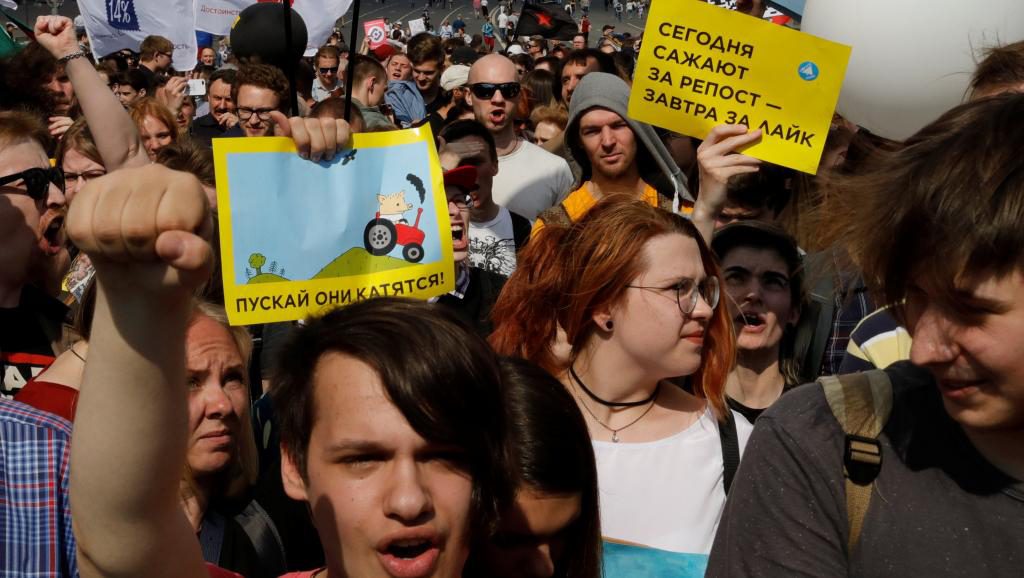
Photo: Twitter / RFI in Russian
The beginning of May in Russia is the time of mass shares. To the traditional demonstrations organized by the authorities of May 1 and 9, this year, protest events on May 5, held in dozens of cities of Russia, and the capital's rally “Free Internet” on May 13 were added . In addition, in the cities of the Moscow Region, “garbage” protests are not subsided, and the case there is already reaching shooting.
It would seem, why are mass processions, rallies and protest promotions in the 21st century, when there are many more calm and convenient ways to express their position, the main of which is elections that allow millions of people to express their position and count on its accounting from the authorities? But in Russia, neither this nor other mechanisms of the full -fledged connection of the authorities and society no longer work. Even the party that formally won the election considers it necessary to demonstrate its dominance on the streets of cities, including through direct violence against disagreed.
Outdated practice
Mass political actions came into fashion in the 19th century as instruments of pressure on power deprived of or limited in electoral rights by sections of the population.
The reaction to democratic forces organized by democratic forces was counter demonstrations arranged by the authorities and created with their participation or support by organizations. The peak of street confrontation came on the first half of the 20th century, and only after the Second World War did street activity gradually decline.
By the beginning of the 21st century, most of the tasks that provoked mass political actions in the past were solved, and above all, by the development of democratic institutions. Today, demonstrations and marches in countries with a stable democratic system are rather a tradition and part of a political culture than a mechanism for the pressure of society to power.
Even in a crisis, during “velvet” and “color” revolutions, the role of street protest is limited: its task is to restart the entire election mechanism, and thus return the authorities to normal.
It’s directly, if it came to mass street protests, then responsible, modern authorities should not be taken to the streets of their supporters, but to recognize defeat and leave, because if elected and other constitutional mechanisms work without failures, no one is trying to change power through street protests.
Russia lived for quite some time without crowded street political protests, and without mass loyalist actions. After the peak of activity in the early 1990s, there were no truly mass shares until the 191 permitted 2011 .
If it came to mass street protests, then responsible, modern authorities should not be taken to the streets of its supporters, but to recognize the defeat and leave
If the thesis about the connection of street activity and satisfaction of society with elections is correct, then the return of mass protests is understandable. By 2011, dissatisfied with the “castling” of Russian citizens simply had no other ways to declare themselves and get a reaction from the authorities to their requirements: only the players convenient for the Kremlin were already allowed to participate in the elections.
Renaissance of street policy
Unfortunately, the leadership of Russia reacted to the protest wave inadequately and instead of reforming the failure of the political system, he threw all the forces to its further distortion and no need for street competition with the opposition.
Despite the constant conversations about the extinction of protest and its futility, the last six years have become the true Renaissance of street policy in Russia.
The Internet plays a role that allows coordinating and uniting people dissatisfied with the power on the country's scale, so the geography of protest activity is constantly expanding and includes cities where it has never been over the past hundred years.
Of course, the quantitative indicators of opposition shares cause understandable skepticism, but it is important to maintain objectivity here: unlike the countries of Europe, where the citizen who goes to the protest rally feels completely protected, in Russia, opposition participants voluntarily agree to the role of the state’s enemies, against which the most diverse measures can be applied - from persecution and small packages in the place of residence and work to direct direct violence and criminal prosecution for far -fetched reasons.
On the other hand, participants in loyalist actions in most cases simply fulfill the orders of the authorities, quite rightly believing that the refusal to obey them will create many problems. Even if they are not comparable more quantitatively, in the sense of ideology, conviction and willingness to risk for the sake of their views, they do not represent any organized and independent power, being only a screen for the bureaucratic and power apparatus of the current government.
Demonstration of power
Why are mass street actions needed by Russian authorities? After all, if she does not doubt the honesty of elections procedures, which over and over again capture the triumph of Vladimir Putin and his nominees, then she seemed to be taken to the streets of loyal citizens. Nevertheless, from year to year, the attention of the authorities of all levels to loyist mass shares is only growing, and the beginning of May is the hottest time.
On May 1, the mobilization of citizens takes place under the auspices of trade unions, although in most cases employees of enterprises and organizations forces to get up in the early morning and go to listen to their direct authorities at the place of work, and on May 9 the trump cards are played on May 9 - the memory of the Second World War, its victims and victory in it. For all the difference between these two dates and the shares held in them, in both cases, it is about the street activity agreed and approved by the authorities, in which high -ranking officials take part up to the president. This year, these two dates also turned out to be the framing of the next inauguration of Vladimir Putin, which took place on May 7, and it is hardly by chance.
If the authorities do not go to democratization of the elections, this process will only intensify, and the next stage of street confrontation is a systematic street violence
The appeal of the authorities to mass shares is the reverse side of the collapse and discrediting of the election system and the actual recognition by officials that the results of the elections themselves mean nothing and no one really believes in their results. Therefore, both the results of the elections and the theses of propaganda about the universal unity of citizens around the authorities have to prove archaic ways-to arrange mass manifestations, so that their participants and everyone else were convinced that living people are still behind the numbers of electoral statistics.
Mass protests, as well as street delays of loyalty organized by the authorities, should be considered, first of all, as anxious evidence of the archaization of political life in Russia. And if the power in the foreseeable future does not go to the democratization of the elections and will not create the conditions for expressing the entire spectrum of moods and positions available in society with the help of local, regional and federal voting, then this process will only intensify, and the next stage of street confrontation is systematic street violence (which already gains momentum ).
It is hardly such a scenario that suits normal people on both sides of the still virtual barricades, but for marginals and hooligans this is a nutritious environment and great opportunities. We already see how the discharge of society receives a sanction for street violence from the authorities, and will it be surprised that enthusiasts of power decisions will appear on the other hand?
* Political scientist, permanent Columnist NT
The author’s opinion may not coincide with the opinion of the editorial office