
Translated material
Damage | Colta.ru
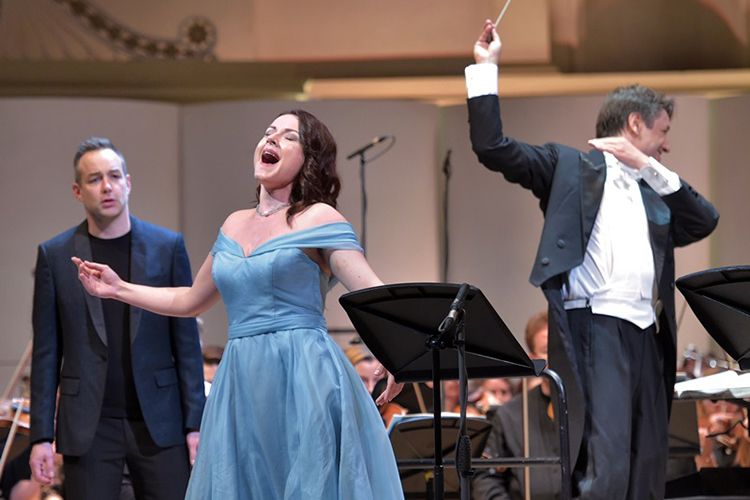
The current Moscow season is trying to assure us that for a good opera we must go not to the profile theater, but to the concert hall. Simon Bokkanigra Gergiev, Don Juan Stefano Montanari - these were brilliant events that caused violent enthusiasm, and not the correct shrug. The boring genre of concert performance of the opera is experiencing a heyday - largely thanks to the Philharmonic Subscription "Opera Masterpieces" and its author Mikhail Fichtengoltz.
The Guno, performed as part of the same Subscription Faust, is another victory. The unconditional trump of the project was American Stephen Costello in the title party, who once captivated the Moscow public as Romeo in the opera of the same composer. The nature of the charm of the singer is poorly explained, but it is simply impossible not to succumb to him. A wandering gaze, shifting from foot to foot, a suit in a blast, a complete discrepancy with the image of a tenor satisfied and a flight voice of a wonderful power and beauty with happy upper notes. In the elements of musical romanticism, the Costello moves freely, meaningfully and at the same time childishly touching.
The guest partner was also picked up by an irresistible one. The Italian bass baritone Luke Pazaroni with a flexible voice of the middle weight category acted not with rough power, but by the spectacular demonity of the cynic. Neither Faust nor the most delicate Margarita (the ideal Romanian star Anita Hartig), nor her non-cortical brothers Valentina (vocal Konstantin Shushakov), nor the adornment of the pantsuits of Alexander Kadurin), nor the public, with adoring all the numerous gags, with adoring all the numerous ges, were dodged from Mephistopheles. Pazaroni.
It is no secret that love scenes in the opera do not always cause spectator participation. Rather, on the contrary - discomfort and a sense of awkwardness. Here it was precisely the meeting of Faust and Margarita in the garden with the subsequent movement of the couple in love to the bedroom under the ominous laughter of Mephistopheles that was the most beautiful. The lack of scenery, costumes, directorial decisions and credits to the French -speaking opera did not interfere. The minimum strokes in the stage behavior of the already expressive singers plus Michael Guttler behind the remote control - and a huge scene of love languor in the final of the third action becomes clear and emotionally exciting (it is unlikely that Wagner would be pleased, but we have to remember that “Faust” and “Tristan” are peers). German-Mariinsky maestro Guttler was among the trump cards of this project. Managing the New Russia orchestra (sounded very vigorously), the chorus of Sveshnikov (sounded liquidly), as well as standing, walking and dancing behind him by soloists, he showed miracles of dexterity and organizational skill, caught the singers in all possible ways, without reducing energy in the orchestra, and crawled out a powerful, damn exciting story.