
Translated material
The New York Times: a big gift of Deripaska from the Trump administration
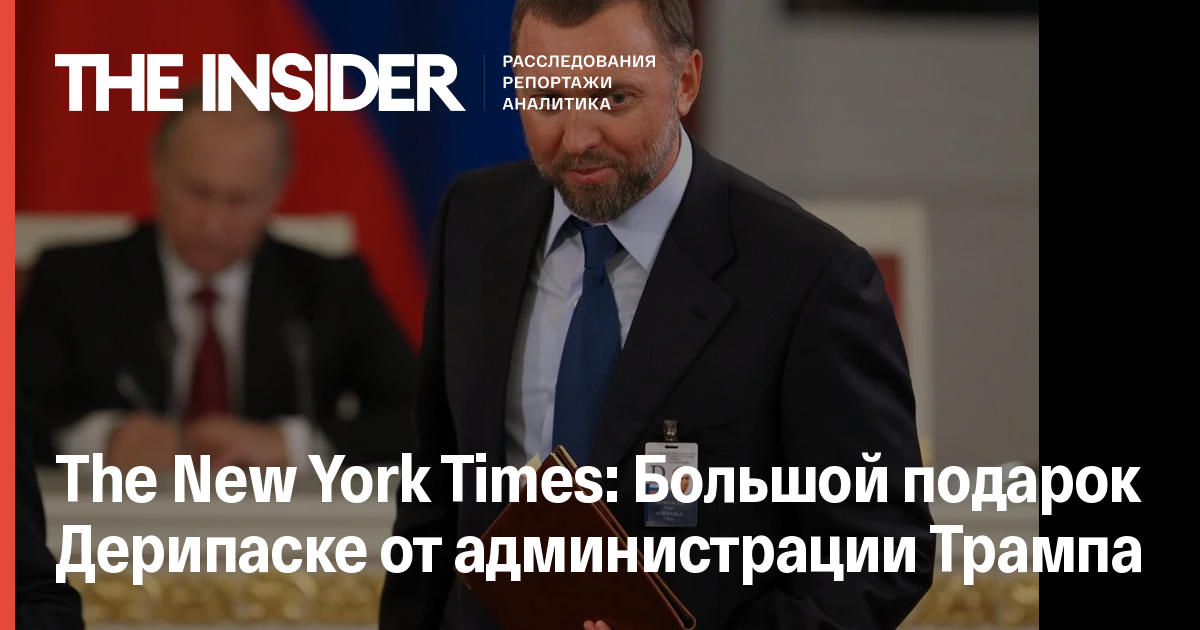
The behavior of the Trump administration in relation to the aluminum company Oleg Deripaska looks like a sign of inexplicable surrender to Russia, writes in The New York Times Seth Hitten. The Insider offers a complete translation of the article.
Even now, when new evidence is emerging that someone, most likely, in Russia, again intervenes in the American elections, about at least one of the closest Russian oligarchs closest to Vladimir Putin can be forgotten.
This week, the Trump administration again loosened the pressure on the largest Russian aluminum company Rusal - in the same four months after sanctions were imposed against the company and its leader in the leader’s bad glory. The White House, it seems, is not going to spare American farmers and consumers, unleashing trade wars, but employees of Russian aluminum enterprises clearly deserve special protection.
Rusal is controlled by Oleg Deripaska, a member of the Putin's near circle. According to the US Treasury, there was an investigation of his possible involvement in laundering of money, he was accused of threats to competitors, illegal survey of telephone conversations of the government official, participation in extortion and racket. There are also suspicions publicly expressed by the Department of Control of Foreign Assets of the Ministry of Finance that Deripaska bribed a government official, ordered the murder of a businessman and is associated with a Russian organized criminal group. During the 2016 presidential campaign, the then headquarters manager Trump Paul Manafort tried to arrange private briefings for Deripaska. On Tuesday, Manafort appeared against the court on charges of banking and tax fraud, not directly related to the campaign.
Finance Minister Stephen Mnuchin said that he was considering the possibility of complete lifting the sanctions, as he is punishing “honest workers” by Rusal. ” But the opposite is true: if the minister was really worried about the fate of 61 thousand workers of Rusal, he would not soften its position until the company is completely cleansed of the deripa and corrupt regime, which is the aluminum giant.
For $ 5.3 billion, a large -scale crime is worth the state of Deripaska. During the “aluminum wars” of the 1990s, when the economic sector was consolidated in the process of chaotic privatization, which followed the collapse of the Soviet Union, a young trader who seized control of a giant metallurgical plant in Siberia, suspected ties with bandits. According to the indications given in Stuttgart, one of the gang members, Deripaska was valuable for grouping, including thanks to his ties with Russian special services. His competitors either died or fled from Russia, and somehow he became the general director of Rusala-a company that received an income of about $ 10 billion last year. Because of suspicions of organized crime, the oligarch refused an American visa.
Deripaska is not only the owner of an aluminum concern. In Russia, the oligarchs like him owe their wealth and status to the Kremlin. For this, they must comply with orders; So, Deripaska, through its holding company, spent more than $ 1 billion on a new infrastructure for the Olympic Games in Sochi. Deripaska accepted this role and said that he does not separate himself from the Russian state. The Memorandum discovered by reporters The Associated Press, from which Manafort tried to offer Deripaska, is well combined with this.
On April 6, the Department for Monitoring Foreign Assets of the Ministry of Finance imposed sanctions against Deripaska for "actions or attempts to act in direct or indirectly in the interests or on behalf of a high -ranking state leader of the Russian Federation." Rusal and the En+Holding Company also controlling the Rusal and the En+Holding Company controlling it. Due to the sanctions, the Rusal campaign doubled, which caused panic in the global aluminum market. Soon Deripaska announced that he would give in control of the Rusal and leave the advice of the directors of Rusala and En+.
This was the strongest signal that the oligarchs like Deripaska would not allow the business with the United States until they support the state that reproduce the boundaries of their neighbors, poisoning its opponents in the foreign territory and helping the Assad regime in Syria to bomb its own citizens. The British Parliamentary Committee, referring to the information discovered by a Harvard researcher, said in May that “on his own site” Rusala “says that it supplies the Russian military industry with strategic raw materials, the products of which can potentially be used in Syria.”
But almost immediately, the Ministry of Finance facilitated the pressure on Rusal. Several times they extended the deadlines in which Deripaska was supposed to leave among the leaders of the company and reduce their share of property. In May, the chairman of the Deripaska holding Lord Gregori Barker Battle hired a lobbyist for $ 108,500 per month to continue negotiations with the Ministry of Finance. Barker chose Mercury Public Affairs - the very one that Manafort paid $ 1.1 million until 2014 for lobbying in the Congress of the interests of Ukraine and its then President Viktor Yanukovych. The company, headed by the former Senator-Republican from Louisiana David Witter, tried among other things to enlist the support of the ambassadors of France, Germany and Australia.
Mercury, which describes its approach as a “public strategy of high bets”, last week began a pressure campaign to the Ministry of Finance, demanding more time to reduce the oligarch’s share in EN+ from 70% to 50%. On July 24, the company sent a statement to the Ministry of Finance, describing in it the disasters that may occur if the sanctions are not facilitated: the global aluminum market will be in a high -rise degree, which will cause “harsh side damage to the interests of the United States and their allies”, En+will probably have to sell “Chinese and/or other potentially hostile interests” - or nonsense simply. Save your control bag. With all the inconsistency of these predictions - Deripaska cannot simultaneously sell his company to the Chinese and save the control package - they were enough for the Ministry of Finance to extend the period on which Deripaska should abandon his share in EN+.
A bad foreboding that the bandit's accomplice will dictate his conditions is another sign of the inexplicable surrender of the Trump administration before Russia. And this surrender followed the meeting in Helsinki on July 16, during which President Trump and Putin talked for more than two hours behind closed doors.
We do not know what they were discussing, but, given the bets of both parties, we can with a high degree of probability assume that the conversation affected the topic of sanctions imposed by the United States against the largest aluminum company of Russia.