
Translated material
Trusted the driver, deviated from the route. All the details of the trip of Russian journalists in the TsAY - and all versions of their death
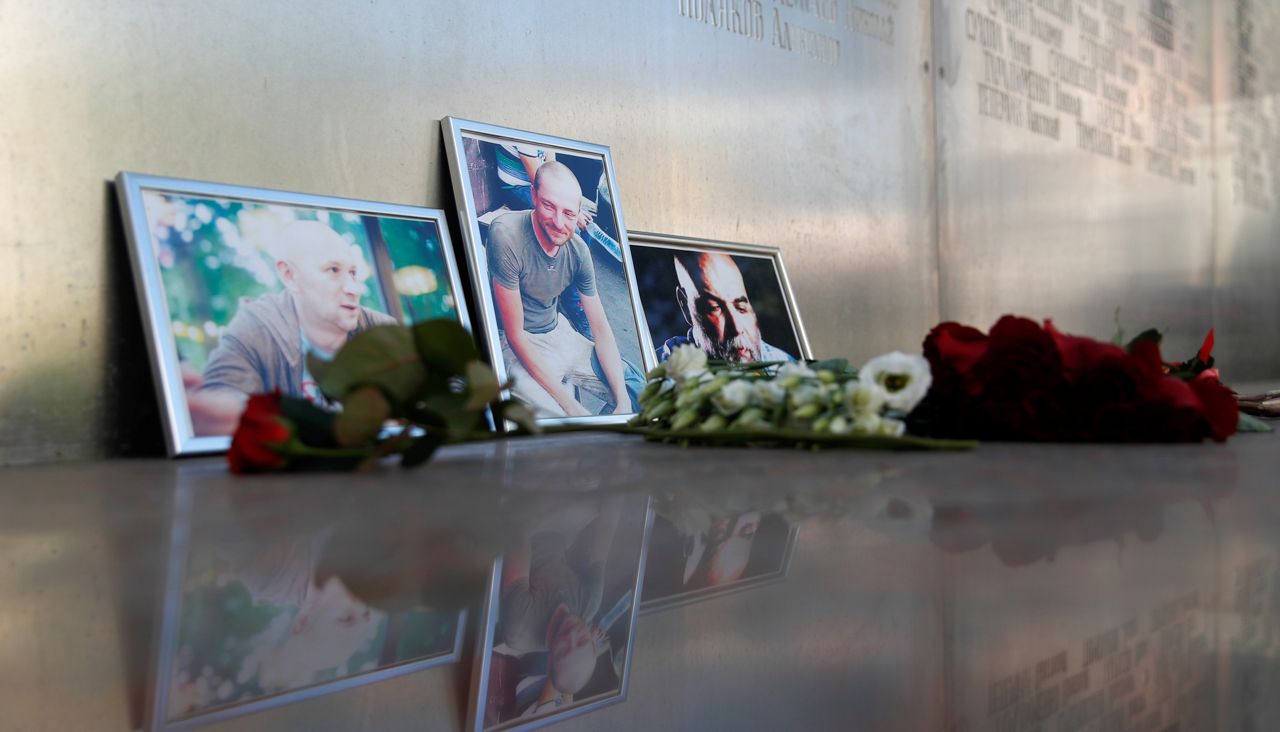
On the night of August 5, the bodies of journalists Alexander Rastorguev , Orhan Dzhemal and Kirill Radchenko will be delivered to Russia. They wanted to make a film about Russian mercenaries in the Central African Republic and were killed there. All the circumstances of the murder, like all the circumstances of the business trip of journalists in the TsA, are still unclear. Medusa collected information from all sources together, talked with the people who lived and worked in the Tsar - and made up the most complete picture of the death of Rastorguev, Dzhemal and Radchenko and what preceded her.
Journalists did not talk about their trip to the authorities of the Central Academy of Sciences or the Russian Federation - but they contacted the UN employee and a presumably reliable driver
Alexander Rastorguev, Orkhan Dzhemal and Kirill Radchenko arrived in the Central African Republic (TsAB) July 27-according to their partners from the publication "Center for Investigation Management" (CUR) to shoot a film-investigation about Russian "instructors" from the private military company Wagner . “The investigation was a joint product [journalists and publication]. By the time of the trip, it lasted several months, ” said Tsur in his telegram channel. The publication financed the shooting "From the money of our investor Mikhail Khodorkovsky."
So that no one could interfere with the investigation, the group did not make itself felt either to the local authorities or the Russian embassy. Tsur said that for help they turned only to an employee of the UN peacekeeping mission named Martin (his last name is unknown). “Safety problems were among the priority, they were discussed with the UN employee, and the routes suitable in terms of security were discussed with him,” the publication telegram channel said.
The UN peacekeepers, who entered the Central African Republic in 2014, in order to stop the many years of civil war, although they did not stop violence completely, now control most of the territory of the republic. On August 1, the press secretary of the mission, Vladimir Monteiro, specified that the journalists did not inform the UN about their arrival, and the organization itself is not involved in the issuance of accreditation to media representatives.
As said in the CUR, before the arrival of the group, the UN employee Martin got in touch “about once every two days”. As of August 1 (a day after the murder of journalists), the publication still could not contact him - it was not not clear whether he was aware that the group would not come to him anymore. " Was it possible to contact Martin by the time of publication of this material, Medusa could not find out, - the editor -in -chief of the CUR Andrei Konyakhin said that he could not say, since he was engaged in relatives of the dead; His deputy Anastasia Gorshkova did not answer calls and messages.
In the Tsur, they said that Martin advised the driver to the driver. Local journalist Henri Grota said that the driver’s name is Bienvenu Nduvokam. CUR claims that the driver’s name is in the database of French journalists, which collected contacts of trusted people in the TsA.
Journalists tried to get to the military base in Berengo. The Russian military is officially there
On July 28, the inconsistent was taken by the investigators to the main base of Russian instructors on the Berengo estate-the self-proclaimed Emperor of Central Africa, Jean Bocass, who ruled the country from 1966 to 1979, lived and was buried there (in the 1980s he was judged, accusing, in particular, in Gosizmen and cannibalism).
The estate is located 60 kilometers from the capital of the country of Bange. The Russian base was created here with the permission of the UN: the military from the Russian Federation should train the handling and tactics of government battalions.
The instructors put several tents right next to the Bocassa grave. On the Facebook page, the President of the Tsar Fosten-Arkange Tuader, photographs from hand-to-hand combat training appeared, which Russians conduct for African military-as well as photos of "presidential adviser to the security of Valery Zakharov." On January 15, 2018, the British analytical agency Stratfor was the first to report with reference to their sources that civilian instructors belong to the Wagner PMC.
The last time Berengo appeared in the news at the end of July: according to local journalists, the widow of Emperor Bokasse turned to the President of Tuader with a request to remove the instructors from the estate, where her husband's dust rests.
Rastorguev, Dzhemal and Radchenko, according to representatives of the Tsur, were not allowed to be allowed in Berengo, demanding that they permission from the Ministry of Defense of the TsA. Then the journalists went to other regions of the republic, where, as it is written in the UN report on July 23 ( .pdf ), “Russian instructors are placed”.
The dead wanted to take off the gold mines. They were controlled by militants, and now there, perhaps, a Russian mining company is working there
According to the UN, one of the locations of the Russian military is the city of Sibu, the center of the Kemo Prefecture. The small town is at the intersection of two roads: one goes through the deco to the north to the stronghold of Muslim rebels in Kaga-Bando; The second is east, to the city of Bambari. The UN report reports that Russian instructors are “involved” in Sibu, and in Bambari they are often seen as part of the columns of government forces - the column cannot drive through the territories occupied by Muslim rebels without the support of Russians. On June 10, according to the UN report, the instructors even took part in an armed clash with militants from the group of “world for peace in Central Africa”.
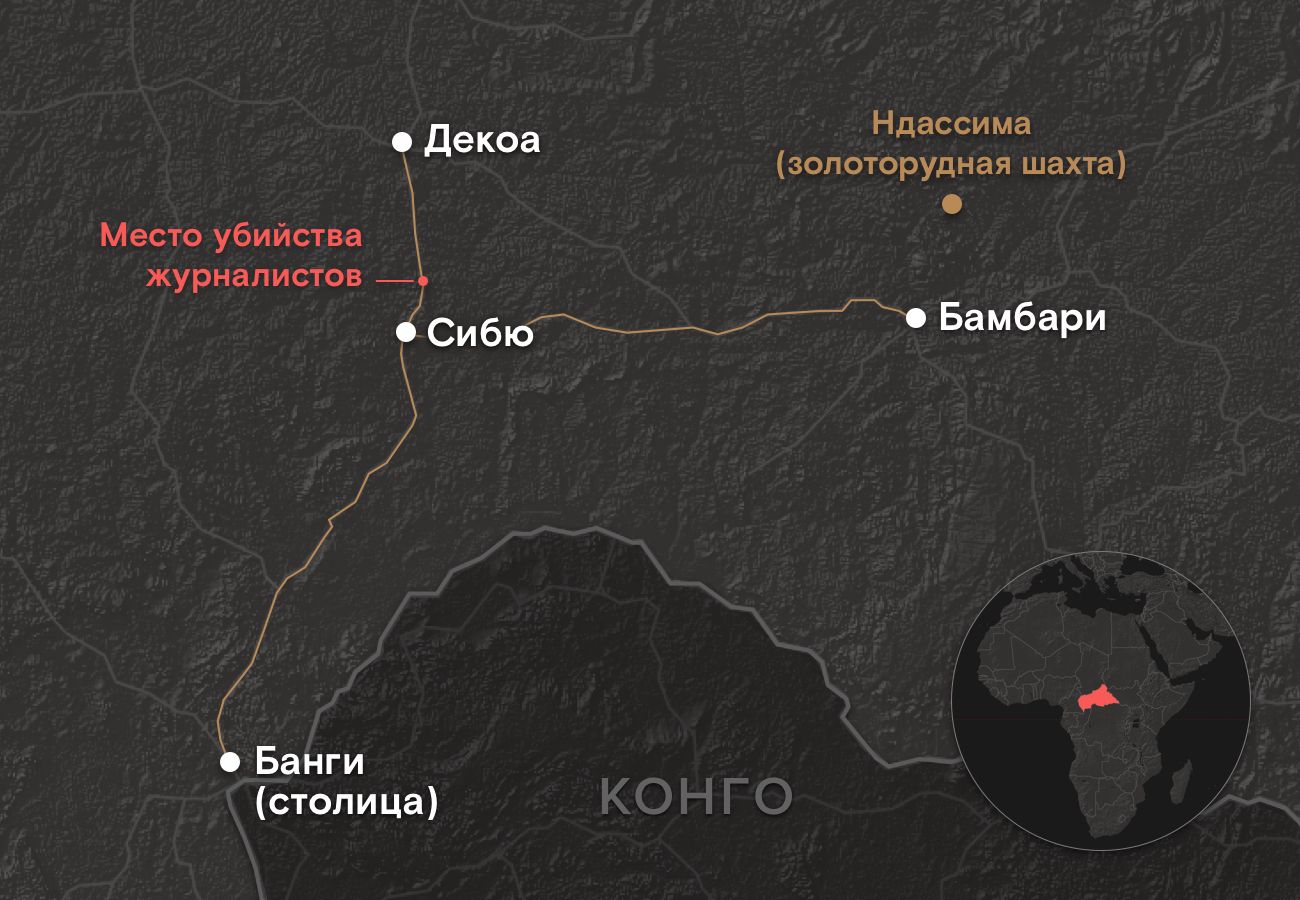
The Tsur claims that from Sibu, journalists had to go to Bambari. There they were going to meet with Martin from the UN mission - "he had to provide information on the situation with Russian military instructors and help with the filming of the gold mines of Ndassima."
Ndassima is a place of fifty kilometers north of Bambari, where the largest gold -bearing region in the country is located. In 2010, before the outbreak of the Civil War in the Central African Republic, the Canadian company Axmin bought the right to develop it for 25 years. In 2013, Muslim rebels from the opposition authorities of the Coalition of the Seleka seized mines, and Axmin evacuated employees and suspended work.
In 2014, Reuters wrote that the rebels have a artisanal way in mines of 15 kilograms of gold per month. According to the UN, the Muslim detachments of the Union for Peace in Central Africa and the People’s Front of the Renaissance of the Central African Republic are still holding control over Ndassima - the Seleka has now split into these groups. UN experts do not mention the participation of Russians in the development of gold.
Until the very recent time, Axmin planned to return to her gold mines as soon as such an opportunity appeared. In December 2017, in the report for investors, she wrote that her representative met with Vice-mayor Bambari to “discuss the situation and express the company's desire to return to the mines”; Axmin did not report the consequences of the meeting. Medusa could not contact Axmin representatives.
In October 2017, the Russian Foreign Minister Sergei Lavrov met in Sochi with the President of Tsar Tuader. In particular, they discussed "significant potential for partnership in the field of mineral exploration." Then two Russian companies appeared in the TsAR - the mining Lobaye Invest and the security security service security. The French media suggested that both of them are connected with Evgeny Prigozhin - a businessman and a restaurateur, who is considered the main organizer and sponsor of the Wagner PMC. On July 18, the research French site Africaintelligence.com wrote that one of the main goals of Russian companies is Ndassima.
Russian journalists deviated from the route
July 30, Rastorguev, Radchenko, Jemal and their driver arrived in Sibu. The deputy editor-in-chief of the CUR Anastasia Gorshkova told BBC that by that time the journalists had doubts about the reliability of the driver. On the eve of July 29, the group of the group was stopped by two police officers (where the journalists rode at that moment, it is unclear) who demanded a bribe; Their requirements were translated by the driver. According to Gorshvkova, the editor -in -chief of Tsnyakhin was sure that the driver of Ndukamam brought the police to Dzhemal, Rastorguev and Radchenko - however, the journalists themselves doubted this and decided not to interrupt the cooperation with the driver.
As the Ministry of Communications and Communications of the Central African Republic later reported , the government military advised journalists not to go further at Sibu's checkpoint, because it was already dark (the sun in the TsAS on July 30 went in the area of six in the evening). They did not agree with this recommendation.
From the city, the car did not leave east, towards Bambari and gold mines, but to the north along the forest road to deco. “The reasons and circumstances of the deviation from the route are unknown to us,” the CUR reported. “We did not have operational contact with Orkhan, Alexander and Cyril at that moment, since there is practically no connection outside the cities in the Tsar.”
The road, along which a car with Russian journalists was traveling, is described in detail by Philip Kleinfeld, the author of an independent investigation of events in deco-there in 2014-15 the peacekeepers of the UN and Gabon forced local women and girls to have sex with them. “Sibu's road - deco, although with a hard coating (one of the few in the country), does not allow to forget about itself with a crunch in the bones and a layer of dirt on clothes,” writes Kleinfeld. 70 kilometers of broken asphalt almost completely run through the tropical forest, only a dozen tiny villages are found along the whole path.
People who traveled along this road claim that it is relatively safe
Medusa talked with two people who moved along the road from Sibu to deco in April and May of this year - journalist Philip Kleinfeld and senior researcher at Human Right Watch Lewis Maja.
Both said that during the day the road to deco is safe. There are checkpoints on it, but they are controlled by the government gendarmerie, not militants. Both also noted that the rebels from the decayed “sketches” are not found up to the city of Kaga-Bannoro, which is located much north of the decorative. According to Madge, at night the path along the Sibyu-Deco is more dangerous, but still the murder of three journalists seems “strange” to him. “I myself would never go there at night - you can meet wild animals or accidentally knock a person walking along the road. In addition, robbers are found on the roads, but they usually do not kill anyone, ”said Maj.
Neither Madge nor Kleinfeld could assume why the journalists deviated from the route and did not go directly to Bambari. Kleinfeld claims that the road to Bambari is "definitely more dangerous." Maj “extremely dangerous” does not consider her, but adds that the quality of the coating is even worse there than the road to the north. True, according to the TsA government, in July, the government delegation reached Bambari to check how the reconstruction of the road goes. The officials were satisfied.
There are several versions of how the journalists were killed. Which of them is reliable - it is incomprehensible
On July 31, the mayor of Sibu Henri Depiel said that the journalists were ambushed at about 22:00 - their car was fired from the bushes on the roadsides of the road. “Three journalists died immediately,” he said.
Several information agencies - for example, AFP, said on July 31 that the Russians were first stopped at a checkpoint and then killed. On August 1, the French newspaper Le Monde claimed that one of the group members were killed immediately, and two were shot later.
The survivor driver Bienvenu, the police and the investigation, said that ten armed people stopped them after 33 kilometers of the journey - and opened fire. He managed to hide and survive.
On August 1, Parlams Centrafrique, citing their own sources, wrote that the journalists were first abducted, then interrogated, then killed; It was the first to publish a photograph of Tel Jemal and Rastorguev with bullet wounds. Without indicating the source of information, Parlams Centrafrique accused of killing people from groups that left the Seleka coalition.
On August 2, spokesman for the Government of the Anges of the Anges Maxim Kazagi told RBC that a group of about ten people “in the Turban” who spoke Arabic stopped at night in Dakoa at night in Dakoa, and demanded to give the car. One of the journalists began to resist, the attackers opened fire, killing him on the spot, the other two died from wounds. The Kazakhs added that at night the road "teeming with raiders, rebels and armed bandits."
On the same day, the Ministry of Information of the country clarified that the attackers accurately spoke in French or Sango - two state languages of the TsA. The local site Corbeaunews.ca with reference to the same driver (without specifying from which source his words were received) said that the journalists "apparently understood the language of the attackers."
Where the surviving driver is now, it is certainly unknown. On the morning of August 3, local journalist Henri Grolet said that he was detained in the capital of TsAGAGY BANGI, in the investigation department of national gendarmerie. Parlams Centrafrique claims that the driver recovers after he was wounded in a hospital in an unnamed city. The publication promises to publish his detailed story about what happened.
On the morning of August 4, the bodies of journalists were delivered from Bange to Paris. The temporary attorney in the affairs of Russia in TsAS Viktor Tokmakov said that the bodies will be transported to Moscow on the night of August 5.
Evgeny Berg , Polina Eremenko , Dmitry Kuznets , Sasha Sulim