
Translated material
Power is more important than growth
What Anton Belousov and Anton Siluanov actually agreed with large businesses
The play played before us by the presidential adviser to Andrei Belousov in two actions allows you to see in the palm of your hand that the Russian government adheres to the president, its administration and playing the technical role of the Cabinet of Ministers with them.
Preservation of addiction
In the first part of the play, we observed an organized leakage of the confidential note of the adviser Belousov to his boss - a kind of fiscal denunciation. The adviser reported that a number of largest export companies have formed a “superprofit” as a result of the devaluation of the ruble, and this “superprofit” can be seized.
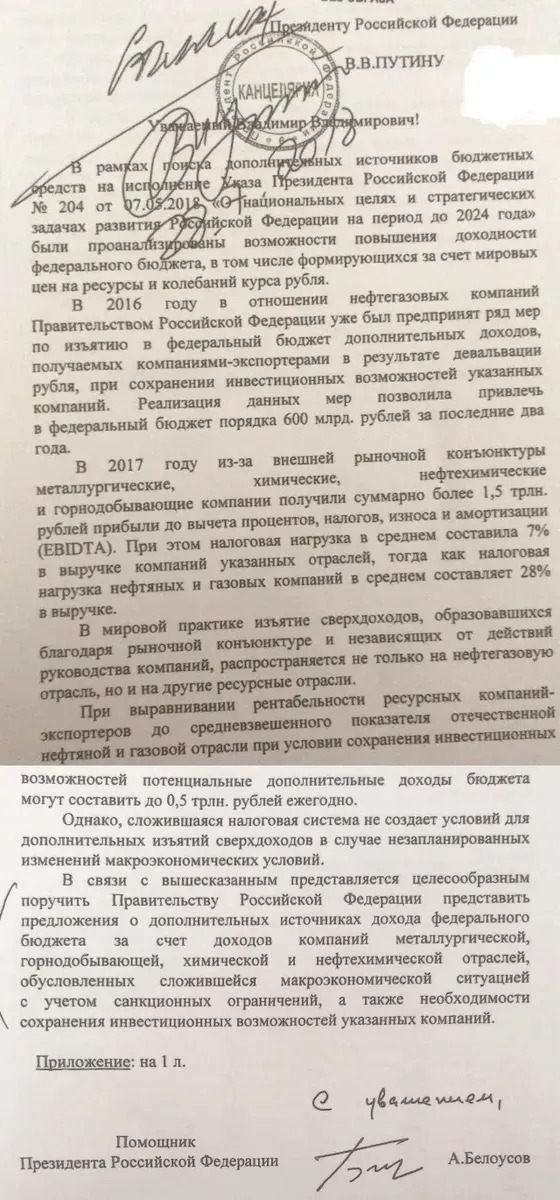
What the adviser calls “superprofit” is the advantage of export companies that occurs after the devaluation of the ruble, which leads to a decrease in their production costs in dollar terms. Calling this "superprofit", of course, is incorrect.
The company can use the advantage to reduce prices for their products in order to conquer a larger market segment and investments in the necessary expansion of production for this. Exactly the countries that seek to increase industrial exports do. They keep a relatively low course, reduce costs due to this and get a price advantage in foreign markets.
But this is not our way. Despite the eternal campaign about the reduction of raw material dependence, the real policy in Russia has been determined by the dominance of the oil and gas oligarchy for 20 years. Unlike industrial exporters, the oil and gas complex does not win, but loses from a low ruble course. He uses imported equipment in prey, his labor costs are low. And the only problem is deliveries to the domestic market, where energy prices are much lower than the world. But the stronger the ruble, the less price difference will be. Therefore, the financial situation of such companies improves when strengthening the ruble.
The movement of the national currency in any direction brings someone “superprofits” (in the terms of Belousov). The weakening of the currency is beneficial to manufacturers of industrial products with a large share of invested labor, it makes their products more competitive. The strengthening of the ruble, on the contrary, is beneficial to importers and those manufacturers whose imported components play an important role in costs, as well as the oil and gas complex.
The Russian ruble was strengthened in 2000-2008 and in 2010-2013. In 2013, it was 2.3 times stronger than in 1999. Thus, the oil and gas complex and importers, following the logic of Belousov, all this time received “superprofits” due to revaluation. But Russian industrial products remained little competitive in domestic and foreign markets. And the growth of population incomes in dollar terms contributed to the expansion of assembly industries within Russia.
All this in general is a policy that preservates raw material dependence.
Upside down
At the same time, in Belousov’s proposals there is a rational grain. The metallurgical and petrochemical companies listed in his list for dispossession are raw materials exporters. And accordingly, they receive rent - income associated not with production activities, but with fluctuations in demand and prices for raw materials in foreign markets. At the same time, unlike the oil and gas complex, they spend much more funds for processing raw materials. That is, they occupy, as it were, an intermediate position between the raw materials and the processing sector - in their economic activity there are both components.
The task of the rational government is to tax the rental component of their economic activity and not to tax additional activities to process raw materials. Rent payments for the export of raw materials would, like rental payments of the oil and gas complex, accumulate in a special fund used to finance pension costs. And the fact that this does not happen is wrong and unfair.
Such a rental payment, however, should be tied to prices in foreign markets (as is done with oil and gas). Linking the concept of “superpituals” with the dynamics of the course, the adviser to Belousov offers the exact opposite. He actually proposes to overplay the additional wiring not rental, but the production component of the activities of these companies.
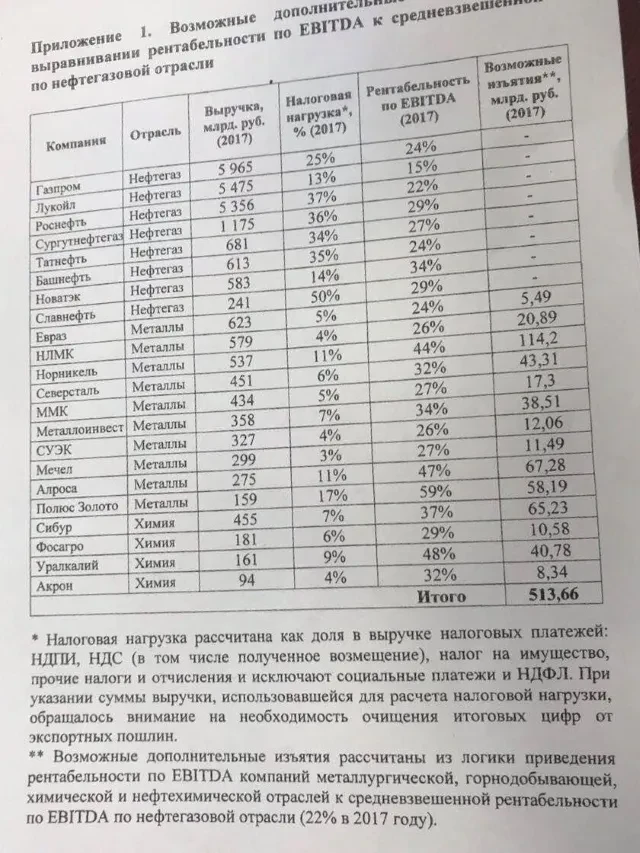
As one of the representatives of the companies of the Belousov list rightly remarked, in this logic it turns out that the higher you have profitability, the more you will be removed.
In other words, quite accurately indicating the second, after oil and gas exporters, a number of “fat cats” of the Russian economy, whose wealth is directly related to the export of raw materials and the rent received,
Mr. Belousov formulated his thought not in economic, but fiscal and exporting logic: there is money-I have disappeared.
And such a substitution of argumentation has, as we will see, their causes.
War and a bad world with the worst
The further course of Belousov’s play was a reprise on the topic of the worst struggle. Deputy Prime Minister Anton Siluanov, who, in theory, had to support the idea of withdrawing rent from exporters of raw materials, suddenly stated that the government did not need this money and is quite satisfied with the level of income that already made decisions.
Siluanov is expressed so ornate, trying not to remind once again that, in violation of its promises, the government has already increased the tax burden on the economy, increasing VAT. In other words, Anton Siluanov refuses to remove the rent from the “fat cats”, but prefers to tax the entire business and the population at the same time.
In Russia, as in most authoritarian regimes, it is easier and more profitable to tax with additional formal patches of the poor and weak, and with strong resolve issues in the regime of informal agreements.
Such agreements turn large business into a political clientele of power groups.
Exactly according to this scenario, the plot of the Belousy play developed. The author himself called her a fairy tale with a good end. And this is probably so, if we consider a good end to one where
The wolf not only ate his grandmother and granddaughter, but also fed the lumberjacks who had passed to his side.
As you know, at a meeting with representatives of mentioned in the list under the dispossession of companies, the government agreed that there would be no formal seizures. But the companies themselves must share money, investing it in the projects indicated by the government from the "May" package.
This not only strengthens the client’s principle of informal agreements of large business and political authorities, but also creates a kind of alliance between the two types of oligarchy - those who receive a rent from the export of raw materials, and those who receive it, mastering budget investments on exclusive conditions.
Now the former will, through the mediation of the government, will directly agree in what amount to “share” income with the second. Export rent will not fall into the budget, and under the supervision of the government to be redistributed from some selected companies to another.
An imaginary deficit
In general, we must remember that the Russian government now has no problems with the budget. According to the results of 7 months of this year, it is executed with a surplus of 2.5% of GDP. Oil oil prices and oil and gas exports are at the levels of 2005, when an oil boom was observed in Russia, according to universal conviction. Export is growing by 30% to the levels of the previous year. In such a situation, the reasonable government of an oil -dependent country, who wants to reduce the scale of dependence, should be reduced, and not to increase taxes in any way.
The reason why the Russian government acts directly in the opposite way, increasing the tax burden and introducing new fragments for exporters, is well known - this is the so -called “May” decree of Putin. This decree created a kind of imaginary deficit. And the government, twisting his eyes, said that the volume of this deficit would be 8 trillion rubles in the next 5 years. It is no more meaningful to discuss the validity of this figure than to discuss the estimate of the construction of the bridge to the moon. In fact,
8 trillion rubles is an approximate amount of free money in the economy that the government has planned to turn from private investments into state.
This is done for two complementary reasons.
Firstly, in the conditions of an unstable legal, tax and external environment, the level of private investment in the economy remains low. And the government has an argument to take the investment process into their own hands.
However, the main motive is still that the volume of funds redistributed by the government determines the stability of political clients - an informal compliance of large business and political power. Such a policy leads to stagnation rather than to growth in the long -term period.
But power is more important than growth. This is the main ideology of the May decree.