
Translated material
The main allies Merkel unsuccessfully performed in the elections in Bavaria. In Germany, they talk about the imminent split of her government
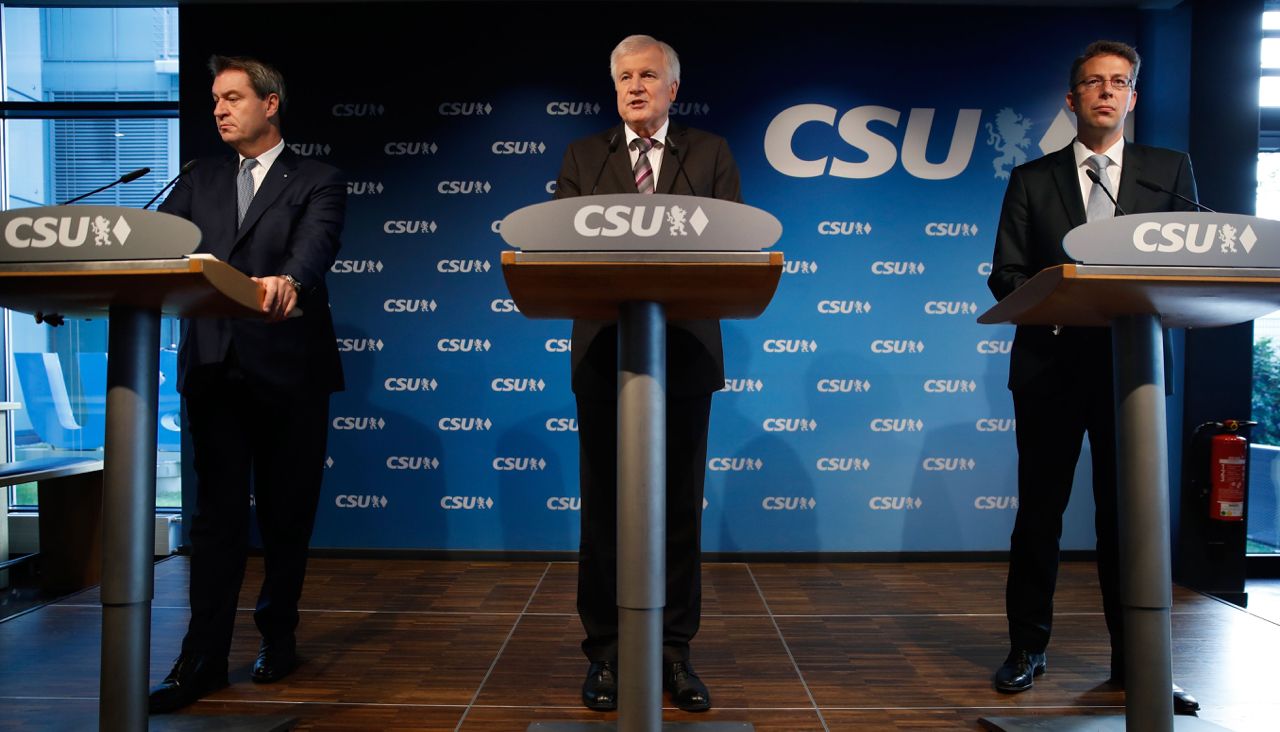
In Bavaria, regional elections were held, in which the ruling Christian Social Union won, having received, however, the worst result since 1950 and having lost the vast majority of places in parliament. The second place was taken by the Green Party, the extremely right of the “alternatives for Germany” were only in fourth place. Most of all, this result hits the government coalition led by an angel Merkel.
The Bavarian "Christian Social Union" (CSS) occupies a special place in the post-war German political system. After 1945, many associations appeared in West Germany with a similar ideology that opposed themselves to the Communists and Social Democrats. All of them advocated the democratic political system (in contrast to the “strong hand” and dictatorship), for the market economy (against socialist ideas) and for the preservation of German cultural and family traditions (the damage to which was believed both left and Nazis). Christian democratic ideas were formed at the beginning of the 20th century, but under Hitler were banned.
Scattered groups soon united into the general German "Christian Democratic Union", and only the CSS retained isolation. This is due, in particular, with the fact that it was Bavaria that was the birthplace of pre -war Christian democracy and therefore the CSS that arose there claimed the role of an independent party. As a result, the CDS and the CSS formed a single faction already in the first Bundestag, elected in 1949, but the Bavarians did not join a single party and, moreover, retained all attributes of independent political force - their own congress, governing bodies, a party program.
In Germany, the unification of the two parties is simply called “Union”. The model in which it has existed has not changed for almost 70 years: the CDU has not exposes its candidates in Bavaria, and the CSS in other federal lands. They have one fraction in the Bundestag, but the CSS deputies form a special group inside it.
The main reason why this design has been working for so long is the unusually high results of the CSS in Bavaria. Since 1957, he only received less than half of the votes of the inhabitants of this land in the Bundestag elections. Given that Bavaria is one of the most densely populated regions of Germany, this is very important. In the local parliament, the CSS lost the vast majority of places only once - in 2008. This is not surprising, because Bavaria for many decades remains the richest and most developed land of Germany.
This time, the CSS scored 37.2 (10.5% less than in 2013) and received 85 seats in the 205-seater parliament. This is the worst result since 1950. He calls into question the special role of the Bavarian Party in the German political system.
Merkel's allies lost due to the fact that they cursed too much among themselves-and with Merkel herself
In 2008, Horst Zeehofer became the chairman of the CSS, and then he was elected Prime Minister of Bavaria. During the immigration crisis of 2015-2016, it was through Bavaria to Germany that a significant number of refugees tried to get to Germany, and Zeehofer criticized Berlin and personally to the Angel Merkel, who heads the government and the CDU, for the policy of “open door”. In addition, he earned a reputation as a “friend of Putin” because of several meetings with the Russian president.
According to the results of the 2017 parliamentary elections, Zeehofer received the post of Minister of Internal Affairs of Germany in the new government of Merkel. The difficult negotiations on the formation of the office lasted a record for six months, but Zeehofer threatened the coalition several times after it was still formed. In June, the head of the Ministry of Internal Affairs again accused Merkel of insufficient efforts to combat illegal immigration, and in September he hired the former chief of the main German special services of Hans-Georg Maasen, whom all parliamentary parties, except for the extreme right “alternative for Germany” (ADG), was accused of unwilling to fight neo-Nazis.
Zeehofer also became famous for the statement that immigration is “the mother of all the problems of Germany”, and now he is called the “father of problems” of the CSS. In particular, Marcus Zeder, who replaced Zeehofer as the head of the Bavaria Government, lamented on the night after the election that the party did not receive enough help from the center. However, there is an opinion that Zeehofer is simply trying to “make the extreme” in numerous and long -accumulating problems.
Not only the head of the German Ministry of Internal Affairs, but also the other leaders of the CSS exploited the right, anti -immigrant and traditionalist rhetoric. During the immigration crisis, the same Zeder criticized the federal government many times, and in the summer of this year he ordered to hang Christian crosses in all state institutions of Bavaria as a “fundamental symbol of Bavarian identity”.
Apparently, in the CSS they overestimated the threat from the right -wing radicals from the Adg and tried to prevent voters to leave it. As a result, as the studies of sociologists show , an approximately equal number of votes, in the last elections of voting for the CSS, departed to the ADG and Green - 160 thousand and 190 thousand, respectively.
In addition, the current result of the CSS only continues the long-term trend on the gradual decrease in the popularity of this party, which was indicated back in the 1980s and only sometimes interrupted by short-term ups. Apparently, fatigue is affected by too long in the power of the same party and the actual lack of intrigue.
Everyone was afraid that the second place would take an “alternative for Germany”, but it received fewer votes than expected
The right-Poopulistic “Alternative for Germany” scored 10.2% in the election and took fourth place-this, of course, is success for the Department of State. But given that shortly before the vote, many predicted that she would take second place, the party’s performance did not seem so successful. According to German journalists, the adg in Bavaria did not have enough charismatic politicians who could attract the electorate.
As in the Bundestag elections in September 2017, it turned out that the Germans vote more conservatively in polling stations than they respond during sociologists polls. A certain effect, apparently, brought the efforts of the CSS to keep voters, intercepting an anti -immigrant agenda from ADG. The extreme right mobilized those who did not participate in the elections in 2013 or voted for one of the small parties, but were able to take only a few voters from large political forces.
Social Democrats took only fifth place-they have problems throughout Germany
Since the 1950s, Bavarian Social Democrats have not been able to challenge the CSS. Moreover, their results in land elections are constantly reduced. But despite this, the Social Democratic Party (SDPG) stably took second place. The current elections brought her defeat, perhaps even more difficult than the CSS. Social Democrats did not just get two times less votes than in the last elections (9.7% versus 20.6%), but ended the race with the fifth-after the CSS, “Green”, ADG and groups called “Free Electors” .
The defeat of the SDPG is explained by the inability to convey to voters, which, in fact, the party wants and what place it occupies in today's German policy. For decades, she was the main opponent of Christian democrats, but nine out of the 13 years old, which Merkel from the CDU is in power, the Social Democrats are entering with her a “large coalition”. Software differences were erased during this time so much that now, at least on the immigration issue, the CDS is closer to the SDPG than to the same CSS - their “nursing” party.
In September 2017, the Social Democrats received the lowest result in the parliamentary elections in history, and, summing up the results of voting in Bavaria, the Bild publication writes that "as a nationwide party of SDPG ceased to exist." The situation is increasingly reminiscent of France, where after the president-socialist Francois Olland the left-wing forces weakened as never before and are represented in parliament with an insignificant minority.
The “green” took the second place-and they claim to become the main opposition party instead of the Social Democrats
In Bavaria, "Green" scored almost 18%. If the Social Democrats lost half of the votes, then the environmentalists, on the contrary, have doubled popularity, and not least just at the expense of the votes of the left voters (230 thousand people from among the SDPGs in the past elections voted for the “green”). But the second source of growth was the supporters of the CSS - 190 thousand votes from their former voters.
According to German analysts, the "green" took advantage of the strategic mistake of the CSS itself. The ruling Bavarian party, instead of focusing on the successes of the richest and most developed land of Germany, tried to play at the fears of voters before immigrants. “Green”, on the contrary, rested on the fact that everything is already good, and the dangers were exaggerated, although at one time they made an image on the fact that they scared the Germans themselves - atomic energy, nuclear weapons, and climate worsening. They gracefully bypassed the fact that the well -being of Bavaria was achieved under the control of the CSS. But the leaders of the Union did not particularly opposite them, carried away by the struggle for potential voters of ADG.
At the beginning of this year, the Green were accused of non-constructive for unwillingness to enter the coalition with Merkel on compromise conditions, which is why Germany was on the verge of a government crisis. But, according to the latest surveys , this party was in second place in popularity, ahead of the Social Democrats.
Apparently, a request for a consistent, fundamental opposition force is growing in the country. The SDPG cannot claim this role, but the same Adg could. But the fear of the nationalists is still higher than before the immigrants, and therefore the “green” is in winning. It is no accident that on the day of the Bavarian elections, the founding father, Alexander Gauland, tried to disown the neo-Nazis, emphasizing that they had nothing to do with his party. This did not help.
The future of the government Merkel is in question - in two weeks another difficult election
The CSS plan is to unite with “free voters”, who are believed to be compromised and also devoid of general Federal ambitions and do not face pressure “large parties”. In 2008, the CSS had already created a coalition with a free democratic party and after five years returned the absolute majority. Oddly enough, the results of the elections in Bavaria bear more problems for Berlin.
It would seem that Angel Merkel's unsuccessful performance of the obstinate Bavarian allies could even bring some benefit: now it can focus less on their opinion. But the severe defeat of the Social Democrats, also included in her office, also threatens her government. In the SDPG, they are increasingly saying that the parties need to leave the coalition, in which the participation only worsens its image. Perhaps the only thing that keeps the Social Democrats from this step is that early elections can even more worsen their results.
To the exit from the coalition of the Social Democrats may push the elections in the Hesse land, which will take place on October 28. Apparently, the SDPG, apparently , will tolerate a new defeat, and the “green” will strengthen their positions. The German press believes that this can be a critical point for the coalition.
If the Social Democrats leave the coalition, then the government Merkel will lose the majority in the Bundestag and in Germany, the early elections will most likely take place. They will most likely win the CDS/CSS on them, and the second place, with a high probability, will take the “green”. The big question is whether they will be able to agree. At the same time, in the case of the collapse of the current coalition, it is likely that Merkel itself will resign.
Dmitry Kartsev