
Translated material
Reforms and repression Kim Jong -un. Modern North Korea through the eyes of Andrei Lankov. Part I
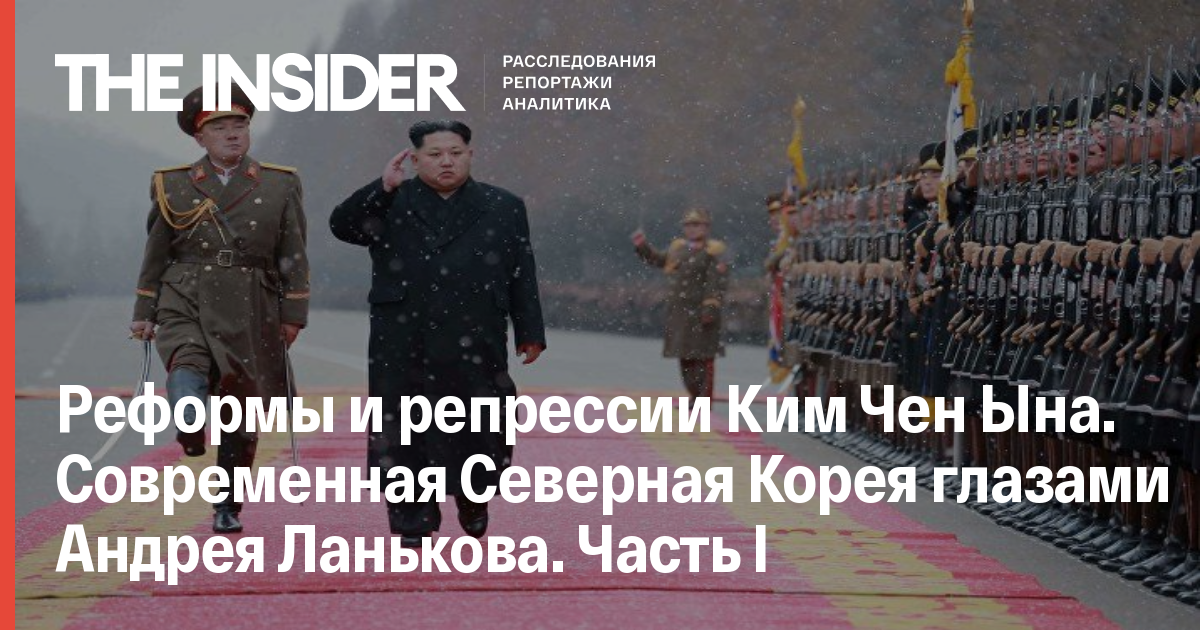
The Insider begins a new cycle of essays Andrei Lankov, professor at the University of Kunmin in Seoul, recently returned from the DPRK. In the new cycle we will talk about modern North Korea. The first part is devoted to the unexpected and decisive formation of Kim Jong -un as the new DPRK dictator and his reform.
On the morning of December 19, 2011, residents of North Korea were announced that an important message would be transmitted on TV at noon on TV. Many of them guessed what would be transmitted-and after the TV presenter Lee Chun-hee appeared on the screen in a mourning robe, there was no doubt: Marshal Kim Jong Ir left this mortal world. According to the official version, he died two days earlier, on the morning of December 17, in the cabin of his armored train, preparing for the next guideline and inspection trip around the country.
Wires Kim Jong Ira
Two years earlier, in the spring of 2009, the first signs appeared that Kim Jong Il had finally decided on the heir, the appointment of which he put off all the time for obscure reasons. After at the end of 2008 he suffered a stroke and, after several months of absence, appeared in the public heavily aged, reports of some “young commander” began to appear in the North Korean press. These messages were not specific, but after some time it became clear: preparations for the appointment of an heir, the appearance of which had been waiting by that time for about 10 years, finally began.
It was known about Kim Jong -uni that the first six months of the media even incorrectly recorded his name
The choice of Kim Jong Ira fell on his third son, Kim Jong -un, about which it was so little known then that the first six months of the media was even incorrectly recorded by his name (“like Kim Chen Un”, and not “Kim Jong -un”). The choice of Marshal at first glance seemed unexpected. By that time, Kim Jong Ira had at least three sons and at least one daughter - and from them he chose the youngest and least known. In October 2010, Kim Jong -un was shown to the world, introduced the country's top leaders and promoted to the army generals (he became the youngest army general in the world - he was then only 26 years old). In the summer of 2011, the cult of Kim Jong -un began to spread. The slogans calling for eternal fidelity to the young commander began to appear next to similar slogans in which it was about his father and his grandfather.
Apparently, the initial plan assumed that Kim Jong-un would have been learning the art of managing the country with his father. The health of Kim Jong Ira by that time worsened noticeably, but it was unlikely that anyone expected that his death was not for long. In this plans, these plans were not destined to come true, and Kim Jong -un, who was not even 28 years old in October 2011, turned out to be at the head of North Korea. From the very beginning it was clear that his father left him a difficult inheritance. However, time showed that the deceased Kim Jong Ira had good reason to opt for his third son. Kim Jong -un showed himself a harsh, pragmatic, decisive leader, although it must be admitted, sometimes unnecessarily emotional and capricious.
The main task of Kim Jong-un was to preserve power in very difficult conditions-he was threatened, firstly, his own dignitaries, who, as he was afraid, could organize a conspiracy. In order to eliminate the potential threat emanating from them, Kim Jong-un acted tough, and the first one and a half to two years of his reign were marked by repression against the military and party leadership, which North Korea has not seen since the late 1950s-that is, from those ancient times, when his grandfather Kim Jong-un has burned out the sympathizers of Moscow and Beijing. It is significant that the point of repression was aimed at the security forces - the leaders of the armed forces, security services and the police. Some of them were repressed, and part was simply dismissed or with kaleidoscopic speed was translated from place to place. On average, during the reign of Kim Jong -un, the North Korean Minister of Defense was for about 11 months, while during the years of his father and grandfather the average term of stay in this position was 10 years.
Kim Jong -un tried to get rid of the potentially disloyal members of his family. In December 2013, he was unexpectedly arrested (right at a meeting of the government, in front of the cameras) his aunt Chan Song Thek, who, according to Kim Jong Ira, was supposed to become the head of the informal regent council under the young son-native. A few days later, Chan's dream Taek was judged by the special tribunal of state security and immediately shot. Chan's dream Taek was accused of all mortal sins - for example, in the indictment, it was also a question that he maliciously ordered to put a stone stele with an Ode in honor of Kim Jong -un into the shadows, far from the sunlight. Another sin of Chan Song Take was that he supposedly applauded with insufficient enthusiasm when the new leader of the country was announced about the “election” of Kim Jong -un.
In the indictment of Chan's, Taek's dream was mentioned that he applauded with insufficient enthusiasm when Kim Jong -un was announced to the new leader of the country.
However, the real reasons and executions of Chan Song Take, and the murder of Kim Jong Nam, who was living abroad in Kual Lumpur, brother Kim Jong -un of his father, were most likely caused by completely pragmatic considerations. Both Chan Song Thek and Kim Jong, being noticeable figures in the Kim clan, were independent, and Kim Jong often came into contact with a foreign press on his own initiative and generally behaved dangerous for the new North Korean leader.
However, in addition to the tasks of maintaining power to Kim Jong -un were the tasks of economic reform. Apparently, the young leader understood that the long -term preservation of power without them was impossible. His father, as you know, decided not to carry out reforms, fearing that their effect could be unexpected: indeed, as world experience showed, reforms can both save the system and accelerate its degradation. Being an elderly person, Kim Jong Ir reasoned that the margin of strength of the regime would be enough for the remaining years, and prudently decided not to change anything.
Kim Jong -un had no choice. The system slowly but steadily spread at the seams, and he understood: in order to remain in power for another 30-40 years (namely, this is his main strategic goal), he needs to do something with the economy. Kim Jong -un was different from his father, who practically did not go abroad, did not speak foreign languages and poorly represented the situation in the world - at least so as to solve economic issues. Kim Jong -un spent his childhood in an expensive private Swiss school, speaks foreign languages and presents quite well how the modern world works.
Kim Jong -un did not build any illusions about the team economy of the Soviet model that existed in the DPRK (by that time, rather on paper). He understood that he needed to dismantle this economy - as it was dismantled in China and Vietnam. However, the existence of a rich and unicoline South Korea in the neighborhood remained a dangerous destabilizing factor. Therefore, starting his reforms, Kim Jong -un had to observe maximum caution. With the Eurocorean leadership, it simply could not afford a policy of reform and openness, similar to the one that has been held in China for almost 40 years. The only way out for Pyongyan was "Reforms without openness." In other words, Kim Jong -un intends to pursue a policy aimed at accelerating the spontaneous transition to a market economy, but at the same time do everything possible in order to maintain ideological and police control over the population and maximum information isolation of the country from the outside world, primarily from South Korea. He understands that the spread of information about the life of the rich south in the country will jeopardize the preservation of domestic political stability in the DPRK, and wants to avoid this.
The strategy of “reforms without openness” generally corresponds to the interests of both the North Korean nomenclature and the new North Korean entrepreneurs, the very tonsha, the “owners of money”. The nomenclature may be unhappy with Kim Jong -un for one reason or another, but the fall in the regime is not included in her plans. It is clear that in the event of the fall of the North Korean regime, in the country united under the control of Seoul, the entire nomenclature, including its most liberal and moderate representatives, will be out of work, and perhaps even become a victim of discrimination and persecution.
However, the fact that the nomenclature wants to maintain the regime seems obvious. Less obvious is the fact that representatives of the new North Korean bourgeoisie - Tonju - also do not have enthusiasm about the possible unification of the country under the auspices of the south. In the current situation, they flourish, however, if the revolution ends according to the German scenario by the absorption of North Korea and the establishment of Seoul control throughout the territory of the peninsula, the North Korean business has no chance of success in competition with industrial giants of the South. Now many businessmen from the DPRK have a chance to get rich seriously, and eventually go into the dollar multimillionaires and even that the devil is not joking, in billionaires, but this will not happen if such a “Hyunde” or “Samsung” get access to the market.
Thus, in his policy, Kim Jong -un could rely on the support of both the old and the new elite - but still during reforms, the maximum caution should be observed.
Reforms Kim Jong -un
The economic policy of Kim Jong -un can be reduced to four elements - agriculture, industry, private business and foreign investments.
Agriculture
The first signs that the new North Korean leader is going to sharply turn the steering wheel of a state ship, appeared very early, in fact, immediately after he found himself at the feeder. On June 28, 2012, Kim Jong -un, who by that time had been in power for only six months, released the so -called “June 28 instructions”, which, in fact, launched reforms in agriculture.
The decision itself to start reform with agriculture was quite predictable. Firstly, this is what the Chinese did at one time, and the reforms in the DPRK imitated transformations in China in the 1980s, that is, the first years of the reign of Dan Xiaopin. Secondly, reforms in agriculture are politically safe. Peasant riots, of course, also occur from time to time, but serious revolutions usually begin in cities. Thirdly, North Korea faced an acute lack of food, so that a reform that could significantly increase its production was vital.
The reform in agriculture was essentially a moderate version of the one that was held in China in the early eighties. The authorities allowed the peasants to create “small links” of 7-10 people who had an unprecedented autonomy. In particular, the link was given a plot of cultivated land, which, as it was implied, would work from year to year. At the end of the work, part of the crop - from 10% to 40% - surrendered to the state, and the rest remained at the link and shared between its participants by their consent. At the same time, the size of the “small link” corresponded either to the size of a large peasant family, or, rather, two peasant families. Although nothing said in official documents in this regard, in practice it was meant that the “small link” would consist of members of the same family or two or three families living in the neighborhood. In fact, it was a slightly disguised transfer of agriculture to a family in a row.
As expected, this scheme worked in North Korea, although with somewhat less success than in China and Vietnam (however, this is understandable - the North Korean version was less radical than Chinese or Vietnamese). The production of grains during the reign of Kim Jong-un increased by 20-30%, and by 2017-2018, the country came close to the level of self-sufficiency of food.
Industry
Reforms in industry began a little later, in 2014. The basis of the new model was the “Autonomous Management of the Socialist Enterprise” system. It largely resembles a system of “double prices”, which existed in China at the dawn of reforms. This is not by chance: from 2012-2013. Groups of North Korean experts were in a number of leading Chinese universities, systematically collecting materials on Chinese economic and social policy during Deng Xiaopin (and without attracting excessive attention to their presence)
In accordance with the new scheme, North Korean industrial enterprises still receive planned tasks, which, however, are significantly less than their expected capacity. All products that are produced in accordance with these planned tasks are sent to the state and redistributed by North Korean planned organizations (North Korean analogues of the State Planning Commission and the State Assembly) at its discretion. The company is paid for these products, but this fee is more likely a symbolic character. Everything that has been made beyond this plan is at the disposal of the enterprise. The company can then sell these products at contractual (actually market) prices. The administration of the enterprise can hire and dismiss employees at their discretion, as well as appoint them the salary that he considers fair.
The average salary in Pyongyang is an average of $ 50-60 per month.
The introduction of the new system predictably contributed to the improvement of the economic situation. Since 2012-2013, tangible economic growth began in North Korea. Regarding the pace of this growth, there are serious discrepancies among specialists. This is not surprising: in the DPRK, almost all economic statistics are secret, so when talking about the condition of the North Korean economy, you will inevitably have to engage in fortune -telling. Pessimists estimate the growth level of 2-3% per year, and optimists talk about 6-7%. At the same time, economic growth is accompanied by an increase in salaries and a noticeable improvement in living conditions of the population. Under Kim Jong Ira, the official salary was only $ 1-2 per month (however, no one lived on it then: they worked as it or another). Now at a successful enterprise, whose products are in demand, the salary can be $ 90-100-especially if this enterprise is actually private, although operating under formal state registration. The average salary in Pyongyang is an average of $ 50-60 per month.
Private business
Simultaneously with the implementation of reforms in agriculture and industry, Kim Jong-un and his government changed their attitude to private business, which appeared in Korea and intensified back in the 1990s. With Kim Jong Ira, the attitude to private business was contradictory: entrepreneurs were encouraged or persecuted. With Kim Jong E, the persecution of the private sector completely stopped.
In 2014, a law on a production enterprise was adopted, the 38th article of which provides that North Korean state enterprises can attract individuals of individuals. Closed decisions and documents constantly emphasize that partnerships between government officials and rich private individuals, that is, Tonju are extremely important for the development of the country. Despite the fact that no one has yet canceled many formal prohibitions on private entrepreneurial activity, in practice Article 38 of the Law on a Production Enterprise creates a magnificent formal loophole to circumvent restrictions.
Private persons can invest in North Korean enterprises - moreover, now it is now much easier to create private enterprises under the roof of official enterprises. In this case, everything looks absolutely legally and completely in socialist on paper: the state enterprise creates a new unit (possibly even in another city), using the money of a private person, which is then appointed by the director or deputy director of this unit. In practice, we are only talking about creating a formal roof for private investment. The number of similar pseudo-state enterprises that have been in North Korea since the beginning of the 1990s, with Kim Jong-un, began to grow rapidly.
Foreign investors
Finally, Kim Jong -un tried to attract foreign capital to the country. In the early years of his reign, it was announced to create 26 special economic zones (SEZs), which copied the SEZ that existed in China back in the 1980s. However, none of this venture came out, since foreign investors showed much interest in North Korea. Partly here is the matter in a sluggish nuclear crisis that creates in potential investors an idea that Korea is a very dangerous place that is better not to contact. Впрочем, куда большую роль тут играют завышенные ожидания северокорейских чиновников, которые, в частности, полагают, что будущие инвесторы возьмут на себя не только возведение совместных предприятий и закупку необходимого оборудования, но и займутся созданием с нуля инфраструктуры в тех районах, где им будет позволено работать. Желающих строить железные дороги и проводить линии электропередач только для того, чтобы потом производить в Северной Корее дешёвые кроссовки, пока как-то не обнаружилось. Немалую роль играет и сложившаяся у северокорейцев репутация крайне ненадёжных партнёров – в целом, увы, заслуженная.
Желающих строить железные дороги и линии электропередач только для того, чтобы потом производить в Северной Корее дешевые кроссовки, не нашлось
Впрочем, конфуз с привлечением иностранных инвестиций – это, пожалуй, единственная серьезная неудача экономической политики Ким Чен Ына. Реформы работают, и жизнь северокорейцев улучшается прямо на глазах. Северная Корея находится сейчас примерно в той же ситуации, в которой находился Китай в начале 1980-х,– если, конечно, вывести за скобки куда более репрессивный характер существующего в КНДР политического режима.
To be continued...
Также читайте исторический цикл Андрея Ланькова о Северной Корее:
Ч.I «Все началось с великого голода» ;
Ч. II«Все способы спастись от голода были капиталистическими» ;
Ч. III Тончжу — как в Северной Корее появились богачи ;
Ч. IV После голода. Почему Северная Корея не пошла по пути Китая? ;
Ч. V «Вредительская» реформа и казнь «американского шпиона» Пак Нам-ки ;
Ч. VI «Великие дни разграбления и контрабанды» ;