
Translated material
"Who is asked about the north?"

At the end of November, Arkhangelsk was held for the third time Arctic Art Forum , which in a short time became one of the most popular and significant events in the city. His curatorials Ekaterina Sharova (Arkhangelsk -Kirkenes), Kristina Dryagina (Arkhangelsk) and Mei toe (Bergen -Niksund), contrary to all obstacles, embodied in their activities an example of passionate self -organization, taking the ancient cultural heritage of the Euroarctic region of Russia as a reference point in curatorial work, which until recently was practically known in the Russian modern modern art. The forum crossed the boundaries of gallery and oversized spaces, placed in the most advanced locations of the city (open space of the SAFU and the House of Youth); boundaries of art, design, architecture, combining artists, designers and architects on one site; The boundaries of the regions, collecting on one site those who are engaged in the production of culture, where the reference point is the place itself - the north.
What prospects have art in the north, how Arkhangelsk reinsures colonial destruction, why the usual formats (White Cube, Biennale) were not sufficient in work in this region forgotten for many years with a unique history, which D. Likhachev called “the most Russians”, and how could one work with an international agenda, with Ekaterina Sharova Anastasia Vepreva.
- Before the start of the Arctic Art Forum this year, it seemed almost on the verge of a breakdown, but now you are writing that he was the most successful of all three. Why did this happen?
- For reasons, from us without dependent, one of the grants was detained for a long time, so many Moscow and Norwegian artists could not come. There were problems with the artist’s visa with Australian passport. Working with art in Russia is a risk, you need to quickly look for a solution. It was interesting to delve into this - Norway is unknown. Of course, this is stress, but after that all the statements in a white cube seem too safe and a little infantile.
As for success, our task from the very beginning was not to bring knowledge, but to update the local agenda and give the site to the voices, which are rarely audible. Due to the imbalance of power, the North found himself in a situation where they speak for him, he was in the position of Subaltern, if we use the term Gayatri Spivak. This has historical reasons associated with a huge experiment of the twentieth century. Attempts to reach Russia to Europe turned into destructive consequences for the North and Arkhangelsk.
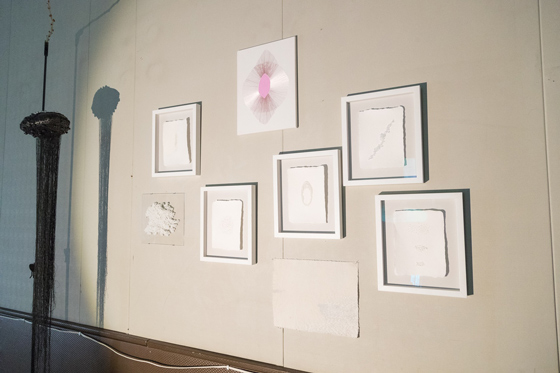 © Nikolai Gevetn Exhibition. Ustin Yakovlev
- Tell me about the main projects that participated in this forum.
- This year the forum consisted of four parts. The first is the exhibition “Maps of meanings” , where local young artists, Moscow and international authors were collected. Many of them are biographically connected with the region, many have already worked on projects for the forum. Their works made a route along various points of the youth house, in which viewers could create a new, own, map of meanings. Among them are Ustina Yakovleva , Anastasia Vepreva , Ingrid Torwood , Daria Orlova . The second block is a fair of creative industries , a hybrid format familiar to the inhabitants of the north of the fair and a new word. Today in the Arkhangelsk region this sector is not supported, and the huge layers of the meanings of the North are not sufficiently capitalized, although the potential is large.
The largest wooden city in Europe, the story with special migrants, gulag, today's economic processes, when most taxes go to Moscow, thereby bleeding the north, all lies the weight on each.
The third part is debatable , the plenary session “Cultural Code of the Arctic” and the seminar “Creative Economy in the North” in the SAFA techno -park were held there - it promises to be a place of attraction of innovation in the region. They were attended by university experts and representatives of creative industries who have established themselves at the federal and international levels, for example, Mikhail Bronsky was the only non -non -Moskvich who won the Creative Business Cup Russia in 2016. His business is built on the use of intangible capital of the North - he produces tea where packages are decorated with Senkur painting (he himself was born and grew up in the Shenkur district of the Arkhangelsk region). Even this year, Anton Kalgaev returned to Arkhangelsk, which was already here in 2012 as part of the Hy Nnerland research laboratory of Strelka . He spoke about his observations about what the national and folk in the post -Soviet context means.
All these events, like the entire forum, are organically related to the topic of the performance of Daria Akimenko, who in early November defended the doctoral dissertation at the University of Lapland (Finland) about how narrative spaces - including art - work with identity.
 © Nikolay Gernet work Ingrid Torvund at the exhibition "Maps of meanings"
One of the seminars was dedicated to the topic of depopulation of the North and the departure of talented youth. This is the pain of many. The director of the Pomeranian Philharmonic Vasily Larionov had a post on social networks that his daughter left for Moscow and with her - all the other graduates in her class. The post received a big resonance. The panel discussion, which was modified by the cultural scientist Tatyana Lefman, included both representatives of the administration of the Governor of the Arkhangelsk Region and the Government of the region, and who left creative workers: violinist Ilya Ershov, producer of the company "Girls on the bridge" Evgeny Bektasov. There were those who came from Moscow to Arkhangelsk, for example, Anna Petrova from Barents Secretariat . According to her, in the north, thanks to international relations with Norway, the level of language teaching was often higher than at a Moscow university, and if you set goals, you can achieve them if you work a lot. And what is to "leave"? You cannot remove yourself the place where you have grown - it is always with you, at least in the language.
An important event was a seminar about the Nemoskva project with Alisa Pruudnikova and Maria Kuzmina, to which the forum socrama Kristina Dryagina managed to invite the Deputy Minister of Culture and directors of the region’s museums who worked with art, including with Arctic Art Institute projects. Perhaps these meetings will become a reference point for the work of the GCS in this region.
The fourth was the block of evening events : the concert of the ensemble Tim Dorofeev with the participation of Nadezhda Mironova, where jazz and northern folklore merged into something one and free. Hope for eight years worked as a choirmister in the northern folk choir, and now she returned to Moscow and makes an amazing workshop of a natural voice.
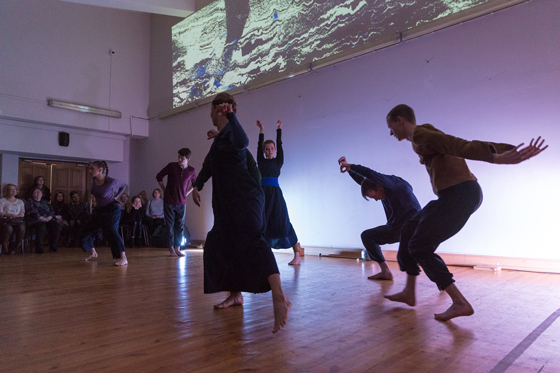 © Nikolay Gevetes Prime Permans “Living Taxes”
The last event of the forum was the performance of the “living trends”. Kristina Dryagina and invited directors - Eva Valieva and choreographer Nikolai Shchetnev worked on him. They were known as the organizers of the avant -garde festivals in Arkhangelsk at the beginning of the zero, and then left, respectively, to Moscow and Kirkenes. The performance-password was created according to the results of a multi-stage laboratory, which took place throughout the year. To make a statement with the young dancers and actors of your hometown is not the same as doing this in the residence: your memory, your bodily knowledge participate in the process. Therefore, it was a performance to himself. The Theater-Verebatim, like folk art, is collective, it is created from many voices, crystallizes into a single statement. Actually, the whole forum is also made: it is a fusion of many flows.
Speaking from the point of view of acquiring by us, the inhabitants of the North, subjectivity, I would note the presentation of the collection of clothing by Anna Zlotko, inventing the new northern aesthetics. We talked a lot with Anya about history, about Pinega, about epics, were partners in the application for a residence in the village of Chakol, from where it is from. She made a collection of clothing "epic" on the basis of impressions from her own experience of growing up in the north. This is an example of a quiet voice that we need to hear.
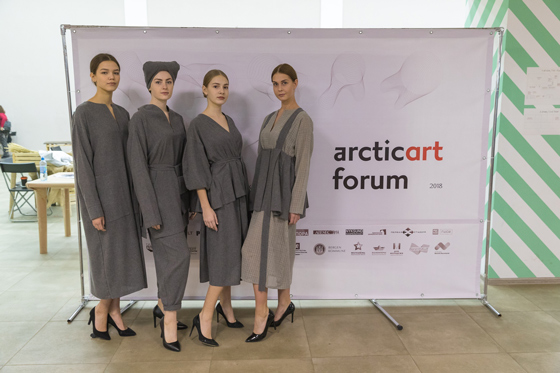 © Nikolai Gernet Fair of creative industries. Anna Zlotko. Epic collection
- I now heard visitors discussed that Arctic Art Forum was a very important event for the city. How was it possible to find a common language with administrative resources, with people who speak a specific language and do not always understand why such events are needed at all?
- Over the years of life and study at the University of Oslo, I learned that no one owes you anything. If you set a goal, then getting it in existing conditions is your task, and everything must be done by yourself, including mastering the administrative language. Previously, many conversations with the Russian administrations were taken by the forum's suppor Christine Dryagin, this year I began. In general, looking at these processes is interesting. The post -Soviet system is inhuman, and this can be seen in many microdetals (from pedestrian paths to investment priorities, when it comes to the interests of large companies, but not specific people). But in every institution there are people, and these are colleagues who can be sensitive to the same topics. Art is a universal language when you understand things that are important not only for the person, but also for the whole region - and, in the end, for the whole nation without words.
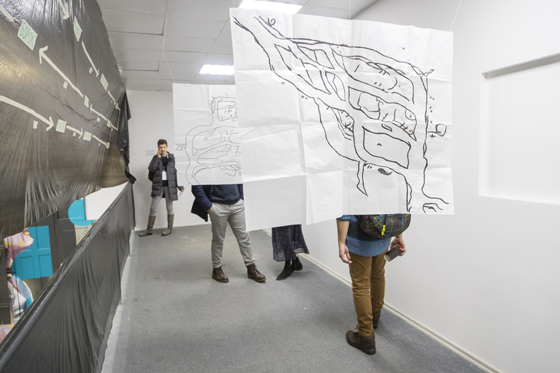 © Nikolai Gevetn Exhibition. Anastasia Vepreva
- How was the concept of the forum transformed? The last time you talked about the “slow culture”, and in general it is logical that “maps of meanings” came out of it. When you slow down, first of all, you begin to pay attention to the environment, which is usually blurred in everyday life - and after that it immediately wants to catalog and structure it into the map.
- The theme of the “Maps of meanings” was proposed by the supporter of the forum May toe. Now she lives and works between three cities - London, Bergen and Nicksund. She worked with projects at Sony , British Airways , Amazon . Seeing how much creative energy of the young is directed to temporary commercial projects, she decided to receive a curatorial education and work with art and with the restoration of the village in the north of Norway. When she offered the topic, I immediately remembered how our colleague and partner Sergei Kulikov brought me to the exhibition “Mastering the North. Thousand years of success ”in the Russian State Library in Moscow . I was interested in that the first maps of the North and the Arctic were created by the Swedes and Dutch in the XVI -XVII centuries, when there was no Petersburg. On these maps, I found familiar settlements indicated by Latin: Pinega , St. Michael (Mikhailo-Arkhangelsk Monastery), Mezen . Commenting on the map, the creator quoted Ovid's “metamorphoses”: “This is a land where cold and death live.” The author did not make Case Study , did not interview the people who live there: the source of knowledge was ancient Roman poetry.
In general, I have no doubt for a second that we are engaged in changing the paradigm.
At the forum, it was important for us to free ourselves from the dominance of Greek and Roman culture. Russian art today is influenced by both classical European culture and America (which is associated with the dominant economic model). In my work in the north in 2015-2018, I sought to get rid of dogmas, examples, samples and work, taking the place itself for the reference point. I have never had a doubt that I am doing the most important thing that can be done in Russia today, we were always ahead of what is happening in the country. In 2015, we held the Feily Knowledge forum: after that, the Krasnoyarsk Biennale Simon Mraz made an exhibition about the village. The difference was, of course, in the budgets and in the degree of articulation, in the extent that we have lived the statement.
All the time there was a feeling that I was from the future, that I need to look for the language, and it seems that this year it was found. It became clear that the main thing is not how they look at us, but how we are aware of ourselves. Who are we, where, where are we going. With this Gauguin thought, I lived the whole of 2015, returning to peripheral Russia, to my hometown, after 11 years of global life in Norway, Italy, Poland.
In the north, there are many unfinished injuries. There is some kind of violence in the air. The largest wooden city in Europe, the story with special migrants, gulag, today's economic processes, when most taxes go to Moscow, thereby bleeding the north, all lies the weight on each. Residents of the North, despite such cultural layers, do not feel pride in their place. It was important to regain these meanings for yourself, to regain this pride. Now the same processes of self -awareness are taking place with Sami in North Norway. But the difference is large - the small people and the keepers of the culture of the whole nation who forgot its history.
 © Nikolai Gevetn Exhibition. Daria Orlova. A flickering ship
- And how can such a work take place with the restoration of heritage?
-Very differently. For example, today people who recorded from the natives of the epics of Kievan Rus live right next to us - Ekaterina Zorina performed one of these epics last year. This year, the forum took place the premiere of Moon Far Away , a group created by Alexei Sheptunov. This is one of the most significant groups in the north, primarily due to the content with which they work. The lyrics are collected in the Arkhangelsk region. In January of this year, I interviewed Vasily Matonin, our teacher, who collected unique materials in the postonague during independent expeditions of the 1990s.
Bylina about Ilya Muromets. Ekaterina Zorina. Severodvinsk. Recorded in the Pinezh village of Krykov Gora at the long -lived Vassa Alekseevna Kuznetsova. XIV laurel folklore Christmas festival. January 15, 2016, St. Petersburg
Paradoxically, these studies are little known outside of Russia. Last year, I was at Arctic Arts Summit in the Norwegian city of Hashta. At the summit, galleries, artists, educational institutions of all Arctic countries were presented. From Russia, a representative of the Federal Ministry of Culture was invited there. He went out and read the piece of paper that everything is fine in the Arctic and the culture is developing. Everything, so to speak, goes according to plan. Observing from the inside, as musicians and artists of the Arkhangelsk region are on the verge of survival, I considered this performance, to put it mildly, not true. Immediately after that I wrote an article where I designated the challenges with which I have been working all this time. The main thing: who is speaking about the north? Who is given the word? Who is asked about the north?
This year, Sofya Gavrilova contacted me, with whom I have known one of the Russian-Norwegian projects to Tromso. She said that she would go to Murmansk with his students to work on the project with the participation of the chief architect of Barcelona: he had previously worked in various extreme landscapes, and now he is interested in the Arctic. Like many others, she was interested in content for her own research. I have long been interested in the existing structures for the production of knowledge and its distribution. Methods where local residents are an object for research, but often do not even find out about its results, seemed to me problematic.
Another example of how culture and science are collected without returning is the video “Border musical” of the “What to do” group, which I first saw at the Bergen Assembly. The project was created on the border of Norway and Russia, but the inhabitants of Nickel, who participated in production, did not understand it. I consider this project typically colonial, where the existing structures of cultural production are not called into question. The chosen strategy in this case contradicts itself. In words, criticizing the capitalist methods of production, artists use the same methods of producing knowledge as the capitalist artist. At the same time, the incompleteness of the knowledge that they possess is not in doubt.
The group "What to do." Border musical. Director - Olga (heron) Egorova. 2013
Obviously, central universities and museums are known too little about the north, and new knowledge has not yet been produced. Evgeny Tenetov, the director of the Northern Marine Museum, said that there are objects in the Oxford Museum that Richard Chansler, who opened the north of Russia for England, but no one knows about this. A good question - why did this story disappear from textbooks?
- In the general text to the forum, you say that we are now facing some challenges at the intersection of traditional and modern cultures. What are they?
- The north is now, that 50 years ago, that 100 years ago, Terra Incognita remains for everyone, and people are so exhausted and do not believe in themselves that there is no always strength to speak out. Therefore, our task was not to criticize and indicate these huge unprepared injuries, but to create living trends, to collect all living things together. Criticism is very important in the tradition of Western contemporary art - but why criticize what is barely breathing? Our task is to show an alternative. We are talking about a method that could be used in many other places that have experienced the destruction of colonization. Take, for example, such a challenge as the Moscow Landing in the Arkhangelsk region. This is the result of replacing and concentration of resources in one city, the result of colonization.
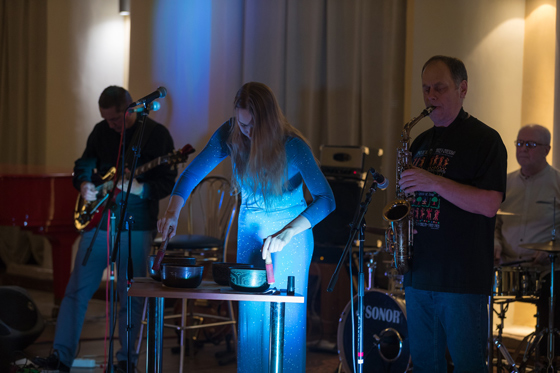 © Николай Гернет Концерт. Ансамбль Тима Дорофеева и Надежда Миронова
— Как ты понимаешь «экологию культуры»?
— Этот термин употребляет Лихачев, который долго жил и работал на Севере, но он, как и все русские исследователи, не всегда рационален. Однако то, что он пишет, сейчас актуально; правда, почему-то этим по сей день интересуются только консерваторы.
В этом году была острая дискуссия в соцсетях по поводу проекта фотографа Данилы Ткаченко , где он сжигает дома в северной деревне ради нескольких кадров. В той дискуссии я говорила с родственницей Лихачева. Мне показалось интересным, что по отношению к народному искусству она употребляет слово «уровень». Интересно возникновение иерархий. Народное искусство как коллективное производство — источник вдохновения. Что с ним произошло за годы СССР? Почему его музеефицировали? Почему оно больше не принадлежит людям? Все это — одни из вопросов, ставящихся на форуме. На эту тему мы много говорили с Натальей Васильевной Дранниковой , которая записала лекцию о былинах, народной драме и крупных открытиях, сделанных на Севере в XIX веке.
Здесь имеет значение и недостаток внимания к локальному знанию. Многие исследования Поморского государственного университета не оцифрованы, хотя материал там очень интересный. Поэтому кажется целесообразным, чтобы специалисты из Оксфорда запросили материалы у тех, кто годами работает над этой темой, пусть и в другой научной традиции.
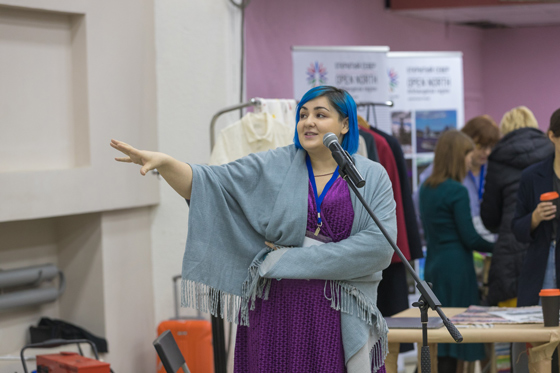 © Николай Гернет Открытый микрофон. Антонина Онишко. Национальная галерея Коми
— Расскажи про свой опыт участия в проекте NEMOSKVA , где все как раз и должно было так работать — приезжают эксперты и спрашивают у местных. У вас на форуме была о нем дискуссия. Очень многие обвиняли проект в том, что эта идея не сработала, общения не получилось и местных никто слушать не стал.
— Мне показалось странным, что там нет Севера. И это был мой главный вопрос, так как мне кажется, что с него все и должно начинаться. Однако проект NEMOSKVA я нахожу более отвечающим запросу регионов, нежели триеннале «Гаража» с лозунгом «Россия, которую вы не видели». Хотя бы потому, что его делали люди не из Москвы. Это похоже на то, что делаем мы — через эмпатию, сочувствие и любовь. Оказалось, когда это в себе включаешь, то все начинает работать.
Вообще то, что Алиса Прудникова и Мария Кузьмина приехали к нам в Архангельск, — это очень круто, и я рада, что они нашли время. Но, чтобы во всем разобраться, конечно, нужно больше времени; надеюсь, в будущем оно найдется.
Север должен быть куда более четко обозначен в федеральных программах и в национальном проекте «Культура».
— А как ты вообще видишь свою роль в Arctic Art Institute — институции, которую вы сами создали? И какая твоя общая цель?
— Я не готова говорить о глобальных целях. Arctic Art Institute стал организацией во время поездки NEMOSKVA , а до этого именно самоорганизация занималась производством таких крупных вещей, как выставки и форумы. Своя НКО у нас появилась, когда я ехала в этом транссибирском поезде, а до этого просто была компания людей.
В целом у меня ни на секунду нет сомнения, что мы занимаемся сменой парадигмы. И я считаю, что я сделала то, что могла сделать. Осталось только написать это, оформить и проговорить.
 © Николай Гернет Открытый микрофон. Николай Михайленко, независимая сцена «Плавучий док». Murmansk
— Как ты видишь идеальную картину культурной ситуации на Севере? В частности, в Архангельске.
— Север должен быть куда более четко обозначен в федеральных программах и в национальном проекте «Культура». Необходимы децентрализация ресурсов и профессиональная консолидация, которые не дают непрофессионалам принимать решения там, где у них нет компетенций. Как сказала в первый день Елена Шатковская, руководитель Кенозерского национального парка: «Проблема России — это низкоквалифицированные высокомотивированные люди».
— Один из главных вопросов форума был в том, как создать условия, чтобы специалисты не уезжали. Но, может быть, проблема в том, как сделать так, чтобы они возвращались? Хотя бы время от времени. Ведь и ты сама сейчас снова уехала в Киркенес.
— Здесь ответственность лежит на самих специалистах. Меня никто не звал в Россию, мне было интересно самой. На семинаре «Талантливая молодежь уезжает в столицы?» мы обсуждали эти темы, и, например, Евгения Бектасова, которая работает сейчас в Pikene på Broen , говорила о том, что нам самим нужно становиться волонтерами. Юлий Марич, представитель администрации, говорил: «Мы полностью открыты — приходите». Дом молодежи, тоже административная структура, говорил: приходите и делайте. Связь между молодыми специалистами и административными единицами быстрее всего работает в молодежных структурах — они гораздо более открытые, чем люди советского поколения.
В Архангельской области скоро будет создан фонд, который будет поддерживать развитие некоммерческих художественных проектов в регионе, — об этом тоже было сказано на семинаре. Если нет экосистемы, то ее нужно создавать самим.
Информация об Arctic Art Forum 2016—2017 годов
Subscribe to the COLTA.RU channel in Yandex.Zen to miss nothing