
Translated material
Memory. Alexander Pechersky
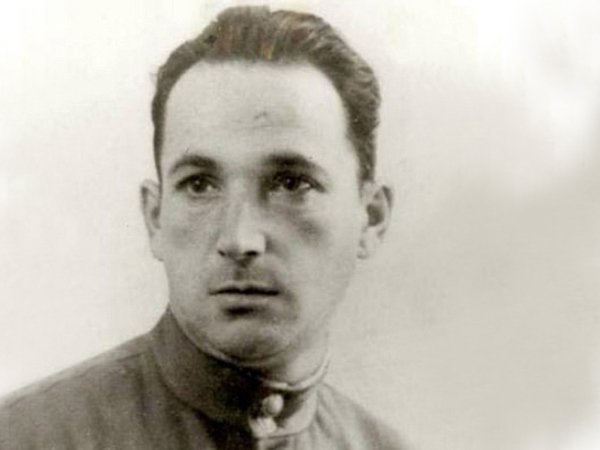
On February 22, 1909, Alexander Pechersky was born, the organizer of the uprising in the death camp of Sobibor.
Personal business
Alexander Aronovich Pechersky (1909-1990) was born in a Jewish family in Kremenchug in the Poltava region. His father was a lawyer. In 1915, the family moved to Rostov-on-Don, where Alexander graduated from a seven-year-old and music school. Having received the certificate, he got an electrician at the steam locomotive factory. He graduated from the University of Rostov. Shortly before the start of the war, he led theatrical and musical amateur performances.
On the first day of the war, the 32-year-old Pechersky as the current commander (junior lieutenant) was drafted into the army. In September 1941, he was certified at the front as a second-ranking technique, which corresponded to the rank of lieutenant; He served in the headquarters of the 596th artillery regiment of the 19th Army.
In October 1941, he was wounded surrounded by Vyazma, was captured, where he was ill with a rash typhus, having managed to hide it (the patients of prisoners were shot).
In May 1942, with four other prisoners, he tried to flee, fugitives were caught and sent to the penalty camp to Minsk. It turned out that Pechersky was a Jew, and he and other prisoners of war of the same nationality were taken to the “forest camp” near Minsk, where they threw into a crowded “Jewish basement”.
“Only on the fifth or sixth day, when most of the people driven here died and the corpses were taken out of the basement, it was possible to lie down for a couple of hours, and then only on their side. We were lying on naked raw land. We could not distinguish days from night, lost the time of time, ”Pechersky recalled.
Ten days later, in this basement, in August 1942 he was sent to the “working camp” of the SS, in which there were about 500 people from the Minsk ghetto, as well as the Jewish-soldered Jews.
A month later, Pechersky, together with others, was sent to the Sobibor Death Camp built in Poland. There, on October 14, 1943, he organized the uprising of the prisoners.
Prisoners of the camp were able to eliminate 12 SS men and 38 Ukrainian guards and break free. Most of those who fled, and everyone who remained died.
Of the approximately 550 prisoners of a working camp, 130 people did not participate in the escape. Near the fleeing 80 prisoners, they died immediately (many were blown up on the Minna Field by the camp), another 170 people were caught and killed during the Germans launched by the search operation.
A week after the escape, Pechersky with several former Soviet prisoners of war entered the Partisan detachment named after Schors, where he was a demolition before the liberation of Belarus from the Nazis. His detachment launched two German trains from a slope.
After uniting with the detachments of the Red Army soldiers, the Pechersky was arrested and sent to the penal battalion, the assault rifle battalion consisting of the 1st Baltic Front. On August 20, 1944, upon attack on the city of Bautsk, he was wounded by a fragment in the thigh. According to some sources, after the battle, he was rehabilitated as "reduced blood with blood." In others, they figured out his case before that, and he received a wound as a full -fledged fighter.
After the injury, he spent four months in hospitals and was demobilized with the rank of captain.
With the end of the war, Pechersky worked as an administrator at the Rostov-on-Don Musical Comedy Theater. In 1945 he wrote the book “An uprising in the Sobyburovsky camp” printed by a small circulation.
In 1948, during the “fight against cosmopolitanism”, Pechersky lost his job. After that, up to the death of Stalin in 1953, he could not get anywhere. At that time, he learned to embroider and sold his products in the market.
Then Pechersky was taken to the Rostselmash machine -building plant, where he was a worker, then a foreman. In 1962, he witnessed the accusations at the process of eleven guards of the Sobibor camp (the courts over former guards took place in 1962-1965 in Kyiv and Krasnodar).
Alexander Pechersky died on January 19, 1990 at the 81st year of life.
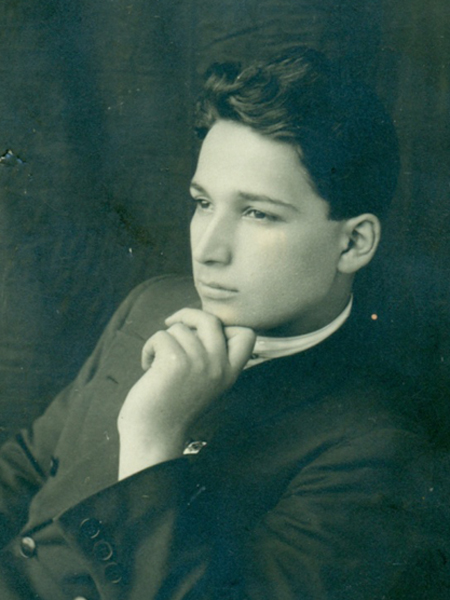 Alexander Pechersky Ejwiki.org
What is famous
Alexander Pechersky became the organizer of the only successful uprising in the German death camps. More than 400 people out of about 550 who were in the labor camp took part in the escape from Sobibor. It was possible to survive from them quite a few: about 250 died during the escape or were soon caught and executed. Before the liberation of Poland from the Nazis, about 90 former former prisoners of Sobibor were given to the Germans by local residents or killed by collaborators. Only 53 participants in the uprising survived until the end of the war.
What you need to know about
In the Soviet Union, the feat of Pechersky was not widely known: Soviet propaganda did not separate the theme of the Holocaust separately, focusing that the Nazis exterminated citizens of all nationalities.
After the war, Pechersky led a quiet, inconspicuous life. Lev Simkin, who wrote about him the book “An hour and a half of retaliation”, said : “He was the most ordinary, typical Soviet man, very far from reasons of national self -identification. He was forced to be a Jew - at first the Germans, and then the situation of post -war anti -Semitism in the USSR. But the thought of emigration to Pechersky did not even occur to the Pechersky. Although the wife, Olga Ivanovna, told him: let's leave, there you will be a hero, there you can tell everything. But he believed that here his homeland and tell about Sobibor he should here.
- Others knew about his biography?
- Close, of course, knew. The rest are not. Already when the book came out, the famous lawyer Mikhail Matveevich Babaev called me and asked for a copy. It turns out they were familiar. After the war, Babaev worked in Rostov-on-Don as chairman of the district court, and Pechersky was a popular assessor with him. I asked Babaev how the Pechersky behaved on the processes. As everyone says, the usual "nodded". Nobody knew anything about his past - so, an ordinary person, a worker. But something, Babaev said, was felt very sluggish, very significant. ”
Direct speech
—To camp Sobibor (memoirs of Alexander Pechersky,. PDF ) : “Borukh was an old camp, one of the few who was here for a year. His work consisted in sorting things removed from the dead. He knew a lot, and from him we became aware of where our comrades disappear and how it is done.
In simple words, as if we were talking about ordinary things, he talked, and we, who had just arrived here, but already surviving enough, listened to him with a shudder.
... In the first camp where we were sorted, workshops are located: shoe, tailor, carpentry. There are two houses for German officers.
As soon as you were separated and brought here, the rest was taken to the second camp. You are lucky. Usually all the arrivals are sent there, no one is left.
From the first camp there is a passage to the second camp, where the bulk of the arrived camps are driven. There they are ordered to put the knots brought with them and undress to go to the "bath". In women, hair is cut off. Everything is done quietly and quickly. Then the sorting and packaging of their things occurs.
And people are sent to the third camp, to the so -called "heavenly road". About half a million Jews have already been destroyed in the third camp.
Women go with children in the same lower shirts. Behind them, at a distance of a hundred steps, under the enhanced guard, there are completely naked men. There, not far from the place where the smoke is visible, and the "bath" is located.
There are two buildings: one for women and children, the second for men. I myself did not see the internal structure of these premises, but they told who knows. At first glance, everything is arranged there as it should be in the bath: taps for hot and cold water, barrels for washing ... As soon as people enter the “bathhouse”, they immediately lock the doors behind them and thick, dark puffs of smoke begin to descend from above. Defending screams are heard. But this does not last long. Soon, screams turn into bubbling, wheezing, people, panting, writhe in dying convulsions. Mothers are trying to cover their children with their own body. The “banner” is following the small window in the ceiling behind the “procedure”. Fifteen minutes - and it's over. Then the floor opens, and the dead bodies fall into the trolleys prepared in advance in the basement of the "bath". Loaded trolleys are rolled out of the basement. Everything is done quickly and organized, according to the latest German technology. The bodies are folded in a certain order, doused with combustible liquid and set fire to. ”
About the girl met in the camp (ibid.): “Luke took out the male upper shirt from his bosom
And gave me.
- Why is it? I asked.
- Put on it.
- I'm in a shirt.
- Put on it.
- For what?
- Sasha, please put on you. She will bring you happiness.
- Luke, love, no, this is superstition. Yes, and once to me.
- No, you will wear it! You must! - She became stubborn and began to pull off my jacket.
- If you do not want to do it for me, then do it for your daughter. You say that she is most expensive for you in the world, so do it for her. In this shirt you will go through all the dangers. And if you pass, then we will live.
I quickly put on a shirt and put an end to the conversation. The girl's face shone with a smile of joy. She kissed me on the lips and hastily ran out of the hut.
The French Jew, who worked with me and watched this scene, came up to me and said seriously:
- Do not laugh at the shirt. This is happiness. Luke brought you happiness. "
Pechersky retained this shirt after the war.
7 facts about Alexander Pechersk
- There is a spelling of the name of the hero as a Pechersky. In the certificate of partisan of Belarus, his surname in Belarusian is indicated as Pechora. There, in Russian, he appears as a Pechersky.
- The penalty battalion commander Major Andreev was shocked by the story of Pechersky about Sobibor and sent him to Moscow to testify in the commission to investigate the atrocities of the German-fascist invaders and their accomplices. Pechersky was heard by writers Pavel Antokolsky and Veniamin Kaverin. On the basis of his story, their essay “Uprising in Sobibor” was published. Immediately after the war, the essay entered the collection “Black Book” about the Holocaust and Jewish Resistance. In the USSR, this book never published.
- The most famous film about Sobibor was Jack Gold's tape “Escape from Sobibor” (1987) with Rutger Hauer in the title role. In 1989, the Soviet-Council documentary “Rebellion in Sobibor” was shot, which was not widely fame.
- Every year on October 14, Pechersky celebrated the anniversary of the escape. To him from different cities of the USSR, the surviving former prisoners of the death camp gathered. He also supported the correspondence with those comrades who lived abroad. “Contrary to the recommendations of the organs, he started correspondence with former prisoners of Sobibor, whom fate scattered around the world,” Olga Ivanovna recalled his widow. - The court is a cold war, we stigmatize the imperialists, and he writes in the USA, Australia, Israel. They answer him, they call to visit. " Despite official invitations to both the Nuremberg process and commemorative events dedicated to Sobibor, the Soviet authorities have never allowed the Pechersky to go abroad.
- Pechersky was married twice: by the beginning of the war, he already had a daughter Ella, who went to kindergarten. Soon after the war, he divorced and marries Olga Kotova, whom he met in the hospital, where he was treated. At first, the family lived in a dark basement.
- When in 1948 they tried to start a criminal case at Pechersky-supposedly due to improper accounting of tickets in the musical theater-and came to his house with a search, the investigators were struck by the poverty in which he lived. The case was closed. But they fired from the work of Pechersky, and also expelled from the party.
- After the uprising, the prisoners remaining in the camp were immediately shot. The camp buildings were dismantled, and the Germans plowed the territory, planting it with cabbage and potatoes. After the war , there was a kindergarten at this place for a long time . In 1965, a monument to the victims of the Holocaust was erected in Sobibor: a huge mound from the removed upper layer of the earth, mixed with ash, burned bodies. On his basement there are windows through which the bones and hair of the dead are visible.
Materials about Alexander Pechersky:
Biographical certificate in Wikipedia
Biographical certificate in the "Electronic Jewish Encyclopedia"
Article in "Arguments and Facts"
Memories of Pechersky in the magazine "Who is the main"
Memories of Alexander Pechersky ( .pdf )