
Translated material
From a bour to the Englishman
Four books about the war in Afghanistan: subjective choice
In February 1989, the war fought, which was waged by the Soviet Union in Afghanistan. The conflict, which is so completely meaningful, is not understood and not reflected. The editor -in -chief of Gorky Konstantin Milchin talks about the four most important, in his opinion, books about that conflict. 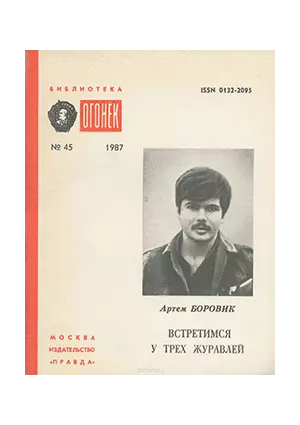 Artem Borovik. Meet me at three cranes. Soviet internationalists in Afghanistan. M.: True, 1987
At the outcome of the war in Afghanistan, Artem Borovik (1960–2000), the prince of the Soviet press (Papa Henry Borovik was one of the most famous international journalists, for some time led the International Panorama, worked for many years a correspondent in the United States), and he went on a business trip to Afghanistan. Major from major, a boy who grew up in America, goes straight to hell and writes from there reports of extraordinary power. There is a trench truth here, a sip of fresh air, maximum immersion in the topic and a sincere desire to write as honestly as possible. This is not Chernukha, but no longer joyful law-abiding reports on internationalist warriors. Borovik created surprisingly strong images - like a description of a take -off from the Kabul airfield of the transporter, where the aircraft is covered by assault helicopters. They discard heat elements to confuse manual anti -aircraft missile systems. Borovik did not forget the Afghan theme, wrote a few more books about her. But it was precisely those reports, along with another impressive series of materials, about the service in the American army, who made him a reputation. Which later turned into the status of one of the most famous journalists of the 1990s.
 Svetlana Aleksievich. Zinc boys. M.: Young Guard, 1989
The third (after the war has not a female face ”and“ non -child’s stories ”) is the book of the future Nobel laureate in the literature of Svetlana Aleksievich, in which the corporate identity (some of the admirable, in others - indignation) is honed almost to perfection. Instead of author’s speech, a continuous stream of consciousness of interlocutors - participants in the war; But to a large extent, not even themselves, but those who stayed at home and were waiting for them from the war are the mothers of the soldier.
“A bullet stumbles upon a person, you hear - not to forget him, not to confuse with anything - a characteristic wet slap. A familiar guy next to him falls downward, in caustic as ash, dust. You turn it on his back: a cigarette that he had just gave him was clamped in his teeth ... She still smokes ... I was not ready to shoot a person, I still from a peaceful life ... from the world ... For the first time you act like in a dream: you run, drag, shoot, but do not remember anything, you can’t tell after the battle. Everything seems to be behind the glass ... behind the wall of the rain ... you see a terrible dream. You wake up from fright, but you can’t remember anything. To experience horror, it turns out, we must remember him, get used to him. After two or three weeks, nothing remains of you, only your name. You are not you, but another person. I think so ... "
There is no longer any charm of war, the war is some exceptional, concentrated evil. “Zinc boys” form a common view of Afghanist for all 1990s. There is nothing to be proud of in this war.
 Sergey Kozlov. GRU special forces. M., 2000
This is not one book, but a whole cycle of publications, interconnected by a single theme, which was preceded by publications in various specialized magazines. The special forces of the GRU existed before, but it was during the Afghan war and in the first years after its end that this non-public structure turned into a certain brand. Of course, the book of a fugitive intelligence officer Viktor Suvorov (Rezun) “Aquarium” played a role, where he boasted his participation in the exercises of the special forces. The motives of Suvorov are mysterious, it seems that he wrote Pasquil on the GRU, but thousands of post -Soviet boys read this text in their manner and learned that in the USSR there were superman -manes like Rimbo, and maybe more abruptly.
In the 1990s, the GRU special forces periodically fell into television screens and the press: one detachment surrendered to the enemy during the First Chechen War, other detachments seemed to participate in all successful and not very operations of that conflict. About the participation of special forces in the Afghan war went on various respectful rumors. It is clear that a fighter of special forces by a person by definition is not public. Nevertheless, in the late 1990s and the beginning of the zero years, a kind of speaker of special forces veterans appeared (well, or called himself) Sergey Kozlov, under the name of which stories of the stories about various operations of special forces in Afghanistan-from participation in the storm of the Amin Palace and to very secret operations somewhere on the Pakistani border. The war here, of course, is severe work, but you always remember the past with nostalgia. And of course, the authors of the book, as honest soldiers, did not doubt the correctness of the decisions of the Soviet leadership, which sent them to this. The pendulum of the attitude to the Afghan war swayed in the other direction. Yes, the war, perhaps, was not very good, but our honor of Russian weapons certainly did not shame there.
 Rodrik Brevet. Afghan. Russians in the war. M.: Corpus, 2013. Translation from English Anton Shirikov
In this small and subjective list there is one book written by a foreign author. Roderick Brandiet is an English diplomat, he was an ambassador to Russia in perestroika, and in 1992-1993 he headed the United Intelligence Committee of Great Britain. On domestic conspiracytic sites, it is periodically included in the list of the worst enemies of Russia, who are attacked by something against our homeland. Meanwhile, his book is imbued with respect and even sympathy for the Soviet soldier. No, he does not sing the victories of Soviet weapons, but he describes in detail the heroism of ordinary warriors.
The decision to introduce troops into Afghanistan near Brawiet looks like a chain of tragic mistakes: not very well understanding where exactly they invade, suspecting the Americans and Chinese in insidious designs, the Soviet leaders unleashed the war, not really understanding how to get out of it with minimal losses. In the book, Brandyite also mentions what has become a common place on the domestic sites of a hurraiotic orientation: now, during the endless War of NATO in Afghanistan, ordinary Afghans recall that war with the Soviet Union with Nostalgia. In an interview with the author of these lines, Brevetet confirmed: yes, with nostalgia:
“I myself did not believe that the Afghans love Russians more than us or Americans. But when I came to Afghanistan, everyone answered me: “Why are you asking such a stupid question? Of course, we love Russians more.” <...> I remember the old Mujahed from Herat, who said: "It was better for the Russians." I then asked: But weren't the Russians more cruel? “No,” he answered, “the Russians fought honestly, and the Americans kill our children and women from the air.” <...> The Russians fought more or less, like the Afghans, their weapons were generally the same. Russians shot Afghans, Afghans - in Russians. It was normal, in Afghanistan they are so fighting. The Americans are fighting with a button. They kill from a height of 10 thousand meters, and no one even sees them. ”