
Translated material
“Spring Time” will appear in Russia - the arrows will translate for half an hour. Experts fear computers failure
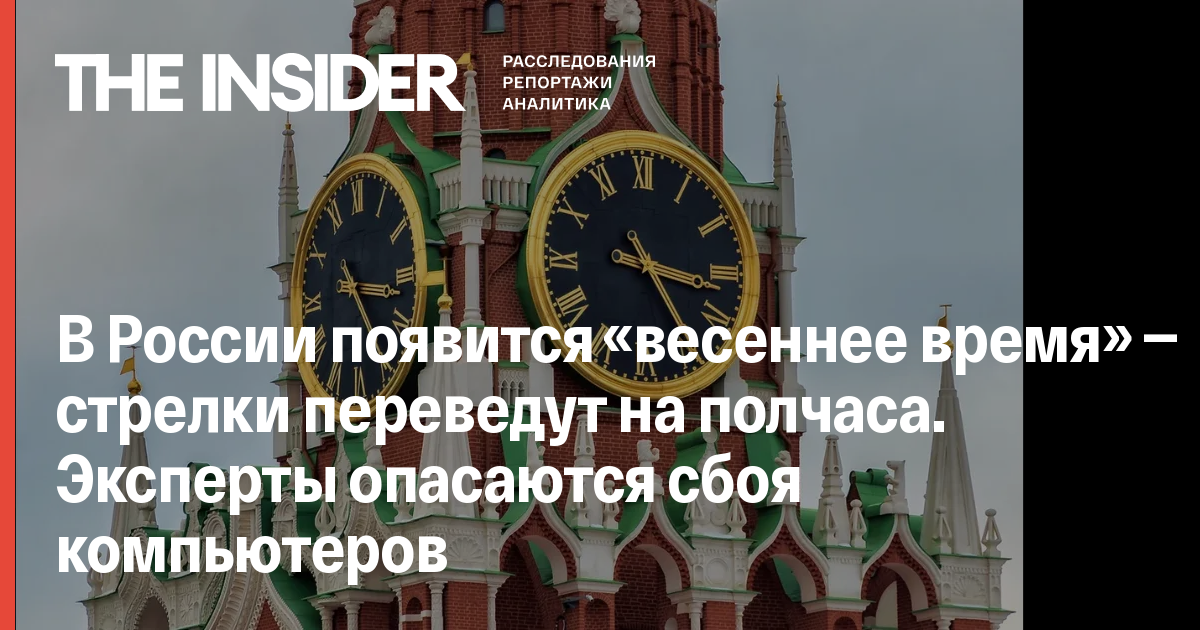
After long interdepartmental battles, the Russian government decided to return to the transfer of the arrows depending on the time of the year. In response to the objections of Rospotrebnadzor that the translation of the shooter leads to “stress and diseases” (especially for young children with a strict daily routine), a compromise decision was made - time will be transferred 4 times a year for half an hour. In other words, the summer and winter time will be the same as the 2011 Medvedev reform (UTC +3 in winter and UTC +4 in the summer), but in the spring and autumn it will differ from the rest of the world for half an hour (UTC +3: 30). The first translation of the arrows for half an hour should occur in April.
The decision on a half -hour translation was also supported by the Ministry of Agriculture on the grounds that this creates less stress for milking animals (primarily cows), which are used to milking at the same time. Opponents of the transfer of hours for half an hour talked about the fact that this would create confusion during communication with other countries (for example, when making calls abroad, as well as for transport companies carrying out transportation abroad). However, this argument was unconscious, since it concerns only a small number of Russians (three quarters of Russians do not have passports at all, and the predominant majority of traveling abroad do this no more than once a year).
Thus, electronic devices will be the main problem - in computers and mobile devices with automatic determination of time, a clock belt shifted for half an hour is not provided. The government has already promised to start negotiations with the largest software manufacturers to add such an option. Experts, however, are sure that this process will be delayed and therefore in the near future, users of smartphones and laptops will have to suffer. “Problems with mobile phones are not even the worst thing,” warns a member of the expert group under the government, the head of the Digital Russia movement Sarkis Shakiryan, “technical difficulties may arise, for example, by air traffic controllers. The problem is not just confusion due to time, but in the fact that due to the lack of synchronization, some software may simply stop working. ”
It is curious that the half -hour difference is not a Russian invention. So, for example, India lives in time UTC+5: 30. In addition, from 1909 to the German occupation in 1940, Holland lived in time UTC+00: 20. To be precise, the Dutch time corresponded to UTC +0 h. 19 min 32.13 sec. And only in 1937, for convenience, it became UTC+00: 20.