
Translated material
Where will your digital traces lead?
Where will your digital traces lead? Orwell's "Big Brother" is already here. The mayor's office buys geoanalyst at mobile operators of communication, the continental hockey league creates a base of profiles of hockey fans (everyone is interested in how much spectators spend on matches), and parents “give” children GPS trackers who are very similar to bracelets for conditionally released. Do we need a compromise between safety and privacy?
In digital traces (Digital Footprint), almost everyone can track down. Your Cyberten will tell you what you were looking for on the Internet, where you check or just pay, in which organizations you will be cooked, how many friends you have, than you do. Any information from the network, mobile Internet and web space is stored and used-by commercial companies, law enforcement agencies or just enthusiasts.
The information owner has the right to determine the procedure and conditions for access to information, as well as allow other actions with information. Information posted in the form of open data is publicly available (clause 4 of Article 7 of Federal Law No. 149-ФЗ), which means the absence of restrictions on its use (clause 1 of Article 7 of Federal Law No. 149-ФЗ). Data.gov.ru, open data in Russia
Digital traces do not perform the function of the passport (so far, who knows whether we will take the experience of China), but their contents and metadata affect the reputation, trust and safety of the user. One of the demonstrative cases: the Barnaul teacher of the Russian language and literature Tatyana Kuvshinnikova lost her job due to the publication of a photo in a swimsuit. Colleagues were organized by organizing a flash mob #teacher of the teacher . The story ended well: Tatyana received the position of specialist in the educational and methodological work of the library and information sector.
But much more terrible news: attackers hunted homosexuals through dating applications. They were searched for victims in public in VKontakte, in the apps Grindr, BlueSystem, Hornet, Love.mail.ru. Through the fake profile they were appointed a meeting, and on the spot they were represented by police, threatened with “consequences” and extorted money.
We have already written about how social networks and microblogs collect (and some sell) about you. It is worth supplementing with only one fact: it is not necessary to be a large corporation or have access to complex analytical tools to find the necessary data. Games, dating sites, USRN, Unified State Register of Legal Entities, FSSP, Cyan, Avito: on the network you know better than many relatives.
"Data Scientist is the sexiest profession of the 21st century." Harvard Business Review, a loud title from the magazine, reflects reality. We were always interested in these (counting the turnover of personnel or normally), but now they have turned into a new type of asset. They can already be turned into AI services that will become a new source of profit: credit scoring, targeted advertising, recommendation system.
All other things being equal (computing power, available machine learning tools: Tensorflow from Google, DMTK from Microsoft) The main competitive advantage in the artificial intelligence market is the data itself. Big corporations have understood this for a long time: that is why Facebook bought Instagram and WhatsApp, and Microsoft - Linkedin.
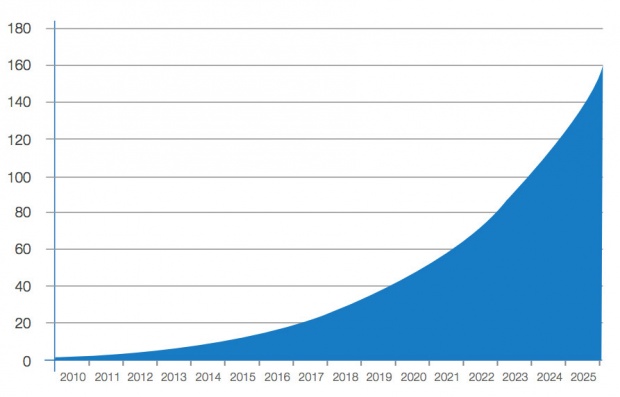
Another topic: what are the algorithms capable of? Machine learning opportunities
Should I wash the "cyber prints"?
Each country has its own “Code of Relations” with a “big brother”. “If you go to Berlin, you will find that it is difficult to pay a card there,” comments Ivan Ninenko , a member of the Future Foundation Expert Council, “many establishments do not fundamentally use cards so as not to transfer data on their consumers. And these same establishments refuse to place cameras, although in public places the tracking system works great. Perhaps in the future there will be a new counterculture that will abandon the patronage of the “Big Brother”, there will be conventional wineswalls - zones without cameras. But so far, security is perceived as what we can abandon Privacy. ”
Given the volume of data and their availability to balance on the verge of safety and personal comfort is becoming increasingly difficult. There are services that are engaged in social media analytics and data collection, for example, SocialDatahub . The company creates intellectual monitoring systems and behavioral models for recognizing photo and video content. Their customers are advertising agencies, officials, as well as private customers.
Some with SocialDatahub are looking for their love , others follow children . The intentions are good, but, obviously, not everything is so simple. In 2018, Facebook noted that the service spy for its users by order of the state, and blocked personal accounts of all employees. At the same time, the founder of the company Arthur Khachuyan said: “We do not give any personal data to anyone, but that they (customers-buyers.- Approx. Ed. ) Doing our software-this is already their job.”
“The society as a whole is developing in the direction where the level of trust is minimal, and everyone is ready to sacrifice many for the sake of safety. Parents for the sake of the safety of children sacrifice them with freedom, including digital-hung on them GPS sensors, data from which they fall into open access. Total surveillance is a story not only about the “big brother”, but about the confidence space. And this is perhaps a starting point for any alternative communities, ”says Ivan Ninenko
According to the expert, an interesting trend has now been indicated: division into those who sell their data, and those who use paid subscriptions. In the first case, users exchange information about themselves for free access to any services and programs (or sell, as in the case of Facebook ). And in the second case, you need to literally pay so that your digital prints do not get into the network.
“A request for data protection is an elite topic, and it will remain like this in the near future. For those who are interested in, there are data protection programs, as well as lawyers protecting digital rights. But for most people, this topic is so far from their everyday reality that they do not consider it necessary to pay attention to it. Most likely, they will come to the conclusion that data exchange for free content is a good deal. ” Ivan Ninenko
Douglas Rashkoff, an American mediaved, writer and publicist, in his book “Team Human” (2019) claims : digital technology is the latest tool to extract value from people and deprivation of the ability to engage in their own life. Meanwhile, evolution is a “team sport, and not the survival of the most adapted”. “Team Human” is a call for the best future of mankind and a game plan for this, ”the author believes.
The writer says that the market and technology work according to the anti -human program, and corporations and culture glorify individualism. In such conditions, not only a digital, but also a real, distorted personality is erased. What this will lead to is the issue of the future, and it, as you know, is a consequence of decisions adopted today.