
Translated material
“The military has made a coup to prevent the revolution” is a political scientist about events in Sudan
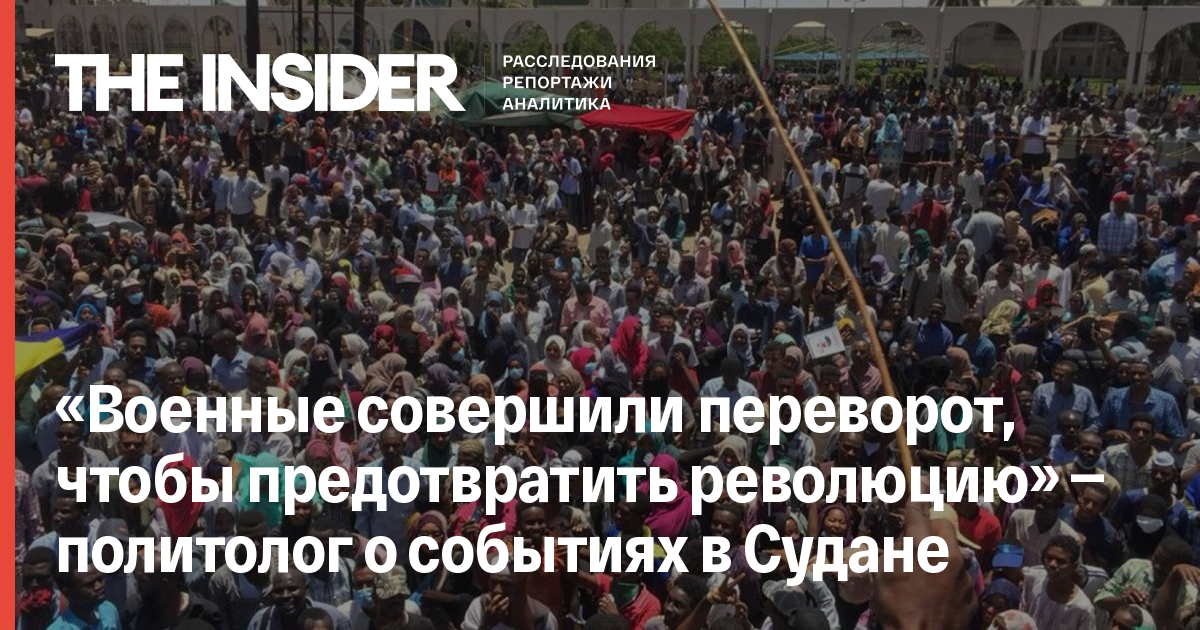
The army of Sudan at an emergency meeting took off the post of President Omar al-Bashira and dismissed the government. The Military Council under the leadership of the First Vice President, the Minister of Defense of Avad Ben Auf, seized power in the country and declared a transition period that could last about a year. Al-Bashir and his supporters were arrested. Protests demanding the resignation of the President of Sudan, who has been in power for more than 25 years, has been continuing since December last year. In February of this year, a state of emergency was introduced in the state. The head of the Center for Sociological and Political Sciences of the Institute of Africa of the Russian Academy of Sciences, Sergei Kostelinets, told The Insider, for what purpose the military seized power in the country, what fate awaits the former president and whether the revolution of Sudan’s cooperation with Russia threatens.
Since 2011, the economic and political crisis has been going on in Sudan. At the branch of South Sudan Hartum, the capital of Sudan, lost a significant part of the receipts from the sale and transit of oil. In this regard, the budget was affected. Anti -crisis measures, including raising the economy, the development of gold mining, brought some successes, but were not able to make up for the loss, and therefore the economic crisis worsened. In 2018, in Sudan there were three devaluation of the national currency, huge problems with a lack of fuel, the state did not have money for medicines. There was no convertible currency for import purchases - and Sudan has a very great dependence on food imports.
All this led to exacerbation in December 2018. It all started with the protests of schoolchildren and students. The schools did not have the opportunity to buy breakfasts, the students did not have the opportunity to buy bread, which went up about three times due to the abolition of subsidies-before that, the price of bread was lower than the cost. Interestingly, student rallies did not begin in the capital, where there are many universities, but in the state of Blue Nile, December 13. Cubs, tear gas were already used there.
The active phase, when the protesters began to burn the offices of the ruling party, intelligence, unfolded on December 19. This has already spread to dozens of cities, to most states. In the capital, demonstrations, roads of roads, arson of tires began - the situation developed as usual in Arab countries. For December, there were about 500 protests.

At the end of February, a state of emergency was introduced, but the protests did not subside. On Fridays and Saturdays, they were especially active, the country these days were actually paralyzed. Professional associations joined the protesters - doctors, lawyers, workers, pharmacists, engineers. Lawyers, say, picketed the Supreme Court, the doctors stopped going to work in the hospitals, especially those related to the army, special services. As the protests developed, the focus shifted to the demands not only to reform the government, but to resign both him and President al-Bashira.
Support from opposition parties also began to grow. For example, the Sudanese Communist Party was almost completely arrested for supporting rallies. Large opposition parties-Al-Umma and Unionist-Democratic, who are decades, spoke for the protesters. The requirements of the protesters were approved even by the conservative “Muslim brothers”.
As a result, the army not only refused to disperse protests, but also began to protect the protesters from the special services
On February 22, the president changed the government, and replaced most of the provinces of the military, to representatives of the special services. A new prime minister was appointed. But this did not lead to the expected result. As a result, the army not only refused to disperse protests, but also began to defend the protesters from the special services, that is, from the police, the National Intelligence and Security Service, from various half -willed formations that supported the president. Over the past two days, about five troops have died. Today the army removed the president.
By the way, in January, the president himself declared readiness to give way to the army to stabilize the situation. Al-Bashir is a military military person from landing units, he fought in the south of Sudan for many years. In 1989, he headed a military coup. Therefore, he was just relied on the military as the main support of his regime. And in this situation, it is difficult to say whether it is a revolution or an attempt to prevent a revolution, since it is quite possible that the military, who allegedly keep him under house arrest, has some agreements on al-Bashir guarantees. I am not sure that he will be subjected to judicial persecution, since the revolution was headed by his many years of associates. Everything happened, in general, without bloodshed, which fits completely in the tradition of Sudan, they are proud of the lack of violence during coups.
Interestingly, first of all, the arrests of those persons in the government that relate to the so -called Islamist wing followed. Since 1989, the government consisted of military and Islamists who advocated the tightening of Sharia. Al-Bashir is considered a representative of the military wing, while the former vice-president of Tah was an informal leader of the Islamic wing arrested today. Therefore, we can say that the army prevented the development of events that could lead to the triumph of the crowd. The protesters did not have a leader, therefore, in the case of a real revolution, a great destabilization could be expected. On the other hand, the military prevented a possible Islamic coup, because the Islamists could try to go to the first positions of the protest.
Judging by the history of Sudan, then, say, during the coup of 1985, the military shifted the military regime of Nimerii, and a 12-month transition government was announced. Then the elections were held, and the authorities were transferred to a more or less democratic government. On the other hand, in 1969, the military revolution ended with the coming to power precisely the dictator Niemayiri. That is, you can consider different scenarios.
At the moment, it is more likely that the military who came to power will lead the transitional council, possibly with the civil government, and will prepare for elections in a year. However, the theoretically possible scenario is possible with the advent of a new authoritarian ruler to power, although this will be perceived very negatively from the street.

The military wing of the government is very close to cooperate with Russia. Therefore, at the moment, when it comes to creating a transitional military government with figures from the General Staff, I do not think that this directly threatens the relations with the Russian Federation. But it is still obvious that any perturbations call into question specific contracts. Many processes will be simply frozen until it becomes clear who will lead one or another direction in the government. Then the authorities will probably have to take populist measures, that is, to send funds to satisfy the direct needs of the population in the field of nutrition, medicine, fuel and so on, and not for long -term projects or weapons imports.
From the point of view of geopolitics, I would not expect sudden movements, because the military has been working with Russia for many years, they use mainly Russian weapons. Among the suppliers of weapons in Sudan, Russia is in the first place, ahead of China in terms of imports over the past 10–20 years. Russian technical instructors work in Sudan. I do not think that the military government will interrupt these contacts.
What will happen after the transition period is another question, because as a result of the elections to power, a completely different government can come, and to noticeable improvement of the economic situation, he will need to withdraw from the list of terrorism, which is created by the US State Department. IMF loans will be needed, we will need to write off huge debts - $ 40-50 billion, which Sudan owes various international structures. That is, the authorities will be interested in establishing ties primarily in the West. Of course, this can affect his foreign policy guidelines in a longer -term plan.