
Translated material
Repair of failure. The series "Sorge": melodramatic inventions instead of historical truth
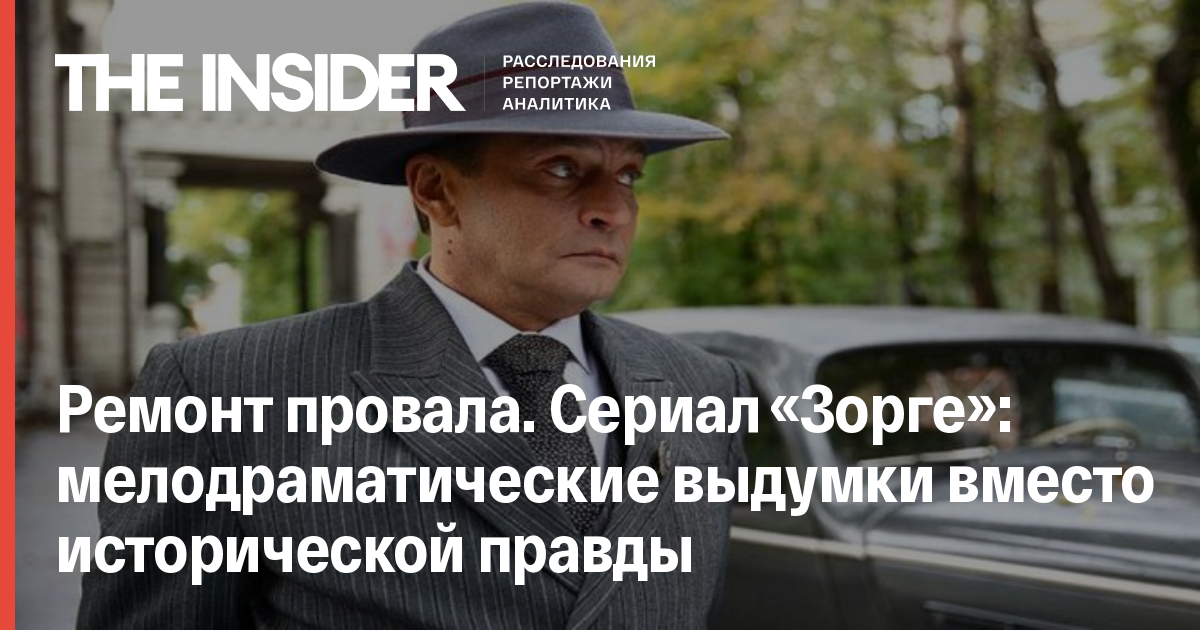
The series "Sorge" directed by Sergei Ginzburg, shown on the first channel, again attracted attention to the fate of one of the most famous Soviet intelligence officers. The series is plentifully equipped with newsreels, which should create the impression of historical reliability. In fact, the events of the life of Sorge and his comrades are interpreted extremely freely, including with gross violations of chronology. The whole invented are the political and love intrigues raging in the film. Yes, and documentary inserts, to put it mildly, tendentious. For example, the battles near Lake Hassan are represented as a Japanese provocation, although the Soviet side actually began the fighting, since Stalin wanted to check the combat effectiveness of the Red Army after a large terror. And the Molotov -Ribbentrop Pact appears as a step of Stalin, who allowed to move the war, but not a word says that as a result of the USSR pact, he occupied and annexed a significant part of Eastern Europe and attacked Poland and Finland.
In fact, the events of the life of Sorge and his comrades are interpreted extremely freely, including with gross violations of chronology
A characteristic example of a violation of chronology in the series: at first we see the flight of the head of the Far Eastern Chekists, the commissar of the state security of the 3rd rank of Henry Lushkov in Manchuria, then the appointment of General Oygen Ott by the German ambassador in Japan, and some time later we are shown by the Austria Anschlus. In fact, Lyushkov escaped from the USSR on June 14, 1938, Ott took office as an ambassador on April 28, 1938, and Anschlus occurred on March 12–13, 1938. Why did all this confusion with chronology need, remains a mystery.
In the series, the center makes the Sorge group kill the traitor Lyushkov, which she ultimately carries out in 1940. In fact, there was nothing like this, and Lushkov, most likely, survived not only Sorge, but also the end of the Second World War.
According to the official Soviet version, based on the testimony of Japanese intelligence officers arrested in Manchuria, Lyushkov on August 8, 1945, with the outbreak of Soviet-Japanese war, was transferred to Manchuria, where on August 19, three days after the capitulation of the Kwantun Army, he was shot by the captain of the Japanese intelligence by Utaka Takoeoka, the head Intelligence agency in the Dyarensky intelligence department so as not to give the defector to the Russians. However, in the materials of the interrogation of Takeoki and other Japanese officers, a number of oddities are striking.

Even before the Soviet attack on Japan in Tokyo, Manchuria and the Kvantun Army had long been written off the accounts there. Japanese diplomacy suggested that the USSR act in negotiations with the United States and its allies to combat Japan on the conditions of surrender, different from unconditional. For this, the Japanese were ready to give Stalin not only South Sakhalin and the Kuril Islands, but also Manchuria, offering Soviet troops without resistance to internet the Kwantun Army. Due to dominance in the air of American aviation and the lack of a fuel in the Manchuria Japanese, a few Japanese aircraft landed then. And they took out a return flight experts whom they wanted to save. But the Japanese did not say in interrogations that the plane, who brought Lyushkov, captured someone with a return flight, and in general there is no documentary evidence that on August 8, any plane really landed in Dyren. The main thing is that the Japanese had no reason to drag Lushkov in Manchuria. He would bring more benefit to Tokyo. If Henry Samoilovich was going to kill as an unnecessary witness, then it would be easier to do in the Japanese capital, and not in Manchuria.
When Takeooka testified to investigators of Smersh, he and his chef, the head of the Russian department of the Dyaren Military Mission Konchi Ivamoto, showed that Lushkov was cremated under the name of Reichi Yamaguchi. The Soviet counterintelligence checked this and found out that, according to the statement from the registration book of the Dyarensky crematorium for August 20, 1945 for No. 2391, a permit for cremation was given for No. 2277 of Reyichi Yamaguchi, born on January 10, 1916, a Japanese, a civil servant of the Japanese army. The time of death is 1 hour of the day on August 19, 1945. The cause of death is a bullet wound in the heart. Cremation Processor is the head of the Manzhou detachment 15518 Fumio Iosimur. The urn with the ashes of Yamaguchi was seized by SMERSH officers. Ivamoto identified her, and the guard of the cemetery of Fuku Nisiam, in turn, recognized Ivamoto as a person who brought an urn for burial.
Then two inconsistencies are striking immediately. Lyushkov, as you know, was born in 1900, and Yamaguchi, under the name of which he seemed to be buried, was born in 1916. Lyushkov was a European in appearance, and he buried him as a Japanese. If Japanese scouts really killed Lyushkov, then they would be worth burying him as Russian, for example, born in 1902. After all, there were also Russians in the Dyaren mission, and there was nothing unusual in the fact that one of them died. And so they could only arouse puzzled questions from cemetery ministers, why suddenly a middle -aged European is buried under the guise of a young Japanese. If Lyushkova really was not at that moment in Manchuria, and the whole performance was intended for representatives of the Soviet special services, who were about to appear in Dyren, then Takeoka and his comrades could give out the urn with the ashes of Lushkov, the cremed remains of some Japanese soldier who committed a shot in the heart (after announcement of surrender about surrender Suicides among the Japanese were commonplace).
Takeoku and Ivamoto knew very well that one of the first questions that they would be asked in captivity would be about the fate of Lushkov. And they willingly answered him. But why then did they not take care to bury Lushkov in the European cemetery so that the corpse could be exhumed? Their actions are more reminiscent of the coverage operation, carried out by order of the Japanese intelligence chief, Lieutenant General Saidzo Arisue, who needed to convince the Soviet side that Lyushkov was dead. The general understood all the value of Lyushkov for the Americans, who could be interesting to the information of the defector about the work of the Soviet intelligence services even seven years ago. At the occupation administration, Arisue flourished, although he was listed as a war criminal of class A. Therefore, it is likely that Lyushkov did not leave Tokyo, fell into the hands of the Americans and subsequently lived in America. Information about the fate of people like him, the FBI and the CIA, as a rule, are not disclosed.
Contrary to the widespread opinion, reflected both in the 1961 film, the French director Ivo Champi “Who are you, Dr. Sorge?” And in the current series, the failure of the Sorge group did not occur due to the fact that the transmitter of his radio operator Clausen was swaddled, and the messages were deciphered. And not because the center in 1939 allegedly ordered Sorge and Clausen to transfer information to contact the employees of the Soviet embassy, which would contradict all the rules of conspiracy. And, of course, not because, as stated in the series that Sorge involuntarily betrayed his Japanese wife out of jealousy.
The Japanese intercepted a number of Clausen reports since 1937 and found that the text has been encrypted by five -digit groups of numbers, as well as that the programs are in the direction of Vladivostok. The Japanese counterintelligence had no doubt that a Soviet intelligence group was operating in the country, although she could not decipher the radiograms, as well as to swagger the location of the transmitter and arrest the radio operator. And about Sorge, the Japanese did not think that he was engaged in espionage in favor of the USSR. After all, he was a close friend of the German ambassador and a convinced Nazi. And contrary to what we see in the series, up to the arrest of the Japanese police of Sorge, did not suspect anything. In addition, he had a well -deserved reputation as a drunkard and a womanizer, and this did not really fit with the image of a foreign intelligence resident.
The Japanese turned to the Germans with a request to send them modern radiors. Ott Ambassador announced this request to Sorge. He replied that, it seems, the Japanese suffer from spyingomania, and he himself demanded from Clausen more often to change the gear sites. The communist ties of one of the members of the group destroyed Sorge. Thanks to betrayal, the police entered the artist Miyagi Yotoku from the Sorge group, who, living in America, joined the US Communist Party and was recruited by Soviet intelligence, and returning home, began to work with Ramzai. The traitor was the results of Ritsa, one of the leaders of the Communist Party of Japan. I emphasize that he did not know anything about Sorge, and he, in turn, did not even suspect his existence. According to the investigation conducted by KPI, after the arrest on June 27, 1941, he “split” and became the informant of the police, after which he was not only released (as if for lack of evidence), but also made it possible to return to work to the research department of the South Manchu Railway. Among others, the results issued his familiar communist Kitabayashi Tomo, a member of the “external circle” of the Sorge group, which was associated with Miyaga. She was arrested and, in turn, issued Miyagi, who unsuccessfully tried to commit suicide, and then betrayed Ozaki and Sorge. The Ozaki, who was founded as a party ally, but not as a Soviet agent, already in prison expressed the conviction that the group failed due to betrayal.
The communist ties of one of the members of the group destroyed Sorge
One of the documents of the Japanese secret police, published after the war, said that "the testimony of the results should be considered the beginning of arrests in this case (Sorge. - B.S.)." This was confirmed by the Americans and the surviving Japanese counterintelligence.
In the award sheets of Japanese police officers who exposed the Sorge group, as a traitor, from whom the thread reached for Kitabayashi, and then to Miyaga, a certain Tomofuji Ken was named. Under this pseudonym, the results were known in the police, who was interrogated, as follows from other documents, on June 27, 1941, one day with the mythical Tomofuji Ken. And here is what is said in the text of the award sheet on a policeman with the pseudonym Tomofuji Takele about, in connection with which he attracted the attention of the Police Tomofuji Ken: “On June 27, 1941, thanks to the honest attitude to the work, relentless efforts and excellent technique of the investigation, he (the Tomofuji Take, the assistant bailiff. Tomofuji Ken, in a prolonged investigation, the case of violation of the law on maintaining public calm and forced to disclose a hitherto unknown crime (preparatory committee to restore the Japanese Communist Party). In addition, he achieved an important recognition that laid the foundation for this matter: "A member of the American Communist Party, a woman of Kitabayashi, who returned from America, is a foreign spy." Thus, thanks to the efforts of this assistant bailiff, we managed to reveal a large spy organization. ”
The preparatory committee for the restoration of the Communist Party included just Ritsu. And the pseudonym was invented by the name of the policeman interrogating him. And the main testimony, apparently, gave Ritsu in the case of an attempt to restore the Communist Party. And about Kitabayashi’s spy, he mentioned, so to speak, to the snack. But it was this indication that brought the award to his investigator.
As Russian historian Vladimir Tomarovsky writes, for the first time uniformly published awarded sheets in the Sorge case, at one of the symposiums “Tomii Vatabe (Japanese historian, who previously defended innocence of Ritsu results), the reversing of award sheets with police officers accessible to him (the list of officials of the police department, the index list of the arrested, ten days arrested). “As a result, I understood,” he wrote in a letter, “that Tomofuji Ken was Ritsu, the Takeor Tomokhiro (Tomofuji), the Takeor from a special police, to the Tanaka to the Nobor Takagi. Until now, in the history of KPI and in the literature in the Zorge case, we considered these arrests only as repressions regarding the movement for the reconstruction of the CPI, and the disclosure of the case of Sorge looked like the subsequent event caused by the testimony of R. results ... "
So Sorge was in no way guilty of the failure of the group. On October 15, 1941, Clausen, coming to Sorge, found him extremely excited. Two days earlier, usually the punctual Miyagi did not come to the meeting. But the 15th did not appear Ozaki (it was on this day that he was arrested). Richard handed Max to the text of the telegram with a request to urgently return the group to the Union or send it to Germany. But he hardly believed in the feasibility of this plan. If the Japanese members of the group issued Sorge, Clausen and Vukelich, they will not be released from the country.
Moscow could not help Sorge and his comrades. It is unlikely that they would take a chance to send a submarine for Sorge, and he could not get to it, even if by some miracle we managed to coordinate Randeva. Moscow simply had no other ways to evacuate Sorge and his people. But the fact that the boat unnoticed at the Japanese coast would not have to be hoped. In the event of its discovery, there would be a grandiose scandal, and a sharp deterioration in Soviet-Japanese relations was least necessary for Stalin in the days when the German tanks approached Moscow.
On October 17, Clausen and Vukelich met Sorge. After drinking a bottle of sake, they never came up with how to get out of a slamming trap. They did not have instructions in case of failure. Max, having come home, thought for some time whether to destroy or at least remove the transmitter from the house and burn the documents, but decided not to do anything. It seems that he already felt doomed and prepared by truthful and extensive testimonies, backed up by material evidence, to buy his life. It was pointless to unlock - the Miyags and Ozaks knew enough to convict them. On October 18, Sorge and the remaining members of the group were arrested.
Sorge and other members of the group were not going to be silent. They understood that in the conditions of the world war and with Moscow’s interest in the neutrality of Tokyo, no one would organize the campaign in their defense. And they (at least Sorge and Ozaki) hardly doubted that they were executed, but testified as if for the story so that the affairs of the Ramzai group were preserved at least in police protocols. At the same time, Sorge, unlike Ozaki, called only those members of the group, who were either already arrested or were outside the reach of the Japanese police, and tried to take the main guilt.
There are no documentary data that the Japanese have ever proposed exchanging Sorge for any prominent Japanese spies arrested in the USSR (there were no such, with the exception of the invented by the NKVD during the years of large terror) or on the German field marshal Paulus.
The fate of his other main characters was completely different than this shown in the series. The Ambassador Otig Ott did not shoot himself at all because of the order of the Fuhrer about his arrest in 1941, and lived a long and prosperous life. For more than a year after the arrest of Sorge, he remained the German ambassador to Tokyo, despite all the scandalous of the situation. At the end of 1942, Ott was nevertheless shifted from his post. Hitler allowed him to stay in Japan as a private person and even allocated certain funds for his maintenance, since it was still not possible to transfer the general to Germany. Until the end of the war, Ott was in the part of China, occupied by Japan, and then returned to West Germany, where he died in 1977 at the age of 87. But the prototype of Schlezinger, a police attache in Tokyo, Joseph Maisinger, was waiting for a much more evil fate. He arrived in Tokyo not in 1938, as in the film, but only in April 1941, having managed to celebrate the numerous military crimes as head of the security police and SD in Warsaw, for which he was hanged there in 1947. So to shoot in the 41st, as shown in the series, he had no opportunity. A business trip to Tokyo was a kind of reference for Maizinger, since his cruelty even Himmler seemed excessive. In the few months that they were familiar with Sorge, Mezinger did not conduct any intrigues against him: on the contrary, he maintained friendly relations with him, eagerly shared information, and sent the most praise to his superiors about Sorge.
Completely different than this shown in the series, was the fate of its other main characters
The genuine life story and death of Richard Sorge could become the basis for a real biographical film, and not a melodramatic detective abound in inaccuracies and inventions.