
Translated material
Lost decade in the economy, hints of Vladimir Putin and shooter in Lubyanka
What did the Russian economy come for in 10 years-in the special project The Bell "Farewell, 2010s"
The Bell launched a special project about the 2010s-a strange decade, which for Russia began with hopes for rapid growth, and ends with a deep stagnation. Economists call the tenths lost by a decade, when the average growth rate of the Russian economy did not exceed 1.8% of GDP per year. In the absence of growth, the authorities are proud of stability, but they cannot but understand that the protracted stagnation only increases social tension.
How did we go to this
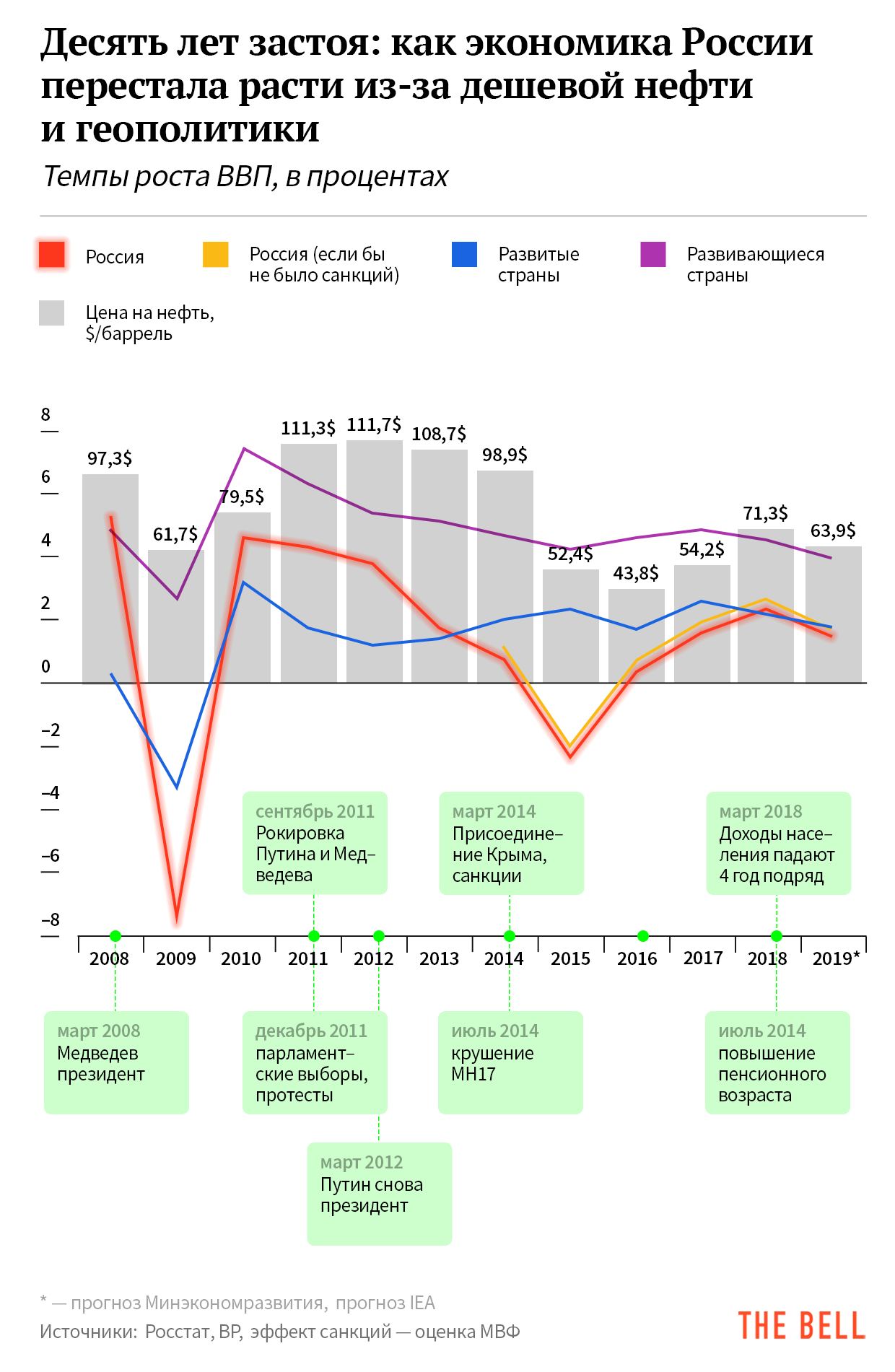
“The Russian economy is in a swamp, so it cannot fall from the cliff,” said the project “Russian norms!” Economist Sergey Guriev. Lack of growth is the main difference between the stagnant 2010s and the masters of the 2000s. In the first decade of the 21st century, Russia entered with a tremendous growth rate: 10%-in 2000, 5-8% in the following. The second - ends with modest average annual 1.8%.
- The growth of the zero was explained by the expensive oil: prices jumped from $ 12 in the late 1990s to $ 110 by the end of the 2010s. This made it possible to increase budget expenditures and pay on public debt. Reforms also helped the growth: the introduction of a flat personal income tax rate 13%, the creation of a deposit insurance system. Russia first received an investmentrating , and foreign money flowed into the country.
- But after the crisis of 2008-2009, the concept of reforms that fell on the table of Vladimir Putin remained on it. Already approved reforms were implemented only for a third, and the most important - the authorities did not begin, German Gref lamented in 2010. The state of the state grew in the economy, but there was no “great privatization”. “We sharply crossed from the fast -growing economy of the developing market to the stagnant European. They slipped from China to Germany, only the income level remained three times lower, ”says economist Marcel Salikhov.
- After 2014, the Russian market again became marginal for foreigners, and business realized that international ambitions can be forgotten. The distrust of the authorities, the outflow of capital, the growth of the public sector in the weakening of market and legal institutions have become the main problems of the Russian economy on the assessment of HSE economists. Further, the drop in oil prices, sanctions and isolation worked. In 2015, GDP decreased by 2.3 percentage points, and since then growth has never reached 3%.
Achievements
- Oil. Oil prices were peak in 2008, then recovered, but in 2016 they went down again. After that, OPEC had to go to unprecedented measures - actually expanding the cartel at the expense of Russia. The creation of OPEC+ and a decrease in production did not give prices to collapse: this can be considered the main achievement of Russian foreign economic diplomacy in this decade. Nevertheless, the IMF believes that the drop in oil prices in 2014-2018 hit Russia three times more painfully more than sanctions. “The budget has untied from oil prices, but not the economy as a whole. If oil will be $ 30 three years old, we can handle it. If five, it will be difficult. No matter how much we talk about diversification, we are sharpened under the defense and raw materials, ”says economist Alexander Suslin.
- Inflation. One of the few indisputable achievements of the outgoing decade is unambiguous inflation and floating ruble. Saving companies and banks in 2008-2009, the Russian authorities spent about 3 trillion rubles. The Central Bank held the ruble, but inflation increased sharply. Enterprises did not pull the rise in price loans and bankrupt. By 2014, it became clear that the currency corridor should be abandoned in favor of inflation targeting. In the moment, this decision exacerbated the fall of the ruble, but in the end saved the economy. In the 2000s, the average inflation was 13.6%, in the 2010s-7%. But today, low inflation is partly a consequence of the weak growth rate.
- Procephite budget. Another symbol of stability of the late 2010s. In 2018, the budget balance for the first time in seven years was positive, in 2019-the surplus will be 1.4% of GDP. The surplus was laid in the budget and three years in advance at the base price of oil $ 42.4 per barrel. This became possible primarily thanks to the budget rule - the transfer of superpituals from oil to the National Welfare Fund. “That is, this surplus is partly random,” warns Suslina. Since 2019, the budget received additional sources of income due to an increase in the retirement age and VAT-but due to the latter, demand has fallen, one of the few drivers of economic growth.
The price of stability
- Ruble. The national currency has become one of the main victims of the geopolitical ambitions of Russia. Over 10 years, the ruble has more than doubled to the dollar. Many blamed the Central Bank’s sharp devaluation, but she also had fundamental prerequisites. For 2010-2013, there was overheating in retail lending, the money mass grew too quickly. And in March 2014, the trigger worked-a drop in oil prices. The “Currency mortgages” of the 2010s became an analogue of the deceived investors of the 90s. The benefits of the weak ruble were not obvious for business: even for exporters, the winning of the devaluation is leveled by the budget rule.

- Investments. The risk of investment in Russia after 2014 became “prohibitive,” said Ryr Simonyan, ex-head of Morgan Stanley. In absolute terms in fixed assets, they are now being invested twice as much as ten years ago. But the growth rate of investment fell three times: in the 2000s it was above 28%, in the 2010s-just below 10%. The volume of direct foreign investment in Russia in 10 years has decreased by 10 times, to $ 8.7 billion, and continues to decline.
What am I to me?
The most obvious consequence of the picture that has developed in the economy is the fall of the income of Russians who have not been growing for five consecutive years. There were no sharp failures of the ruble in the past year and a half, but if the state does not continue to carry out structural reforms, it will be necessary to catch up the price competitiveness of the ruble, the chief economist of Alfa-Bank Natalia Orlova warns, and this is without taking into account the consequences of probable external shocks: new sanctions, the slowdown of China, and trade wars.
The first material of the special project “Farewell, 2010s”-about how the authorities in the struggle for the rating deprived the Russians of the possibility of participating in political life-read here .
What everyone is talking about
A shootout on Lubyanka
The event of the week is shooting in the very center of Moscow, moreover - at the FSB building. The attack happened on Thursday evening, when people return from work. The attacked journalists, if they did not calculate the special services before, then they were told about him exactly before. Vladimir Putin received a report on what happened right during a concert dedicated to the holiday of employees of the state security organs.
- The attackers who tried to penetrate the FSB building was 39-year-old Yevgeny Manyurov, an unmarried native of Podolsk, a failed businessman who once studied at the Russian Academy of Justice. In recent years, he worked in private security enterprises and participated in the DOSAAF competitions in shooting, where he took prizes.
- Only in the evening on Friday, the Investigative Committee confirmed the name of the attacker. He himself was killed on the spot, also as a result of the shootout two law enforcement officers died - their names were not officially named. Five more people, including one civilian, were injured. “Medusa”, comparing the video from the scene, writes that one of them could suffer after Manyurov was killed, that is, from the security forces.
- The UK investigates a criminal case on the fact of an encroachment on the life of law enforcement officials, without qualifying the attack as a terrorist attack, although Manyurov’s backpack was an explosive device connected to a mobile phone and grenades. Komsomolskaya Pravda, citing the attacker’s mother, wrote that recently he “talked with some Arabs on the phone” in English. Telegram channel “112” with reference to Father Manyurov said that he allegedly told him about his work at the embassy of the United Arab Emirates (UAE).
More than a loud incident on the eve of its own holiday is the last thing the Russian special services need. Given the large corruption scandals of this year associated with the FSB, the Cherkalin case and the Metallurg Bank - can be followed by sealing and personnel permutations, said a high -ranking source of Kommersant.
Signals
The hints of Vladimir Putin
The four-hour press conference of Vladimir Putin this time had an obvious nail-the question specified by the journalist RIA Novosti (which means, agreed by the Kremlin) the question of what the president would change in the constitution and how to change the political system. Putin had answers to both questions. From the Constitution, you can remove the reservation that one person cannot hold the president’s post twice in a row, he said. There is nothing surprising here - Putin proposed to do this in April 2012). The answer to the question of the political system was more interesting.
“I see and consider it not without reason that the current parliamentary parties raise the question of expanding the powers of the parliament,” Putin said. - People want more responsibility for the decision made at the upper level of state power. In principle, this is quite justified. But here you can not take any rash steps and rush. The discussion is coming, I will also watch how it develops. ”
The “discussion” of the expansion of the powers of the parliament was launched in the fall of the State Duma speaker Vyacheslav Volodin, writing an article where he proposed to give the Duma the right to participate in the appointment of members of the government. A few days before the publication of the article, the sources told Bloomberg about Plan-2024, which is discussed in the Kremlin: the State Duma gives new powers and additional legitimacy, after which it nominates the leader of Putin’s “United Russia” to the position of Prime Minister of the Parliamentary President Republic. However, as Vladimir Putin said on Thursday, “the discussion continues” - we will watch how it develops, with him.
INVESTMENTS
How to buy shares cheap
“We buy promotions like fruits and vegetables, and not as perfumes,” writes investor John Neff in his book. The cost of the perfume includes an extinguishing brand and fashion, and the jence is not ready to take shares with such an extinguishing. The essence of value investment is to buy shares cheap, but how to evaluate their cost and really buy shares at a market price? About which animators are used for evaluation, read the investment cycle in the next material of the investment cycle that Movchan's Group , Associate Professor of the Faculty of Economics of Economics of Economic Sciences, Elena Chirkova, has prepared for The Bell.
BOOK
Devotion for Bezos
Every year, Jeff Bezos writes a large letter to Amazon shareholders. In these letters, the richest man in the world talks about the strategy and principles of management that follows. Steve Anderson analyzed all the letters of the billionaire and deduced the 14 component success of Amazon in the book “Letters of Bezos”. In Russian, the book will be released at the Alpina Plisher publishing house only in January, but one chapter from it, which tells how Bezos instills the employees of the owner’s mentality, can be read on our site now.