
Translated material
Iranian tsugtsvang. The murder of Suleimani put Tehran before the choice between humiliation and defeat
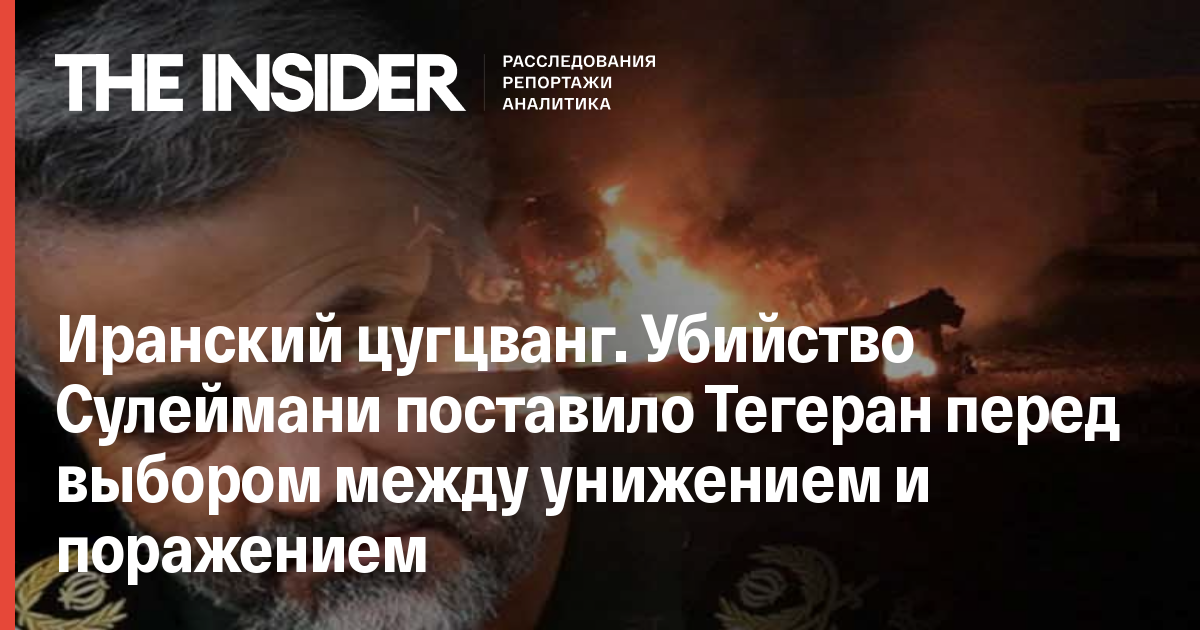
On the night of January 8, Iran fired at the US military bases in Iraq. According to the Islamic Revolution Corps (KSIR), the attack of the US Air Force Ain al-Asad in the west of Iraq was also subjected to attack. In turn, the Pentagon also declares an attack on the base in Erbil. Ksir called this shelling an act of retaliation for the murder of Iranian General Kasem Suleimani. With the name of the Kasem Suleimani Islamic Revolution, which was liquidated as a result of the special operation of the Corps of the Islamic Revolution of the Islamic Revolution of the Islamic Revolution, Kasem Suleimani connected the formation of a “Shiite crescent” in the Middle East in recent years. Leonid Isaev, an associate professor of the VSHE African and Africanism department in St. Petersburg, explains why Suleimani’s death and Iran’s weakening will still not allow Russia to reach a leading position in the region and what lessons Moscow can extract for itself after Iran was so unceremonious for attempts to provoke the United States.
Iran consciously went to this moment. Not, of course, the sense that the Iranian leadership sought the death of his general, but that the Iranian regime throughout the first term of the presidency of Donald Trump and especially in the past year was experienced by Washington and his regional allies for flexibility, trying to outline the “red lines” for himself.
In this regard, the tanker war in the Gulf in the summer of 2019, the shelling of the Saudi oil facilities ABBAK and Khurais and the attack on the American embassy in Baghdad - the links of one chain. And the murder of Suleimani is a logical result of the Iranian struggle for regional leadership, as well as a clear message to Iran that under any circumstances, American objects should not be threatened. Moreover, this message was sent to Tehran in the (and only in the) form in which it could be decoded in the Islamic Republic: from the position of the right of strong.
On this, in fact, the conflict can be considered exhausted. Firstly, because Iran has no possibilities for a symmetrical answer. If you leave the hysteria in the Iranian Majlis, which the Pentagon once again recognized the terrorist organization, as well as traditional for the Islamic Republic of Extraonpries with the burning of the American flag and the ristalism of the ayatoll to invent the most charitable way to reduce the scores with the “big satan”, the spectrum of opportunities for adequate response to the official Tegran is very Scarious. The adoption of the Iraqi House of Representatives under the pressure of Iran does not mean anything from a legal point of view on the need to withdraw foreign troops - ultimately, and there is a limit to Iranian capabilities. Any attempt by the power answer A priori will put the Iranian regime on the face of survival. A blow to the US bases in Iraq is even hard to call it. According to preliminary messages, only the Iraqis suffered as a result of the shelling, but there are no victims among American citizens. Apparently, for the Iranian leadership, which had not yet lost the instinct of self -preservation, it was important to more loudly declare retribution than to really take revenge on his general. And this means that the Xirir, launching the missiles towards the American military base, proceeded from the principle of Primum Non NoCere, intentionally wanting to exclude the likelihood of victims from the United States.
Ksir, launching missiles towards the American military base, proceeded from the principle of Primum non nocera, intentionally wanting to exclude the likelihood of victims from the USA
Secondly, because for the United States itself and Donald Trump, in particular, to unleash another war in the Middle East, not the most optimal decision in the midst of another presidential race. But the power response to the attack on the American embassy in Baghdad will clearly give additional Trump points in the struggle to extend his stay in the White House. In the end, the alternative to such an immediate and strict reaction from Washington could be a repetition of the story with the American Embassy in Benghazi in 2012, when the ambassador and three employees of the diplomatic mission and three employees of the diplomatic mission were killed as a result of the shelling of the US Embassy. But this would not promise Trump anything good.
In other words, no one was looking for and looking for a “big war”. However, the story of the liquidation of Kase Suleimani could not only become instructive for many regional and global actors (including Russia), but would also open a certain window of opportunities for them.
If we talk about Russia, then the Kremlin, of course, should be grateful to Donald Trump for such an unexpected “New Year” gift. First of all, this applies to the situation in Syria, which opens up for Moscow the opportunity to strengthen its influence on Damascus. The thing is that since the Congress of the Syrian people in Sochi in 2018, the Alliance of the Garant countries of the “Astana process”-Russia, Iran and Turkey-began to clearly move in favor of increasing the significance of Russian-Turkish relations. As a result, the disagreements between Moscow and Damascus only intensified, which forced Moscow to look for alternative mechanisms for resolving conflicts in Syria, lying outside Astana, where the role of Damascus and Tehran still remained significant.
As a result, over the past two years, the most important decisions on Syria began to be made in negotiations between Vladimir Putin and Recep Erdogan. A striking confirmation of this is the Idlib agreement in September 2018 (which, by the way, preceded unsuccessful negotiations in the “triple format”), as well as agreements on the northeast of Syria in October 2019 (which were also reached outside the framework of the “Astana format”). However, from the point of view of Damascus and Tehran, the negotiations of Putin and Erdogan on Syria are nothing more than evidence of the formation of two, albeit situational, but still poles of influence in Syria, into which the “Astaninsky format” degenerates.
The death of Kasem Suleimani in the short term will inevitably lead to a weakening of Iranian influence in Syria. The murdered Iranian general with his own hands created the Right Military Groups in Syria, led them, and also was responsible for the formation of a single network of Iranian proxyils on the territory of the entire “Shiite crescent”. But since there is no comparable candidacy in the military-political arsenal of Tehran, in the near future we will observe a conditional transitional period during which the complete or partial dismantling of the Iranian agents in the region created under Suleimani cannot be excluded.
The death of Kasem Suleimani in the short term will inevitably lead to a weakening of Iranian influence in Syria
For Moscow, which is increasingly opposing Tehran in Syria, this opens a window of possibilities. The Kremlin can now make Damascus more accommodating (even on such seemingly dead end issues, as the situation in Idlib and the work of the Constitutional Committee), as well as pushing the summary for itself on the Syrian track.
However, despite the fact that the liquidation of the general gives Moscow a number of tactical advantages in the short term, and also weakens the “partner” extremely uncomfortable for the Kremlin, the murder of Suleimani still caused the next surge in the indignation of the Russian Foreign Ministry. And it is no coincidence. Largely because the actions of the United States, which once again made exactly what corresponded to their national interests, without wasting time on meaningless discussions in the UN Security Council, once dispelled all the illusions about the leading positions of Moscow in the Middle East. When Donald Trump needed to respond to the attacks of his embassy and eliminate Suleimani, who, as well as in many civilized countries, entered into terrorist lists, the White House was not at all “not interested in the world reaction”, as the official representative of the Foreign Ministry Maria Zakharova was lamented on her Facebook . Trump, again, in understandable both for the Kremlin and for regional leaders, the language of force recalled who the real owner in the Middle East is and how illusory and groundless the arguments about American leaving the region are. In other words, one can hate America arbitrarily for its role as a “world gendarme”, but neither Russia, nor anyone else is able to take over similar functions. Hence, of course, moralizing by the Russian Foreign Ministry about the need to listen to Vox Populi, which is based on banal envy and awareness of their own limitation.
US actions overnight dispelled all the illusions about the leading positions of Moscow in the Middle East
But even in this situation, Moscow has its advantages. Of course, in the Middle East, due to economic circumstances, Russia is not able to play the role of the “first violin”, not to mention being a conductor. On the other hand, Moscow does not have worthy competitors in the region yet. Even after the liquidation of Suleimani, it is hardly worth counting on the fact that the United States will pay attention to the device of the fate of Syrian or Iraqi societies under Donald Trump. Washington is ready to give these questions to Moscow, which, in several more favorable conditions for itself, will once again try to offer the region its services of an “honest broker”. The visit of the Russian president on January 7, 2020 to Damascus and his meeting with Al-Asad is a direct confirmation of this. The only question is whether Moscow can take advantage of the benefit of the current political moment.
The last thing that should have taken the Kremlin out of this whole story with Iran was that even the most adventurous and seeming very successful policy of flirting with the “world gendarme” comes to an end. The most unceremonious elimination of one of the key figures of the Islamic Republic in front of the eyes of the entire world community and the impossibility of a symmetrical answer actually crossed out all the benefits previously obtained by Tehran. From an internal political point of view, a difficult dilemma is faced with the Iranian regime: to recognize the premature of plans for the overthrow of the hegemon and fall in the eyes of their own population, or to quit the real challenge to Washington, while realizing that the history of the Islamic Republic will end.
In its permanent opposition to the West, Russia is very similar to Iran. Both countries are trying to form the image of the “besieged fortress” in the eyes of their own population and justify their inefficiency by the machinations of external enemies. However, Iranian experience shows the limitations of this strategy - ultimately, the bets will be too high, and the costs of their own inferiority will devalue previously mined advantages.