
Translated material
Putin wants to radically and very quickly rewrite the Constitution - is this a constitutional coup?
"Medusa" asked lawyers and political scientists
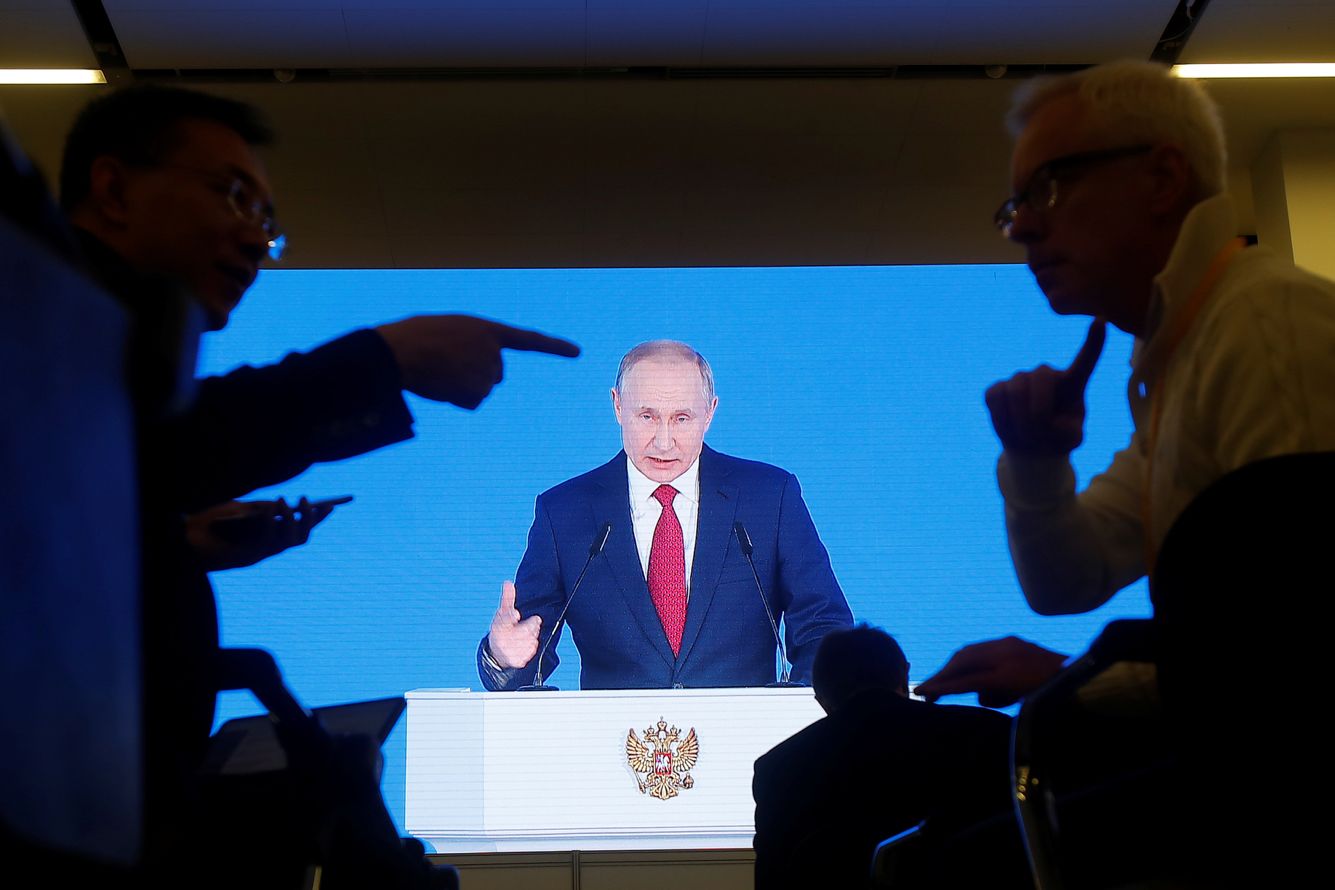
On January 15, Vladimir Putin proposed rewriting the Russian Constitution, making a number of amendments to it: to give the State Duma the authority to choose the candidates of the Prime Minister and members of the government, to turn the deliberative state council into a constitutional body and to limit the priority of international law over Russian. He is going to make amendments with a package for a "nationwide vote." Due to the radicality of changes, some observers and experts managed to name what was happening in Russia as a “constitutional coup”. Medusa asked lawyers and political scientists how accurately such an interpretation and how they evaluate the causes and consequences of the Constitution editing proposed by the President.
Elena Lukyanova
Lawyer, professor of the Higher School
Due to amendments, the basics of the constitutional system are subjected to danger. Moreover, it is proposed not to make amendments directly to the first and second chapters , but with amendments to the rest of the chapters to deprive them of strength.
For example, it is proposed to redistribute part of the personnel powers from the federation to the center. In fact, to abolish the powers of the Federation Council by the creation of the State Council, because [this] governing body will [stand] over the chamber of parliament. The addition of this incomprehensible body is to the detriment of the principle of separation of powers, which is enshrined in the first chapter [of the Constitution] - as federalism and the principles of local self -government. Now it is proposed to integrate local governments in the vertical of power. At the same time, the European Charter of Local Self -Government , signed by us, suggests that it should be independently, and not built into the vertical. This is one of the most important democratic principles, prescribed in the basics of the constitutional system.
The same with the priority of the Constitution over interstate acts. Modern constitutional legislation has actually acquired an international character - this is a system of values and principles in which states are associated in its constitutions. States that signed documents such as the European Convention on Human Rights cannot be free to cancel it in the Constitution. To say [that this will not affect the rights and freedoms of citizens] they can as much as they like. But this is the creation of a mechanism to fail to fulfill its international obligations. This is a real threat to the constitutional system.
The expansion of the real powers of the Duma and the Council of the Federation also does not occur, because all this is a game of words: coordination, appointment, and so on. The president can deprive any judge or prosecutor, so all this does not work. It will not work out and a real responsible government. Well, they will appoint someone, and tomorrow the president will remove it due to a lack of trust. With the prime minister, the same thing: the Duma approved, and the president appointed. This is again a game of words. The real parliamentary control is not added, the government’s responsibility, too.
All this strengthening the vertical of power. This is the construction of a unified undemocratic Nefederative vertical - without the separation of powers and independence of the judiciary, but with the infringement of the rights of citizens. It is not very clear how these “wishes” will be realized, but what we heard yesterday, I evaluate this way, but how it will be - we will evaluate along the way.
[In addition,] what was yesterday has nothing to do with the procedure for amending the Constitution. The president cannot declare a referendum on the constitution - and they already said that this could not be called a referendum. Only a constitutional assembly that we do not have. This vote also has nothing to do with the law on the procedure for amending the Constitution. It will have no legal force.
Vladimir Mazaev
Lawyer, professor of the Higher School
So far, the president only said what he said. And the lawyer looks at the documents. For example, a project to introduce a state council into the structure of power is not clear what status he will have, what he will do and so on. These are the words of a purely political property that there is no legal material yet.
Another point is the expansion of the powers of parliamentarians. This can be done with minimal amendments. But the model itself, the design of the government itself does not change from this - the strong presidential republic. No one has canceled the main things and mechanisms. Judging by these abstract sentences, nothing will change much.
As for the words about the superiority of national law over international, then our Constitutional Court has repeatedly interpreted this. He said that the constitution has supremacy, and all other acts are mounted in our system, if they do not contradict the constitutions. And then there were amendments to the Law on the Constitutional Court, where they said that we all [international laws] recognize, but we can only comply with the decisions that do not contradict the Constitution. Our buffer has long been created, so nothing will change with regard to the execution of decisions of the ECHR. I think that from Putin it was just an additional political message about sovereignty.
According to the described procedure for the adoption of amendments with voting, there are questions. According to the Constitution, a constitutional assembly can bring this issue to a referendum. But he proposed not a referendum, but a certain vote. It is not yet clear what he has in mind. Perhaps this will be some kind of advisory vote about whether people are approved by amendments. There are such institutions in other countries, but not with us - then it also needs to be introduced, painted and consolidated. So far, it’s too early to talk about the legal points of this. Too many ambiguous directions of interpretation. So far, there is rather political science moments, not legal.
Alexander Baunov
Political scientist, editor -in -chief Carnegie.ru
I don’t know a strict scientific definition of what a constitutional coup is. I think this is a topic of scientific discussion. For example, did Yeltsin make a constitutional coup in 1993 when, in response to the rebellion of the old but legal parliament, he dispersed him with the help of the armed forces and adopted a new constitution? From a certain point of view, yes - but many critics of today's changes then held him: it seemed that it was a coup in the right direction.
There is a spirit of the 1993 Constitution, when Russia was in the western route. Then no one doubted that Russia would develop as the USA or France. And he will live by Western political cycles - that is, there will be a regular change of president. And, of course, when Yeltsin adopted this constitution, he suggested this particular picture - he did not have another picture. This other picture began to take shape later, in the 90s, when the manipulation began not with the letter, but with the spirit of the constitution. For example, in 1999, the ruling class decided that it was impossible to miss the management of Russia-due to the protest voting of the dissatisfied population after the default . And then Yeltsin did not stay, but made the president the man he himself chose.
Then the manipulations with the spirit of the constitution were repeated, and the story with the successor was the most striking example. In fact, since 1999, the section of the Constitution regarding the supreme power is performed only by the letter. What is happening now is the inheritance of this tradition - this is another revision of the spirit of the Constitution. But this is not so much a fracture of tradition as the continuation of the already established.
Of course, now, unlike 1993, none of the highest bureaucracy sees Russia a country that goes west and will live a Western political life. They build some other model. This is not just the president as a senior official who is regularly replaced, this is some more complicated design, which is now simply stopped hiding. Putin does not pretend that Russia is another country with the Western Constitution. If they are told that the model is no longer like the western one, then they will answer: why should it look like? In this sense, this is not a revolution, but, of course, a complete change in the ideology of the ruling class from the western to some other-eastern or ancient Roman. If you take at the point, and what the authors of the 1993 Constitution planned, and for point B - what we have now, it is clear that this is very far from their plans. In this sense, we left the Constitution.
The 1993 Constitution, probably implied the principle of "leaving - go." That is, a person leaves, and some other people who are not related to him or not directly directly who are directly related to him compete. And the Kazakh, Singapore or Chinese model suggests that a person who leaves the highest post does not leave at all. He does not go nowhere, he remains somewhere. And Asia says: “Why should we retire an experienced person who successfully governs the state? Let him work as a mentor of the new president. ” This is an Asian model that is not practiced in a pure form in the West. On the other hand, we all know these backstage “makers of kings” or a very strange “family democracy”, when there are political families, immigrants from whom apply for higher posts in India, Greece or in the USA.
Boris Makarenko
Political scientist, professor of the Higher School
Even in the term “constitutional coup” there is a contradiction. If the constitution changes according to the rules that are spelled out in it, then this is not a coup, but a legal process. So this can only be treated as a figurative expression.
In general, we can only judge that it was, we can only one reliable source - the text of the President’s message. The proposals in it are formulated with varying degrees of details. Some are formulated specifically and clearly, we will be able to judge others only when the relevant documents appear. In constitutional law, the devil is always in detail, therefore it is too early to talk about changes in the rights of local self -government. Now in this matter we can only guess. The same applies to changes that speak of the priority of national law over international.
If we talk about the block of proposals related to the formation and resignation of the government, then everything is enough here. If you read the text, then this is definitely not a coup, but a soft correction towards moderate expansion of the powers of the parliament and some autonomy of the prime minister. But the type of state structure remains the same. Because the “formator” of the executive branch remains the same - the president. The rights of the parliament are slightly expanding, but within the framework of the same model.
Another thing is the State Council. Again, so far it is only said that it should be mentioned in the constitution. In what capacity is not said. At its core, the State Council is now an advisory body. And in order to endow it with power, they need to be taken from someone-nothing was said about it yesterday. All power powers are now constitutionally distributed and worked out in practice. So this also does not pull for a coup.
Yes, the current system is undergoing changes, but the degree of these changes is not yet completely clear. At the same time, some changes have long suggested-for example, a mild expansion of the powers of the parliament. This is a step in the right direction, but I'm not sure that he will create a new quality in politics.
Surely Putin looks at 2021, and at 2024, and he has an action plan. The fact that immediately after the President’s message was followed by the resignation of the government, indicates that this is a multi -way plan. In fact, if we talk about the game, there is not much time left before the elections. In the year of elections, the authorities in Russia, as a rule, avoids sudden movements. Now the last year has begun without federal elections. The window of opportunities is very small.
There are not so few options in which a long -term leader leaves state posts, but retains power. And the direct parallel with Kazakhstan, in my opinion, is excessive. In Russia, the eastern tradition in politics is not dead, but still is not as popular as in Kazakhstan. Moreover, we will not forget that Nursultan Nazarbayev, like other first presidents of Central Asian states, are not only presidents, but also the fathers of the nations who created this state with their symbols and so on. Honor and respect for such leaders at an unprecedented height, all the more enhanced by oriental traditions. It is impossible to transfer this one to one to Russian realities.
Maxim Trustlyubov
Vedomosti and The New York Times, editor Inliberty
In my opinion, Putin yesterday appeared on the role of Dan Xiaopin or Lee Kuan Yu - or Nazarbayev. But there are doubts that Putin can be considered an architect of Russian transformation and the father of our economic miracle. If only because the key stages of the post -communist transformation went to him, and we do not see any economic miracle. Dan Xiaopin, of course, was the creator of the political and economic system of postmaoist China, and the “miracle” was quite tangible there. Putin does not correspond to this level.
All the mentioned Asian leaders went along the path of integration of the country into the world community, attracting investments, developing education, building ties with institutions of the Western world. Russia is rather cutting off these ties. We will not talk about education at all. I do not see foreign investment in Russia. Putin is such a sly Dan Xiaopin, who behaves as a reformer, being actually a conservative.
I would call what happened, not a constitutional coup, but a revolution from above. The revolution from above is an old Russian tradition. There are many examples from the royal and Soviet times. Either we have a “year of the great turning point”, then “dizziness from success”, otherwise suddenly “rootless cosmopolitans”. Stalin was a master of this game-to take and declare some new general line. And now everyone is already walking along the string, and no one threatens the leader. Stalin was afraid of conspiracies, although science could not find a single real conspiracy against him. In this sense, Putin is like Stalin, but only in this. In everything else - no. He is not Stalin, but Russia is not a Soviet Union.
The meaning of what Putin did, in my opinion, is what. He is going to remain a dominant figure for an indefinite - he is known to one - time. Probably, it will observe the successors and monitor how one successor replaces the other. Therefore, it is important for him to decentralize the system so that too much power does not accumulate in any place. He will then receive the post that will choose. He left himself many options - he loves it. Now he has a lot of opportunities.
It seems to me that there will not be very many changes that will touch literally all of us. Everything that happened is incredibly important primarily for those who are in the presidential administration or government. Putin is an incredibly talented politician. It can be seen that for some time he already understood that he was losing popularity, that the system begins to get out of control. And he shaved and mixed it in time, weakened those who intensified, and strengthened those who were weak. In this sense, the choice of [Mikhail] Mishustin [to the post of Prime Minister of the Russian Federation] is very characteristic. This is probably a capable manager, a modern bureaucrat of a quite world -class. Apparently, it does not have political ambitions. This is the perfect Putin's frame. Although who knows how he will be a politician. Putin himself was an unknown bureaucrat, and there was opened.
Pavel Merzlikin recorded