
Translated material
Mikhail Mishustin formed a new government - why is it exactly and what to expect from these people?
Medusa asked political scientists, economists and scientists
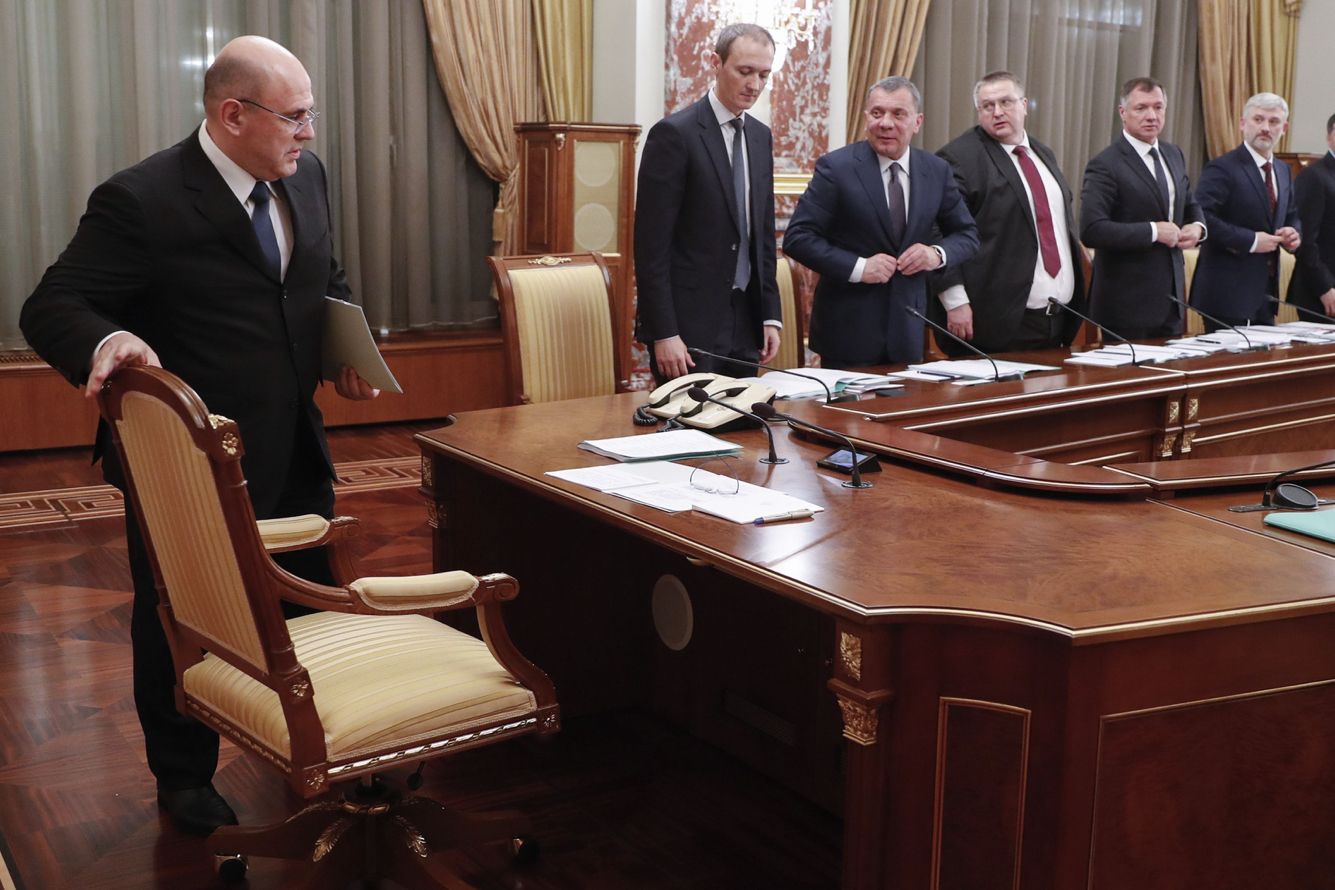
On the evening of January 21, the new Russian Prime Minister Mikhail Mishustin formed his government. The list of ministers and deputy prime ministers was noticeably updated-about half of the new people came to it. Medusa asked well -known political scientists, economists and researchers, by which the new cabinet was collected and what should be expected from it in politics, economics, education and science.
Ekaterina Shulman
political scientist
The financial and economic bloc ideologically remained the same with the superstructure from above by Deputy Prime Minister [Andrei] Belousov. He is a well -known supporter of budget expenditures - what is called in the non -economic language "printing of the cube." Obviously, he will, together with the prime minister of [Mikhail] Mishustin, be responsible for the implementation of the social part from the President’s Epistle. The power and foreign policy blocks - the “presidential” ministers - remained in place, there were no changes there.
The social block has changed as much as possible. He was unpopular: these people were not loved, they were associated with public scandals, with “optimization” in the field of health and education, and in general with what is called “anti -people's reforms”. These people were removed - I would not dare to call this a concession to public pressure, but one cannot help but see what is most, as is commonly expressed, toxic people, starting with the prime minister, no longer in the government. This is the first thing that catches the eye.
The second is, of course, the “Club of Friends” [Mayor of Moscow Sergey] Sobyanin, [There were many people who worked with him. Probably, the experience of the “burial of Moscow” is recognized as successful and subject to distribution throughout the country as a whole. But it is clear that it can be distributed even to some extent to the whole country as a whole only if large-scale budget expenditures. Because the successes of Moscow are the successes of its gigantic, immense and constantly growing budget. All of Russia cannot boast of this, but some kind of increase in expenses will obviously occur.
The third - judging by the composition of the government, Mishustin is a real head of government, and not technical, as they put it in previous eras. He, obviously, has extensive personnel powers. A large number of people who worked with him became both members of the government, and led the apparatus [government]. I remind you that the government as a collective body is actually a government apparatus, it is the device that is responsible for its permanent work. The direct work of the government - the preparation of documents, which then become government decisions - is carried out by the apparatus. Therefore, the one who heads the device, and his deputies, I would say, alternative ministers in their directions.
Alexander Kynev
political scientist
What is the difference between this office from all previous ones? It is much more clearly structured in groups of influence. Firstly, there are Mishustin and his closest associates who came with him from the Federal Tax Service- two deputy prime miners at once. It is still necessary to look for it when the prime minister came to us and could immediately bring a team with him. The influence of Mishustin will obviously grow.
The second group, which is very clearly visible, is the sharply intensified representation of people who are close enough to Sergei Sobyanin. There was already Minister Vladimir Yakushev (former governor of the Tyumen region), now three more people: [Maxim] Reshetnikov, [Valery] Falcov and Marat Khusnullin, naturally ( Dmitry Kobylkin, who used to lead the Yamalo-Nenets district, is also called the "man of Sobyanin" ( 1 , 2 ),-approx. "Medicals" ). Their connection with the team of Sobyanin is quite obvious, these are not the last people. Sobyanin himself did not become the prime minister, although many [on this] expected - but his group increased sharply. I think this means that the tough policy of the Moscow government in the last year was rewarded. It is clear that we are talking about areas that are very important for Moscow: higher education and science, construction. These are the key directions for Moscow, so having allies at the head of the federal ministries is very profitable.
Third - a group of conditional Ministry of Finance was preserved, that is, [Anton] Siluanov, Anton Kotyakov, [Alexander] Novak and so on. The Ministry of Finance group also increased due to the fact that it included a new ministry - the Ministry of Labor and Social Policy.
I think that the course will not change radically, because it is a derivative of long -established trends. Fiscal policy will definitely not change. The financial policy is also unlikely to change. Politics in relation to business-I also doubt that some liberalism awaits us. As the state led itself harshly, it will behave further. There were no liberals in the office a long time ago, so no exile of the liberals occurred.
The main question is Belousov as the first deputy prime minister, since he is a pronounced conductor from the point of view of state relations with large business, national projects, and so on. But if you look carefully, then by and large the government worked in this perspective. So I don't think something will change. I don’t think that [its purpose] means that the government will invest more. This is a system with many keys: decisions are not made solely, they require the coordination of many players. Then almost the entire large business is tied in one way or another, including with various power structures, this is the protection of each major owner. I think they have not disappeared and will act further. As for investments through the national projects - this has long been announced, this is not news. Most likely, the already announced and promised policy will continue: national projects, due to which the state expects to achieve growth in some directions. Let them try. The problem is that inside the system there are many players who have their own interests. And no one canceled these interests, they will not disappear anywhere.
And even when I watched the biographies of the cabinet members, I drew attention to the fact that all of them, as a rule, people who graduated from a regional university, and then [built] a long internal career, moving from office to position. These are not ideologists, but people who are accustomed to act as part of departmental instructions and standards. These are children of the current administrative system. This is not an old nomenclature that has some Soviet experience. These are not people from business who have experience in a non -state corporation. These are already administrative services. In this sense, this is the office of managers, not ideologists. In the office of Dmitry Medvedev there were rather bright people. Unpopular, but bright. The same [Vladimir] Medinsky, for all his odious, is a bright character. From the point of view of personal brightness [this] office is much more faded. In it, such bright characters are very, very few.
Ruben Enicolopes
Rector of the Russian Economic School
At the moment, they changed the entire economic block, and I would not even identify separately [Maxim Reshetnikov’s minister appointed to the post of Minister of Economics. The economic goal of the formation of a new block is an increase in government spending. I think that they will accelerate work on planned national projects - the previous government did this very slowly. The second goal of creating a new block is that, in fact, Mishustin announced, an increase in the role of targeted transfers. That is, social assistance will become more targeted. The collection of information about people's income will be more automated so that you can then make targeted social assistance. From my point of view, this will affect positively, because the “Bolsheviks” have been talking about the need for targeted assistance for a very long time. In the community, the appointment of Reshetnikov himself was perceived with restrained optimism. Working in Moscow, he established himself as a professional person. That is, no one expects a course for global changes from him, as they were waiting before, but there is a feeling that at least there will be a forward movement within the framework of the course that has already been chosen.
In principle, I agree with the opinion of my colleagues that the new cabinet consists of technocrats. But at the same time, this is a general characteristic of our entire political system. We have practically no politicians, because they are only where there are competitive elections. In our system, if we talk about members of the government, then all of them can be considered as technocrats. Their political explanations are almost lobbying explanations of different groups of influence. But they are simply by definition all technocrats, because we have a political system that way. The former Cabinet could be characterized in the same way.
I think that Medvedev will not be essential differences from the Cabinet of Ministers, except for small ones. At the same time, I have restrained optimism according to the economic bloc. I can disagree with the concept they declared, but if they act in this paradigm, it is necessary that at least it works. I will explain: in the previous couple of years there was a monstrous fiscal policy when the tax burden on the economy increased both due to an increase in tax collection and due to an increase in VAT rates. At the same time, they began to collect taxes more, but they did not spend anymore. That is, the state took out money from the economy and did not return it back. From my point of view, it would be the best solution to lower the tax burden and return the money to private business, but it is now politically unacceptable, tax rates will not be reduced. But if they take money out of the economy, then let them spend it at least.
I associate the appointment of Belousov with the fact that there will be more state investments in the economy. After all, this is, in fact, a paradigm that the state should be a drive of economic growth. This concept of Belousov will be realized now. Again, I do not agree with him and think that the private sector should play a big role. But in a sense, I am glad that let him [Belousov] now at least be responsible for this. After all, it is one thing to be an adviser - it is easy to give advice - and now let him realize his own strategy. At the same time, Belousov’s approach to private business, when he proposed a year and a half ago, to forcefully invest , causes very big fears. Our state already plays a gigantic role in the economy, and investments of private business are largely limited by fears about ensuring property rights and legality. In such a situation, increased pressure from the state can lead to an even greater reduction in private investment.
Siluanov’s decrease was predictable. He just did not fit into the concept of the fact that the state spends more, because he behaved as a typical Minister of Finance. The Minister of Finance is a person who should limit the expenses of other ministries, unlike the Minister of Economic Development, who should advocate for increasing expenses. With this approach, you cannot be at the deputy prime minister, because this does not fit into the concept of increasing government spending. Siluanov is now put on the place where there should be a person with such an approach.
Alexey Makarkin
Professor NIU HSE, vice president of the Center for Political Technology
Already now it is clear that Mishustin will be a very influential prime minister. Around him is a loyal environment, and this, of course, will give him many opportunities. He had a much greater influence on the formation of the Cabinet of Ministers than Medvedev in 2012 and in 2018. It is clear that he did not receive a complete carte blanche, but he was given a very serious personnel currency, and he was able to fully form his team.
Another thing is that he [Mishustin] should give effective growth, they expect this from him, and he is appointed for this. Can he give it? They are going to increase growth through national projects. But today everything is arranged in such a way that the money does not go to national projects, because it turned out that the state apparatus is not able to administer such projects. The task of Mishustin and his team is to solve this problem and, as they say, tie these nodes. On how he manages to do this, it will depend on whether there will be growth, and whether it will be effective for citizens or not.
There will be practically no changes in the political life of the country with the advent of new ministers. All political ministers, except the Minister of Justice, remained in their posts. New people came to education, science, social spheres, but they do not determine politics.
The government now has a very specific task - economic growth. Belousov had the idea that the business should invest in those projects that the state would indicate. I think that now such elements of state totalitarianism may intensify. On the other hand, business also has its own interests and opportunities. The state wants business to invest in those areas that are strategically beneficial to the state; Business wants to invest in areas that will bring speedy and maximum profits. I do not think that one of them will be the dominant side, which will impose its conditions. Business will have to negotiate with the state and look for a compromise.
Vadim Volkov
Rector of the European University in St. Petersburg
The appointment of Sergei Kravtsov for the post of Minister of Education was not predictable for our community. He is a contradictory figure in the field of higher education. To the department of Kravtsov [since 2013 he led Rosobrnadzor] and his own work had questions from the university community. He was remembered by the policy of clearing the educational field from organizations that work much lower than the required standards of higher education. Rosobrnadzor really closed many branches, as well as private and just weak universities. But with him a regulatory environment was formed, which interferes with the development of higher education. On the one hand, checks and accreditation procedures bear large costs, on the other hand, checks do not concern the quality of education, but only papers and documents without any connection with reality. All this was done in a non -modern way, that is, it was fraught with a huge number of papers, checks by experts, the reputation of which did not always meet scientific standards.
Kravtsov consistently defended the powers of Rosobrnadzor and was not glad to introduce a risk-oriented approach. This is when checks are carried out only in relation to those organizations where there are high risks for life, health or signs of low quality work. In the field of higher education, it would be more logical to introduce remote monitoring, thanks to which universities would be revealed in which the situation is clearly dysfunctional. And then, based on this, the supervisory authority would help to straighten the situation, and not punish the university. Apparently, the previous leader was not ready to go this way.
Regarding the new appointment - Kravtsov from the Livanov team, he was engaged in the implementation of the exam, his development, therefore, probably, is ready to engage in schools. So a compromise was obtained: it was necessary to remove the contradictions in the field of supervision of education, but at the same time increase the former head of the supervisory authority as the former. Experience in the exam is useful.
At the same time, we took the appointment of Valery Falkov to the post of Minister of Science with optimism. He is a young and very modern rector. Some time ago, he began to change the University of Tyumen and consistently makes him an international oriented university, which, thanks to him, entered the project 5-100. This project focuses on international science and standards of education, creates and introduces modern research centers, including the social and humanities. There are quite a few interesting discussions on its site, a young and dynamic team formed around the rector. If Falkov transfer all these practices to the sphere of science and higher education, then this seems to be a very positive development.
Sergey Guriev
Professor at the University of Sciences PO, Paris
What is the task of economic policy? Not only in ensuring macroeconomic stability (lack of crises, low and predictable inflation), but also in acceleration of economic growth. Investments are needed to accelerate economic growth. In the 2012 May decrees, Vladimir Putin promised to increase investments from 21 to 27% of GDP. This did not happen. In the May Decree of 2018, he promised to increase investments to 25%. Over the past two years, investment growth has not occurred again.
Isolation from the external economy and a poor investment climate do not allow us to hope for a rapid increase in foreign and private investments. Therefore, the Russian authorities are more and more counting on state investigations. Andrei Belousov, the author of the proposal of 2018 on the removal of profit from private companies to finance state national projects, was appointed the first deputy prime minister. Therefore, from the new government, it is worth expecting to strengthen the role of the state in the economy and increase state investigations. Most likely, we will see the deployment of national projects, which over the past two years, the previous government did not manage to launch.
Irina Kravtsova, Kristina Safonova