
Translated material
The criminal activity of the ultra -right. Crimes of hatred and opposition to him in Russia in 2019
Systematic racist and neo -Nazi violence : attacks on “ethnic strangers” : attacks on LGBT : attacks on ideological opponents : other attacks: other attacks :
Criminal prosecution for violence
Criminal prosecution for crimes against property
Brief statistics of crimes and punishment
This report of the owl center [1] is focused on what is called hatred crimes, that is, on ordinary criminal offenses, but committed by the motive of ethnic, religious and the like by enmity or prejudice [2] , and to counter such crimes from the state.
A similar report we release the third year. Prior to this, we included sections on hatred crimes in a large annual report, including both the criminal and political activity of nationalists, as well as all measures to counteract them.
Resume
According to the monitoring of the SOVA Center, in 2019 the number of racist and neo -Nazi motivated attacks decreased, although the number of murders was higher. The main group of victims is still “ethnic strangers”, and the number of victims among this group also grew.
Last year, two criminal incidents occurred that caused mass clashes under xenophobic slogans. The most noticeable of them were anti -sabotage performances in the suitcase of the Penza region. For the first time in many years, we learned about organized groups of ethnic minorities - the Yakutsk “Us Tumsu” and Azerbaijan.
Over the year, the number of attacks on representatives of LGBT and those who were considered such also increased. But the number of attacks on “ideological opponents”, including those who were considered “National Distributions”, decreased significantly. The Prochrevsky radical group SERB remains active, but its activity was dosed, and members of this group in 2019 did not almost not move to the attacks of people, limiting themselves to verbal insults.
Cases of damage to buildings, monuments, cemeteries, various cultural objects motivated by religious, ethnic or ideological hatred are less common than before. However, as in the situation with violence, the share of dangerous acts - explosions and arson has grown over the year. The number of desecrations of religious objects remains approximately the same. First of all, the number of attacks on ideological objects decreased.
As for the practice of law enforcement against crimes on the motive of hatred, the number of sentences in 2019 decreased, which correlates with a decrease in the number of attacks. The quality of counteracting crimes of hatred is debatable: on the one hand, members of famous Nazi groups, such as the Khabarovsk Stolz, went to jail last year; On the other hand, the share of conditionally convicted for such crimes began to grow again.
We observe a decrease in the criminal activity of the ultra -right, but we observe the growing share of more dangerous violence. In addition, there is reason to believe that hatred crimes have become even more latent. It cannot be argued that ideologically motivated violence disappears, so there are plenty of work in this direction in this direction.
Systematic racist
And neo -Nazi violence
In 2019, at least 45 people were injured from racist and other ideologically motivated violence, of which at least 5 people died, the rest were injured or beaten, 2 people received serious threats to murder. Unfortunately, our data does not fully cover the whole country, they are given without taking into account the victims in the republics of the North Caucasus and in Crimea, where our methodology, alas, does not work. The number of those killed in 2019 turned out to be more than a year earlier, although the total number of attacks motivated by hatred decreases: in 2018, 4 people were killed, 55 were injured or beaten [3] . Of course, our data, especially over the past year, are very incomplete, because often we learn about many crimes with a great delay [4] . Unfortunately, we cannot superior our data with official or some others, because there is no other statistics on Hate CRIMES in Russia.
Information about such crimes is becoming more and more fragmented every year. Media sources have long described crimes in such a way that it was impossible to understand whether it was committed by the motive of hatred. And more often the media simply do not report such incidents. The victims themselves practically do not turn to public organizations, especially to the police, rightly fearing problems already from law enforcement agencies. The attackers, a few years ago fearlessly posting videos from their “shares” have now become more careful . But even in the event of such videos, there is often no way to check their authenticity, nor find out the time or place of attack. For example, on December 31, 2019, the ultra-right telegram channel congratulated everyone on the upcoming New Year by publishing a video where a whole series of attacks with arson and beatings of people on the street and in train wagons is demonstrated, including two times-using knives. At the end of the video, a young man in a mask writes on the wall “Happy New Year NS/WP” and throws his hand in a Nazi greeting. However, from this video it is absolutely impossible to understand where and when these acts were committed.
As a result, our data in no way reflect the true scope of what is happening. But since our technique has not changed since the start of calculations, we can judge dynamics and say that progress is undeniable compared to the events of a decade ago.
Rice. 1. The dynamics of attacks and murders on the motive of hatred (2004–2019) [5]
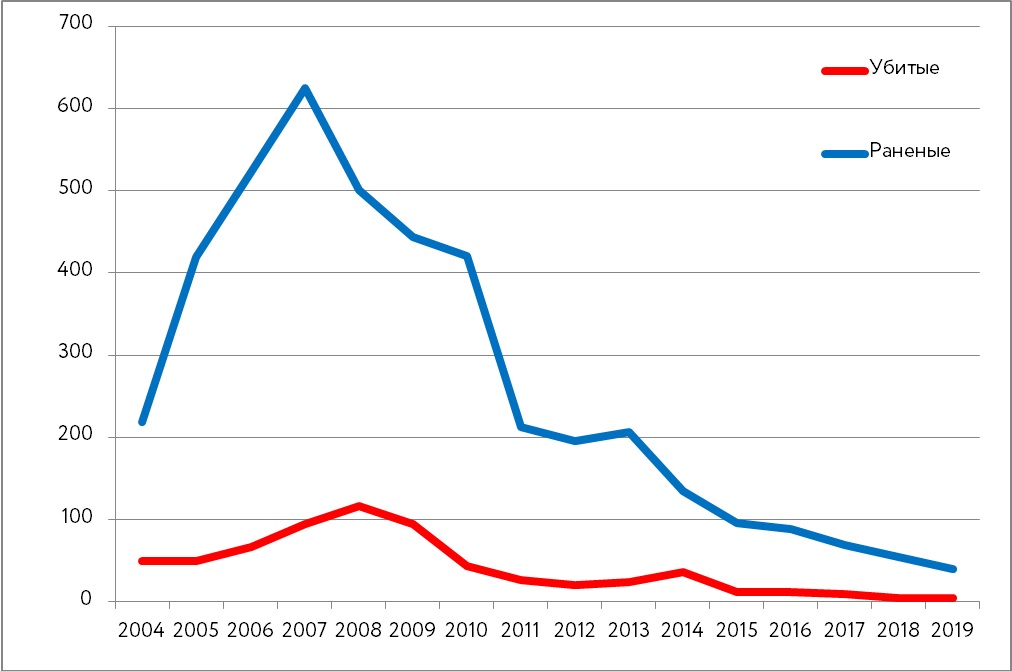
Last year, we recorded attacks in 18 regions of the country (in 2018 - in 12 regions). In terms of violence, Moscow is traditionally leaded (2 killed [6] , 11 beaten and wounded) and St. Petersburg (9 beaten and wounded). A noticeable number of victims - in the Sverdlovsk region (3 victims).
Last year, we did not note the crimes of hatred in the Kaluga, Kirov, Novosibirsk, Samara, Tyumen regions. But attacks were noted in the new regions compared to the previous year: Vologda, Voronezh, Leningrad, Nizhny Novgorod, Rostov, Tula regions, Altai, Primorsky and Khabarovsk Territory, the Republic of Sakha (Yakutia), Khanty-Mansi Autonomous Okrug.
According to our data, in the last ten years, in addition to Moscow, St. Petersburg and the Moscow Region, crimes have been recorded almost annually in regions such as Volgograd, Voronezh, Kaluga, Kirov, Kursk, Leningrad, Nizhny Novgorod, Novosibirsk, Omsk, Rostov, Samara, Sverdlovsk and Tula regions, Primorsky, Krasnodar and Khabarovsk. edges. However, it is possible that the media and prosecutors of these subjects of the Federation are better informed about what is happening.
Rice. 2. Types of victims of ideologically motivated violence (2016–2019)

Attacks on "ethnic strangers"
The dominant group of victims remain people whom the attackers perceived as “ethnic strangers”, and their number grew compared to the previous year. In 2019, we recorded 21 attacks on an ethnic basis. In 2018, we wrote about 20 such victims.
Among the victims of this category of victims are natives of Central Asia, 3 killed, 11 beaten (in 2018 - 2 killed, 3 beaten), the Caucasus - 1 beaten (a year earlier it is not known about such victims); People of the non -identified “non -Slavic appearance” (3 beaten), their appearance was described by eyewitnesses as “Asian”, so that, most likely, these were natives of Central Asia (in 2018 - 12 beaten).
Threats and violence in the police, including xenophobic subtext, are unfortunately frequent. Law enforcement officers experience the same prejudices as the rest of the citizens, and often abuse their official position. But it is impossible to analyze the dynamics of motivated violence in the police, since information about the details is almost always closed. The public’s property is only completely egregious cases, such as in Khabarovsk in December 2019, when the police beat more than a hundred migrants during the next raid, accompanying the beating with xenophobic cries like “narrow -eyed, tired! Get out of here so that you are no longer here! " [7] .
We only know about one attack on the dark -skinned [8] over the past year (in 2018 and 2017 - also 1 beaten). However, it is possible that there are much more such attacks, because the level of intolerance to dark -skinned in Russia is quite high. This is clearly evidenced by the story in Stavropol, where some local establishments simply refused to let dark visitors to themselves. The situation was announced by a student from Angola Ezhidios Nanga, who said that he and his friends could not once get into several restaurants and clubs, such as the Goldy club, a restaurant of Forbs and the YES cafe [9] .
Attacks on Jews in Russia are not found every year, although anti-Semitic rhetoric is still very noticeable in the right-wing segment of the Internet. Probably, the reason for the infartite attacks is that Jews are difficult to visually distort from the crowd. However, last year we know one case of an anti-Semitic attack in St. Petersburg [10] .
According to the sociological survey of the Levada Center for 2019 [11] , the most unpopular ethnic community in Russia is the gypsies: there were one and a half times more who wanted to expel them from the country than supporters of getting rid of Africans and immigrants from Central Asia.
And it was the Anti -Tysygansky that turned out to be the most, perhaps, large massive unrest with the ethnic subtext of 2019. We are talking about events in the village of Scheodanovka, Penza Region, where on June 13, as a result of a mass fight, one person died. The reasons for the fight are unknown to the end. According to some Penza media, the reason was that the gypsies molested the daughter or daughters of local residents, after which several local residents came to the gypsy house to “appoint an arrow”. President of the Federal National Cultural Autonomy of Russian Gypsies Nadezhda Demeter stated that the incident occurred due to a quarrel of children, so the villagers came to the Gypsy House. The next day, a mass fight occurred on the pond, in which five people were injured. One of the victims, Vladimir Grushin born in 1985, later died. There was no police in the village, as a result, riot police were called from the regional center, which stopped a collision. 174 people were delivered to the internal affairs bodies, three gypsies - participants in the conflict were arrested. After the incident, the villagers reached the “people's gathering” and blocked the federal highway, demanding the evictation of the gypsies. A day later, in the neighboring village of Shovels in the house where the gypsies lived, a large fire occurred. Then a message appeared with reference to the head of the village council that the authorities forcibly took out all local gypsies; The information was promptly refuted by the governor’s spokesman, but the gypsies really almost disappeared from both villages [12] .
Events in the Penza region caused a stormy response on social networks: they talked about the beginning of the “war” against the gypsies, fake news spread that the gypsies appointed revenge on July 1 and went with gasoline for their suitcase. Roskomnadzor even demanded that social networks delete the invalid information about the conflict in the village recognized by the Prosecutor General. In particular, VKontakte blocked the “Suitcase on the Fire” community “because of calls for violent actions”.
However, threats to the gypsies were distributed on social networks not only in connection with the events in a suitcase. On the VKontakte social network on the page of one of the Cossack communities and on the pages of the ultra -right ones there were messages with a photograph of the gypsy, the address of his page on the social network and calls to inform all the Cossacks “rule it according to the full program” .
Another major example of a massive speech against migrants as a result of household criminal history is the events of March 2019 in Yakutsk, where rape of ethnic yakutka visitors provoked a whole series of threats to migrants and pogroms of vegetable tents [13] .
Extremely little is known about organized racist groups of ethnic minorities (such as the Kyrgyz Patriot gang, who beat compatriots for allegedly met with young people - “not the Kyrgyz” [14] ).
One such group surfaced in connection with the riots in Yakutsk, of the involvement of which the local Vigilantic nationalist movement “Us Tumsu” [15] , which collaborates with the local authorities and protruding conservative values, was suspected. For example, in the early days of 2019, together with the police, the participants in the movement held a raid on the nightclubs of Yakutsk in order to intimidate migrants and enlighten the Yakut girls, who, according to activists, should “return to their own - Yakuts” [16] .
In 2019, another ethno -nationalist organization became known - “for the benefit of the common people” (in a base). This is the Azerbaijani movement, which promotes traditional values and a healthy lifestyle, “became famous” after video grips with beatings and screenshots with threats with “insultors of the Azerbaijani people” signed by the abbreviation of VBONs spread in social networks and in the telegram channel. The attacks and threats committed in Russia [17] were motivated both by hatred of the “insults” of Azerbaijanis and hatred of the Armenians [18] .
In addition to the mentioned, attacks under xenophobic slogans and other “ethnic strangers” were noted. For example, a student from India was beaten in Barnaul, a resident of Kalmykia in Volgograd.
Attacks on LGBT
The number of attacks on LGBT turned out to be more than a year earlier - 1 killed [19] , 7 wounded and beaten (in 2018 - 1 killed, 5 wounded and beaten). Official statistics on such victims in Russia do not exist. We are again forced to make a reservation that we give minimal data and that the real level of homophobic violence is unknown to us. Among the victims in 2019 were mainly participants in pickets or other events associated with LGBT; But attacks on passers-by on the streets were noted on those who were mistaken for LGBT in appearance, as happened in Yekaterinburg, where a group of aggressive young people attacked a passerby, taking him for homosexual [20] , or in St. Petersburg, when the girls who were mistaken for lesbians [21] were beaten.
In 2019, the murder of the activist Elena Grigoryeva in St. Petersburg on the night of July 19 to 20 was killed in 2019. Grigoryeva was an open bisexual and actively participated in the St. Petersburg LGBT movement. Her name appeared in the list of threats, which was published on the website of the homophobic group "saw" [22] . The threats of Grigoryeva also came from the famous St. Petersburg homophobic activist Timur Bulatov and from certain nationalists. She repeatedly turned to the police in connection with threats, but " there was no reaction [from law enforcement agencies]." However, at the time of writing the report, the main version of the murder is household. The police detained the suspect, with whom, according to the investigation, the activist had a personal conflict that led to her death [23] .
In addition to physical attacks, LGBT activists regularly encounter threats from homophobic citizens and right -wing radicals of all types. For example, even after the murder of Grigoryeva, threats from Bulatov continued to the activists. In particular, they were received by an activist from Saransk Karolina Kanaeva [24] . The already mentioned group “saw” on July 1 published a list of those whom they threatened. On July 17, the resource center for LGBT in Yekaterinburg received a letter signed by the “saw” with a request to close the center until the end of July and transfer all the money to the “Give Life” fund [25] .
In the conduct of homophobic shares last year, there was a very actively national-conservative movement (NKD) Mikhail Okhkin and Valentina Bobrova. The NKD, together with the Archpriest, Father Vsevolod Chaplin, opposed the "attack of Russia of liberal LGBT-Lobby and anti-Christian trends" through a variety of homophobic actions and pickets. And on August 28, in Moscow, the NKD, together with the Prochrevsky movement of SERB and activists of the national liberation movement (NOD), tore the performance in the theater.doc, dedicated to the position of homosexuals in Russia [26] .
Attacks on ideological opponents
In 2019, the number of ultra -right attacks on political, ideological or “stylistic” opponents was significantly lower than a year earlier - 4 beaten (in 2018 - 19 beaten) [27] . Among the victims - both a politicized representative of the youth subculture (anti -fascist) and an apolitical rapper.
Those who were considered the “fifth column” and “traitors of the Motherland”, mainly participants in protest promotions, affected by the actions of the SERB (South East Radical Blosk) Igor Beketov (Goshi Tarasevich) [28] [28] , also fall into this group.
In general, the shares of the pro -Kremlin group SERB last year were very noticeable. Fortunately, the case almost did not reach serious attacks, activists were limited to provocations, verbal insults and cries to the participants in the events. In particular, in February, they thwarted the show of the “holiday” in “Memorial”, in April interfered with the participants of the initiative group “Against torture and discrimination”, led by Leo Ponomarev, hold a series of single pickets in support of the defendants in the “Network” case by the FSB building and on Manezhnaya Square, in December they tried to break the opposition on Pushkinskaya Square.
The whole year the topic of threats from the ultra -right ones remained relevant, photos and groups appeared on the pages on the social networks of these organizations and groups, personal data of anti -fascists, left -wing activists, independent journalists, law enforcement officers and threats addressed to them. Photos of “traitors”, that is, the ultra -right ones who testified to “associates” in trials, appeared on social networks.
Other attacks
В 2019 году мы зафиксировали 7 нападений на бездомных (1 убитый, 6 раненых), что в два раза меньше, чем годом ранее (в 2018 году – 1/13). Однако мы полагаем, что таких нападений куда больше, ведь бездомные являются, пожалуй, самой незащищенной от агрессии частью общества. В нашу статистику попадают лишь те инциденты, где мотив ненависти уже признан следствием, как, например, в Нижнем Новгороде, где были задержаны четверо молодых людей, убивших бездомного, руководствуясь «мотивом ненависти к социально неблагополучным слоям населения».
Мы не знаем совершенных в 2019 году нападений по мотиву религиозной вражды.
Свидетели Иеговы, которые ранее составляли подавляющее большинство жертв в этой группе, теперь не сообщают о нападениях. Возможно, после того, как у Свидетелей отняли здания и им было запрещено миссионерство, они стали менее заметны и нападений на них действительно стало меньше. Однако репрессивная кампания против этого религиозного движения не может пройти бесследно: например, в конце декабря 2019 года неизвестные разбили лобовое стекло машины жителя села Сухобузимское Красноярского края Кирилла Михайлина и подбросили в салон машины записку с нецензурной бранью в адрес Свидетелей Иеговы. По словам Михайлина, угрозы из-за вероисповедания его семья получала весь прошедший год [29] .
В нашу статистику традиционно попали и те, кто попытался вступиться за избиваемых. Например, при уже упомянутом гомофобном нападении в Екатеринбурге пострадало еще двое прохожих, пытавшихся вступиться за избиваемого молодого человека.
Crimes against property
Crimes against property include damage to cemeteries, monuments, various cultural objects and generally various property. The Criminal Code qualifies these cases under different articles, but law enforcement in this sense is not always consistently. Такие акции обычно именуются вандализмом, этим же термином их называли и мы, но два года назад решили отказаться от этой практики, так как понятие «вандализм» не только в УК, но и в обыденном языке явно не описывает все возможные покушения на собственность.
Rice. 3. Динамика преступлений против собственности (2006–2019)
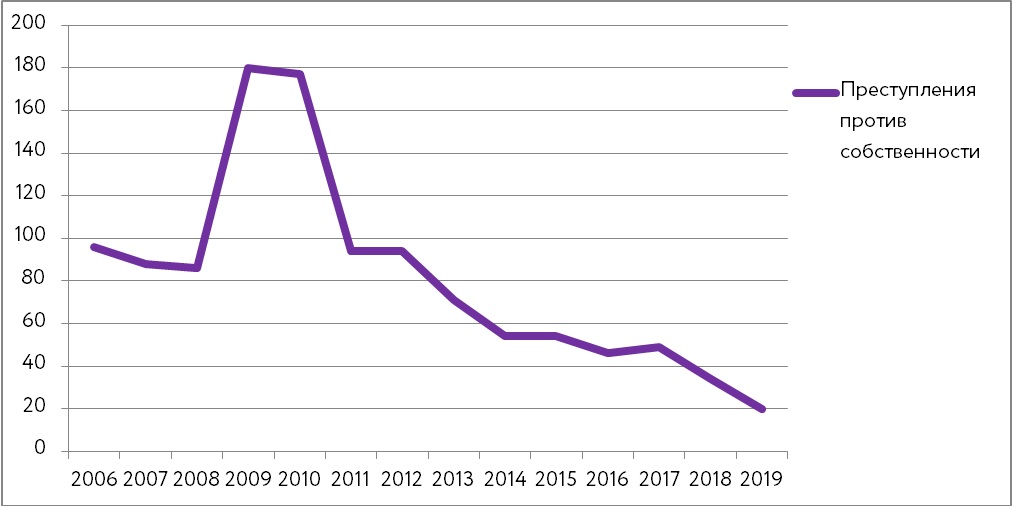
В 2019 году количество преступлений против собственности, мотивированных религиозной, этнической или идеологической ненавистью, вновь оказалось существенно ниже, чем годом ранее: в 2019 году их произошло не менее 20 в 17 регионах страны, в 2018 году – не менее 34 в 23 регионах. Мы не включаем в статистику единичные случаи обнаружения неонацистских граффити и рисунков на домах и заборах, но включаем серии граффити (правоприменение понимает граффити или как форму вандализма, или как метод публичного высказывания).
В 2019 году пострадало 5 идеологических объектов, что тоже явно меньше, чем годом ранее (в 2018 году – 14 эпизодов). В течение прошедшего года пострадали памятники погибшим во Второй мировой войне, монумент русско-китайской дружбы, мемориал американского рэпера XXXTentacion.
Rice. 4. Оскверненные религиозные и идеологические объекты (2016–2019)
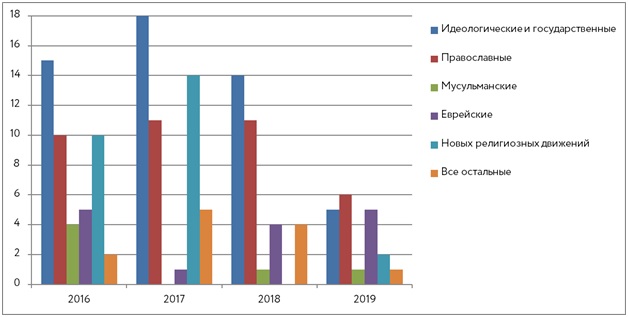
Большинство таких действий, как и ранее, направлено против религиозных объектов. Больше всего за год оказалось оскверненных православных храмов и крестов – 6 эпизодов (в 2018 году – 11 эпизодов). Второе место – у еврейских объектов – 5 эпизодов (годом ранее – 4). У зданий новых религиозных движений – 2 эпизода (в 2018 году не было), у мусульманских и католических объектов – по 1 эпизоду (в 2018 году у мусульманских – 1, у католических – 0).
В целом количество нападений на религиозные объекты уменьшилось: 15 в 2019 году (в 2018 году мы писали о 20, в 2017 годах – о 30). Доля наиболее опасных актов – поджогов и взрывов – по сравнению с прошлым годом же увеличилась и составила 30 %, то есть 6 из 20 (годом ранее – 7 из 35). Самым громкой из таких акций стало нападение активистов националистической Ассоциации народного сопротивления (АНС) на патриаршую резиденцию в Чистом переулке в Москве, осуществленное 16 мая. Члены АНС вывесили на воротах баннер «Извинись за Екб» и закидали дымовыми шашками территорию резиденции, где также располагается управление делами Московской патриархии. Атака была связана с акциями протеста в Екатеринбурге против строительства храма на территории сквера [30] .
Региональное распределение за год заметно изменилось. В 2019 году такие преступления были отмечены в 11 новых регионах: Астраханской, Владимирской, Волгоградской, Иркутской, Московской и Тверской областях, Алтайском, Красноярском и Приморском краях, Кабардино-Балкарской республике, Севастополе; ранее же фигурировали 17 регионов, теперь не попавшие в нашу статистику: Архангельская, Воронежская, Кемеровская, Ленинградская, Мурманская, Рязанская, Самарская, Свердловская, Смоленская, Тульская, Ульяновская, Челябинская и Ярославская области, Республики Карелия и Хакасия, Ханты-Мансийский автономный округ, Крым.
Впервые в нашей практике география актов насилия оказалась шире (18 регионов), чем деятельность ксенофобов-вандалов (17 регионов). И то, и другое было зафиксировано в 5 регионах (годом ранее также в 5): Москва, Санкт-Петербург, Алтайский край, Волгоградская и Московская области.
Criminal prosecution for violence
В 2019 году количество осужденных за насильственные преступления по мотиву ненависти оказалось ниже того, что было годом ранее. В 2019 году в Санкт-Петербурге, в Омске и в Хабаровском крае было вынесено не менее 4 обвинительных приговоров, в которых судами был признан мотив ненависти [31] . В этих процессах были признаны виновными 10 человек [32] (в 2018 году – 11 человек в 11 регионах).
Обращает на себя внимание приговор Железнодорожного районного суда Барнаула за ксенофобное нападение в одном из торговых центров города, сопровождавшееся оскорблением «в адрес выходцев с Кавказа». Во время следственных действий нападавший объяснил свой поступок тем, что его «возмущает поведение людей другой национальности, приехавших [в Россию] из других стран». Однакоуголовное дело было возбуждено без учета мотива ненависти по ст. 116.1 УК («Нанесение побоев лицом, подвергнутым административному наказанию»), и в итоге прекращено в связи с примирением сторон.
Rice. 5. Динамика потерпевших от насильственных преступлений ненависти и осужденных за такие преступления (2004–2019)
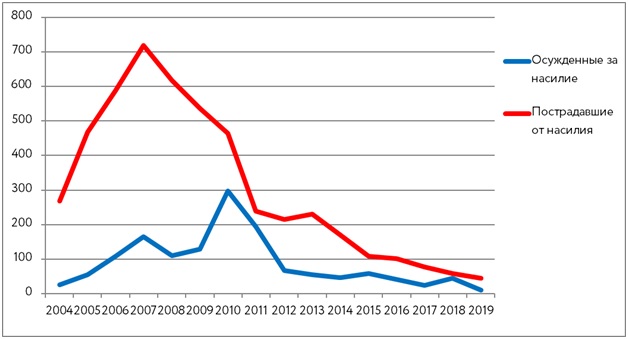
В остальных приговорах для квалификации расистского насилия использовались следующие статьи, содержащие мотив ненависти как квалифицирующий признак: «Причинение легкого вреда здоровью», «Побои», «Вовлечение несовершеннолетнего в преступную группу». Первые две статьи применяются практические ежегодно. Art. 282 УК («Возбуждение ненависти») применительно к насильственным преступлениям фигурировала в 3 обвинительных приговорах (годом ранее – в 5), были применены пункты «а» и «в» ч. 2 ст. 282 of the Criminal Code (“The excitement of hatred with the use of violence or with the threat of such” or “committed by an organized group”). Art. 280 УК («Публичные призывы к осуществлению экстремистской деятельности») была применена тоже в трех приговорах. В двух случаях она соседствовала со ст. 282 УК и была добавлена к другим статьям обвинения участников групповых процессов или членов ультраправых группировок, таких как члены группировки из Омска [33] или организатору и участнику хабаровского сообщества «Штольц» [34] .
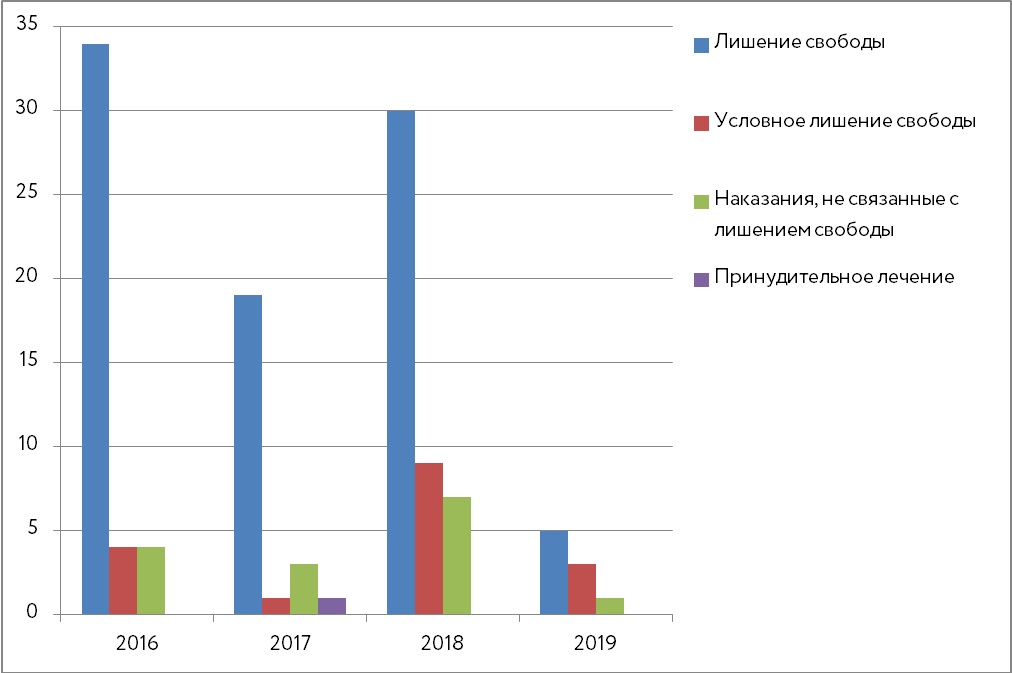
Наказания за насильственные деяния распределились следующим образом:
- 1 человек осужден на срок более 20 лет лишения свободы;
- 2 человека – от 10 до 20 лет лишения свободы;
- 2 человека – от 5 до 10 лет;
- 3 человека – к условному лишению свободы;
- человек – к обязательным работам;
- 1 человек освобожден от наказания в связи с истечением срока давности.
Rice. 6. Наказания за идеологически мотивированное насилие (2016–2019)
Нам известно только об одном случае дополнительного наказания: организатор упоминавшегося сообщества «Штольц» [35] был лишен права руководить и участвовать в работе общественных организаций на восемь лет, а также размещать обращения и какие-либо материалы в информационно-телекоммуникационных сетях общего пользования, включая интернет, на два года.
Как видно из приведенных данных, половина осужденных за насилие (5 из 10) была приговорена к различным срокам лишения свободы. Однако второй год растет доля осужденных получивших условные сроки. В 2019 году она составила 30 % (3 из 10), в 2018 году – 20 % осужденных (9 из 45).
У нас вызывает сомнения условный срок, который получил житель Омска за два нападения: избиение прохожего, заподозренного в употреблении наркотиков, и прохожего с «неславянской внешностью» [36] . Приговор двоим подросткам из Санкт-Петербурга, устроившим «белый вагон», в виде небольших условных сроков также кажется нам неоправданно мягким [37] , даже несмотря на то что в момент совершения преступления они были несовершеннолетними. Мы не устаем повторять, что крайне настороженно относимся к условным срокам за идейно мотивированные нападения. По нашим наблюдениям, такие сроки очень редко останавливают нападавших от совершения аналогичных преступлений в дальнейшем.
Уголовное преследование за
преступления против собственности
В 2019 году нам неизвестны приговоры за преступления против собственности, в которых был бы вменен мотив ненависти. (В 2018 году мы знаем 2 таких приговора против 6 человек в 2 регионах, в 2017 году – 3 приговора против 5 человек в 3 регионах.)
Нам известен случай, когда идейно мотивированное преступление против собственности не было квалифицировано как преступление ненависти. За несколько граффити и поджог здании «Единой России» в Перми было вынесено 2 приговора против 6 членов группы «PNZS» (в официальных документах расшифровано как «Пермская нацистская команда»; вероятно, Perm Nazi Squad). Эти деяния были квалифицированы по ч. 2 ст. 167 УК («Покушение на уничтожение чужого имущества путем поджога»), по ст. 282 1 («Организация и участие в экстремистском сообществе») и по ч. 1 ст. 282 УК («Возбуждение ненависти»), но у одного из осужденных – по ч. 2 ст. 282 и по ст. 280 УК [38] . Однако ч. 1 ст. 282 была декриминализирована [39] .
[1] Наша работа по этой тематике поддерживается Норвежским Хельсинкским комитетом, Международным партнерством по правам человека и Европейским Союзом .
30 декабря 2016 г. РОО Центр «Сова» была принудительно внесена Минюстом в реестр «некоммерческих организаций, выполняющих функции иностранного агента». Мы не согласны с этим решением и обжалуем его.
[2] Hate Crime Law: A Practical Guide. Warsaw: OSCE/ODIHR, 2009 (доступно на сайте ОБСЕ на нескольких языках, включая русский: http://www.osce.org/odihr/36426).
Verkhovsky Alexander. Уголовное право стран ОБСЕ против преступлений ненависти, возбуждения ненависти и языка вражды (2-е издание, исправленное и дополненное). М., 2015 (доступно на сайте центра «Сова»: http://www.sova-center.ru/files/books/cl15-text.pdf).
[3] Данные за 2018 и 2019 годы приведены на 20 января 2020 г.
[4] В аналогичном докладе за 2019 год мы писали о 4 погибших, 53 раненых и избитых. См.: Юдина Н. Ультраправые и арифметика: Преступления ненависти и противодействие им в России в 2018 году. Преступления ненависти и противодействие им в России в 2018 году // Центр «Сова». 2019. 22 января (https://www.sova-center.ru/racism-xenophobia/publications/2019/01/d40542/).
[5] Здесь и далее все данные графиков основаны на мониторинге Центра «Сова».
[6] Годом ранее – тоже двое убитых.
[7] В Хабаровске полиция избила мигрантов, выкрикивая ксенофобные оскорбления // Центр «Сова». 2019. 23 декабря (https://www.sova-center.ru/racism-xenophobia/news/racism-nationalism/2019/12/d41885/).
[8] В Кудрове избит африканец // Центр «Сова». 2019. 16 января (https://www.sova-center.ru/racism-xenophobia/news/racism-nationalism/2019/01/d40524/).
[9] Ставропольский общепит против африканских студентов // Кавказ.Реалии. 2019. 11 декабря. (https://www.kavkazr.com/a/30319758.html).
[10] Санкт-Петербург: таксист избил и оскорбил музыканта // Центр «Сова». 2019. 20 мая (https://www.sova-center.ru/racism-xenophobia/news/racism-nationalism/2019/05/d41032/).
[11] Мониторинг ксенофобских настроений // Левада-центр. 2019. 18 сентября (https://www.levada.ru/2019/09/18/monitoring-ksenofobskih-nastroenij-2/).
[12] Антицыганские выступления в Чемодановке // Центр «Сова». 2019. 17 июня (https://www.sova-center.ru/racism-xenophobia/news/racism-nationalism/2019/06/d41149/).
[13] Антимигрантские волнения в Якутске. Введены ограничения на прием иностранцев на работу // Центр «Сова». 2019. 19 марта (https://www.sova-center.ru/racism-xenophobia/news/racism-nationalism/2019/03/d40783/).
[14] Альперович Вера, Юдина Н. Ультраправые на улицах: с плакатом за демократию или с ножом в кармане. Ксенофобия и радикальный национализм и противодействие им в 2012 году в России // 2013. 15 марта (https://www.sova-center.ru/racism-xenophobia/publications/2013/03/d26655/).
[15] Официально зарегистрировано как Центр гражданско-патриотического воспитания молодежи республики Саха «Три».
[16] Бекбулатова Таисия. Народ спит как медведь – не надо его будить // Такие дела. 2019. 5 апреля (https://takiedela.ru/2019/04/narod-spit-kak-medved/).
[17] Сообщается также как минимум об одном нападении членов ВБОН 6 августа на четверых геев в Баку.
[18] Нападения и угрозы от имени объединения ВБОН // Центр «Сова». 2019. 25 октября (https://www.sova-center.ru/racism-xenophobia/news/racism-nationalism/2019/10/d41622/).
[19] Речь идет о жестоком убийстве трансгендерной женщины Ники Сургутской. Подробнее см.: Курск: жестокое убийство трансгендерной женщины // Центр «Сова». 2019. 24 апреля (https://www.sova-center.ru/racism-xenophobia/news/racism-nationalism/2019/04/d40936/).
[20] В Екатеринбурге произошло гомофобное нападение // Центр «Сова». 2019. 16 сентября (https://www.sova-center.ru/racism-xenophobia/news/racism-nationalism/2019/09/d41469/).
[21] Несколько молодых людей напали на группу девушек, приняв их за лесбиянок // Центр «Сова». 2019. 10 декабря (https://www.sova-center.ru/racism-xenophobia/news/racism-nationalism/2019/12/d41822/).
[22] Морозова Ксения. Пила против ЛГБТ: что известно о гомофобном движении, которое считают причастным к смерти Елены Григорьевой // Собака. 2019. 24 июля (http://www.sobaka.ru/city/society/94002).
[23] Убита активистка Елена Григорьева. Задержан подозреваемый // Центр «Сова». 2019. 23 июля (https://www.sova-center.ru/racism-xenophobia/news/racism-nationalism/2019/07/d41276/).
[24] После убийства Елены Григорьевой ее знакомой поступают угрозы // ОВД-инфо. 2019. 27 июля (https://ovdinfo.org/express-news/2019/07/25/posle-ubiystva-eleny-grigorevoy-ee-znakomoy-postupayut-ugrozy).
[25] Ресурсный центр для ЛГБТ в Екатеринбурге об угрозах «Пилы» в свой адрес // The Village. 2019. 17 июля (https://www.the-village.ru/village/city/news-city/356591-lgbt-ugroza).
[26] НКД, SERB и НОД сорвали спектакль Театра.doc // Центр «Сова». 2019. 29 августа (https://www.sova-center.ru/racism-xenophobia/news/racism-nationalism/2019/08/d41410/).
[27] Пик таких нападений пришелся на 2007 год (7 убитых, 118 раненых); с тех пор происходило постоянно снижение. После 2013 года динамика нестабильна.
[28] Подробнее о них см.: Альперович Вера, Юдина Н. Прокремлевские и оппозиции со щитом или на щите // Центр «Сова». 2015. 27 июля (https://www.sova-center.ru/racism-xenophobia/publications/2015/07/d32502/).
[29] В Красноярском крае вандалы разбили стекло машины Свидетеля Иеговы и подбросили записку с оскорблениями // Центр «Сова». 2020. 9 января (https://www.sova-center.ru/racism-xenophobia/news/racism-nationalism/2020/01/d41917/).
[30] Активисты АНС вывесили баннер и забросали дымовыми шашками патриаршую резиденцию // Центр «Сова». 2019. 17 мая (https://www.sova-center.ru/religion/news/community-media/communities-conflicts/2019/05/d41022/).
[31] Речь идет только о тех приговорах, где признан мотив ненависти и которые мы считаем правомерными.
[32] Один из них освобожден от наказания в связи с истечением срока давности.
[33] Омск: приговор участникам местной ультраправой группировки оставлен без изменений // Центр «Сова». 2019. 4 октября (https://www.sova-center.ru/racism-xenophobia/news/counteraction/2018/10/d40102/).
[34] Движение было признано экстремистским в декабре 2017 года.
[35] На Дальнем Востоке осуждены организатор и участник группы «Штольц» // Центр «Сова». 2019. 26 июня (https://www.sova-center.ru/racism-xenophobia/news/counteraction/2019/06/d41188/).
[36] Омск. Вынесен приговор по делу о ксенофобных нападениях // Центр «Сова». 2019. 7 октября (https://www.sova-center.ru/racism-xenophobia/news/counteraction/2019/10/d41549/).
[37] Санкт-Петербург. Участники акции «белый вагон» получили условные сроки // Центр «Сова». 2019. 3 сентября (https://www.sova-center.ru/racism-xenophobia/news/counteraction/2018/09/d39950/).
[38] Суд вынес приговор двум членам «Пермской нацистской команды» // Центр «Сова». 2019. 29 июля (https://www.sova-center.ru/racism-xenophobia/news/counteraction/2019/07/d41299/); Пермь: приговор по делу «Пермской нацистской команды» // Центр «Сова». 2019. 14 августа (https://www.sova-center.ru/racism-xenophobia/news/counteraction/2019/07/d41220/).
[39] Путин подписал законы о частичной декриминализации ст. 282 УК // Центр «Сова». 2018. 28 декабря (https://www.sova-center.ru/misuse/news/lawmaking/2018/12/d40472/).