
Translated material
As entrepreneurs are judged in Russia. The analysis of The Bell
It is believed that on average, about 200 thousand criminal cases of businessmen are started in Russia annually in Russia and this figure is only growing from year to year. The Bell found out that the number of criminal cases against businessmen and top managers in reality is much less-from 5 to 15 thousand a year. But there are still enough problems for business. We tell how they actually persecute entrepreneurs and who is at risk.

Content:
- The present number of criminal cases against entrepreneurs
- For which they judge entrepreneurs and top managers
- Crime and punishment: damage and term
- Portrait of a typical entrepreneur "under the article"
- What are your chances to face criminal prosecution
Criminal cases against entrepreneurs are several times less than it is customary to think
In mid -February, the Commissioner for the Protection of Entrepreneurs under the President and the head of the growth party Boris Titov announced a sharp growth - by 37% - the number of entrepreneurial criminal cases. Titov did not name the exact figure this time. But journalists and entrepreneurs, referring to it ( 1 , 2 , 3 , 4 ), are often called the figure of 200 thousand criminal cases a year - as an assessment of the persecution of businessmen or as the number of entrepreneurs in Russian pre -trial detention centers. This figure sounded in the summer of 2019 at the Stolypin Forum, in 2015 it was called Vladimir Putin. And, according to the State Duma deputy Andrei Golushko, a thousand criminal cases against entrepreneurs per day are completely initiated in Russia - the figure is large, but also comparable.
According to Titov’s latest data, in 2019, 317,627 crimes were registered in Russia:
- According to articles from the 22 of the Chapter of the Criminal Code (crimes in the field of economic activity)
- Articles on fraud (Articles 159-159.6 of the Criminal Code)
- Assignment or embezzlement (Article 160)
- causing property damage to the owner or other owner of the property by deception (Article 165)
The number of cases transferred to the court at the same time practically did not increase - there are 68,828 of them. But the number of cases increased, the production for which was suspended - for example, according to the same fraudulent articles, reported Titov.
The Bell decided to find out why they most often judge entrepreneurs, but quickly found that there was no need to trust the existing statistics on the persecution of businessmen. For example, on the assessment of the Institute of Law Problems (IPP), based on data from the Ministry of Internal Affairs, Prosecutor General and the Judicial Department at the Supreme Court, the real number of such criminal cases is in the range from 5 to 15 thousand-against 200-300 thousand at Titov.
Such a huge discrepancy is explained, first of all, the difference between the number of crimes, accused and convicted persons. The number of investigated crimes is much less than the number of registered ones. Even below the number of crimes for which guilty persons are established.
“About 300 thousand in the year of affairs. Not all of them will appear in all of them, you say. Not in all. And who is easier from this?” The member of the Federal Political Council of the growth party Alexander Khuruji argues in response to the request of The Bell. “Our problem is that the investigator is not responsible for the fact that the assigned case, so that there is a sentence, still need to work out, proof, proof, evidence. To assemble (although what evidence we collect - a separate song).

The number of accused can indeed be two to three times less than the number of investigated crimes-depending on the method of accounting, writes IPP in the study "Structure and the main features of economic crimes in Russia."
Both the business ombudsman, and after him, the president love to claim that many cases regarding entrepreneurs do not reach court-for example, Vladimir Putin claimed that in 2014, 200 thousand cases were initiated on economic articles, of which only 46 thousand reached the court. Usually this argument is given as evidence of the arbitrariness of the security forces - the case was opened, and before the trial it fell apart. But the numbers do not confirm this: there are cases of the accused in the case, but the case did not reach the court, in 2014 there were less than 15%. Most likely, the data given by the president indicate crimes on which the perpetrators were not established - such cases really cannot reach the court.
To find out the truth, one could focus on the number of convicts: according to the named Titian articles in 2018, there were 37,675 people (data from the judicial department). But this figure cannot be considered absolutely accurate, since different departments have different approaches to conducting statistics, none of which allows us to separate entrepreneurial affairs from general -unawares. For example, the Ministry of Internal Affairs and the Prosecutor General use their own category of "economic crimes". But almost a third of these crimes are the cases of counterfeiters who cannot be attributed to entrepreneurial.
For which they judge entrepreneurs and top managers
It is difficult to separate things against entrepreneurs, but there are several statistical categories that give a more accurate idea of their number. One of them is the cases in which the socio-economic status of the accused is indicated. Such statistics are in statistical cards of the Ministry of Internal Affairs (law enforcement officers fill them out in accordance with the provisions of the Civil Code). But she also has a drawback - we can talk about crimes committed by people in the status of an entrepreneur (the owner of an enterprise, an entrepreneur without the formation of a legal entity, a rentier, etc.), but not related to entrepreneurial activities.
The IPP, exploring all the data, collected its own classification of economic crimes as those that are most often charged "in connection with the performance of official duties in the organization or its management or can be easily applied to the head of the enterprise." According to his statistics:
- In 2014, the share of economic crimes with the accused, among which at least one had the status of an entrepreneur was 14.6% (approximately 8.2 thousand crimes).
- In about 19.8% of cases (11 thousand crimes), there were at least one among the accused with the status of a top manager-a head, deputy head or an employee performing managerial functions in a commercial or other organization.
In 2018, according to the judicial department, the total number of sentences against entrepreneurs amounted to 9,235 - but this includes crimes not only under economic articles.

It is difficult to determine who constitutes the rest of the accused on economic articles, says Kirill Titaev, director of IPP on research and associated professor of sociology of law named after S.A. Muromtseva of the European University in St. Petersburg: everyone falls into this statistics-and the real business, and scammers, and those who cash out maternity capital in different ways.
A significantly fewer cases of entrepreneurs do not mean that the problem with the criminal prosecution of the business is far -fetched. It’s simply not a matter of mass persecution, but in widespread practice to describe ordinary business relations in criminal law categories.
“The essence of entrepreneurial activity is that the entrepreneur, acting at his own peril and risk, can make decisions that do not guarantee income,” says Kirill Titaev. “Now the beneficiary and person who makes decisions is not one and the same person. When the decision does not lead to the expected income, or even more so leads to losses, the beneficiary may have a matter of the management. For example, you and I have concluded an agreement for the shipment of a thousand tons of gravel, I began to build a business model, I could not ship you a gravel, because of this, if I foresaw and planned that you will suffer losses, and I will not have a fraud and I should not have any fraud. To foresee, this is an ordinary entrepreneurial situation where I will compensate you for the losses that is obliged in accordance with the contract, and we are diverging this. The problem is that in Russian realities, absolutely inevitable mistakes begin to interpret as a criminal offense. "
“The root of evil is in improper evidence of intent, then non-compliance with the guarantees provided for by the legislator, the rest is essentially derivatives,” agrees Ekaterina Avdeeva, the chairman of the legal services committee and the examination of Business Russia bills, and the public business ombudsman of Moscow in the criminal process.-for economic compositions, improving intention is especially important, since the lack of lack Senses, for example, to theft, non-payment of tax, customs payments leads to the fact that the very event of the crime is absent, and non-fulfillment or improper fulfillment of obligations lies within the framework of civil law relations and should be resolved within the framework of a civil or arbitration process. Which leads to hasty presentations of "duty" accusations. "
It is incorrect to assume that the main interest of criminal cases against entrepreneurs is law enforcement officers who seek a bribe or try to “squeeze” the business, according to the SPP. "Recent studies show that quite often the criminal prosecution system is only a tool for solving disputes between business entities," and the basis of Russian legislation is criminal law. The main thing is not compensation for damage to the injured party, but withdrawal in favor of the state.
Crime and punishment: damage and term
The crimes that are charged with entrepreneurs do not necessarily cause damage, all the more significant. There is an absurd dependence here, experts believe: when the crime has a real victim who is damaged, the suspect is most often not able to detect. But in matters in which there is a suspect, the size of the damage is most often unknown - indirectly this indicates the absence of a real victim.
Damage. Oddly enough, it is not so great in crimes, which is most often accused of entrepreneurs and leaders. According to IPP, in 2014 the damage was:
- less than 119 thousand rubles - in 25% of economic crimes;
- less than 650 thousand rubles - in 50% of crimes;
- Less than 2.7 million rubles - in 75% of crimes, including tax crimes.
“ The world practice for the most part lies in the fact that if a person is accused of not mistaken, but deceived counterparties, then evidence of intent is needed,” Titaev says. “First it is necessary to evaluate whether it was possible to make a mistake. If there is doubt, the witnesses, correspondence, or something that is an objective evidence of intent is still needed. In Russian realities, intent is simply charged with-the fact is simply charged Damage to the actions of the person, the opinion of the damage to whom the damage is allegedly caused may not be taken into account in Russian practice. "
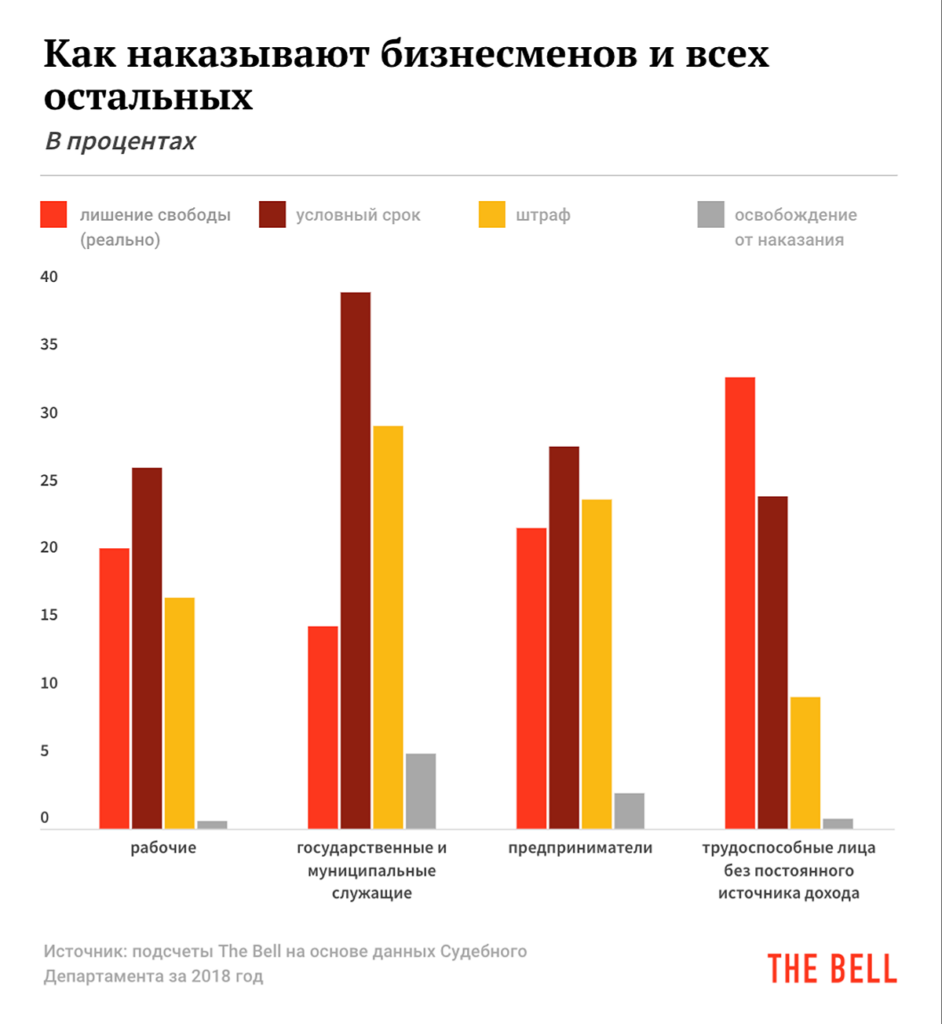
The severity of the punishment. Entrepreneurs receive real terms more often than civil servants, but less often than unemployed, follows from the data of the judicial department. And entrepreneurs also receive the longest median terms of conclusion compared to the categories of unemployed and economically active, it follows from another IPP study : in 2013 it was 3.3 years compared with 2.4 and 2.5 years, respectively. The liberal reforms of the time of the presidency of Dmitry Medvedev, which were supposed to create a special legal regime for entrepreneurs, actually did not affect their position, follows from the same study. Mitigation in the application of laws took place thanks to general reforms, not entrepreneurial.
Portrait of a typical entrepreneur "under the article"
“I think, any entrepreneur will remember the case: it turns out that the order will be with the state-it means that the entrepreneur will double the price, because the state needs to insure with additional risks,” Titaev answers the question about the most risky business relations. “We still do not know how exactly the risks are higher in the case of the state contract, but experts say that they will be significantly higher (this will become known in the end of the end of the end. The next study after six months).
The share of the public sector in the Russian GDP is really high and continues to grow, although its estimates are varying. According to the IMF, this share in Russia was 32% in 2012 and increased to 33% in 2016. The FAS stated that in 2015 it amounted to 70% against 35% in 2005. Moody's Investors Service estimates the state sector in Russia, taking into account partially privatized companies in 40-50%, which corresponds to the assessment of the Center for Strategic Development of 46% of GDP.
“Gosakases are generally a separate topic for the criminal prosecution of entrepreneurs,” confirms Alexey Dobrynin, the managing partner of the St. Petersburg Office of the Pen & Paper Bar Assistance Office. “If we are talking about contracts related to budget financing, we can safely say that the entrepreneurs have the risks in this area, and serious example: everything was built, and everything was built, and everything was built, and everything was built, and everything was built, and everything was built, and everything was built. The customer is dissatisfied with the result: he conducts a construction and technical examination, which confirms that part of the work was performed not on the project, etc.
In recent years, among the high -profile affairs of business, they have been increasingly related to state orders or with cooperation with the state -owned enterprise:
- The ex-owner of the antipinic refinery of Dmitry Mazurov is suspected of fraud with the loan of the State Sberbank-according to the investigation, under the guise of receiving a loan of Mazurov, he abducted 1.8 billion rubles, hiding data on other creditors and guarantees for another business Mazurov in other banks. Mazurov claims that Sberbank always knew about all operations related to the plant.
- The former general director of the LPO “Mostovik” Oleg Shishov, after the construction of several state facilities-the Primorsky Oceanarium and a number of objects for the Olympics in Sochi, became a defendant of several criminal cases-about the consideration in the embezzlement, about non-payment of wages and about tax evasion. At the Mostovik Olympics, according to Shishov, he built objects in a “poorly organized emergency” and at a loss to himself, after which he went bankrupt.
- The same story in the high -profile case of the Seventh Studio - according to the investigation, director Kirill Serebrennikov and the studio staff stole budget funds allocated by the Ministry of Culture on the theater project "Platform". To do this, they, as the investigation believed, took events much cheaper than the amount that the Ministry of Culture allocated, or did not conduct them at all. The examination later found that the events were actually even more expensive, but the case was still not terminated.
“The massive, simple, compact business - store, hairdresser, car wash,” says Titaev, the least of all, ”Titaev claims.“ There are their absurd cases and they make a tangible contribution, but due to the fact that these businesses are very, their risks are small. Today is a typical person pursued for economic crime, not the owner of the auto -sales, is not the owner And the director of the kindergarten, the accountant of the third park, etc., and the most dangerous profession in Russia is a mayor.
“In the risk zone, firstly, those who carry out state contracts,” Avdeeva agrees from the Committee for the Development of Legal Services and the Expertise of Business Russia bills. “Often we are faced with the fact that even in the execution of the contract and the acceptance of goods or work the customer can then be instituted by a criminal case. The theft of budget funds with all the arising serious consequences. The customer uses the customer, they are not charged with violations, which are more likely to be attributed to a civilian dispute, at the risk zone of the director and beneficiaries of companies that compensate for the VAT, which also refer to the beneficiaries and leaders of developmental companies, at least until the legislation on shared construction, the Benifucials and the Benifucials and the Benifiers and the Benefit. The leadership of credit institutions from which the license was withdrawn. "
В статье об уровне оптимального правоприменения для бизнеса ИПП приводит типичные случаи чрезмерной криминализации экономической деятельности — то есть те, когда "уголовное наказание явно чрезмерно по тяжести за совершенное деяние":
- Преступления, связанные с нарушением правил ведения бухгалтерского и налогового учета
Кодекс об административных правонарушениях позволяет оштрафовать должностное или юридическое лицо за нарушения в хозяйственной деятельности предприятия. Поскольку штраф для юрлица существенно выше, часто штраф накладывают на сотрудника, которому предприятие компенсирует сумму штрафа. Опытные руководители оформляют такую компенсацию как премию сотруднику, неопытные платят из кассы предприятия — что правоохранители нередко трактуют как растрату.
- Преступления, связанные с неисполнением договорных обязательств
Не все заключенные договоры могут быть исполнены, такова природа предпринимательской деятельности — партнеры могут неверно оценить риски, обстоятельства и условия, они могут измениться. Готовность в такой ситуации вернуть средства в установленный договором срок не всегда защитит предпринимателя от уголовного преследования, которое может начаться еще до наступления срока возврата денег по договору.
- Преступления, связанные с несоблюдением правил распоряжения господдержкой
Средства господдержки предполагают целевое использование — считается, что деньги пойдут на определенные цели, например, развитие бизнеса. Два распространенных основания для уголовных дел в таком случае: фальсификация статуса адресата господдержки и нецелевое расходование средств.
Например: предприниматель может получить целевой кредит на развитие сельского хозяйства под более низкие проценты, чем нецелевой кредит. Многие хозяйства не имеют достаточных доходов, чтобы брать нецелевые кредиты, но и заниматься сезонной деятельностью без кредитов не могут, поэтому часто берут целевые кредиты и тратят их на фактические нужды, например, выплату зарплаты сотрудникам. Несмотря на то, что, по факту средства тратятся именно на развитие предприятия, целевым расходованием средств это не считается — и за это предпринимателя привлекают к уголовной ответственности.
- Преступления, связанные с нарушением требований лицензирования
Предпринимательская деятельность без регистрации часто приводит к появлению уголовных дел — однако в большинстве случаев поводом для возбуждения дела становится не нарушение правил безопасности или причинение кому бы то ни было ущерба, а исключительно факт отсутствия лицензии и получения дохода. Несмотря на то, что работы были выполнены с соблюдением всех требований безопасности (о чем говорит отсутствие обвинения по другой статье), предприниматель или руководитель все равно могут быть привлечены к уголовной ответственности.
Требования самого бизнеса, которые он упорно адресует власти, во многом повторяют выводы исследований — необходимо декриминализовать часть статей УК (мелкие мошенничество и растрату, мелкий коммерческий подкуп, незаконное предпринимательство), изменить условия заключения под стражу и возбуждения уголовных дел, дополнить УПК так, чтобы хозяйственные споры не приводили к уголовному преследованию, а в том, что касается налоговых преследований — не возбуждать дела без заключения налогового органа, как это было раньше.
Ваши шансы попасть под уголовное дело
По оценке ИПП, шансы стать фигурантом уголовного дела для среднего предпринимателя или руководителя — 1 к 50 в течение жизни. "Это не очень большое число дел, — поясняет Титаев. — У типового предпринимателя шанс в следующем году оказаться жертвой серьезного уголовного преследования — это доли процента. Но за счет того, что есть круг общения, есть общая репутационная ситуация, портится бизнес-климат". По его словам, сложившаяся ситуация приводит к тому, что предприниматели начинают чрезмерно инвестировать в собственную безопасность и опасаться рискованных проектов, которые, в конечном счете, и могли бы привести к экономическому прорыву.
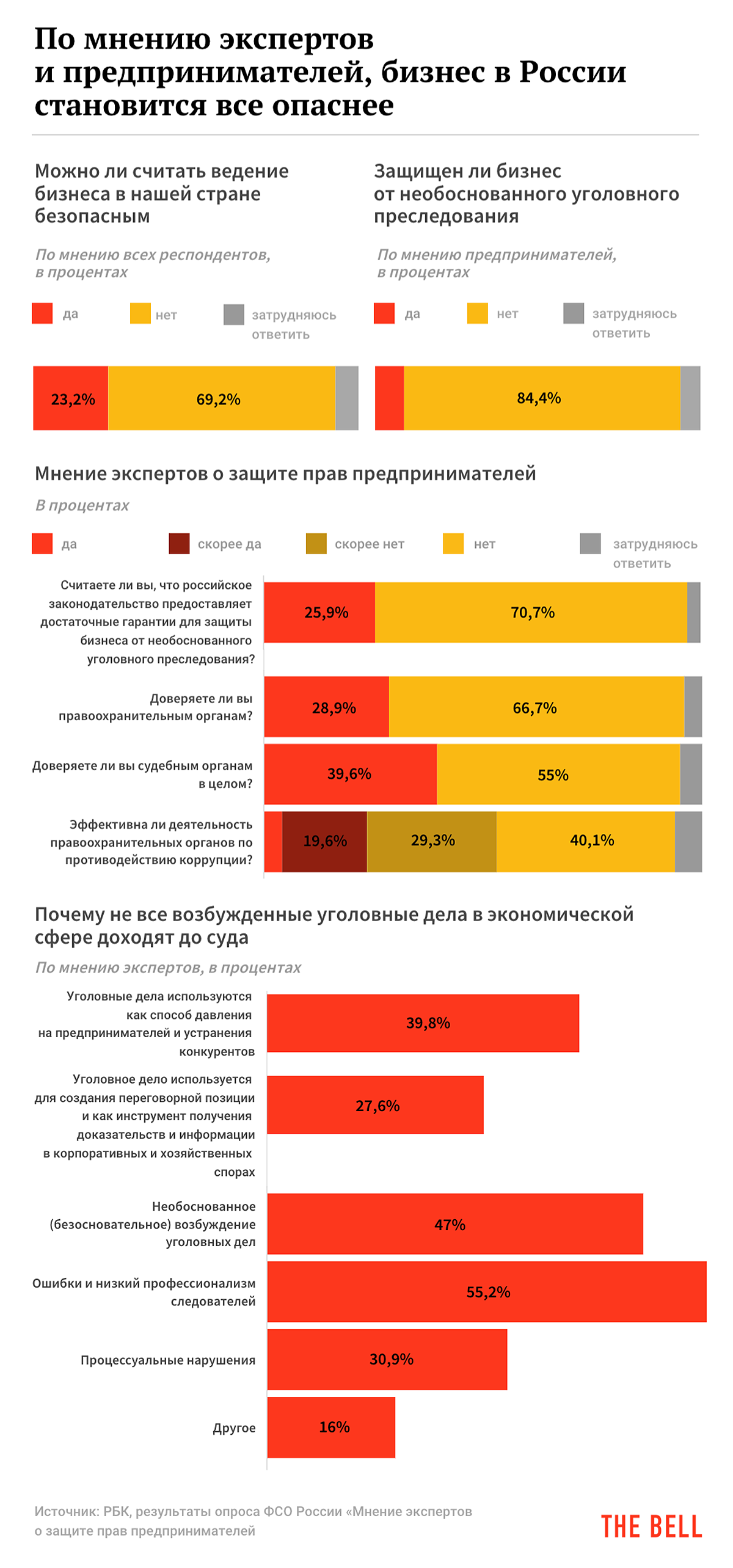
"Например, человек, начиная свой бизнес, говорит: “Я начну не сейчас, а через год, мне через год должны дать звание заслуженного работника некоторой отрасли, что в случае уголовки будет серьезным смягчающим обстоятельством”, — пересказывает Титаев. — И человек год ждет с началом своего бизнеса при том, что объективно его шансы на уголовное дело достаточно скромны. Все ведут себя так, как будто эти шансы достаточно велики. Как любит говорить Екатерина Шульман, репрессии у нас выборочные, но если эти репрессии касаются именно вас, вам все равно, что они выборочные".
Измерить влияние на поведение предпринимателей в цифрах исследователям пока не удалось: "Мы знаем из разговоров, что вот от одного проекта отказались, от другого, но определить, как конкретно это влияет на поведение предпринимателей, пока не можем", — говорит Титаев.