
Translated material
From Alexander the First to Putin the rewind. Brief History of the Russian Constitution
For two centuries, Russia has been unsuccessfully trying to find a constitution worthy of a modern civilized country. The times of several emperors have passed in fruitless attempts to accept at least a project of what the name of which was even afraid to pronounce. At the end of the Russian Empire, “basic laws” were adopted, and the word “constitution” in irony was applied only by the Bolsheviks. The world sensation was the “most democratic” Stalin Constitution, adopted on the eve of 1937. The Constitution of the winning democracy lasted from 1993 to 2020. The historian Tamara Eidelman recalls Russia's attempts to become a legal state in the days of five emperors, five Secretary Generals and two and a half presidents.
The word "constitution" has long caused great concerns in Russia. In the XVIII - XIX centuries, his French origin was clear to everyone, which means that horror! - The connection with the Great Revolution, when several constitutions were replaced in France. The state where the absolute power of the king existed for centuries, suddenly became at first a constitutional monarchy, and then generally a republic. In the interval between the adoption of different constitutions, the French also managed to execute the king and queen, as well as many others.
Of course, the thought of the Constitution inspired fear for the Russian rulers. However, not everyone. The young heir to the throne, Grand Duke Alexander Pavlovich, admitted to his friends that he wanted to give Russia a constitution, renounce the throne and settle with his wife in a “little house on the banks of the Rhine”. It’s interesting: the constitution theoretically had to bless Russia, but Alexander was going to live away from it: it was obvious that he suggested that the new state structure could personally bring him trouble.
Having entered the throne, Alexander I energetically set about reforms. Together with his young friends, whom he introduced into the "secret committee", he intended to turn the mountains. At the first meetings, he warmly convinced them that Russia needed cardinal changes - the introduction of the Constitution and the abolition of serfdom. Friends had to hold him and reassure him. The teacher of Alexander, the philosopher Lagarp, wrote him a letter in which he begged not to let out the autocratic power out of his hands - otherwise there can be no question of any reforms, because, as Lagarp believed, the tsar does not have to wait for support from anyone other than young enlightened officers.
As a result, no change in the state system occurred. Instead, state institutions were changed - obsolete colleges were replaced by more modern ministries. The reform is certainly useful, but clearly inferior in scale to what the young emperor saw in his dreams.
Speransky Constitution: First Pancake
The king gradually lost interest in the secret committee, moreover, in 1805, the war with Napoleon began. After the conclusion of peace in 1807, Alexander again began to think about changes in the country, and in these years Russia received a unique chance. The star of the outstanding statesman Mikhail Mikhailovich Speransky ascended. From 1807 to 1812, Speransky was one of the people closest to Alexander - he had the right to a daily personal report to the tsar, and what could provide a greater influence in an autocratic state than constant contacts with the ruler? Speransky and Alexander, obviously, talked a lot about possible reforms, and in the end Speransky offered the king his plan of state transformations.
In the entry to the project, he very carefully tried to dispel the king’s fears about the fact that the constitution was not far from to the revolution. “Earthly kingdoms have their own eras of greatness and decline, and in each era the image of the rule should be proportionate to the degree of civil education, which stands by the state. Each time the image of the reign is lagging behind or precedes this degree, it rushes with a greater shock. ” Simply put, if Russia lags behind the “degree of civil education” and does not carry out reforms, then the storm will break. The Constitution (although this word, of course, is not pronounced) will not bring a revolution, on the contrary, will strengthen stability. In addition, if the changes are carried out from above, and not torn by the rebellious people, as in France, then there is nothing to fear at all.
For some time, Alexander seems to have believed Speransky and approved his project. The plan was absolutely wonderful and, probably, the most consistent and thought out of all reform projects created in the 19th century. Speransky proposed creating a four -stage system of elected organs - volost, district, provincial thoughts and, finally, the State Duma. Above the Duma, in the manner of the English House of Lords, the upper house was supposed to be created - the State Council, without the approval of which the laws were not adopted. The right to vote should be provided to everyone who owned property. If the serf peasant bought the will and received property, he also gained political rights. However, it was clear that with such a system serfdom would not last long and would be canceled.
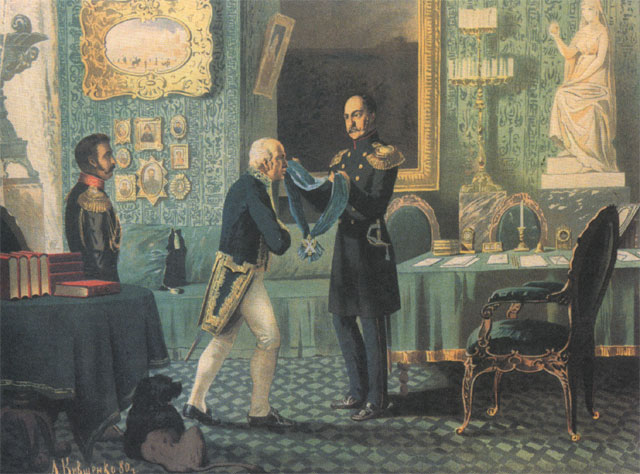
Alexander seems to have approved Speransky’s project and even took the first step - in 1810 an updated state council was created. But it was only the tip of the iceberg, now it was necessary to form the rest of the system. At this time, complaints began to reach the king from all sides, and sometimes frank denunciations of Speransky. The universal indignation at the court was caused by two declining reformer entered from the submission of the reformer - about the need for government officials either to submit a diploma of graduation or passing an exam for a university course. In Russia, where most of the nobles at that time received a home education, this meant that middle -aged ministers, senators, and departments would have to pass exams. The second decree made the court ranks simply by ranks - now it was no longer possible to consider yourself in the service, to receive a salary and awards if you were just court. If you want to serve, serve for real, and not just make a mistake at the court. One can imagine the rage of courtiers, especially since Speransky was a stranger - a native of a provincial clergy.
The last blow was struck by a wonderful person and an outstanding historian-Nikolai Mikhailovich Karamzin, who was so excited by impending changes that he came off from working on the “history of the Russian state” and wrote a “note about ancient and new Russia”, in which he went through his elegant syllable throughout history, proving that the autocracy was once abandoned and called on the liberties and called on the liberties and called on Varangians, and the liberation of the peasants will bring them only harm.
Karamzin argued that autocracy is natural for the country, and the liberation of the peasants would only harm them
Karamzin, who sincerely loved and respected the king, was not afraid to remind him of the murder of his father - Paul I, in which Alexander himself was involved, and hint that, having deprived the nobles of their privileges, the king will shock the foundations of Russia themselves, which then could happen? Alexander I remembered well that his grandfather and his father were overthrown and killed by the conspirators. Can we reproach him for deciding not to rush with reforms? And yet, if the Speransky project were implemented in 1810 and Russia actually received the Constitution and parliament, today we would live in a completely different country ...
In March 1812, the king invited Speransky to him and unexpectedly said that he was sending him to exile. During this conversation, both of them cried, only Alexander remained in the palace, and Speransky went to Nizhny Novgorod, where everyone considered him a French spy. Later Speransky will be returned to St. Petersburg, his career will continue, but there will be no question of the reforms ...
Alexander in fact, until the end of his reign, did not leave a dream of the constitution. After the war of 1812 and the final victory over Napoleon, Alexander literally forced the new French king Louis XVIII not to destroy all the achievements of the revolution and give the country another constitution in order to avoid new shocks. The Constitution was also received by the Kingdom of Poland, which became part of the Russian Empire. Why not Russia?
In 1818, the tsar ordered his longtime friend to Nikolai Novosiltsev, who then managed the Kingdom of Poland, to draw up a constitution for Russia - and a year later a charter was written, according to which a bicapalate parliament was supposed to appear in the country. But again nothing happened. The project was not implemented, and we could generally not know anything about it, if later, in 1830, the Polish rebels did not capture state papers in Warsaw, among which there was a Novosiltsev project.
"On the sweet liberty of citizenship"
Future Decembrists, those very young enlightened officers, where his teacher Lagarp proposed to Alexander, did not know about the projects of the king. Only after the war of 1812 and the foreign campaigns of the Russian army, the tsar was no longer for the young military adored idol - he deceived their expectations, did not conduct reforms, became, in the words of Pushkin, "nomadic despot." Moreover, he is ready to give the Constitution to Poland, but not to Russia - does he really despise his country so much? Who knows, if the Decembrists knew, for example, about the Novosiltsev project, then maybe they would behave differently, they would not have seen the enemy and tyrant in the king. But autocratic power always prefers to hide its secrets.
Members of secret societies begin to prepare in the overthrow of tsarist power and write their projects of the constitutions - Nikita Muravyov is developing a draft constitutional monarchy, and Pestel - the republic. No one understands exactly when and how a change of power will happen, but everyone craves changes.
In 1825, after the death of Alexander I, the conspirators will go to Senate Square - and someone will go to the gallows and who to Siberia or the Caucasus. Evil languages claimed that the soldiers who brought to the square believed that the constitution that their commanders spoke of was the wife of the Grand Duke Constantine, on whose behalf the rebels spoke. This, most likely, is not true, but someone’s evil joke, but that few heard about the constitution at that moment in Russia-this is alas, so.
Modern people are often warping how the Decembrists behaved during interrogations: almost none of them hid anything, they willingly, as we would say today, "collaborated with the investigation." But this is not a sign of cowardice - most of them were military, more than once courageously standing on the battlefield under bullets and nuclei. One of the reasons for their “conversationalism” was the desire to speak out, to explain to the new Tsar Nicholas I what they really wanted to push him to reform.
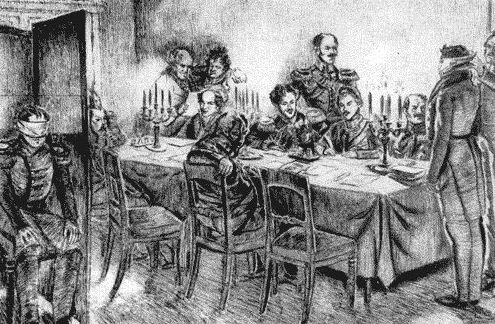
Nikolai really carefully got acquainted with all the Decembrist projects, but made a conclusion for himself, exactly the opposite of the one that the rebels counted on. He decided that all the ideas related to the constitution, the separation of powers, rights and freedoms were the product of the Western fermentation of the minds, which just plunged Europe into the storm of revolutions. Russia, from his point of view, had its own path - calm and stability during the rule of the autocratic sovereign.
For thirty years of the Nikolaev rule, it seemed that it was so - a calm life, a gradual economic The development, visible love of subjects inspired Nikolai's confidence in the correctness of the chosen path. A small handful of talkers who read Western books was under constant supervision of the third department. Only the shameful defeat of Russia in the Crimean war showed that everything was not as well in the country as it seemed to the king. We do not know whether Nicholas I committed suicide, unable to withstand the reports of the defeats of the Russian army in the Crimea, but in any case, he died, feeling complete confusion and disappointment, saying before his death to the heir: "I give you a team in full."
Alexander II realized that the country needed reforms. But, as it often happens in Russia, it seemed to him that, having changed economic and social relations, the political system could be left unchanged. The serfs received freedom, elected organs arose in the provinces, counties and cities, the seal was freed from censorship, the people from painful recruitment sets. What else can you want?
It turned out that there were still people who believed that Russia should get rid of the autocracy, that the district and provincial zemstvos should not be a certain all -Russian elected body, at least an advisory one in the country. But this already seemed to Alexander a too radical offer. Again, the ghost of the Constitution was dawn, and behind him - the guillotine, chopping his head during the French Revolution.
Relations between the king-reformer and society were more and more inflated. Young radicals did not want to go to any compromises - the era of terror began. And in these terrible years, when Alexander II became almost a captive in its palace, Russia again received a unique chance.
Loris-Melikov, or blown up project
Mikhail Tarielovich Loris-Melikov gained the confidence of the emperor by the fact that he successfully fought with terrorists as the Minister of Internal Affairs. After at the beginning of 1880, the explosion thundered directly in the Winter Palace and the king did not die only by a miracle, it seemed that the revolutionaries were already everywhere. However, over the next year there were no more terrorist attacks, and some major figures of the "people's will" were arrested. At the same time, Loris-Melikov constantly convinced the king that politics should be flexible: in relation to the revolutionaries ruthless, but in relation to an educated society-softer. It was clear that many supported the revolutionaries, which means that it was necessary to attract people to their side. And for that, reforms were needed.
So the famous project arose, which is often called the "Constitution of Loris-Melikov." Of course, this was not a constitution. It was simply proposed to resolve the most important issues of Russian life to convene a commission formed partly from people appointed by the authorities, and partly from the elected representatives of cities and zemstvos. It is possible that later from the work of this commission it would have grown up what could then become, if not by the legislative parliament, then at least an advisory zemstvo cathedral, and this would already be a great change in Russian life.
Alas, the Loris-Melikov project was the last document signed by the king on March 1, 1881. A few hours after that, he died from the bomb of the people's veins. A week after the death of the king, his heir, Alexander III gathered the council to discuss the project. Loris-Melikov was sure that Alexander III would begin to carry out the last will of his father. However, Konstantin Pobedonostsev, the teacher of the new king, the chief prosecutor of the Synod, known for his conservative views, spoke incredibly at the meeting. The main idea of his ardent speech came down to the fact that the late Emperor himself was to blame for what happened - starting the reform twenty years ago, he gave rise to a revolutionary movement and terror.
The main idea of Pobedonostsev came down to the fact that the late Emperor himself gave rise to a revolutionary movement and terror
The Loris-Melikov project was rejected. Soon he resigned, and other liberal ministers followed him. Many reforms of Alexander II were limited, but the idea that the Orthodox people love their sovereign and do not need constitutions was very close to the new king. And again, as under Nicholas I, the reign of Alexander III passed calmly, which seemed to confirm his view of Russia. But his son Nicholas II had to pay for this.
One of the reasons for the terrifying unconsciousness of Nicholas II and the unwillingness to change anything was the belief that the state system should remain unchanged. “I can’t waste the inheritance received from my ancestors, because I must convey it to my son,” Nikolai said more than once. As a result, the Constitution in Russia nevertheless appeared, but not granted from above, as Speransky also offered, but torn by the people during the 1905 revolution.
The word itself was too terrible and was not pronounced, but the basic laws of the Russian Empire, which recorded the existence of a legislative state Duma in 1906, is what, if not a constitution? She retained the enormous power of the king, did not allow the Duma to influence the formation of the government, besides the king dispersed the Duma, he himself changed the laws he adopted, but this was a beginning, from which a lot could have grown.
With Bolshevik directness
Alas, the old Russia was a thing of the past, and the Bolsheviks, having received power, decided to write the constitution as they needed.
On July 10, 1918, the V All -Russian Congress of Soviets, the same during which the uprising of the Left Socialist Revolutionaries began, who managed to realize what their allies of the Bolsheviks did in the 8 months after the revolution, - adopted the Constitution of the RSFSR. The supreme power belonged to the All -Russian Congress of Soviets, and its executive body was the All -Russian Central Executive Committee. В конституции была этакая бандитская откровенность — она не пыталась делать вид, что в новом государстве все равны. Мало того, что голосовать могли не все. «Лишенцы» — дворяне, предприниматели, духовенство — вскоре узнали, что, помимо возможности выбирать и избираться в советы, их лишили еще и продовольственных карточек. И даже один голос рабочего приравнивался к пяти голосам крестьян. Впрочем, уже здесь присутствует то расхождение между принципами и реальностью, которое потом будет видно у всех конституций. Верховная власть у Съезда Советов, но на самом-то деле она у партии большевиков и ее карательных органов. Как говаривали советские люди «ЦК цыкает, а ЧК чикает».
Конституция СССР 1924 года закрепила все то же неравенство и все ту же фальшь, но теперь к ней прибавились еще слова о том, что Советский Союз — это «добровольное объединение равноправных народов» и «за каждой республикой обеспечено свободное право выхода из Союза». Скольким поколениям в послесталинскую эпоху радостно объясняли, насколько ленинский план создания СССР был лучше сталинского, потому что все республики на равных входили в состав Союза, а не подчинялись России. Позднейшие события показали, что не во всех республиках оценили демократичность ленинского плана.
Прошло двенадцать лет, и накануне Большого террора появилась куда более демократичная конституция. «Систему выборов надо менять не только в смысле уничтожения ее многостепенности. Ее надо менять еще и в смысле замены открытого голосования закрытым (тайным) голосованием». Кто написал такие прекрасные слова? Товарищ Сталин, отец народа. Кто написал основной текст конституции, в которой провозглашалось введение всеобщего, равного и прямого избирательного права при тайном голосовании и гарантировались все важнейшие свободы — совести, слова, печати, собраний — и даже неприкосновенность личности? — Бухарин, который будет арестован в феврале 1937 года, через неполных три месяца после принятия прекрасной конституции. Кто обсуждал и вносил поправки в конституцию? Да весь советский народ — 75 миллионов участвовали в обсуждениях, было опубликовано полтора миллиона поправок. Тот самый народ, который в это время гнали по этапу, избивали в камерах, гноили в лагерях. Те, кто стоял по ночам у окна, прислушиваясь к шуму колес на улице и вздыхая с облегчением: Пронесло. Сегодня не за мной.
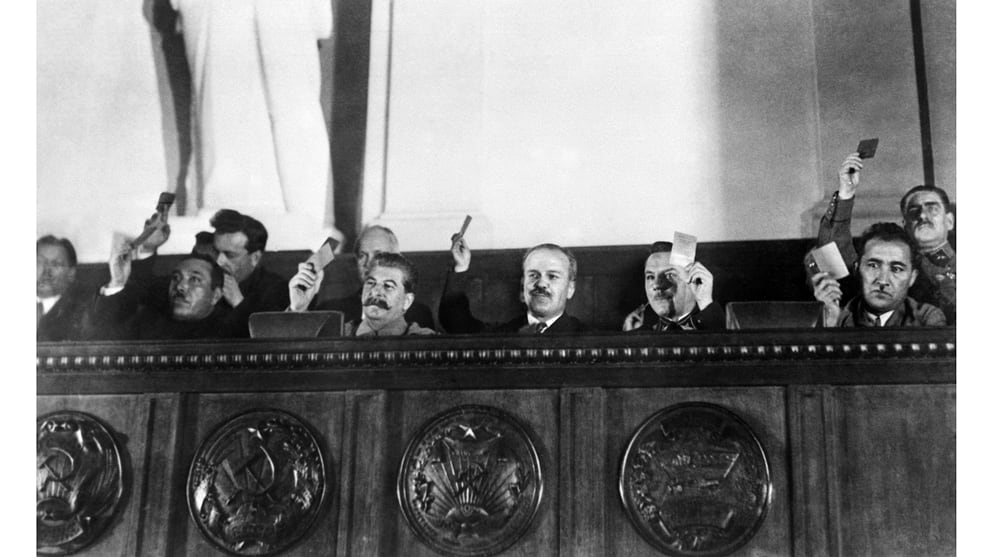
В этой конституции тоже проскакивают откровения, показывающие стоящую за ней реальность. Статья 131: «Лица, покушающиеся на общественную, социалистическую собственность, являются врагами народа». Еще бы не являлись: «Закон о трех колосках» был принят еще в 1932 году, и сколько уже малолеток, которых голодавшие матери отправили на колхозное поле подобрать остатки урожая, и сколько таких матерей и отцов уже пожрал ГУЛАГ?
Статья 133: «Измена Родине, нарушение присяги, переход на сторону врага, нанесение ущерба военной мощи государства, шпионаж — караются по всей строгости закона, как самое тяжкое злодеяние». Скольких людей к этому времени уже заставили признаться, что они японские, немецкие и еще бог (или вернее черт) знает чьи шпионы? Скольких уже расстреляли?
И все равно, как дико это ни звучит, конституция 1936 года оставалась в течение многих лет самым демократичным документом, официально изданным в нашей стране. Не случайно в 1965 году правозащитники вышли на Пушкинскую площадь с плакатами «Уважайте советскую Конституцию!» И не случайно уже через несколько минут их разогнали.
В 1977 году торжественно приняли новую конституцию. Ее уже обсуждали 140 миллионов человек. Теперь в ней уже никого не называли врагами народа. Было только написано, что «лица, посягающие на социалистическую собственность, наказываются по закону». Можно вспомнить, например, расстрелянных валютчиков или подпольных предпринимателей, или директора Елисеевского магазина.
Здесь тоже вдруг вылезла на поверхность жизненная реальность — знаменитая 6-я статья: «Руководящей и направляющей силой советского общества, ядром его политической системы… является Коммунистическая партия Советского Союза» — та самая статья, за отмену которой мы так боролись в перестройку.
А потом, через два с половиной месяца после того как отгремели выстрелы в октябре 1993 года, 12 декабря мы отправились на референдум и приняли новую конституцию. С 81-й статьей, где говорится, что одно лицо не может занимать пост президента более двух сроков «подряд». С 31-й статьей, гарантирующей право «собираться мирно без оружия, проводить собрания, митинги и демонстрации, шествия и пикетирование». С 19-й статьей, гарантирующей равенство перед законом и судом. С 29-й статьей, гарантирующей право на свободу мысли и слова. С 35 статьей, гарантирующей неприкосновенность частной собственности. С 49-й статьей, гласящей, что «каждый обвиняемый в совершении преступления считается невиновным, пока его виновность не будет доказана». С 53-й статьей, дающей «право на возмещение государством вреда, причиненного незаконными действиями (или бездействием) органов государственной власти или их должностных лиц».
Теперь же, после «обнуления» и поправок Россия по сути опять остается без конституции. Ну что ж, не в первый раз…