
Translated material
They breathe in the incense. How believers violated the self -isolation regime to mark Palm Sunday
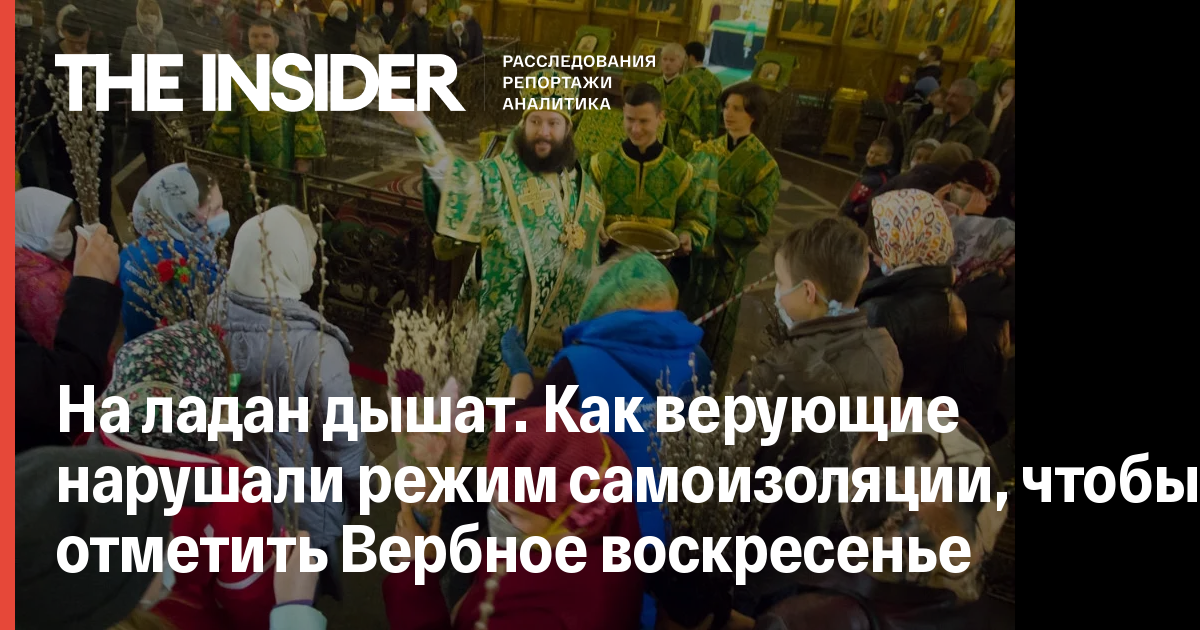
Patriarch Kirill urged believers to stay at home and watch Easter services on TV, and clergymen - not to let parishioners into temples. However, this instruction begins to operate only on April 13, and until that time, churches throughout Russia remain open. Therefore, on Palm Sunday, crowds of parishioners, despite the strict regime of self -isolation, came to services in different cities. About how it was, in the selection of The Insider.
Moscow
On April 12, a message appeared on the website of the Russian Orthodox Church that due to the epidemic of the coronavirus of worship in Moscow and the Moscow Region from April 13 to 19, they will be held without parishioners. According to the Union of Orthodox Journalists, on the same day the Moscow police issued protocols for violating the self -isolation regime to believers who came to the Liturgy to the temple of the Prophet of God Elijah in Golovino. The chairman of the Synodal Department for the relationship between the Church with society and the media, Vladimir Legoyda, declared this in his Telegram channel that the reasons for the fines are unclear, since the order to conduct worships without them is really from April 13.
Saint Petersburg
More than 70 parishioners came to the Kazan Cathedral to the liturgy, who, violating the regime of self -isolation. This was reported by the publication 78.ru.

“The ones who come to the service do not comply with the established distance of one and a half meters from each other and do not use masks. Most of the participants in the ceremony are elderly people, ”the publication notes. In addition, parishioners of the temple informed him that they were not afraid of coronavirus and are convinced that "on such a special day you need to be in the temple."
Nizhny Novgorod region
According to the news portal of Nizhny Novgorod “Pro City”, in the village of Diveevo, at a worship in the Holy Trinity Serafimo-Diveevsky convent, despite the restrictions due to the spread of coronavirus, a large number of believers who stood close to each other gathered. The two -hour service was broadcast on YouTube.

The head of the Nizhny Novgorod headquarters to combat coronavirus, deputy governor David Melik-Guseynov later stated that the decision of people to come to the temple would subsequently lead to a surge of new sick people.
“The growth continues. Today is a Palm Sunday. People decided to go to the church. Today, this decision does not yet affect the crooked crooked. But it will certainly affect 5-10 days. The train effect of the incubation period will not be long in coming, ”Nn.ru news portal quoted his words.
Samara
According to the publication of 63.ru, on April 11, the chief sanitary doctor of the Samara region Svetlana Arkhipova recommended that residents of Samara not hold mass events and religious rites in Palm Sunday. In addition, according to the publication, the Samara Region operates the self -isolation regime, which was extended until April 19, and in parallel with this, "the authorities began to prepare for the emergency regime."
Despite this, according to 63.ru, the temples and cathedrals of the city are open to visitors, police officers are on duty next to the entrance. The security forces explained that they did not limit the parishioners the entrance, since they did not have an order not to let anyone into the temples.
One of the parishioners noted in a conversation with the correspondent of the publication that "in the incense has antibacterial properties, so there is nothing to be afraid of." She also said that the priest made her a remark due to the fact that she entered the temple in a mask.
“I think and adhere to the opinion of colleagues that coronavirus is an ordinary adenovirus infection, nothing special. It occurs every year in Russia and around the world, and does not lead to pandemia. Therefore, in the temple you can calmly be without a mask. Coronavirus affects, first of all, weakened organisms - patients with oncology, weak immunity (HIV, AIDS). He will not bring any harm to healthy. The usual ultraviolet “kills” the virus, ”said 63.ru parishioner Sergey Gurov, working as a neurologist.
Arkhangelsk
According to 29.ru, the entrance to one of the churches of Arkhangelsk was guarded by two men in papakha and a protective color form, which introduced themselves as the Cossacks of the Arkhangelsk City Cossack Society. They said that they were monitoring the order and compliance with the decrees of the president and the governor, but at the same time, as noted by the publication, they put on masks only when they began to photograph them.
According to the publication, there were about 150 people in the St. Nicholas Church, most of whom were pensioners without masks. All parishioners stood about half a meter from each other, but, as the author of the material reports, "the closer to the priest, the denser."
Mines
In the city of Shakhty, according to the local information portal Donday, the Cossacks and police did not let the parishioners into the courtyard of the Pokrovsky Cathedral, but did not disperse them. Because of this, a crowd of people formed near the temple, a mandatory distance between which was not respected.
“In addition, a law enforcement officer traveled near the cathedral, who, using a speakerphone, notified people about the danger of staying in public places, urging the stay at home,” the Donday correspondent notes.
Novosibirsk
A resident of Novosibirsk Alexander Litvinov told Sib.fm that he was surprised by the large number of parishioners in one of the local temples. “There are so many people that they don’t go into the main hall,” he said.

The publication recalls: on April 10, the Governor of the Novosibirsk Region stated that there would be no obstacles to believers who want to visit temples on Palm Sunday and Easter.
“Despite the current isolation regime and the measures of responsibility for its violation, of course, no one will rise from anyone to prevent, and even more so to punish parishioners and believers if they intend to visit the temples,” the governor said.
After the statement of the head of the city, the Novosibirsk residents demanded to ban the visit of churches in order to prevent the distribution of coronavirus and created the appropriate petition on the Change.org platform.
“We consider it extremely dangerous in a situation where the peak of the epidemic has not yet been passed, to encourage mass meetings - and in self -isolation mode, the promise not to repair obstacles is perceived precisely as encouragement,” the authors of the petition emphasized.
The NDN.info portal notes that thousands of parishioners gathered near one of the temples of Novosibirsk on April 12. They were filmed on the video.
Yekaterinburg
The Governor of the Sverdlovsk Region Yevgeny Kuyvashev on his Instagram page criticized believers who came to the temples on a Palm Sunday, despite the fact that the city has a self -insulation regime.
The governor published a photo from the service in the temple of the healer Panteleimon, where a large number of people gathered in a small square. He noted that "there is no talk of any social distance."

“I understand that we all need hope now, we need strength and belief that we will definitely cope with this difficult period. But going to the temple is not the most reasonable way to cope with anxiety. Rather, on the contrary, mass accumulations of people during the pandemic period are especially dangerous from the point of view of the spread of a new infection, from which every day around the world is in terrible suffering, panting, people die, ”Kuyvashev said in his publication.
The local publication URA.News notes that earlier the governor signed a law involving fines for violating the self -isolation regime. Then the "Yekaterinburg diocese promised to protect parishioners from these fines."
On April 3, Patriarch Kirill traveled to Moscow with the icon of the Mother of God “Trouble” allegedly to protect the capital from coronavirus. Deacon Andrei Kuraev, in a conversation with The Insider, expressed the opinion that the pandemic can affect church life in Russia and the Russian Orthodox Church: “The Patriarch with an icon on a Mercedes is not a service, but a luxury class.” Andrey Kuraev about the behavior of the Russian Orthodox Church during the pandemic