
Translated material
"There are 1.5 months left before the overflow of storage facilities"
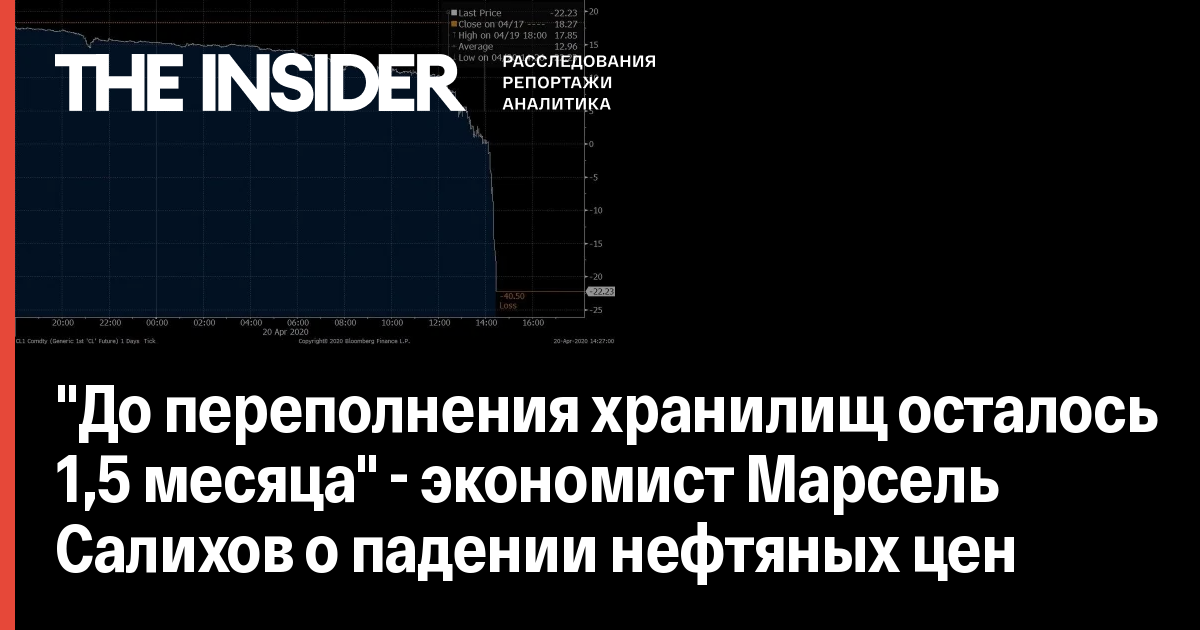
Yesterday, the price of a barrel of Russian oil Urals first dropped below 0. Today, prices returned to positive numbers, but still remain at the level of the 1990s. The head of the Economic Department of the Institute of Energy and Finance, Higher School of Economics, Marseille Salikhov, explained to The Insider, why should not wait for prices in the near future, when a global overflow of storage facilities may come and how Russian companies will survive
Yesterday's situation with negative prices made headlines and surprised everyone, but from the point of view of the volume of contracts, we can say that more attention was focused on this than it was worth it. Nevertheless, this shows the scale of the problems that have accumulated in the industry, and confirms that there is a large excess of oil due to a sharp drop in demand, as well as due to the fact that the proposal reacts quite weakly.
There are two possible scenarios. Either the parties and countries within the framework of OPEC+ and OPEC ++ agree and take some additional steps to reduce the offer, or prices are further reduced and the reduction of production is in a market way, when someone can already “not tolerate this pain” and is forced to close.
The situation with storage facilities is not yet catastrophic. Yesterday's negative prices were associated with certain restrictions in Kushing, the factor was affected that according to the rules of the exchange it is impossible to use all available storages, some changes in the pipeline system that limited the possibility of oil output. This is a very specific story, there is no global overflow of storage facilities, but this can happen in a month and a half. In the United States, according to general data, the storage facilities are 70%, but this is the average temperature in the hospital, because there may be free storage in one place, but there is no prey, and there is prey in another place, but there is no possibility of transportation to the storage.
As for the price of Russian oil Urals, I think that at the current rate we are moving to the $ 10 area for a barrel.
Each market has its own local features. You can see the Brent, WTI differential and they change. Yesterday, the negative prices of everyone surprised everyone and many people in the market seemed that the situation was much harder than it was possible on Friday. Actually, therefore, we are observing today a strong decrease in prices in all varieties. The Urals differential for Brent has not changed today relative to yesterday. Brent sagged strongly and Urals also sagged, but in general this is not a feature of Urals.
The problem is that there are few storage facilities in Russia, they are small and there is no possibility to balance the prey and demand for their expense. In this sense, the situation is more complicated for us than for the United States. It is impossible to say exactly what the level of use of storage facilities, because for the most part they belong to oil companies, and they do not disclose volumes. In Russia there is no normal reporting system, as in the United States. In the United States, energy information management is reporting daily about what is the level of full -scale storage facilities in the country.
But on the other hand, if there are no storage facilities, then there is nothing to fill out. And this means that if demand has fallen and it is impossible to attach oil for export, production must be stopped. The presence of reserves allows you to balance, that is, now you can sharply stop the production, but to ship the oil that cannot be attached to the market in the storage. This gives a certain flexibility. If there are no storage facilities, in the absence of demand, you have to cut prey.
Russian oil companies are partially protected by the tax system. If the average price for a month lasts at $ 10-15, the export duty is reset, the tax on mining is also. For them, it is immediately saving resources. If there are no taxes, everything is determined by the operating cost and cost of transportation. Operating costs at the equipped deposit in Russia are $ 3-4 per barrel and another $ 4-5 for transportation to take from the deposit to the Khanty-Mansi Autonomous Okrug to the consumer. The total expenses are approximately the same.
The companies have other expenses - commercial ones, duty, and so on, but in general, up to $ 10, this is a situation that does not kill the company. The current situation is months, but definitely not until the end of the year. Now is the hardest period, because most countries have been introduced hard restrictions. And the strongest blow to demand - April -May, - and then presumably the situation begins to align. In some countries they are already announcing a reduction in quarantine measures, others will soon follow, and all this will somehow more or less stimulate activity, even if it quickly does not return to levels to coronavirus.