
Translated material
Let's live - see. Sweden continues to study the contradictory consequences of its experiment with quarantine
The “special Swedish approach” is experiencing a crisis to the coronavirus epidemic. The numbers become threatening and reach the first lines of world ratings: according to official figures on April 24, another 131 people per day died from Covid-19, and 2152. In total, the discovered shortcomings of the Swedish approach are realized by local politicians and doctors. It is recognized that medicine was not ready, and the organization of quarantine does not correspond to the level of threat. The main miscalculation is the destruction of strategic military reserves. The writer and journalist Irina Merkina tells how, in these conditions, the Swedish society and the state continues its own “long strategy” in the fight against a deadly threat.
Contrast with Europe
“Do not think that we have already survived the crisis,” said Swedish Prime Minister Stefan Levan to his people at a press conference on April 22. But few doubts this. About 70% of the Swedish population still trust the government and the “special path”, which it chose in the fight against coronavirus, and are ready to follow it as much as necessary.
“We are going to the plateau” - these words are the chief epidemiologist of Sweden Anders Tagnell repeating since the beginning of March. But so far the graphs of diseases and deaths in Sweden do not show this. The number of deceased stepped over 2 thousand, the sick - more than 16 thousand. More than 190 deaths per million inhabitants are the result of Sweden, especially depressing against the background of neighboring countries that fight the epidemic with traditional methods. In Denmark for a million population - 66 dead, in Norway - 35, in Finland - 27.
190 deaths per million inhabitants in Sweden - the result is many times worse than in neighboring countries
The share of tested in Sweden is much less than that of neighbors: 7.4 per 1000 inhabitants. In Norway, about 26 tests are held for 1000 residents, in Denmark - 16. Now in Sweden the number of tests will increase and probably the share of those who died relative to the sick in statistics will decrease (after all, people with symptoms and health workers are mainly tested in Sweden), but the figures on deaths are still too high to consider Sweden as an example.
Does this mean that the special Swedish path of the struggle against coronavirus has led to a dead end?
The essence of this path is to preserve the economy and mental health of the population as much as possible. There is no hard quarantine or emergency, there are kindergartens and schools, people walk freely, go to visit, play sports, restaurants and cafes can serve customers if the distance between the tables is at least two meters. Some enterprises do not work, mass holidays and meetings of more than 50 people are canceled. Senior school and universities switched to distance learning. Since March 18, the entrance to the country for non -citizens and non -residents has been closed. Visits in the nursing homes are prohibited. Those who are in risk groups are recommended not to leave home, the rest - take reasonable precautions.
The media assure that 70% fewer people have become on the streets; Nevertheless, the Swedish cities are a striking contrast compared to the rest of Europe.
The number of deaths from Covid-19 per million people in different countries, starting from the date of the first death. Source - SVT.SE according to the University of Hopkins.“When I leave work, it is amazing me that people live a normal life, as if nothing was happening,” the SVT nurse from the Carolinsk hospital in Stockholm wrote on the Swedish television website. The situation there is the same as everywhere: death, pain, fear, doctors and younger staff. There are still free beds in intensive care, but the hospitals have already received instructions: in case of a shortage of places, do not send patients over 70 years old. Recently, a 40-year-old nurse, infected with coronavirus, died in Carolinsk.
Man or law?
Using the recommendations instead of prohibitions, the Swedish government relyed on the law -abpension of its citizens - and itself demonstrated commitment to the law. “Our constitution guarantees freedom of movement,” explained lawyers of the public health department, “therefore it is not possible to declare a commandant hour without the support of the law.” They decided not to adopt such a law in Sweden, unlike other countries, where there are also constitutions and civil freedoms.
"Our constitution guarantees freedom of movement, so there is no way to declare a commandant hour"
Following the laws and instructions here sometimes takes bizarre forms. Thus, the government refused to purchase protective equipment already ordered by private sponsors in Poland, because they do not comply with Swedish standards - despite the fact that the employees of the institutions for the elderly and disabled people do not even have enough simple masks.
When the epidemic began, some parents stopped letting their children into schools and switched to home schooling. Soon, letters from the school administration began to come to such families. Leaving the child at home, even if he makes lessons and receives estimates from teachers, is a violation of the law on education, for which parents are facing a fine, and the family can be registered in the social service. The National Education Department calls on schools to conduct dialogue with parents and take into account all the circumstances (for example, the presence of people from the risk group in the family), but the law is the law. In a controversial situation, only the court can decide the case.
To the question of the audience of Swedish television, why are the schools of the younger and middle steps, unlike the elders, the healthcare department answered honestly: if you close schools, then people working in vital areas, for example, in hospitals, will remain at home with their children.
Work on mistakes
Mistakes and miscalculations of the “Special Way” are openly criticized and discussed in society, and the authorities correct them as much as possible, but not all. For example, the government considers it correct that after the closure of the borders the country continued to accept thousands of refugees.
Swedish leaders constantly emphasize that the development of “collective immunity”, for which 60–70% of the population should be ill with coronavirus, are only a by -product of the national strategy. Its main task is to protect the older generation. Nevertheless, the Swedish approach suffered the most crushing failure precisely in the nursing homes, and the true scale of this tragedy is difficult to assess.
Not all fatal cases in these institutions fall into statistics, since their inhabitants are not tested on the Covid-19-there are not enough reagents in the country. The problem is complicated by the fact that most of the nursing houses in Sweden are private. Personnel are denied the issuance of protective equipment and tests: according to the instructions, protective equipment should be used only when there is a suspicion of infection. Only in early April, a number of communes (municipal districts) introduced mandatory testing for those who serve the elderly. But this is not happening everywhere. When several patients infected coronavirus and died in one of these institutions, the authorities still refused to test the staff: “It turns out that you are all infected - and who will work then?”
In some communes, they decided not to inform relatives that a virus was discovered in some nursing home. Local leaders refer to the law (yes, again the law!) On confidentiality - they say, they are not obliged to inform strangers about the health status of other patients.
After the number of who died in the nursing homes went hundreds, and Koronavirus was discovered in the third of these institutions, Anders Tegnelle admitted that the elderly in Sweden was “missed”. On April 22, the Minister of Social Support Lena Hallengren announced that everyone who is engaged in caring for the elderly and disabled people will receive disinfectants free of charge. But this will not help many old people.
When Covid was found in 30% of the elderly houses, the chief epidemiologist of Sweden admitted that they "missed" the old people
Swedish medicine, which is considered to be affordable and highly professional, is actually not in the best condition. Even in “peaceful” time, people have been waiting for examinations and operations for months. The course towards saving and optimization led to the fact that every year in the country is closed by hospitals. Today, 10 million people have only 71 emergency assistance (in 1970 there were 115 of them). According to this indicator, Sweden occupies one of the last places in the European Union.
But the main miscalculation of Sweden is the destruction of their strategic reserves prepared in case of emergency. Products, medicines, field hospitals, Ivl devices were sold out or donated to developing countries in the 90s. (Did our restructuring became the cause of our restructuring? Did the Swedes believe that they should no longer be afraid of the attack from the East? Now it’s hard to say now. But the fact is that the neighboring Finland was not so gullible and retained its reserves). As a result, Swedish civilian medicine has only 510 IVL devices and about 50 more for the military.
Thus, the Swedish authorities simply did not have resources for the declaration of quarantine and the fight against the epidemic. They had no choice but recommendations to the population and the strategy of “collective immunity”.
There are many people in the country who are unhappy with a government approach. Cecilia Sodaberg-Jukeler calls the Swedish strategy a risky experiment and indicates fundamental errors in forecasts: for example, that the virus will not go beyond China and that the number of infection in Sweden will fall when the incubation period for infected abroad will end. Similar estimates were made in other countries, and the UK also counted on “national immunity”, but they quickly abandoned this idea. Sweden continues to stand his own.
Stockholm - Open City
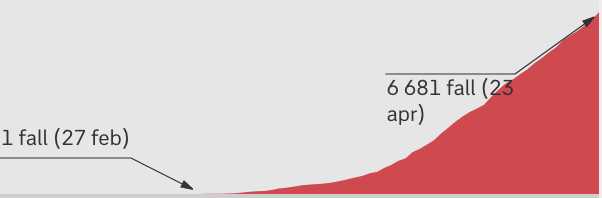
The most difficult situation with the virus is in Stockholm. Today there are more than 6,500 sick and 1128 dead - more than half of all victims of the disease through the country, and there are no trends to a decrease yet. According to the updated forecasts, until May 1, every fourth resident of the city will become infected or already illuminated by Covid-19. This is the highest indicator in the world, and some experts insist that strict quarantine needs to be introduced in the city. The morgues are crowded, and in the associations of cemeteries and crematoriums they consider the opportunity to use industrial grocery refrigerators, although they hope that it will not reach.
The worst of all is the immigrant quarters of the capital. Having renounced, the authorities began to disseminate information about coronavirus and precautions in different languages there, explaining the situation by the fact that many newcomers do not speak in Swedish. But immigrants are settled throughout the country, and it cannot be argued that it is in Stockholm that they create a critical mass that affects statistics. So this factor can hardly be called decisive.
Sweden is a country of villages, villages and quiet provincial towns. There are few real cities here, and Those where life boils is even smaller. Stockholm is the only millionaire among them (about a million people live in the city itself, and with the suburbs - 2.4 million). People freely walk through the streets, shops and cafes, go to work, go in public transport. And many restaurants do not observe precautions, despite the threat of closing. Almost no one wears masks, since this was not recommended ( according to WHO , healthy people should wear a mask only if they provide assistance to a person with suspicion of infection 2019-NCOV).
Questions still remain open - how much Swedish statistics would have changed if it had gone in a traditional way. Would the sick and the dead really be significantly less? Or would the epidemic just last longer? What would happen to other European countries if they followed by Sweden? Although the non -flowering of the Swedes, like other northerners, is somewhat exaggerated, but the social distance between people in the provinces is really greater, which affects the spread of the virus - it is only therefore to automatically transfer its experience in countries, say, southern Europe would be wrong.
An infectious example
The most dangerous in the Swedish approach, or rather, how others see this approach, is an infectious (literally) example (literally). Coronasquarters of all countries appeal to Swedish experience, accusing their authorities of unreasonable twisting of nuts and sabotting quarantine measures. At the same time, most often skeptics perceive the Swedish example vulgarly, presenting it as evidence of the harmlessness of coronavirus and ignoring all examples of recommendations that are more or less observed in disciplined Sweden.
However, among the Swedes there are those who sincerely believe that the Covid-19 is an ordinary flu that needs to be ill in order to gain immunity. So, a member of the city council of one of the communes in the province of Vermland specially went to Stockholm to become infected with coronavirus, and called his colleagues the panicars when, upon returning, they did not allow him to attend the meeting and filed a complaint with the Ombudsman.
Will the curve take out?
It is too early to draw the final conclusions - the Swedish approach can still prove its rationality. Today, most European countries are weakening quarantine, although the epidemic is far from the end: the economy does not withstand such a long locaun. At the same time, experts warn of the second wave of the disease, possibly even more terrible. Sweden is not going to cancel its few restrictive measures over the next months. “We have chosen a strategy that people can endure for a long time,” said Anders Tegnell.
Thus, the incidence curve here will be possible relatively high, but smooth, without sharp bursts, the epidemic will not require radical measures, and the economy will not suffer as much as in other countries.
“I feel that our strategy is true,” says Prime Minister Stefan Lyven. “But we will understand who was right, only after the crisis.”
This has its own reason. Although after the crisis it will be more important than anyone was right, and who survived.