
Translated material
The rebellious Middle Ages. Why are the Orthodox radicals hung up on the Patriarch and the President
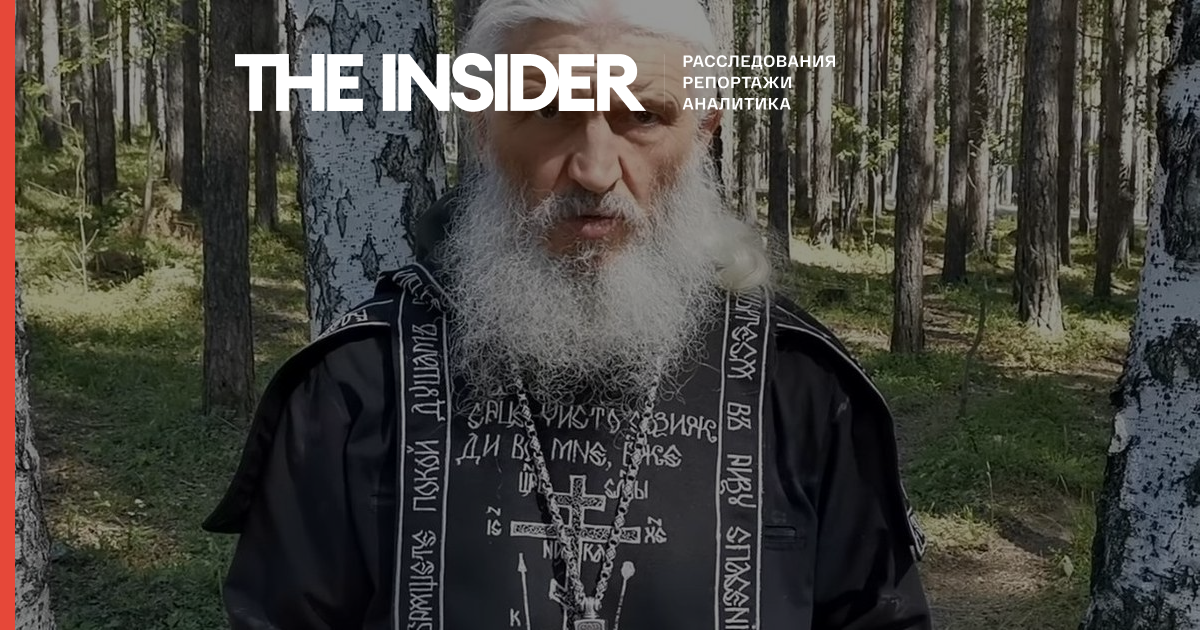
On July 12, the science of the Sergius, who captured the Central Monastery, who seized the Middle Urish monastery, in his next video demanded from Vladimir Putin to temporarily lay down the presidential powers and transfer them to him. In case of refusal, the priest threatened to begin the "full -scale spiritual war." Previously, he also demanded that Patriarch Kirill free up the place of the Primate of the Russian Orthodox Church. The struggle against the rebellious abbot is being waged by both the state and the church. The Upper Pyshma court for the denial of the Covid-19 already found Father Sergius guilty of the distribution of obviously inaccurate information and fined it 90 thousand rubles. The Church Court of the Yekaterinburg diocese deprived the scheme of San for the videos on YouTube so that the decision to enter into force only the signature of the Patriarch. The biblicalist and religious scholar Andrei Desnitsky explains why the most conservative part of the Orthodox Church rebelled against Patriarch Kirill and how the Russian Orthodox Church turned out to be the hostage of the atmosphere that she herself created.
The access to the media space Sergius Romanov was a complete surprise for many. Until now, people have heard at best: there is somewhere in the Urals a certain conservative priest, admirer of the deceased emperor, Poklonskaya still went to him when he was passionate about it. The sovereign, conservative, guardian - there are many of them in any monastery. They also knew that he “reports the possessed”, even, they say, helps some.
And here, it turns out, he pronounces fiery sermons against the patriarch and state power. And suddenly a completely scandalous circumstance surfaced: it turns out, before becoming a priest, he served more than ten years for murder (which, from a strictly canonical point of view, forever deprived him of the opportunity to be a priest). Moreover, in the monastery there is a children's shelter, the orders in which, to put it mildly, resemble orders in the zone ... Where does this come from?
Reference
Sergius (Nikolai Romanov) was born on March 19, 1955 in the village of Kriush, the Voznesensky district of the Gorky region. He served in the army in the rank of sergeant in 1973-1975. He received a legal education and worked in the police. 1984-1985 was the culprit of an accident that led to the death of a person, and was fired from the police. According to the court’s sentence, at that time he worked as the seller of the food store in Moscow, in the same years he made the theft of state property. During the trial on August 9, 1985, he appeared with a confession to the prosecutor's office of the city of Dmitrov, the Moscow Region, confessing to the murder of murder with aggravating circumstances committed in April 1984. In November 1986, according to the totality of crimes, he was convicted by the Moscow Regional Court of 13 years with serving a sentence in the Nizhny Tagil IK-13 “Red Duck”, where he was until 1997.
And for those who are familiar with the life of domestic monasteries, there is absolutely nothing sensational. Priests and monks with similar moods are found in abundance, and that that splashes Sergius on the Internet, now and then sounds, albeit quietly, in private conversations somewhere in the refectory. It’s just that now these moods have someone to express loudly and clearly.
When in the nineties “one hundred flowers bloomed”, it became clear that a considerable number of Orthodox were carried away by the reconstructive game in the Holy Middle Ages. Among the characteristic signs of reconstructors are unconditional obedience to the chosen old man-priest, worshiping the last emperor with his family as a special understanding for Russia (“tsarboyers”), the denial of the whole new and the fears that the state will impose a digital concentration camp to us, which will take advantage of the Antichrist (especially brightly manifested in the case of replacing passports and the introduction of Inn). And I must say that both the state and the church authorities tried not to annoy those once again: for example, it was allowed not to receive the TIN, many believers are so without it.
Many Orthodox were carried away by the reconstructive game in the Holy Middle Ages
Apparently, these are people of a special psychological warehouse: they need to be on the side of the unconditional and unambiguous good, they need clear indestructible rules and absolute authorities. In the stormy nineties, all this could be found almost exclusively in the church, especially in monasteries. And the church priesthood did not mind, seeing in these people even the inert, but exceptionally faithful and obedient followers. Many priests were one way or another punished by their superiors for minor offenses or for saying a non -standard opinion, but almost always these punishments poured on those who were “on the left”: just on the pro -Western and conditionally liberal Orthodox.
And this conservative wing was emphasized loyal to church and state institutions, with rare exceptions like Bishop Diomid Dziuban (went into a split in 2008). But this loyalty was far from absolute and unconditional. In the picture of the world of such people, one of the main values is a strong Orthodox Russia, the continuation of the centuries -old empire in its age -old confrontation with the corrupted West. And everything that at least remotely resembled the movement towards this ideal was approved by them. The objections caused mainly the ecumenical contacts of church hierarchs with the West (with heretics, in the language of these people), but they did not cause much irritation, since they were superficial and episodic.
What happened, where did such changes come from? The main event, of course, was the pandemic and especially - the ban on gather in temples for prayer in connection with quarantine measures. In a standard monastery, he was simply more or less clearly ignored. And very rarely one could find an understanding of the need for such measures. Until now, the answer to almost any question from the conservative believers was "and you often go to the temple, pray, proceed to the sacraments." In response to any claims to state power, one could hear: "But they do not interfere with us to pray, and what else is needed for salvation?"
And the temple prayer, in fact, was banned, and even on Easter. How they began to say in amazement in those same refectory and corridors: “Neither the Bolsheviks nor the Nazis managed to close the temples on Easter, but these were able, antichrist!” Maybe this logic will seem naive to someone. But where it is about the highest and eternal values, naivety is another name for honesty and fundamental. Of course, fatigue from the fall of living standards, pension reform and all kinds of other actions of the authorities, in which tyranny more than the desired paternalism, played a role. But it was precisely the doors of the cathedrals, locked for believers on Easter - and then all other claims against secular and church authorities were remembered at the same time.
“Neither the Bolsheviks nor the Nazis managed to close the temples on Easter, but these were able, antichrist!”
Church authorities are completely not ready for such a confrontation, as, indeed, secular. Radical conservatives have always looked like a regime support. And now? Take the monastery storm? But church institutions actually enjoyed extraterritoriality, with rare exceptions, much more serious violations were ignored than the preaching of rebellious Sergius. So, at the end of the two thousandth years of the public, she learned about the children's shelter in the Bogolyubsky monastery in the Vladimir region, where children were also regularly fought for a lack of piety. Moreover, they learned from the girl who escaped from the shelter. And what? The abbess was removed, and the confessor of the monastery of Peter (Kucher) was sent to rest (to retire). Until his death in June of this year, he lived in the same monastery and remained an informal, but deeply revered confessor and one of the main ideologists of the conservative wing of Orthodoxy.
And the shelter was simply closed. It is unnecessary to remind that in any orphanage or summer camp, teachers would have received considerable terms for such a treatment with children. In the end, adults are responsible for themselves and if they decided to hide from the world and wait for the soon arrival of the Antichrist, this is their choice. But why do children's shelters arise in such monasteries? It is clear that this is an imitation of the state of affairs in the good old empire, where the monasteries were engaged in "the prosecution of orphans and miserable" simply because there was no one else to do this.
This question is ideological. In the picture of the world, which is professed by radical Orthodox conservatives, there is, in fact, the only saving lifestyle - monasticism. But when a monk becomes an adult, burdened with a load of sins and past habits, it is difficult for him to achieve holiness. It is much more convenient to raise children according to a monastic model from a young age, but where to do this, if not in a monastery? Every pedagogy and the rights of the child is unnecessary there, it is necessary to be guided by the creations of the Holy Fathers, and the most reliable methods of education are grandfather. And if the child does not accept the monastic future, in him a demon, and do not wait for mercy here. I would very much like the story with Sergius to become a reason for revising this phenomenon itself: children's shelters in monasteries. They really should definitely be deprived of an informal status of extraterritoriality. Or maybe completely close. The temptation is too great!
And what to do with everything else is not very clear. Power - both church and secular - so long and diligently convinced us all that patriotism and conservatism are not only our glorious past, but also a bright future, and now they do not know how to answer those who privatized patriotism and conservatism. And you have to answer. On the official website of the diocese, an open letter was published as a rebellious Sergius from his bishop, Metropolitan Cyril - an unprecedented business! Previously, the bishops talked with objectionable clerians exclusively privately, or even reported on their disgrace decrees, without explaining its motives. This letter says a lot of true, but the situation itself is described as a result of the bad nature of Sergius itself. But the problem is systemic.
This paragraph is especially impressive: “As an Apostolic successor and in the Yekaterinburg diocese, the immediate source of the Church of the Church, I ... should not explain my reluctance to delegate this power to you, even for the only reason that you are in my obedience, and not me in yours.”
The answer followed immediately, and was quite predictable: Metropolitan Cyril was accused of heresy, and if so, he should not be any obedience. And all the media circled the news that Sergius now demands to transfer the presidential powers to him and promises to restore order of three days. Whatever you say, and the most sticky drug is power, especially the power over the souls ...
This is a typical Russian conflict between the non-bending system, which requires primarily loyalty, and a single charismatus that refuses loyalty due to absolute values. The system is confused. She suspects that a certain number of adherents can follow this loner (and they are, and among the elites too). Orders do not apply, force compulsory obedience will look too scandalous, but the system has been unlearned for a long time to explain and convince.
With a good scenario, one can hope for the gradual return of the atmosphere of intellectual freedom, search and diversity to the Russian Orthodox Church (they were in perestroika and in the early nineties). A bad scenario can be a full split. The semantic split between the conditional liberals and the conventional conservatives (and in fact, there are more than two such groups), in fact, has already occurred, but so far it has not been organized. People who go to Orthodox churches have quite different and sometimes incompatible ideas about faith and God, but so far any groups that declare themselves alternative Orthodox jurisdictions are extremely small and subjected to strict pressure from secular authorities. It is possible that the story with Sergius can change this picture.