
Translated material
The arc of stability vs arc of resistance. How is the Israeli agreement with the UAE and Bahrain can change the Middle East

The arc of stability vs arc of resistance. How is the Israeli agreement with the UAE and Bahrain can change the Middle East
22 September 2020Alexander Shumilin
Political scientist, head of the Center "Europe-Shortia East"
Saudi Arabia made an official statement about a possible peace treaty with Israel: full -fledged connections between the two states are possible only with a peaceful resolution of the Palestinian issue. A week ago, on September 15, the Israeli Prime Minister Benjamin Netanyahu signed two historical documents on the White House lawn - a peace treaty with the united Arab Emirates (UAE) and a declaration of peace with the Kingdom of Bahrain. Then Donald Trump said that now Saudi Arabia is in line. Orientalist, Director of the Center for the “European East”, Alexander Shumilin, believes that if these monarchies, along with Israel, can withstand the policy of expansion, which is carried out by Turkey and Iran, then in the foreseeable future we can hope for the formation of a new Middle East.
According to the covenants of Abraham
A week after Israel signed a peace treaty with the UAE and the declaration of peace with the Kingdom of Bahrain, it became clear that not only these monarchies, but also the Arab world as a whole, had matured to make responsible strategic decisions that will form a new Middle East. Donald Trump assured fateful documents with his signature. The signing procedure was almost a copy of the truly breakthrough that took place in the same place 41 years ago: then President Jimmy Carter put his signature under the Camp-David agreements of Egypt's leaders (Anvara Sadat) and Israel (Menachem Begin). Like the Carter in 1979, Trump today reinforces the political agreement and the military component: in particular, it does not exclude the supply of the latest F-35 fighters to these Middle Eastern countries.
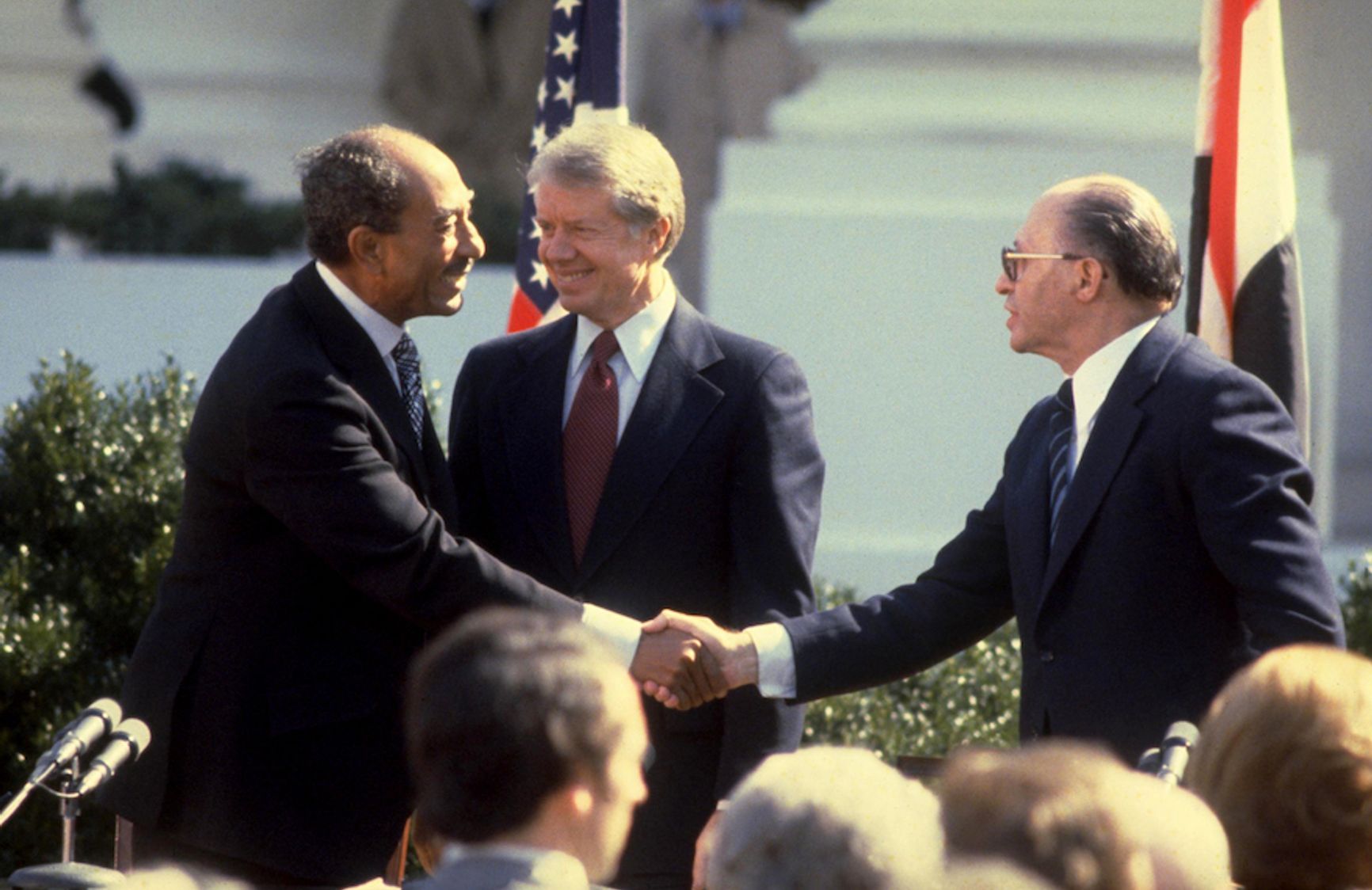
US President Jimmy Carter, Egyptian leader Anvar Sadat and Israel Menacham Begin after signing the Camp-David Agreement on March 26, 1979
The first attempt to normalize relations between Egypt and Israel in 1979 caused condemnation and even angry rejection by most Arab countries: in protest, they excluded Egypt from the League of the Arab states (lag), and the very regional organization was moved from Cairo to Tunisia. It was returned back to the Egyptian capital only in 1991. It was then, I recall, the “storm in the desert” erupted - an international military operation to expel Iraq from Kuwait occupied by him.
The events around the Irako-Kuwait conflict (1990-1991) became a turning point-they seemed to open the eyes of the Arab elites that most of their problems and shocks are not associated with Israel, but with more deep socio-political and religious splits in the region. It became clear that the Soviet Union was not ready, as before, to stand a mountain for its radical clients, such as Saddam Hussein, Hafiz Assad or Muammar Gaddafi. Hence the desire of responsible Arab politicians who indicated in the 90s to create the architecture of the new Middle East, for which it was necessary to turn the page of the Arab-Israeli confrontation. In 1994, the world with Israel concluded Jordan. And in 2002, the general Arab (initially Saudi) peaceful initiative, based on the principle of “two states for two peoples”, was born. She became the first manifestation of the realistic approach of the lag: the goal was proclaimed to create a Palestinian state not instead of Israel, but next to it. On this principle, the current position of the UAE and Bahrain, entering the era of the world with Israel, is also based: the most important condition for the agreements of the Government of Netanyahu from the annexation of part of the territory of the western bank of the Jordan River.
Most of the problems and shocks of the Arab countries are not associated with Israel, but with deep splitting in the region
True, the leadership of the Palestinian autonomy, not to mention the extremist grouping of Hamas, who seized power in the gas sector, consider the position of Abu Dhabi and Manama insufficient pressure on Israel and even almost a betrayal of the “Palestinian struggle”. However, their attempts to revive the policy of the boycott of their “Arab brothers”, as was the case with Egypt from 1979 to 1989, this time failed: on September 10, the Foreign Minister of the Member countries Lag rejected the request of the Palestinians to condemn the peace treaty of the UAE with Israel. “The discussion of this issue was serious and comprehensive, it took time. But we were not able to reach an agreement on the text of the resolution proposed by the Palestinians, ”the assistant Secretary of the Secretary General Lag Husam Zaki told Al-Jazir. Something unique happened: the Palestinians were in isolation in the lag.
At the same time, the number of countries who want to follow in the footsteps of the UAE began to grow: on the eve of the ceremony in the White House on September 15, Bahrain's leadership was about to join it. Donald Trump, presenting what was happening as his personal victory, announced the “queue” of the Arab countries, ready to begin to create a new security architecture in the region. Among these, Saudi Arabia is also mentioned, whose leadership does not deny the opportunity to arrange a peaceful relationship with Israel.
First of all, we are talking about the block of countries of the Arab conservative community (Saudi Arabia, Kuwait, Oman, the UAE, Qatar, Bahrain), which, due to tradition and inertia, delayed the normalization of relations with Israel longer. Rushing this vicious circle, the UAE and Bahrain took a step that will undoubtedly affect the military-political situation in the Middle East and especially in the Persian Gulf. Despite the breakthrough, the situation in the region, of course, will not become more calm in the foreseeable future, but many political processes will proceed according to other rules. As the signatures are expressed, according to the “covenants of Abraham” - the forefather of all Semitic tribes. Such, by the way, do not belong to the Persians (Iranians) and the Turks. It is no coincidence that the process of establishing peace between Israel and the Arab countries was called the “Agreement of Abraham” - “Abraham Treaty”.
Why Bahrain and the UAE?
On the one hand, Bahrain and the UAE are the same monarchies as their Arab neighbors, with the prevalence of the same interpretation of the Sunni doctrine of Islam (except for Qatar, whose leadership respects the ideology of the Muslim Brothers), with the economy, built mainly on hydrocarbon export. And on the other hand, the UAE and Bahrain have a long-standing (since the beginning of the 70s) constitutional traditions that created systems for coordinating the interests of various layers of society while maintaining the privileged positions of the ruling clans in them (the UAE, we note, the federation of seven equal principalities). Another difference from neighbors is the betting of both monarchies leadership on economic modernization in combination with the preservation of national and religious customs. These countries were the first in the region to open for foreign tourism. Abu Dhabi and Manama became prestigious sites for holding the largest international forums. Sea and air ports of countries have become important transport hubs between Asia, Africa and Europe. Western companies, specialists and experts with their advanced technologies and experience have long been actively working in Abu Dabi, Dubai and Manam.
For decades to maintain the effectiveness of “islands of modernization”, a special socio-psychological atmosphere has developed in these two monarchies, in which foreigners allowed the usual way of life (in the western, liberal style), but so that this did not undermine the foundations of traditionalist society. In fact, we are talking about the coexistence of two civilizational spaces, which is unthinkable in other monarchies of the bay. The population of the UAE and Bahrain is impregnated with the spirit of tolerance: despite the fact that Islam remains an important cultural-forming element, it is not confessed in strict forms and is not considered the only norm that determines the everyday life of citizens.
For many years, inter-religious forums have been held in Abu Dhabi and Manam, in which representatives of Islam, Christianity, Judaism and Buddhism are discussing the problems common to all people in the refraction of the corresponding religious dogma. Each of these two countries has its own special religious landscape: if in the UAE it is created by a numerical predominance of the Muslims-Sunnis, in the Kingdom of Bahrain, most of the Shiite, on the contrary. In addition, for centuries, the Jewish community has been living there for centuries.
In the UAE and the Kingdom of Bahrain, two civilizational spaces coexist, which is unthinkable in other monarchies of the bay
We can say that the state and public systems based on the postulates of moderate Islam in the UAE and in the Kingdom of Bahrain began to represent a special inter -civilizational phenomenon. It is not surprising that this example causes the rejection of fundamentalists in the region. And their geographical proximity to Iran makes itself felt: the conspiracies of the Iranian special services are periodically revealed on the island. Note that many in Tehran consider this country as the historical part of Iran.
Why right now?
Contacts between Israel and the monarchies have been taking place for many years, but there have been no breakthroughs for several decades. What has changed now? Among the fundamental factors is the aggravation of the Sunni-Shiite confrontation in connection with conflicts in Syria and Yemen, bursts of unrest in Iraq and Lebanon. All this is a direct result of the activation of the expansionist policy of Iran in the region. The Turkish leadership is also actively trying to recreate the influence within the former Ottoman Empire, which is expressed in politics in relation to Syria and Libya, which are perceived by Arab monarchies as hostile. Simply put, Iran and Türkiye expand the presence in the Arab space, and, to the detriment of the Arabic community. All this put the monarchies in a difficult position and forced to proceed to de facto coordination and partial interaction in military terms with Israel, the most powerful state of the state in the region.
The medium -term factors are associated with the conclusion in 2015 by permanent members of the UN Security Council and Germany of the “nuclear transaction” with Iran, as well as with the policy of the Trump administration to disrupt this transaction. The monarchies and Israel are outraged by the fact that the agreements with Iran were reached without coordination with them, and they themselves are afraid to become the first victims of the “excessive complacency” of the Western countries, Russia and China regarding Tehran. The bay has no doubt: the strengthening of Iran’s aggressiveness is a direct consequence of this transaction. The fears of the Middle Eastern partners of the United States, that after the election of November 3, Washington’s position may return to the time of Obama (one of the main initiators of the transaction), pushes them to the design of the relations that already have already developed. From the very beginning, diplomacy of the Trump administration was also aimed at such an outcome, for which the fact of signing agreements on September 15 becomes a significant bonus on the eve of the elections.
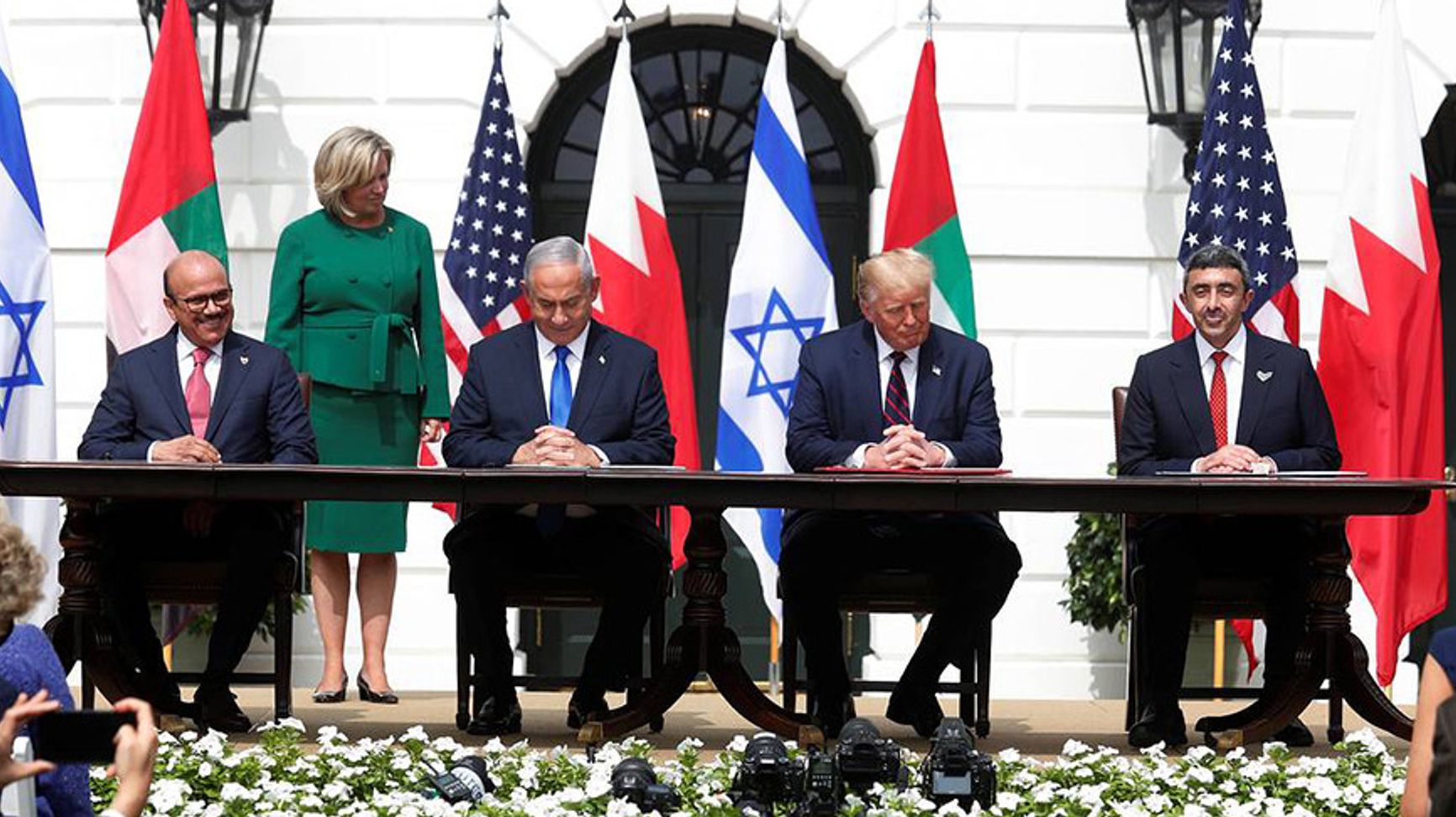
The signing ceremony of "Abraham Agreements" in the White House on September 15, 2020
Finally, the factors are direct. Firstly, the presentation of Trump Plan of the Palestinian-Israeli settlement (“Transaction of the Century”), in general, was positively perceived by the Middle Eastern partners of the United States. Secondly, the threat of Benjamin Netanyahu annexate part of the West Coast, which according to this plan should go to Israel. And thirdly, the attempts of monarchies urgently prevent this annexation, which, according to the leadership of the UAE, will make it impossible to further converge the monarchies with Israel. The fee for the “abstinence” of Netanyahu from the annexation was agreements with the UAE and Bahrain.
As a result, the consensus of the interests of the Arab countries, Israel and the United States, which can change the current military-political trends in the Middle Eastern fields, took shape. Participants in the agreements claim that the “arc of stability” is created in the region - this term should become an antipode introduced by Tehran the concept of “arc of resistance”. The Iranian leadership attributes the zones of its expanding influence to the latter - Shiite communities in Iraq, Lebanon, the Palestinian group of Hamas, and now Syria. Together with Israel, the Arabs intend to restrain the expansionist appetites of Tehran. And at the same time, demonstrate muscles to Ankara. While there is a stronger Tayyip Erdogan in power.