
Translated material
Will Biden make America “normal” again? By the way, how is it?
To answer these questions, Maxim Trustlyubov turned to the history of the United States - and advises books that will help to better understand it
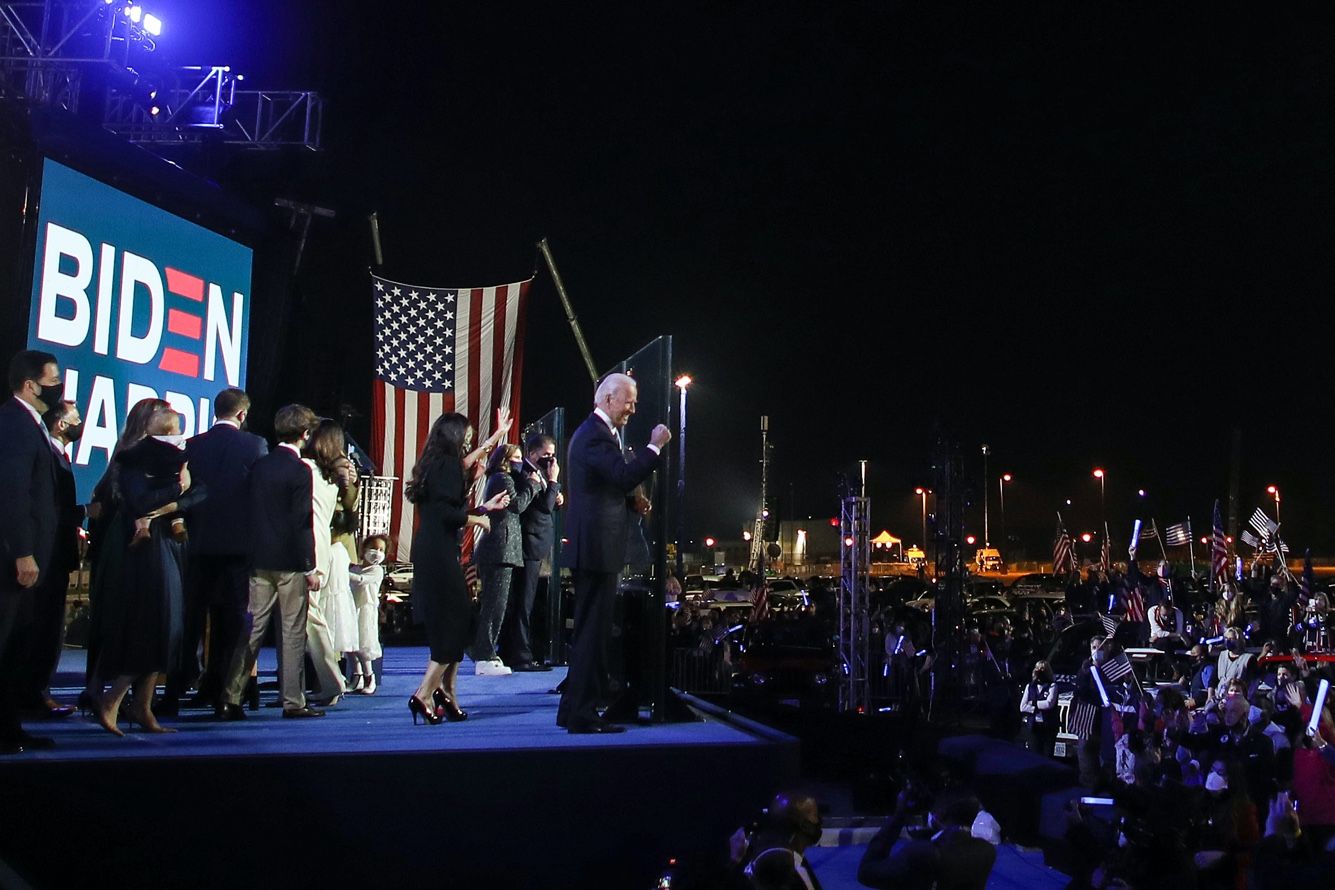
In the United States, in connection with the current painful election campaign, the word "normality" constantly sounds. Joe Biden promises to return it to American politics, obviously means by this that the United States with him will become the same as they were before Donald Trump. Biden’s opponents, on the contrary, are frightened by the fact that he will take their familiar “normality” of an exclusive power from the Americans. In fact, this word is not at all as vague as it might seem. It is simply historically that it has two opposite values. The Columnist The New York Times, the editor of The Russia File and Medusa Maxim Trudovyubov explains what laws the American foreign policy has been developing in the last hundred years - and advises books that will help to better understand these laws.
The word "normality" - in the form of Normalcy, not Normality - entered the American politician exactly a hundred years ago, during the 1920 presidential campaign. Prior to this, Normalcy was rarely used, the word Normality was generally accepted. Republican Senator Warren Harding, who made a “return to normality” by his pre-election slogan, contrasted himself with the departing president-democrat Woodlon Wilson.
Wilson led the United States from 1913 to 1921, and his presidency was saturated with the events of international politics. Under Wilson, America entered the world arena, participated in the First World War, intervened in the civil war in Russia and - with the formation of the League of Nations - promised to become one of the leaders of the post -war world.
"Normality" of non -interference
Harding said : “It is time to stop, calm in internal life is more important than the world abroad ... Now America needs not heroism, but a cure; not false panacea, but normality; Not a revolution, but a restoration; not surgical intervention, but peace; Not interference in international conflicts, but immersion in a triumphal national policy. ”
Harding guessed the mood of voters, everyone really liked his “normality” - and he ahead of his opponent, democrat James Cox, having won one of the most convincing victories in the history of the American elections. Wilson considered those elections as a “referendum” about the League of Nations - and lost it.
It was in the dispute about the League of Nations Normality that the United States’s reluctance was determined to assume contractual obligations in relation to partners in the world. Article 10 of the Charter of the League of Nations obliged the participating countries to protect each other's territorial integrity and caused the greatest rejection in the American elite. The United States never became a member of the League, although Wilson was its inspirer and received the Nobel Prize of the world for this.
It was the isolationist political tradition for four years that President Donald Trump represented, who chose the slogan “America, first of all!”.
Where did this slogan come from?
The history of the slogan "America is primarily!" (American First) is such that you can understand why Trump's campaign did not advertise it. This phrase was used by early Wilson, then the same Harding in his 1920 campaign, but it is mainly known as the name of the Committee, which opposed the US entry into the Second World War. The representative of the America Committee, first of all,, the tough isolationist Charles Lindberg, after the beginning of the Second World War, opposed the law on Lend-Lisa, called for neutrality with Germany and said that American society should resist the calls to the war because they come from the Jewish lobby in the United States.
So, reasoning historically, the “return to normality” in the United States was supposed to happen - well, or it has already happened - it was under Trump. Judge for yourself. Trump managed to withdraw the country out of the Paris Climate Agreement , the Transstoocian Partnership , the Treaty of the Iranian Nuclear Program, from the UNESCO, from the UN Human Rights Council , as well as from the agreement on the elimination of medium and lower -range missiles with Russia. Next in line were the World Health Organization (WHO) and, possibly, the World Trade Organization (WTO).
"Normality" of intervention
But if you look from Europe, and through the eyes of the Center Elite of Western Europe and many (but not all) politicians of Central Europe, Trump's presidency is just a political “anomaly”, and a return to normality means something opposite to its course. Namely - the restoration of reliable ties between NATO and the European Union on the one hand, and the United States on the other. The “normal” USA for them is an interventionist power, ready to protect the status quo, understandable to the centrist European forces.
These expectations include a tough American position in relation to the Kremlin both in connection with Ukraine and in connection with the observance of human rights in Russia itself. From America, Biden in Europe is waiting for confirmation of the unambiguous role of the United States as a guarantor of international order. In this case, the order is understood in the form that has developed, very relatively speaking, by the second term by George Bush - the youngest or by the beginning of the first term of Barack Obama (that is, we are talking about the second half of the zero). This is the world until a sharp deterioration in relations with Russia, before the migration crisis in Europe, to strengthening the populists, to the beginning of the gradual exit of the United States from international conflicts, contracts and organizations.
Such an idea of normality arises from another historical optics and is based on contractual obligations taken by the States after the Second World War. Key remains in force even after Trump. First of all, these are the obligations determined by Article 5 of the NATO Charter , which says that the attack on one of the alliance members is considered as an attack on all its members. Before joining NATO, America became one of the founders of the UN and a member of the Security Council of this organization.
Harding normality, like all American isolationists, was to return from the frightening world to the good old America, not to take on any obligations towards other countries and "plunge into triumphal national policy." A newer understanding of the “normality” is mirrored opposite to the original.
"Normality" of life without norm
The restoration of any of the "Norms" - that the pre -war, to which Trump was striving, that the post -war, to which Biden seems to be promising to return, seems to be difficult. Of course, if the Trump administration was more radical and capable, the United States could further advance towards the exit from everywhere, where possible.
Decisions of this level, and even made by the presidential decrees -, in fact, the stroke of the pen - are disturbed by a huge number of states and large corporations around the world. Of course, I do not hint at any direct interference in the American elections by some mysterious forces, but I state that there are large players who are not interested in the withdrawal of their countries from the most important international agreements inside. That is why Biden, who is configured to business less friendly than Trump, receives significant support from the business community.
But the US returning to the post -war “normality” with the advent of Bayden also does not have to wait. He will probably stop the country's exit from WHO, extend the agreement on strategic offensive weapons with Russia (START-III), will partially be able to return the United States to international organizations and contracts, but will be limited in its capabilities. Due to the deepest polarization of the American elite and society as a whole, Biden will be a weakened president. Republicans, having all the chances of maintaining control of the Senate, will repair the democratic administration all possible obstacles. It is possible that measures to discredit the political system of the United States, which will take Trump even after its defeat, will also affect the effectiveness of the new government.
This, however, is also nothing new. “Normality”, whatever it may be, has always encountered the real practice of international relations. Soon after President Harding first proclaimed her, the United States joined sanctions against aggressors in the 1930s and 1940s.
In fact, few people in the world like that American politics is subordinated exclusively by domestic dynamics. Indeed, because of this, the US authorities are prone to unilateral actions-then to interventionist (when everyone is against war), then, on the contrary, to isolationist (when everyone is waiting for intervention). But this behavior is based not only on the possession of rough power. Actually, it is so in demand in the United States, as it helps to ensure “American exclusivity” - an idea that built the political culture of this country. The principle of unilateral actions that arose from here has repeatedly conflicts the USA with the world community and brought a lot of problems to everyone.
Republicans, as a rule, are more “one -sided”, and democrats with a little more readiness go to multilateral agreements. But to expect predictability from the United States in international affairs is difficult in any government. That is why at least membership in international organizations (see about American double standards in the description of the book of Michael Ignatiev below) and contracts so valuable from the point of view of US partners.
What to read about it
Mallon T. How The Promise of Normalcy Won The20 Election // New Yorker. September 14, 2020
American society, polarized and tired of the turbulent presidency, experiences a difficult epidemic and dreams of returning to “normality” - this is not about today, but about what happened exactly a hundred years ago, writer and publicist Thomas Mallon writes in a fascinating essay for The New Yorker. He analyzes in detail the appearance in the American political language of the word "normality" and analyzes parallels with the current USA.
American Exceptionalism and Human Rights. Michael ignatieff, ed. New York: Princeton University Press, 2005
The Canadian politician and publicist Michael Ignatiev (a descendant of the Russian count of Ignatievs) so summarizes the consequences of the doctrine of exclusivity in the political behavior of the United States. Firstly, the United States, even concluding international agreements, often do not ratify them or, under various pretexts, free themselves from their action. Secondly, in the United States, in fact, double standards are institutionalized: American organizations, as a rule, judge opponents more strictly than themselves and their partners. Thirdly, the United States supports jurisdictional isolationism: they rely only on their laws, willingly extend their effects outside the country and prevents the exhibit of other people's jurisdictions to their own citizens and the company.
Lipset SM American Exceptionalism a Double Edged Sword. New York: ww Norton Company, 1996
In this classical book about the concept of American exclusivity, one of the leading sociologists of the twentieth century Seymour Martin Lipset considers “Americanism” as a special ideology, and American society as a society built at a certain set of ideological principles, which fundamentally distinguishes the United States from countries that have been rooted in national history and national culture.
Maxim Trustlyubov