
Translated material
"Poverty and snobbery"
"This is superficial - to interpret me as a Petersburger."
Nikolai Komjagin in an interview with "dog"
During the New Year holidays in Vyborg (Leningrad Region), the festival "What is happening at the factory of children's strollers?" - showed art in the former building of the plant (children's strollers). It was built in 1937 according to the project of the Finnish architect Aarne Ervi - Vyborg then was part of Finland. Now there is a shopping center, but there are no boutiques yet, but there is a gallery on the ground floor-“Art League”, a division of St. Petersburg “Pushkinskaya, 10” . The festival promised to comprehend the topic of childhood, to say something secret in the actual intonation.
I do not really trust the “Pushkin”, but the idea to work out the memory of the place-the former production tied to the topic of childhood-seemed brilliant. The ideal hit in the benevolent infantility of peers and fashion for locality (and constructivism).
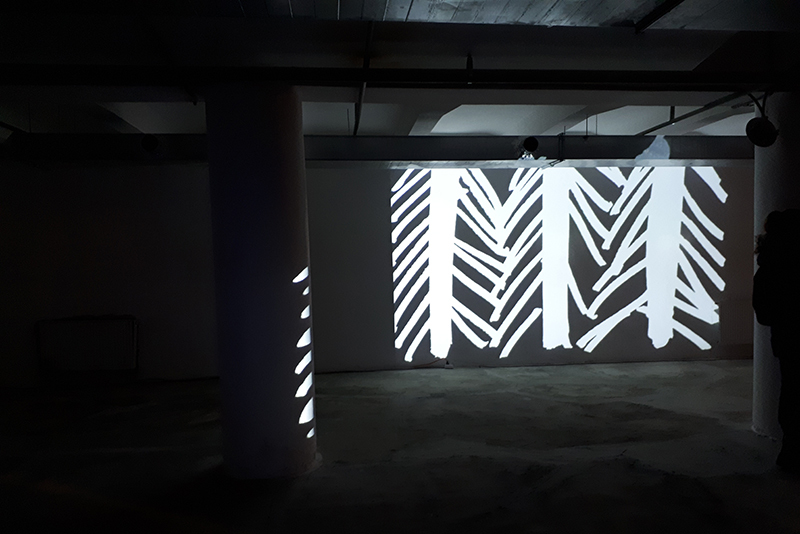
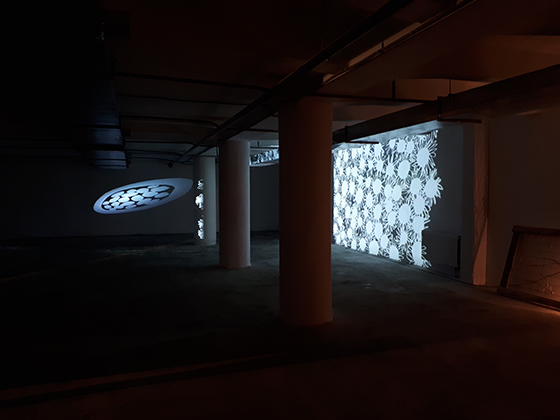
The organizers did not fall into the formats that suggest in the trading complex of the district center: this is not a quest for the whole family, not a glossy gallery between Calzedonia and Zara . There were penetrating, pleasant things - for example, the “alternating landscape” of Marina Kolneskaya. The installation successfully occupied a non -combined, dark, empty nook. Exclusion promised to convey the sensations of rain, clouds, fog with simple light drawings “to the meditative sounds of ethnic instruments”.
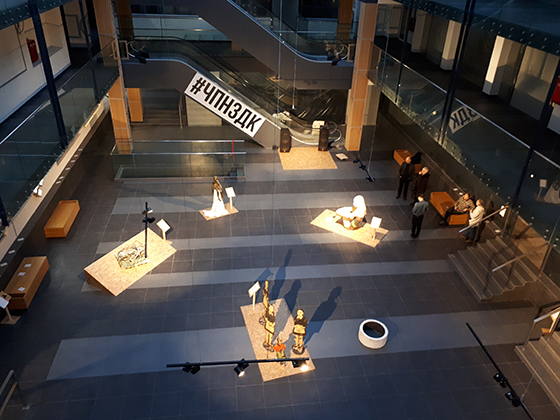 © Anastasia Semenovich
They hooked me, and did not sound an ethnic. Shazam confirmed the suspicions - it was The Package a Perfect Circle - a group that will improve any installation in my picture of the world. It is not dishonest to set their tracks in the gallery, I think. Maybe this simple manipulation worked, but the landscape, in my opinion , is simpler and thinner than most of the works. While the projections are crawling along the walls, you will cover you with flashbacks: here you and your mother are walking in small rain, you are on rubber boots, and the world is placed under the edge of your mother’s umbrella and a hood of raincoat - dense polyethylene in large red berries. Here you are being taken on a sled, the mitten is dragged through the trampled snow, but you don’t think about it - you look at the sky, there is the winter magic of snow and stars. In the same hall - the “water lilies” of Peter Bely, concrete slapping on a thin grid in a reference light. Also a simple and shoal image - a crooked and a sincere children. Obviously, this is the most careless part of the exposition - but I liked the most.
Because in the halls with painting, fixation on the topic of childhood did not work in favor of the viewer: a lot of work, attracted by formal basis - “about children”. Sleeping kids, pioneers - all in the average academic intonation (the worst possible). But childhood is a more complex substance. Compositions with children broadcast a concept from which we have long been tired. That the child is an unamitable “sweet” creature, which still needs to be grown before the “person”.
 © Anastasia Semenovich
As a result, the project looks undemanded: there is a non -reflective, craft and emphasized “adult” look with “compositions about children” and abstract in form, honestly obtained in the inner world of things. The latter are more like immersion in the topic, but they look unpresentable. At the same time, in St. Petersburg there was an exhibition of Tanya Raush -with a cool, but real, air sensation of childhood. Her painting wants to give a context like a factory of baby strollers. But we were distracted - two projects were successfully mixed in my head in one impression, but I want to talk about something else.
About how good it would be to raise the bar - so that every thing appears in the exposition meaningfully, without “filling out space” out of fear that will be “empty”. Lee Bul in the St. Petersburg arena trusted in the air - she works with him through architecture, like a raus in painting. And the exposure breathes, the meaning is crystallized. The problem is that the laconicism of the form, air and unwillingness to make the attraction from the project are read as poverty and poor -quality work. Why?
I will make a reservation right away - I mainly look and write about Petersburg. And, on the one hand, there is the “Poor Petersburg” genre, which implies, say, in the spirit of “Poster”, punk-minimalism. There is no money, but we are talented, and we have fun. On the other hand, this poverty is accepted, rather, ashamed. See how in Moscow - they smiled, improved, brought, advertisements in each browser tab. This is the quality!
 © Anastasia Semenovich Nikolay Bogomolov. Courtyard. Printing of the author
But this is just money. For specialists, purchases, advertising. And here we are envious and complex in swamps: after all, we also have complaints about the “capital”. Therefore, it does not particularly go panking, there is no fun. There are ideas, dull and incompletely realized. Flegma broadcasting about the "cultural capital." Elibating equal - an image of a pseudo -resistant scale, those very enviable richest attractions. For what?
In the “Cultural Capital” the best projects are those that have never happened or happened in Moscow. Friends-artists work in St. Petersburg, but show and sell work in Moscow-because it makes no sense at home. There is no market, money, media. For the promoted Erarta, it is awkward, for the basement art groups working with traditional St. Petersburg materials-shit and sticks-awkward too. Massive marketing of the Museum of Contemporary Art and a multi -layer party with diluted efficiency. We cannot give “quality” here and are aware of this before we begin to do anything; A dense, severe despondency is one of the main St. Petersburg states. This is not a reproach, this is a statement of the fact - I’m talking about myself too.
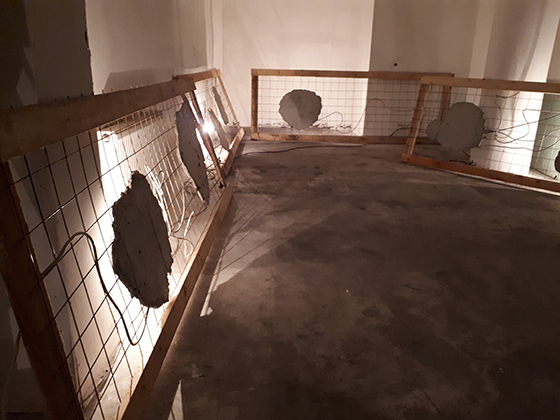 © Anastasia Semenovich Peter Bely. Lides. 2019. Wood, Deton, steel, electric wire
The point, of course, is not in Erart: in the end, exhibitions of hats and motorcycles are not a crime. But all the time it seems to me that here, with the “official” status of the “cultural capital”, the role of institutions grows. Budget giants that could dispel despondency.
But large interesting projects here happen disproportionately less often than in the “uncultured” capital. A friend - an employee of the Hermitage - in response to my indignation (as so, is called the “main museum of the country”, and you are jumping by the Mlime of Pushkin ) phlegmatically notes that Moscow colleagues are banal more quickly. The Hermitage is slower and, it seems, is more pretentious.
Monographic blockbusters (Serov, Repin, Aivazovsky and other Publishesses of the public) of the Tretyakovka are so powerful than similar projects of the Russian Museum that it is even disappointing. There is a charm in this restraint (poverty?), But it does not leave the idea that in order to understand the local exhibition, Moscow must be seen, but our projects do not need to do not do with Muscovites.
 © Anastasia Semenovich
In the summer of 2020, I prepared for Fontanka the material about the exhibition “Artists and Collectors-the Russian Museum. Gifts. 1898–2019 ”, and the deputy director of the timing for scientific work, Evgeny Petrov, said that the state does not give money to purchase new things for the museum for ten years. The museum accepts as a gift, but cannot fully form a collection. We have to constantly ask: artists-to give something, the Ministry of Culture-to finally give money. This is humiliating, and it is difficult to say who is to blame. In general, in jokes about the St. Petersburg swamp - only a share of a joke. In local media, columns sometimes appear about how it was better than St. Petersburg to deliberately turn into a province (large and rich Moscow). Sadness-tying with the purchases of new things in this hypothesis is laid, but despondency, small-town thinking is not. And they, in my opinion , are more dangerous-so do not go for a long time into nagging about the "special St. Petersburg culture." After all, not only the chairman of the local parliament Vyacheslav Makarov ( the famous Pearl about the “genetic code”), but also adequate people, speaks about her.
The loud “non -umoskva” - made, of course, by the hands of Moscow and according to the metropolitan command - was held in the St. Petersburg arena with the subtitle “Nothing happens again!” In the context of the swampy art landscape, it sounds almost a mockery. No, something, of course, is happening. In the fall of 2020, there were a rather energetic Art-Weekend and, for example, the exhibition "History of the development of multimedia art of Leningrad- St. Petersburg 1985–2000 ." And ... it was like "Pushkin, 10." Cute scraps of the past, they will cause a surge of tenderness (and not everyone), but, minus the centers of structural thought, there was no structural thought. These are exactly fragments - they are curious if you are well represented by the whole and are ready to surrender to nostalgia right in the hall.
When I prepared the text about the legacy of Timur Novikov and Georgy Guryanov several years ago, I heard the thought: Moscow conceptualists were able to agree with whom to work, what to adhere to. And now Moscow conceptualism can be explained, this is an understandable phenomenon; And the fragmented Leningrad-Petersburg neo-academics are fragments. Flickering and expensive ∗ to some ∗ hearts, but still. There were no large exhibitions and heavy catalogs of George Guryanov, there is no single “confirmed” work building of Timur Novikov. Again awkward.
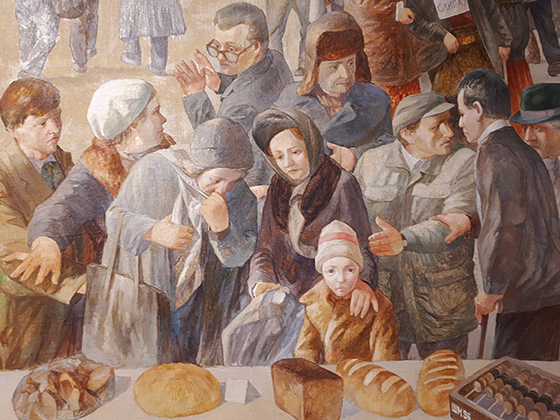 © Anastasia Semenovich Gennady Shapanikov. Care. 1996. Canvas, family oil collection of Franz
They say that once the epithet "The Criminal Capital" decided to replace the "cultural". Who knew that the product of political strategists would be perceived so seriously. The characters who have appointed the bearers of “St. Petersburg culture” sometimes broadcast ordinary chauvinism under its appearance. More than once, not two or five expressed that I “understand nothing” - only because I was born not in Leningrad/St. Petersburg. Yes, I do not care-I don’t understand how to identify myself only through the city, it seems petty to me. And I would like to speak out much sharper: that this ostentatious “culture” is an ugly growth that prevents the city from breathing. The most rotten version of snobbery. The bloated complexes that cultivate here. But, firstly , I am not so immersed in the context of "St. Petersburg culture", I do not know everything. Secondly, under the shishkutic shapito “cultures” there are live, fresh-although not blockbusters that die in the announcements of the federal press.
Petersburg builds his identity on the denial of Moscow identity - this, of course, is the giant complex of the “former” and obviously losing position. It is ironic that the circles in our swamp in 2020 left the "non -umoskva". It is not so important that this is not a St. Petersburg phenomenon, too, the main thing is that not Moscow. Here, to say that Petersburg claims to be the role of the capital not Moscow - Russia minus the metropolis - but this is not so. Due to the emphasized town, the capital is one, and this is objectively not Petersburg. It's time to stop calling him so. Let go, love. To accept that we will never have enough money. To become poor and funny, because we were already poor and sad.
Around us young, still fresh - with lemon plaster in overhaul, the Arctic wind in June, Ladoga ice under bridges in May - the city of big water, which lives with the self -awareness of the old man, aching, as "it used to be better." Provinciality - not about “nothing happens”, but about the reluctance to see yourself from the outside. And there is an inability - we do not really know how to keep in the frame there are enough factors for sanity, so for the “rest of Russia” we are caricature snobs. Snobism and complexes burn air, leaving nothing from freshness, which is actually freedom of poverty.
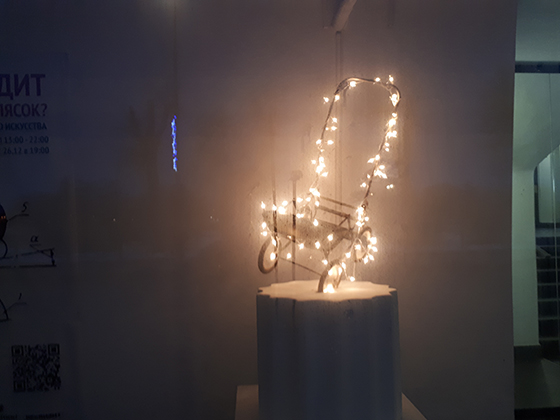
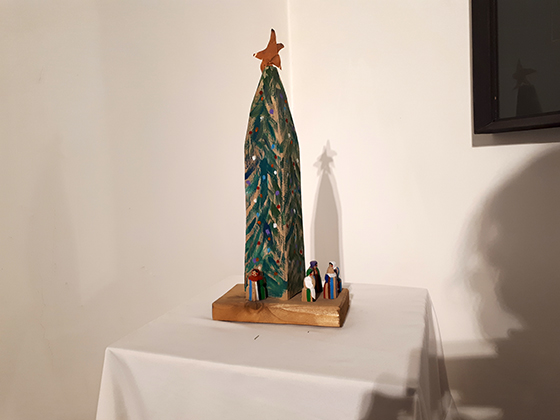 © Anastasia Semenovich Gel Pisareva. Object "New Year tree"
It is difficult for us - and we do not always need to do megalomanian projects “like in Moscow”. Because, firstly, most likely it will not work-if you are not Semyon Mikhailovsky, and the site is not a arena. Secondly, because this is already enough. Let's think about the soul of the sense. There are more problems with him than with the form - and I am ready to once again praise the exhibition Lee Bul for the meaning. We write a bunch of texts about Deinek/Samokhvalov, or “Non -Wortion”, or the colonial “Nemoskva”. But we are a party that is not picked up by “discussions”. Giant projects have been translated by imperial game to the ordinary viewer-as if someone again and again retells the pompous and boring ode from the secondary school program. In the Tretyakov Gallery, in the Hermitage Lee. In the text about the new officialdom, I talked about this a little more.
So, officialdom just needs infusion. He cannot be poor, only expensive-toe. And, in my opinion , Petersburg is a great platform not for loud projects, but for more subtle work with meaning. If you tear out the growths of the complexes and the eternal desire to be “no worse than in Moscow”, to become ourselves, and not “Petersburg culture” - it will be easier and more pleasant for us to live. This, of course, will not happen, but they will reproach me again that I was not born in Leningrad and therefore I don’t understand anything, but I repeat: I do not care about the “cultural” reaction.
If you, too, come to my telegram channel .